
Energy system and resource utilization in space: A state-of-the-art review
-
GRAPHICAL ABSTRACT

 DownLoad:
Full size image
DownLoad:
Full size image
-
PUBLIC SUMMARY
-
Advanced environmental control and construction technologies are overviewed.
Cutting-edge techniques for extraterrestrial in situ resource utilization are summarized.
Innovative technologies for efficient energy harvesting on the moon are highlighted.
Typical technologies for planetary transportation platforms and geological explorations are commented.
The current status, challenges, and perspectives are introduced and envisioned.
-
-
ABSTRACT
Deep space exploration expands our understanding about the evolution history of solar system, while the future development heavily relies on the construction of energy systems and utilization of resources on the planet. This paper systematically reviewed the progress in the environmental control and construction technologies of space bases, extraterrestrial in situ resource utilization technology, energy systems, key technologies for planetary transportation platforms, and geological explorations. The current status, pros and cons of these technologies and systems are introduced and discussed. As an important artificial microenvironment in the space base, the environmental control and life support system (ECLSS) provides necessary resources for human. Sintering and additive manufacturing technologies demonstrate the potential to construct a space base with lunar regolith or simulants. The extraction and in situ utilization of resources on the Moon, including water ice, oxygen, and helium-3, are crucial to maintain life support for lunar exploration. Typical energy systems that can be used on the Moon include photovoltaic cell, Stirling power generation technology, closed Brayton cycle (CBC) system, Rankine cycle system, heat storage system, and integrated energy system. The CBC system has the highest thermal efficiency (39%) among them, making it suitable for late-period energy supply. The performance of various planetary rovers, the most important transportation platforms, are summarized. Through geological explorations, the resource distribution, content, and occurrence can be obtained. Perspectives on the future, promotions of environment adaptation, resource recovery, energy efficiency, and intelligence of the existing technologies are still needed to move forward on space explorations. -

-
REFERENCES
[1] Evans, M.E., and Graham, L.D. (2020). A Flexible Lunar Architecture for Exploration (FLARE) supporting NASA's Artemis Program. Acta Astronaut. 177: 351−372. DOI: 10.1016/j.actaastro.2020.07.032. [2] Metzger, P.T. (2023). Economics of in-space industry and competitiveness of lunar-derived rocket propellant. Acta Astronaut. 207: 425−444. DOI: 10.1016/j.actaastro.2023.03.014. [3] Carpenter, J.D., Fisackerly, R., De Rosa, D.,et al. (2012). Scientific preparations for lunar exploration with the European Lunar Lander. Planet. Space Sci. 74(1): 208−223. DOI: 10.1016/j.pss.2012.07.024. [4] Haeuplik-Meusburger, S., and Bannova, O. (2023). Reflections on early lunar base design-From sketch to the first moon landing. Acta Astronaut. 202: 729−741. DOI: 10.1016/j.actaastro.2022.09.021. [5] Nesnas, I.A.D., Kerber, L., Sellar, G., et al. (2023). Moon Diver: Exploring a pit's exposed strata to understand lunar volcanism. Acta Astronaut. 211: 163−176. DOI: 10.1016/j.actaastro.2023.05.042. [6] Olthoff, C., Kaschubek, D., and Killian, M. (2023). Dynamic thermal interactions between spacesuits and lunar regolith in permanently shaded regions on the moon. Acta Astronaut. 203: 351−369. DOI: 10.1016/j.actaastro.2022.12.001. [7] Eccles, D.S., Guidi, C., and Rathjen, T.W. (2021). Avoiding costly delays in human space exploration: Historical perspectives on NASA programs. J. Space Safety Eng. 8: 281−287. DOI: 10.1016/j.jsse.2021.10.002. [8] Siegel, B., Spry, J.A., Broyan, J., et al. (2023). Development of a NASA roadmap for planetary protection to prepare for the first human missions to Mars. Life Sci. Space Res. 38: 1−7. DOI: 10.1016/j.lssr.2023.03.009. [9] Konstantinidis, M., Lalla, E.A., Daly, M.G., et al. (2021). Elemental estimation of terrestrial analogues from the CanMars rover field campaign using LiRS: Implications for detecting silica-rich deposits on Mars. Icarus 358. DOI: 10.1016/j.icarus.2020.114113. [10] Chumikov, A.E., Cheptsov, V.S., Wurz, P., et al. (2021). Design, characteristics and scientific tasks of the LASMA-LR laser ionization mass spectrometer onboard Luna-25 and Luna-27 space missions. Int. J. Mass Spectrom. 469. DOI: 10.1016/j.ijms.2021.116676. [11] Litvak, M., Kozlova, T., Ilyin, A., et al. (2022). Luna-25 robotic arm: Results of experiment with analog of lunar regolith in lunar like conditions. Acta Astronaut. 200: 282−290. DOI: 10.1016/j.actaastro.2022.08.003. [12] Shkuratov, Y., Kaydash, V., Sysolyatina, X., et al. (2013). Lunar surface traces of engine jets of Soviet sample return probes: The enigma of the Luna-23 and Luna-24 landing sites. Planet. Space Sci. 75: 28−36. DOI: 10.1016/j.pss.2012.10.016. [13] Dallas, J.A., Raval, S., Gaitan, J.P.A., et al. (2020). Mining beyond earth for sustainable development: Will humanity benefit from resource extraction in outer space. Acta Astronaut. 167: 181−188. DOI: 10.1016/j.actaastro.2019.11.006. [14] Sterling Saletta, M., and Orrman-Rossiter, K. (2018). Can space mining benefit all of humanity. : The resource fund and citizen's dividend model of Alaska, the ‘last frontier’. Space Policy 43: 1−6. DOI: 10.1016/j.spacepol.2018.02.002. [15] McKeown, B., Dempster, A.G., Saydam, S., and Coulton, J. (2023). Commercial Lunar Ice Mining: Is There a Role for Royalties. Space Policy 64: 101525. DOI: 10.1016/j.spacepol.2022.101525. [16] Liu, Z., Cheng, K., Wang, Z., et al. (2023). Performance analysis of the heat pipe-based thermoelectric generator (HP-TEG) energy system using in-situ resource for heat storage applied to the early-period lunar base. Appl. Therm. Eng. 218. 119303,DOI: 10.1016/j.applthermaleng.2022.119303. [17] Tang, J., Jiang, S., Quan, Q., et al. (2019). Soil simulant preparation for lunar deep drilling exploration: Modeling and validation. Planet. Space Sci. 173: 1−13. DOI: 10.1016/j.pss.2019.05.005. [18] Wang, Y., Hao, L., Li, Y., et al. (2022). In-situ utilization of regolith resource and future exploration of additive manufacturing for lunar/martian habitats: A review. Appl. Clay Sci. 229. DOI: 10.1016/j.clay.2022.106673. [19] Chen, H., du Jonchay, T.S., Hou, L., et al. (2020). Integrated in-situ resource utilization system design and logistics for Mars exploration. Acta Astronaut. 170: 80−92. DOI: 10.1016/j.actaastro.2020.01.031. [20] Lee, S., and van Riessen, A. (2022). A Review on geopolymer technology for lunar base construction. Materials 15(13). DOI: 10.3390/ma15134516. [21] Ruess, F., Zacny, K., and Braun, B. (2008). Lunar in-situ resource utilization: Regolith bags automated filling technology. AIAA SPACE 2008 Conference & Exposition. DOI: 10.2514/6.2008-7678. [22] Benaroya, H., Indyk, S., and Mottaghi, S. (2012). Advanced Systems Concept for Autonomous Construction and Self-repair of Lunar Surface ISRU Structures. In Moon: Prospective Energy and Material Resources, V. Badescu, ed. (Springer Berlin Heidelberg), pp. 641-660. DOI:10.1007/978-3-642-27969-0_27. [23] Horz, F. (1985). Lava tubes-potential shelters for habitats. Lunar bases and space activities of the 21st century. [24] Khoshnevis, B., Carlson, A., Leach, N., et al. (2012). Contour crafting simulation plan for lunar settlement infrastructure buildup. Earth and Space 2012:1458−1467. DOI: 10.1061/9780784412190.155. [25] Hecht, M., Hoffman, J., Rapp, D., et al. (2021). Mars Oxygen ISRU Experiment (MOXIE). Space Sci. Rev. 217: 9. DOI: 10.1007/s11214-020-00782-8. [26] Schlueter, L., and Cowley, A. (2020). Review of techniques for In-Situ oxygen extraction on the moon. Planet. Space Sci. 181: 104753. DOI: 10.1016/j.pss.2019.104753. [27] Sowers, G.F., and Dreyer, C.B. (2019). Ice mining in lunar permanently shadowed regions. New Space 7: 235−244. DOI: 10.1089/space.2019.0002. [28] Schieber, G.L., Jones, B.M., Orlando, T.M., et al. (2022). Indirect solar receiver development for the thermal extraction of H2O(v) from lunar regolith: Heat and mass transfer modeling. Acta Astronaut. 190: 365−376. DOI: 10.1016/j.actaastro.2021.09.020. [29] Pu, Z., Zhang, G., Hassanpour, A., et al. (2021). Regenerative fuel cells: Recent progress, challenges, perspectives and their applications for space energy system. Appl. Energy 283. DOI: 10.1016/j.apenergy.2020.116376. [30] Mercer, C., Jankovsky, A., Reid, C., et al. (2010). Energy storage technology development for space exploration. AIAA SPACE 2010 Conference & Exposition. DOI: 10.2514/6.2010-8709. [31] Palos, M.F., Serra, P., Fereres, S., et al. (2020). Lunar ISRU energy storage and electricity generation. Acta Astronaut. 170: 412−420. DOI: 10.1016/j.actaastro.2020.02.005. [32] Li, J., Yang, L., Yang, Q., et al. (2022). Degradation adaptive energy management with a recognition-prediction method and lifetime competition-cooperation control for fuel cell hybrid bus. Energy Conver. Manag. 271. DOI: 10.1016/j.enconman.2022.116306. [33] OCHMO (2023). Environmental Control and Life Support Subsystem Diagram. OCHMO. DOI: 10.1007/978-3-662-03974-8_4. [34] Wang, H.M., Guo, D.D., Zhang, W.R., et al. (2023). Observation, prediction, and risk assessment of volatile organic compounds in a vehicle cabin environment. Cell Rep. Phys. Sci. 4: 101375. DOI: 10.1016/j.xcrp.2023.101375. [35] OCHMO (2022). Spaceflight Toxicology Chemical Contaminants. OCMHO. [36] Akay, Ö., Bashkatov, A., Coy, E., et al. (2022). Electrolysis in reduced gravitational environments: current research perspectives and future applications. npj Micrograv. 8: 56. DOI: 10.1038/s41526-022-00239-y. [37] Sabatier, P. (1922). Catalysis in organic chemistry (D. Van Nostrand Company). DOI:10.1021/acs.joc.6b01449. [38] Vogt, C., Monai, M., Kramer, G.J., and Weckhuysen, B.M. (2019). The renaissance of the Sabatier reaction and its applications on Earth and in space. Nat. Catal. 2: 188−197. DOI: 10.1038/s41929-019-0244-4. [39] Green, R.D., Matter, P.H., Holt, C., et al. (2016). Development status for a combined solid oxide co-electrolyzer and carbon formation reactor system for oxygen regeneration. In AIAA SPACE 2016. DOI: 10.2514/6.2016-5454. [40] High-Performance Photocatalytic Oxidation Reactor System. (2015). NASA tech. brief.(39-4). https://www.techbriefs.com/component/content/article/21769-mfs-33126-1. [41] OCHMO (2023). Water-human consumption. NASA-STD-3001 Tech. Brief. OCHMO-TB-027 Rev B. https://www.nasa.gov/wp-content/uploads/2023/03/water-technical-brief-ochmo.pdf [42] Holder, D.W., and Hutchens, C.F. (2003). Development Status of the International Space Station Urine Processor Assembly. Int. Conf. Environ. Sys. DOI: 10.4271/2003-01-2690. [43] Nelson, G.J., Vijapur, S.H., Hall, T.D., et al. (2020). Electrochemistry for space life support. Electrochem. Soc. Int. 29:47. DOI 10.1149/2.F06201IF. [44] Carter, D.L., Tobias, B., and Orozco, N.Y. (2013). Status of ISS water management and recovery. 43rd Int. Conf. Environ. Sys. DOI: 10.2514/6.2013-3509. [45] Massa, G.D., Dufour, N.F., Carver, J.A., et al. (2017). VEG-01: Veggie hardware validation testing on the international space station. Open Agri. 2(1): 33−41. DOI: 10.1515/opag-2017-0003. [46] Zabel, P., Bamsey, M., Schubert, D., et al. (2016). Review and analysis of over 40 years of space plant growth systems. Life Sci. Space Res. 10: 1−16. DOI: 10.1016/j.lssr.2016.06.004. [47] Broyan, J.L., McKinley, M., Stambaugh, I., et al. (2021). NASA environmental control and life support technology development and maturation for exploration: 2021 to 2022 overview. 51st Int. Conf. Environ. Sys. https://ntrs.nasa.gov/citations/20210023841. [48] Gitelson, I.I., Terskov, I.A., Kovrov, B.G., et al. (1989). Long-term experiments on man's stay in biological life-support system. Adv. Space Res. 9: 65-71. DOI: 10.1016/0273-1177(89)90030-6. [49] Du, M., Peng, X., Zhang, H., et al., (2021). Geology, environment, and life in the deepest part of the world’s oceans. The Innovation 2: 100109. DOI: 10.1016/j.xinn.2021.100109. [50] Tang, Y., Dong, W., Ai, W., et al. (2021). Design and establishment of a large-scale controlled ecological life-support system integrated experimental platform. Life Sci. Space Res. 31: 121−130. DOI: 10.1016/j.lssr.2021.08.001. [51] Fu, Y., Yi, Z., Du, Y., et al. (2021). Establishment of a closed artificial ecosystem to ensure human long-term survival on the moon. bioRxiv 2021.01.12.426282. DOI: 10.1101/2021.01.12.426282. [52] Yin, J., and Slater, L. (2023). Understanding heatwave-drought compound hazards and impacts on socio-ecosystems. The Innovation Geoscience 1: 100042. DOI: 10.59717/j.xinn-geo.2023.100042. [53] Sanders, G.B., and Larson, W.E. (2012). Progress made in lunar in situ resource utilization under NASA's exploration technology and development program. ASCE: 457-478. DOI: 10.1061/9780784412190.050. [54] Zhou, S.Q., Zhu, X.Y., Lu, C.H., et al. (2022). Synthesis and characterization of geopolymer from lunar regolith simulant based on natural volcanic scoria. Chin. J. Aeronaut. 35(1): 144−159. DOI: 10.1016/j.cja.2020.06.014. [55] Khitab, A., Anwar, W., Mehmood, I., et al. (2016). Lunar concrete: Prospects and challenges. Astro. Rep. 60: 306−312. DOI: 10.1134/S1063772916020050. [56] Isachenkov, M., Chugunov, S., Akhatov, I., et al. (2021). Regolith-based additive manufacturing for sustainable development of lunar infrastructure–An overview. Acta Astronaut. 180: 650−678. DOI: 10.1016/j.actaastro.2021.01.005. [57] Taylor, L.A., and Meek, T.T. (2005). Microwave sintering of lunar soil: properties, theory, and practice. J. Aerospace Eng. 18: 188−196. DOI: 10.1061/(ASCE)0893-1321(2005)18:3(188). [58] Fateri, M., Meurisse, A., Sperl, M., et al. (2019). Solar sintering for lunar additive manufacturing. J. Aerospace Eng. 32: 04019101. DOI: 10.1061/(asce)as.1943-5525.0001093. [59] Licheri, R., Orrù, R., Sani, E., et al. (2022). Spark plasma sintering and optical characterization of lunar regolith simulant. Acta Astronaut. 201: 164−171. DOI: 10.1016/j.actaastro.2022.09.016. [60] Lim, S., Prabhu, V.L., Anand, M., et al. (2017). Extra-terrestrial construction processes - Advancements, opportunities and challenges. Adv. Space Res. 60(7): 1413−1429. DOI: 10.1016/j.asr.2017.06.038. [61] Hintze, P., Curran, J., and Back, T. (2009). Lunar surface stabilization via sintering or the use of heat cured polymers. In AIAA Aerospace Sciences Meeting Including the New Horizons Forum & Aerospace Exposition DOI: 10.2514/6.2009-1015. [62] Anderson, S.D., and Thangavelautham, J. (2021). Solar-powered additive manufacturing in extraterrestrial environments. Earth and Space 2021: 732−744. DOI: 10.1061/9780784483374.068. [63] Cesaretti, G., Dini, E., De Kestelier, X., et al. (2014). Building components for an outpost on the Lunar soil by means of a novel 3D printing technology. Acta Astronaut. 93: 430−450. DOI: 10.1016/j.actaastro.2013.07.034. [64] Bos, F., Wolfs, R., Ahmed, Z., and Salet, T. (2016). Additive manufacturing of concrete in construction: potentials and challenges of 3D concrete printing. Virt. Phys. Prototyp. 11: 209−225. DOI: 10.1080/17452759.2016.1209867. [65] Lim, S., Buswell, R.A., Le, T.T., et al. (2012). Developments in construction-scale additive manufacturing processes. Auto. Construct. 21: 262−268. DOI: 10.1016/j.autcon.2011.06.010. [66] Prater, T., Werkheiser, N., Ledbetter, F., et al. (2019). 3D printing in zero G technology demonstration mission: Complete experimental results and summary of related material modeling efforts. Int. J. Adv. Manufact. Tech. 101(1-4): 391−417. DOI: 10.1007/s00170-018-2827-7. [67] Thomas, D., Snyder, M.P., Napoli, M., et al. (2017). Effect of acrylonitrile butadiene styrene melt extrusion additive manufacturing on mechanical performance in reduced gravity. In AIAA SPACE and Astronautics Forum and Exposition. DOI: 10.2514/6.2017-5278. [68] Allende, M.I., Davis, B.A., Miller, J.E., et al. (2020). Hypervelocity impact performance of biopolymer-bound soil composites for space construction. J. Aerospace Eng. 33: 04020001. DOI: 10.1061/(ASCE)AS.1943-5525.0001110. [69] Ferrone, K., Taylor, A., and Helvajian, H. (2022). In situ resource utilization of structural material from planetary regolith. Adv. Space Res. 69: 2268−2282. DOI: 10.1016/j.asr.2021.12.025. [70] Steiner, J.T., and Malla, R.B. (2021). A study of layered structural configurations as thermal and impact shielding of lunar habitats. Earth and Space 2021: 1285−1296. DOI: 10.1061/9780784483374.119. [71] Kalapodis, N., Málaga-Chuquitaype, C., and Kampas, G. (2022). Structural efficiency of varying-thickness regolith-based lunar arches against inertial loading. Acta Astronaut. 191: 438−450. DOI: 10.1016/j.actaastro.2021.11.031. [72] Heiken, G., Vaniman, D., and French, B.M. (1991). Lunar sourcebook: A user's guide to the Moon (Cup Archive). Cambridge University Press. https://www.lpi.usra.edu/lunar_sourcebook/. [73] Zheng, Y., Wang, S., Ouyang, Z., et al. (2009). CAS-1 lunar soil simulant. Adv. Space Res. 43: 448−454. DOI: 10.1016/j.asr.2008.07.006. [74] Matsushima, T., Katagiri, J., Uesugi, K., et al. (2009). 3D shape characterization and image-based DEM simulation of the lunar soil simulant FJS-1. J. Aerospace Eng. 22: 15−23. DOI: 10.1061/(ASCE)0893-1321(2009)22:1(15). [75] Ryu, B.-H., Wang, C.-C., and Chang, I. (2018). Development and geotechnical engineering properties of KLS-1 lunar simulant. J. Aerospace Eng. 31: 04017083. DOI: 10.1061/(asce)as.1943-5525.0000798. [76] Bonanno, A., and Bernold, L. (2015). Exploratory review of sintered lunar soil based on the results of the thermal analysis of a lunar soil simulant. J. Aerospace Eng. 28: 04014114. DOI: 10.1061/(ASCE)AS.1943-5525.0000428. [77] Gustafson, G. (2009). JSC-1A lunar regolith simulant: availability and characterization. 2009 Lunar Regolith Simulant Workshop. DOI: 10.1016/j.jnoncrysol.2010.04.049. [78] Watson, K., Murray, B.C., and Brown, H. (1961). The behavior of volatiles on the lunar surface. J. Geophy. Res. 66: 3033−3045. DOI: 10.1029/jz066i009p03033. [79] Fisher, E.A., Lucey, P.G., Lemelin, M., et al. (2017). Evidence for surface water ice in the lunar polar regions using reflectance measurements from the Lunar Orbiter Laser Altimeter and temperature measurements from the Diviner Lunar Radiometer Experiment. Icarus 292: 74−85. DOI: 10.1016/j.icarus.2017.03.023. [80] Hayne, P.O., Hendrix, A., Sefton-Nash, E., et al. (2015). Evidence for exposed water ice in the Moon’s south polar regions from Lunar Reconnaissance Orbiter ultraviolet albedo and temperature measurements. Icarus 255: 58−69. DOI: 10.1016/j.icarus.2015.03.032. [81] Li, S., Lucey, P.G., Milliken, R.E., et al. (2018). Direct evidence of surface exposed water ice in the lunar polar regions. PNAS 115: 8907−8912. DOI: 10.1073/pnas.1802345115. [82] Colaprete, A., Schultz, P., Heldmann, J., et al. (2010). Detection of water in the LCROSS ejecta plume. Science 330: 463−468. DOI: 10.1126/science.1186986. [83] Deutsch, A.N., Neumann, G.A., and Head, J.W. (2017). New evidence for surface water ice in small‐scale cold traps and in three large craters at the north polar region of Mercury from the Mercury Laser Altimeter. Geophys. Res. Lett. 44: 9233−9241. DOI: 10.1002/2017GL074723. [84] Sunshine, J., A'hearn, M., Groussin, O., et al. (2006). Exposed water ice deposits on the surface of comet 9P/Tempel 1. Science 311: 1453−1455. DOI: 10.1126/science.1123632. [85] Nazari-Sharabian, M., Aghababaei, M., Karakouzian, M., et al. (2020). Water on Mars—a literature review. Galaxies 8: 40. DOI. DOI: 10.3390/galaxies8020040. [86] Lauro, S.E., Pettinelli, E., Caprarelli, G., et al. (2021). Multiple subglacial water bodies below the south pole of Mars unveiled by new MARSIS data. Nat. Astron. 5: 63−70. [87] Watters, T.R., Campbell, B.A., Leuschen, C.J., et al. (2024). Evidence of ice-rich layered deposits in the medusae fossae formation of Mars. Geophys. Res. Lett. 51(2): e2023GL105490. DOI: 10.1029/2023GL105490. [88] Doran, P., Hayes, A., Grasset, O., et al. (2024). The COSPAR planetary protection policy for missions to icy worlds: A review of history, current scientific knowledge, and future directions. Life Sci. Space Res. 41: 86-99. DOI: 10.1016/j.lssr.2024.02.002. [89] Jie, J., Weiwei, Z., Xu, Y., et al. (2022). Overview of water ice sampling and detection techniques in the lunar polar region. J. Deep Space Explor. 9: 101−113. DOI: 10.15982/j.issn.2096-9287.2022.20210151. [90] Song, H., Zhang, J., Ni, D., et al. (2021). Investigation on in-situ water ice recovery considering energy efficiency at the lunar south pole. Appl. Energy 298: 117136. DOI: 10.1016/j.apenergy.2021.117136. [91] Frias, J.A., Shafirovich, E., and VanWoerkom, M. (2014). Extraction of volatiles from lunar regolith using solar power. J. Thermophys. Heat Trans. 28: 343−346. DOI: 10.2514/1.T4106. [92] Duke, M., Gustafson, R., and Rice, E. (1998). Mining of lunar polar ice. 36th AIAA Aerospace Sciences Meeting and Exhibit. DOI: 10.2514/6.1998-1069. [93] Cole, J.D., Lim, S., Sargeant, H.M., et al. (2023). Water extraction from icy lunar simulants using low power microwave heating. Acta Astronaut. 209: 95−103. DOI: 10.1016/j.actaastro.2023.04.035. [94] Liu, Z., Deng, Z., and Huang, X. (2023). A carbon-monitoring strategy through near-real–time data and space technology. The Innovation 4: 100346. DOI: 10.1016/j.xinn.2022.100346. [95] Zhang L., Zhang J., and Mitchell R.N. (2022). Dichotomy in crustal melting on early Mars inferred from antipodal effect. The Innovation 3: 100280. DOI: 10.1016/j.xinn.2022.100280. [96] Wang, S., Sun, P., Zhang, G., et al., (2022). Contribution of periphytic biofilm of paddy soils to carbon dioxide fixation and methane emissions. The Innovation 3(1), 100192. DOI: 10.1016/j.xinn.2021.100192. [97] Wasilewski, T.G. (2018). Evaluation of drilling-based water extraction methods for Martian ISRU from mid-latitude ice resources. Planet. Space Sci. 158: 16−24. DOI: 10.1016/j.pss.2018.05.012. [98] Biswas, J., Sheridan, S., Pitcher, C., et al. (2020). Searching for potential ice-rich mining sites on the Moon with the Lunar Volatiles Scout. Planet. Space Sci. 181: 104826. DOI: 10.1016/j.pss.2019.104826. [99] Li, X., Zhang, G., Wang, C., et al. (2020). Water harvesting from soils by light-to-heat induced evaporation and capillary water migration. Appl. Therm. Eng. 175: 115417. DOI: 10.1016/j.applthermaleng.2020.115417. [100] Yang, L., Zhang, C., Yu, X., et al. (2021). Extraterrestrial artificial photosynthetic materials for in-situ resource utilization. Nation. Sci. Rev. 8(8). DOI: 10.1093/nsr/nwab104. [101] Yao, Y., Wang, L., Zhu, X., et al. (2022). Extraterrestrial photosynthesis by Chang’E-5 lunar soil. Joule 6: 1008−1014. DOI: 10.1016/j.joule.2022.04.011. [102] Chen, Y., Hu, S., Li, J., et al. (2023). Chang’e-5 lunar samples shed new light on the Moon. The Innovation Geoscience 1: 100014. DOI: 10.59717/j.xinn-geo.2023.100014. [103] Feng, D., Zhang, C., Jiang, W., et al. (2020). Design and trial of extraterrestrial artificial photosynthesis device. Chin. Space Sci. Tech. 40: 13−22. DOI: 10.16708/j.cnki.1000-758X.2020.0067. [104] Yang, Q., Dong, R., Yang, S., et al. (2023). Microfluidic system for extraterrestrial artificial photosynthetic device. Microsys. Tech. 29(1): 49−61. DOI: 10.1007/s00542-022-05370-0. [105] Ellingham H.J.T. (1944). Reducibility of oxides and sulphides in metallurgical processes. J. Soc. Chem. Ind. 63:125-160. DOI: 10.1002/jctb.5000630501. [106] Li, H., Fang, W., Wang, L.-X., et al., (2023). Physical regulation of copper catalyst with a hydrophobic promoter for enhancing CO2 hydrogenation to methanol. The Innovation 4: 100445. DOI: 10.1016/j.xinn.2023.100445. [107] Yoshida, H., Watanabe, T., Kanamori, H., et al. (2000). Experimental study on water production by hydrogen reduction of lunar soil simulant in a fixed bed reactor. In Space Resources Roundtable II 75. https://ui.adsabs.harvard.edu/abs/2000srrt.conf..75Y. [108] Lee, K.A., Oryshchyn, L., Paz, A., et al. (2013). The ROxygen project: Outpost-scale lunar oxygen production system development at Johnson Space Center. J. Aerospace Eng. 26: 67−73. DOI: 10.1061/(ASCE)AS.1943-5525.0000230. [109] Sargeant, H.M. (2020). Water from lunar regolith: Reduction by hydrogen for a small-scale demonstration of in situ resource utilisation for the Moon. PhD Thsis, The Open University, UK. DOI:10.21954/ou.ro.00011fb6. [110] Denk, T. (2022). Terrestrial demonstrator for the hydrogen extraction of oxygen from lunar regolith with concentrated solar energy. PhD Thesis, Universidad od Seville, Seville. DOI: oai:idus.us.es:11441/133362. [111] Lee, H.-C., Dhage, S., Akhtar, M.S., et al. (2010). A simulation study on the direct carbothermal reduction of SiO2 for Si metal. Current Appl. Phys. 10: S218−S221. DOI: 10.1016/j.cap.2009.11.053. [112] Gustafson, R., White, B., Fidler, M., et al. (2010). Demonstrating the solar carbothermal reduction of lunar regolith to produce oxygen. In 48th AIAA Aerospace Sciences Meeting Including the New Horizons Forum and Aerospace Exposition. DOI: 10.2514/6.2010-1163. [113] Seboldt, W., Lingner, S., Hoernes, S., et al. (1991). Lunar oxygen extraction using fluorine. Resources of Near-Earth Space, University of Arizona, Space Science Series, Tucson (accepted 1991). [114] Lomax, B.A., Conti, M., Khan, N., et al. (2020). Proving the viability of an electrochemical process for the simultaneous extraction of oxygen and production of metal alloys from lunar regolith. Planet. Space Sci. 180: 104748. DOI: 10.1016/j.pss.2019.104748. [115] Shi, H., Li, P., Yang, Z., et al. (2022). Extracting oxygen from chang'e-5 lunar regolith simulants. ACS Sustain. Chem. Eng. 10(41): 13661−13668. DOI: 10.1021/acssuschemeng.2c03545. [116] Liu, A., Shi, Z., Hu, X., et al. (2017). Lunar soil simulant electrolysis using inert anode for Al-Si alloy and oxygen production. J. Electrochem. Soc. 164(2): H126−H133. DOI: 10.1149/2.1381702jes. [117] Shchetkovskiy, A., Mckechnie, T.N., Sadoway, D.R., et al. (2012). Development and testing of high surface area iridium anodes for molten oxide electrolysis. Earth and Space 2010: 1039-1045. DOI: 10.1061/41096(366)96. [118] Schreiner, S.S., Sibille, L., Dominguez, J.A., et al. (2016). A parametric sizing model for Molten Regolith Electrolysis reactors to produce oxygen on the Moon. Adv. Space Res. 57(7): 1585−1603. DOI: 10.1016/j.asr.2016.01.006. [119] Paley, M.S., Karr, L.J., and Curreri, P. (2009). Oxygen production from lunar regolith using Ionic liquids. In Space, Propulsion and Energy Sciences International Forum. https://ntrs.nasa.gov/citations/20090017882. [120] Badescu, V. (2009). Mars: prospective energy and material resources (Springer Science & Business Media). [121] Sibille, L., Carpenter, P., Schlagheck, R., et al. (2006). Lunar regolith simulant materials: Recommendations for standardization, production, and usage. https://ntrs.nasa.gov/citations/20060051776. [122] Stoeser, D., Rickman, D., and Wilson, S. (2011). Design and specifications for the highland regolith prototype simulants NU-LHT-1M and-2M. [123] Trigwell, S., Captain, J., Weis, K., et al. (2013). Electrostatic beneficiation of lunar regolith: Applications in in situ resource utilization. J.Aerospace Eng. 26(1): 30−36. DOI: 10.1061/(asce)as.1943-5525.0000226. [124] Rasera, J.N., Cilliers, J.J., Lamamy, J.A., et al. (2020). The beneficiation of lunar regolith for space resource utilisation: A review. Planet. Space Sci. 186. 104879. DOI: 10.1016/j.pss.2020.104879. [125] Lee, H.-C., Dhage, S., Akhtar, M.S., et al. (2010). A simulation study on the direct carbothermal reduction of SiO2 for Si metal. Current Appl. Phy. 10(2, Supplement):S218-S221. DOI: 10.1016/j.cap.2009.11.053. [126] Halmann, M., Frei, A., and Steinfeld, A. (2011). Vacuum carbothermic reduction of Al2O3, BeO, MgO-CaO, TiO2, ZrO2, HfO2 + ZrO2, SiO2, SiO2 + Fe2O3, and GeO2 to the metals. A thermodynamic study. Mine. Process. Extract. Metal. Rev. 32(4): 247−266. DOI: 10.1080/08827508.2010.530723. [127] Du Fresne, E., and Schroeder, J. (1983). Magma electrolysis. Res. Use Space Resour.(83-36). https://ntrs.nasa.gov/citations/19840008159. [128] Schreiner, S.S., Sibille, L., Dominguez, J.A., et al. (2015). Development of a molten regolith electrolysis reactor model for lunar in-situ resource utilization. In AIAA Aerospace Research Central. DOI: 10.2514/6.2015-1180. [129] Hecht, M., Hoffman, J., Rapp, D., et al. (2021). Mars oxygen ISRU experiment (Moxie). Space Sci. Rev. 217: 1−76. DOI: 10.1007/s11214-020-00782-8. [130] Guerra, V., Silva, T., Ogloblina, P., et al. (2017). The case for in situ resource utilisation for oxygen production on Mars by nonequilibrium plasmas. Plasma Sour. Sci. Tech. 26: 11LT01. DOI: 10.1088/1361-6595/aa8dcc. [131] Guerra, V., Silva, T., Pinhao, N., et al. (2022). Plasmas for in situ resource utilization on Mars: Fuels, life support, and agriculture. J. Appl. Phys. 132: 070902. DOI: 10.1063/5.0098011. [132] Ogloblina, P., Morillo-Candas, A.S., Silva, A.F., et al. (2021). Mars in situ oxygen and propellant production by non-equilibrium plasmas. Plasma Sour. Sci. Tech. 30: 065005,DOI: 10.1088/1361-6595/abec28. [133] Kelly, S., Verheyen, C., Cowley, A., et al. (2022). Producing oxygen and fertilizer with the Martian atmosphere by using microwave plasma. Chem. 8(10): 2797−2816. DOI: 10.1016/j.chempr.2022.07.015. [134] McKinney, L.G., Silva, T., Guerra, V., et al. (2024). A numerical model for plasma reactor design: Application to CO2 conversion for Mars In-Situ Resource Utilization. AIAA SCITECH 2024 Forum. DOI: 10.2514/6.2024-2243. [135] Simko, T., and Gray, M. (2014). Lunar helium-3 fuel for nuclear fusion: Technology, economics, and resources. World Future Rev. 6: 158−171. DOI: 10.1177/1946756714536142. [136] Kuhlman, K., Kulcinski, G., and Schmitt, H. (2004). Simulation of helium-3 extraction from lunar ilmenite. In Space Resources Roundtable VI. https://ntrs.nasa.gov/citations/20040196377. [137] Wittenberg, L., Santarius, J., and Kulcinski, G. (1986). Lunar source of 3He for commercial fusion power. Fusion Tech. 10(2): 167−178. DOI: 10.13182/FST86-A24972. [138] Fegley, B., and Swindle, T.D. (1993). Lunar volatiles: Implications for lunar resource utilization. Resour. near-Earth space: 367-426. https://ui.adsabs.harvard.edu/abs/1993rnes.book.367F. [139] Slyuta, E., Abdrakhimov, A., and Galimov, E. (2007). The estimation of helium-3 probable reserves in lunar regolith. In 38th Annual Lunar and Planetary Science Conference. 38: 2175. https://www.lpi.usra.edu/meetings/lpsc2007/pdf/2175.pdf. [140] Li, D., Liu, H., Zhang, W., et al. (2010). Lunar 3He estimations and related parameters analyses. Sci. China Earth Sci. 53: 1103−1114. DOI: 10.1007/s11430-010-3071-7. [141] Kulcinski, G., and Schmitt, H.H.J.J.F.T. (1992). Fusion power from lunar resources. Fusion Tech. 21: 2221−2229. DOI: 10.13182/FST92-A29717. [142] Lucey, P.G., Blewett, D.T., and Hawke, B.R. (1998). Mapping the FeO and TiO2 content of the lunar surface multispectral imagery. J. Geophys. Res. Planet. 103(E2): 3679−3699. DOI: 10.1029/97je03019. [143] Pepin, R., Nyquist, L., Phinney, D., et al (1970). Rare gases in Apollo 11 lunar material. Geochim. Cosmochim. Acta Suppl. 1: 1435. https://ntrs.nasa.gov/citations/19700065482. [144] Eberhardt, P., Geiss, J., Graf, H., et al. (1972). Trapped solar wind noble gases in Apollo 12 lunar fines 12001 and Apollo 11 breccia 10046. Bern Univ.(Switzerland). [145] Wittenberg, L., Cameron, E., Kulcinski, G., et al. (1992). A review of 3He resources and acquisition for use as fusion fuel. Fusion Tech. 21(4): 2230−2253. DOI: 10.13182/FST92-A29718. [146] Sviatoslavsky, I., Jacobs, M.J.E., Construction,, et al. (1988). Mobile helium-3 mining and extraction system and its benefits toward lunar base self-sufficiency. Eng. Construct. Operat. Space: 310-321. DOI: ui.adsabs.harvard.edu/abs/1988ecos.proc.310S. [147] Sviatoslavsky, I.J.N. (1988). Processes and energy costs for mining lunar helium-3. In NASA, Lewis Research Center, Lunar Helium-3 and Fusion Power. https://ntrs.nasa.gov/citations/19890005477. [148] Kulcinski, G.L., Sviatoslavsky, I., Santarius, J., et al. (1988). Energy requirements for He-3 mining operations on the Moon. Trans. Fifth Sympos. Space Nuclear Power Sys: 77-80. DOI: ui.adsabs.harvard.edu/abs/1988snps.symp..77K. [149] Gilmore, D.G. (2002). Spacecraft thermal control handbook: Cryogenics. In AIAA Aerospace Res. Central. DOI:10.2514/4.989148. [150] Bowman Jr, R.C. (2006). Roles of hydrogen in space explorations. In AIP Conference Proceedings. AIP 837: 175-199. DOI: 10.1063/1.2213074. [151] Toutanji, H.A., Evans, S., Grugel, R.N.J.C., et al. (2012). Performance of lunar sulfur concrete in lunar environments. Construct. Build. Mater. 29: 444−448. DOI: 10.1016/j.conbuildmat.2011.10.041. [152] Grugel, R.N., and Toutanji, H.J.A.i.S.R. (2008). Sulfur “concrete” for lunar applications–Sublimation concerns. Adv. Space Res. 41: 103−112. DOI: 10.1016/j.asr.2007.08.018. [153] Wang, K.-t., Lemougna, P.N., Tang, Q., et al. (2017). Lunar regolith can allow the synthesis of cement materials with near-zero water consumption. Gondwana Res. 44: 1−6. DOI: 10.1016/j.gr.2016.11.001. [154] Lee, J., Ann, K.Y., Lee, T.S., et al. (2018). Bottom-up heating method for producing polyethylene lunar concrete in lunar environment. Adv. Space Res. 62(1): 164−173. DOI: 10.1016/j.asr.2018.03.039. [155] Liu, M., Tang, W., Duan, W., et al. (2019). Digital light processing of lunar regolith structures with high mechanical properties. Ceram. Int. 45: 5829−5836. DOI: 10.1016/j.ceramint.2018.12.049. [156] Aguiar, B.A., Nisar, A., Thomas, T., et al. (2023). In-situ resource utilization of lunar highlands regolith via additive manufacturing using digital light processing. Ceram. Int. 49: 17283−17295. DOI: 10.1016/j.ceramint.2023.02.095. [157] Canning, J., and Peng, G. (2012). Proceedings of SPIE-The International Society for Optical Engineering: Introduction. Proceedings of SPIE-The International Society for Optical Engineering. [158] Goulas, A., Binner, J.G., Harris, R.A., and Friel, R.J. (2017). Assessing extraterrestrial regolith material simulants for in-situ resource utilisation based 3D printing. Appl. Mater. Today 6: 54−61. DOI: 10.1016/j.apmt.2016.11.004. [159] Wang, R., Qiao, G., Song, G.J.C., and Materials, B. (2023). Additive manufacturing by laser powder bed fusion and thermal post-treatment of the lunar-regolith-based glass-ceramics for in-situ resource utilization. Construct. Build. Mater. 392: 132051. DOI: 10.1016/j.conbuildmat.2023.132051. [160] Liu, Z., Wang, J., Wang, Z., et al. (2023). Numerical analysis on lunar heat storage system: Multi-objective optimization, heat storage capacity, and thermal insulation performance. J. Energy Stor. 59: 106508. DOI: 10.1016/j.est.2022.106508. [161] Tillotson, B.J.A.S.T. (1991). Regolith thermal energy storage for lunar nighttime power. Conf. Adv. SEI Tech. DOI: 10.2514/6.1991-3420. [162] Cui, T., Xuan, Y., and Li, Q. (2016). Design of a novel concentrating photovoltaic–thermoelectric system incorporated with phase change materials. Energy Conver. Manag. 112: 49−60. DOI: 10.1016/j.enconman.2016.01.008. [163] Zhang, S., Liu, Z., Zhang, X., et al. (2024). Sustainable thermal energy harvest for generating electricity. The Innovation 5: 100591. DOI: 10.1016/j.xinn.2024.100591. [164] Afshar-Mohajer, N., Wu, C.-Y., Curtis, J.S., et al. (2015). Review of dust transport and mitigation technologies in lunar and Martian atmospheres. Adv. Space Res. 56(6): 1222−1241. DOI: 10.1016/j.asr.2015.06.007. [165] Allison, C. (2017). Building a Viable Spaceport Economy through the Eyes of a Reentry Vehicle Operator. In AIAA Space Astronaut. Forum Expos. DOI: 10.2514/6.2017-5350. [166] Gläser, P., Oberst, J., Neumann, G., et al. (2018). Illumination conditions at the lunar poles: Implications for future exploration. Planet. Space Sci. 162: 170−178. DOI: 10.1016/j.pss.2017.07.006. [167] Liu, Z., Cheng, K., Wang, Z., et al. (2023). Performance analysis of the heat pipe-based thermoelectric generator (HP-TEG) energy system using in-situ resource for heat storage applied to the early-period lunar base. Appl. Therm. Eng. 218: 119303. DOI: 10.1016/j.applthermaleng.2022.119303. [168] Fleith, P., Cowley, A., Canals Pou, A., et al. (2020). In-situ approach for thermal energy storage and thermoelectricity generation on the Moon: Modelling and simulation. Planet. Space Sci. 181: 104789. DOI: 10.1016/j.pss.2019.104789. [169] Xie, H., Li, C., Sun, L., et al. (2020). Conceptualization of in-situ energy support technology on the Moon. Adv. Eng. Sci. 52: 1-9. DOI: 10.15961/j.jsuese.202000313. [170] Chu, S., and Majumdar, A. (2012). Opportunities and challenges for a sustainable energy future. Nature 488: 294−303. DOI: 10.1038/nature11475. [171] Jeevarajan, J.A. (2009). Power Goals for NASA's Exploration Program. In AIAA-Houston Annual Tech. Symposium 2009. https://ntrs.nasa.gov/citations/20090020689. [172] Queneau, Y., Han, B. (2022). Biomass: Renewable carbon resource for chemical and energy industry. The Innovation 3:100184. DOI: 10.1016/j.xinn.2021.100184. [173] Kuhn, V., Klemeš, J., and Bulatov, I. (2008). MicroCHP: Overview of selected technologies, products and field test results. Appl. Therm. Eng. 28: 2039−2048. DOI: 10.1016/j.applthermaleng.2008.02.003. [174] Bouvenot, J.B., Andlauer, B., Stabat, P., et al. (2014). Gas Stirling engine μCHP boiler experimental data driven model for building energy simulation. Energy Build. 84: 117−131. DOI: 10.1016/j.enbuild.2014.08.023. [175] Roselli, C., Sasso, M., Sibilio, S., et al. (2011). Experimental analysis of microcogenerators based on different prime movers. Energy Build. 43(4): 796−804. DOI: 10.1016/j.enbuild.2010.11.021. [176] Babazadeh, M.A., Babaelahi, M., and Saadatfar, M. (2023). Enhancing solar stirling engine performance through the use of innovative heat transfer fin shapes. Int. J. Therm. Sci. 190: 108290. DOI: 10.1016/j.ijthermalsci.2023.108290. [177] Al-Nimr, M.d., Khashan, S.A., and Al-Oqla, H. (2023). Novel techniques to enhance the performance of Stirling engines integrated with solar systems. Renew. Energy 202: 894−906. DOI: 10.1016/j.renene.2022.11.086. [178] Lu, X., Yao, W., Wang, C., et al. (2019). Exergy analysis of a lunar based solar thermal power system with finite-time thermodynamics. Energy Proced. 158: 792−796. DOI: 10.1016/j.egypro.2019.01.209. [179] Ren, S., Feng, X., Gundersen, T., et al. (2023). Performance improvement of liquid air energy storage: Introducing Stirling engine and solar energy. Energy Conver. Manag. 296: 117666. DOI: 10.1016/j.enconman.2023.117666. [180] Hu, D.H., Li, M., and Li, Q.J.E. (2021). A solar thermal storage power generation system based on lunar in-situ resources utilization: Modeling and analysis. Energy 223: 120083. DOI: 10.1016/j.energy.2021.120083. [181] Smirnov, S.V., Sinkevich, M.V., Antipov, Y.A., et al. (2021). A calculation method of a heat rejection system in a lunar power plant consisting of a free-piston Stirling engine (FPSE). Acta Astronaut. 180: 46−57. DOI: 10.1016/j.actaastro.2020.12.008. [182] Yang, Q., Li, J., Cao, W., et al. (2022) An improved vehicle to the grid method with battery longevity management in a microgrid application. Energy 198: 117374. DOI: 10.1016/j.energy.2020.117374. [183] Hu, D.-H., Li, M., and Li, Q. (2021). Numerical analysis of thermal storage characteristics of stacked lunar regolith spheres. J. Appl. Therm. Eng. Design Proces. Equip. Eco. 188: 116617. DOI: 10.1016/j.applthermaleng.2021.116617. [184] Balasubramaniam, R., Gokoglu, S.A., Sacksteder, K.R., et al. (2011). Analysis of solar-heated thermal wadis to support extended-duration lunar exploration. J.Thermophys. Heat Trans. 25(1): 130−139. DOI: 10.2514/1.49843. [185] Zhang, K., Sun, P., Li, S., et al. (2022). Characteristic of thermal energy system self-driven by exhausted heat from equipment in lunar base. Appl. Therm. Eng. 213: 118751. DOI: 10.1016/j.applthermaleng.2022.118751. [186] Liu, Z., Wang, J., Wang, Z., et al. (2023). Numerical analysis on lunar heat storage system: Multi-objective optimization, heat storage capacity, and thermal insulation performance. J. Energy Stor. 59: 106508. DOI: 10.1016/j.est.2022.106508. [187] Zhang, C., Shi, L., Pei, G., et al. (2023). Thermodynamic analysis of combined heating and power system with In-Situ resource utilization for lunar base. Energy 284: 129230. DOI: 10.1016/j.energy.2023.129230. [188] Liu, Z., Wang, Z., Cheng, K., et al. (2023). Performance assessment of closed Brayton cycle-organic Rankine cycle lunar base energy system: Thermodynamic analysis, multi-objective optimization. Energy 278: 127936. DOI: 10.1016/j.energy.2023.127936. [189] Saleh, B.J. (2016). Performance analysis and working fluid selection for ejector refrigeration cycle. Appl. Therm. Eng. 107: 114−124. DOI: 10.1016/j.applthermaleng.2016.06.147. [190] Sherwani, A.F.J.I.J.o.R. (2022). Analysis of organic Rankine cycle integrated multi evaporator vapor-compression refrigeration (ORC-mVCR) system. Int. J. Refrig. 138: 233−243. DOI: 10.1016/j.ijrefrig.2022.03.014. [191] Malwe, P.D., Shaikh, J., Gawali, B.S., et al. (2022). Dynamic simulation and exergy analysis of an Organic Rankine Cycle integrated with vapor compression refrigeration system. Sustain. Energy Tech. Assess. 53: 102684. DOI: 10.1016/j.seta.2022.102684. [192] Xia, X., Liu, Z., Wang, Z., et al. (2023). Energy, conventional and advanced exergy analysis for the organic Rankine cycle-vapor compression refrigeration combined system driven by low-grade waste heat. Appl. Therm. Eng. 220: 119650. DOI: 10.1016/j.applthermaleng.2022.119650. [193] Liu, Z., Cheng, K., Yin, Z., et al. (2022). Evaluation of the CBC-ORC energy system in lunar base: Working fluid combination selection, day and night operation performance. Energy Conver. Manag. 257: 115445. DOI: 10.1016/j.enconman.2022.115445. [194] Gromov, V., Kemurdjian, A., Bogatchev, A., et al. (2003). Lunokhod 2-A retrospective Glance after 30 Years. In EGS-AGU-EUG Joint Assem: 14528. https://ui.adsabs.harvard.edu/abs/2003EAEJA..14528G. [195] Li, J., Liu, J., Wang, T., et al. (2024). Analysis of the evolution characteristics of hydrogen leakage and diffusion in a temperature stratified environment. Energy 293: 130598. DOI: 10.1016/j.energy.2024.130598. [196] Li, J., Tian, Z., Yang, Q., et al. (2023). A new visual approach with the concentration calibration method for the hydrogen leakage and distribution research. Fuel 346: 128132. DOI: 10.1016/j.fuel.2023.128132. [197] Branicio, P.S. (2012). Atomistic mechanisms in silicon carbide nanostructures. J. Comput. Theoret. Nanosci. 9: 1870−1880. DOI: 10.1166/jctn.2012.2598. [198] Ning, X.J., Huvey, N., and Pirouz, P. (1997). Dislocation cores and hardness polarity of 4H‐SiC. JACS 80(7): 1645−1652. DOI: 10.1111/j.1151-2916.1997.tb03033.x. [199] Morris, R.V. (1983). Handbook of lunar soils (Lyndon B. Johnson Space Center). [200] Sitch, P., Jones, R., Öberg, S., and Heggie, M. (1995). Ab initio investigation of the dislocation structure and activation energy for dislocation motion in silicon carbide. Phys. Rev. B 52: 4951. DOI: 10.1103/PhysRevB.52.4951. [201] Harvey, B.J.S., and Exploration, R.L. (2007). Samplers, rovers and orbiters. Soviet and Russian Lunar Exploration. Praxis: 239-286. DOI: 10.1007/978-0-387-73976-2_7. [202] Wang, W.-R., Ren, X., Wang, F.-F., et al. (2015). Terrain reconstruction from Chang'e-3 PCAM images. Res. Astron. Astrophys. 15: 1057. DOI: 10.1088/1674-4527/15/7/013. [203] Gellert, R., Rieder, R., Brückner, J., et al. (2006). Alpha Particle X-ray Spectrometer (APXS): Results from Gusev crater and calibration report. J. Geophys. Res. Planet. 111(E2). DOI: 10.1029/2005je002555. [204] Arvidson, R.E., Bell III, J.F., Bellutta, P., et al. (2010). Spirit mars rover mission: Overview and selected results from the northern Home Plate Winter Haven to the side of Scamander crater. J. Geophys. Res. Planet. 115(E7). DOI: 10.1029/2010je003633. [205] Mangold, N., Gupta, S., Caravaca, G., et al. (2022). Significance of the variations in fluvial input within Jezero crater from Perseverance rover observations. 53rd Lunar Planet. Sci. Conf. https://www.hou.usra.edu/meetings/lpsc2022/pdf/1814.pdf. [206] Blackley, W., and Scattergood, R. (1991). Ductile-regime machining model for diamond turning of brittle materials. Precis. Eng. 13: 95−103. DOI: 10.1016/0141-6359(91)90500-i. [207] Maeda, K., Suzuki, K., Fujita, S., et al. (1988). Defects in plastically deformed 6H SiC single crystals studied by transmission electron microscopy. Philosoph. Magaz. A 57: 573−592. DOI: 10.1080/01418618808214408. [208] Helmick, D., Angelova, A., and Matthies, L. (2009). Terrain adaptive navigation for planetary rovers. J. Field Robot. 26: 391−410. DOI: 10.1002/rob.20292. [209] Leger, P.C., Trebi-Ollennu, A., Wright, J.R., et al. (2005). Mars exploration rover surface operations: Driving spirit at gusev crater. 2005 IEEE ICSMC. DOI: 10.1109/ICSMC.2005.1571411. [210] Ho, K., Peynot, T., and Sukkarieh, S. (2012). Analysis of terrain geometry representations for traversability of a mars rover. 11th ASSC: 359-372. https://eprints.qut.edu.au/67613/15/Ho-ASSC-2011.pdf. [211] Sutoh, M., Otsuki, M., Wakabayashi, S., et al. (2015). The right path: comprehensive path planning for lunar exploration rovers. IEEE MRA 22: 22−33. DOI: 10.1109/MRA.2014.2381359. [212] Choi, D., Kim, Y., Jung, S., et al. (2017). Improvement of step-climbing capability of a new mobile robot RHyMo via kineto-static analysis. Mechan. Mach. Theory 114: 20−37. DOI: 10.1016/j.mechmachtheory.2017.03.018. [213] Patel, N., Slade, R., and Clemmet, J. (2010). The ExoMars rover locomotion subsystem. J. Terramechan. 47: 227−242. DOI: 10.1016/j.jterra.2010.02.004. [214] Vago, J., Witasse, O., Svedhem, H., et al. (2015). ESA ExoMars program: the next step in exploring Mars. Sol. Sys. Res. 49: 518−528. DOI: 10.1134/s0038094615070199. [215] Cordes, F., Kirchner, F., and Babu, A. (2018). Design and field testing of a rover with an actively articulated suspension system in a Mars analog terrain. J. Field Robot. 35: 1149−1181. DOI: 10.1002/rob.21808. [216] Yang, Q., Shen, J., Li, J., et al. (2022). An Improved Adaptive Coordination Control of Wind Integrated Multi-Terminal HVdc System. IEEE TPEL 38: 5490-5499. DOI: 10.1109/TPEL.2022.3228949. [217] Ke, F., Li, Z., and Yang, C. (2017). Robust tube-based predictive control for visual servoing of constrained differential-drive mobile robots. IEEE TIE 65: 3437−3446. DOI: 10.1109/TIE.2017.2756595. [218] Kobayashi, T., Fujiwara, Y., Yamakawa, J., et al. (2010). Mobility performance of a rigid wheel in low gravity environments. J. Terramechan. 47: 261−274. DOI: 10.1016/j.jterra.2009.12.001. [219] Pérez del Pulgar Mancebo, C.J., Romeo Manrique, P., Paz Delgado, G.J., et al. (2019). Choosing the best locomotion mode in reconfigurable rovers. Electronics 8: 818. DOI: 10.3390/electronics8070818. [220] Martín-Torres, F.J., Zorzano, M.-P., Valentín-Serrano, P., et al. (2015). Transient liquid water and water activity at Gale crater on Mars. Nat. Geosci. 8: 357−361. DOI: 10.1038/ngeo2412. [221] McCarthy, J., Minsky, M.L., Rochester, N., and Shannon, C.E. (2006). A proposal for the dartmouth summer research project on artificial intelligence, august 31, 1955. AI magaz. 27: 12−12. DOI: 10.1609/aimag.v27i4.1904. [222] Maimone, M., Cheng, Y., and Matthies, L. (2007). Two years of visual odometry on the mars exploration rovers. J. Field Robot. 24: 169−186. DOI: 10.1002/rob.20184. [223] Maimone, M., Johnson, A., Cheng, Y., et al. (2006). Autonomous navigation results from the Mars Exploration Rover (MER) mission. Exp. Robot. 9th Int. Sympos. Exp. Robot. 21: 3-13. DOI: 10.1007/11552246_1. [224] Börner, A., Baumbach, D., Buder, M., et al. (2015). IPS-an autonomous navigation system for future planetary exploration missions. https://core.ac.uk/download/pdf/31018236.pdf. [225] Li, B., Chen, P., Liu, H., et al. (2021). Random sketch learning for deep neural networks in edge computing. Nat. Comput. Sci. 1: 221−228. DOI: 10.1038/s43588-021-00039-6. [226] Hong, Z., Tu, B., Tong, X., et al. (2022). A Fast Large-Scale Path Planning Method on Lunar DEM Using Distributed Tile Pyramid Strategy. IEEE JSTARS 16: 344−355. DOI: 10.1109/JSTARS.2022.3226527. [227] Seo, M.-G., Hong, S.-M., and Tahk, M.-J. (2016). Lunar lander landing site decision in low-fuel case. MATEC Web Conf. 54: 09003. DOI: 10.1051/matecconf/20165409003. [228] Laubach, S.L., and Burdick, J.W. (1999). An autonomous sensor-based path-planner for planetary microrovers. Proceedings 1999 IEEE Int. Conf. Robot. Auto. 1: 347-354. DOI: 10.1109/ROBOT.1999.770003. [229] Rubio, F., Valero, F., and Llopis-Albert, C. (2019). A review of mobile robots: Concepts, methods, theoretical framework, and applications. Int. J.Adv. Robot. Sys. 16:1729881419839596. DOI: 10.1177/1729881419839596. [230] Li, S., Lucey, P.G., Milliken, R.E., et al. (2018). Direct evidence of surface exposed water ice in the lunar polar regions. PNAS 115: 8907−8912. DOI: 10.1073/pnas.180234511. [231] Wu, Y. (2012). Major elements and Mg# of the Moon: Results from Chang’E-1 Interference Imaging Spectrometer (IIM) data. Geochim. Cosmochim. Acta 93:214-234. DOI: https://doi.org/10.1016/j.gca.2012.07.011. [232] Feldman, W., Gasnault, O., Maurice, S., et al. (2002). Global distribution of lunar composition: New results from lunar prospector. J. Geophys. Res. 107(E3): 1-13. DOI: 10.1029/2001JE001506. [233] Sunshine, J.M., Farnham, T.L., Feaga, L.M., et al. (2009). Temporal and spatial variability of lunar hydration as observed by the deep impact spacecraft. Science 326: 565−568. DOI: 10.1126/science.1179788. [234] Fa, W., and Wieczorek, M.A. (2012). Regolith thickness over the lunar nearside: Results from Earth-based 70-cm Arecibo radar observations. Icarus 218: 771−787. DOI: 10.1016/j.icarus.2012.01.010. [235] Theinat, A.K., Modiriasari, A., Bobet, A., et al. (2020). Lunar lava tubes: Morphology to structural stability. Icarus 338: 113442. DOI: 10.1016/j.icarus.2019.113442. [236] Barnes, J.J., Kring, D.A., Tartèse, R., et al. (2016). An asteroidal origin for water in the Moon. Nat. Commun. 7: 11684. DOI: 10.1038/ncomms11684. [237] Whiteway, J.A., Komguem, L., Dickinson, C., et al. (2009). Mars Water-Ice Clouds and Precipitation. Science 325: 68−70. DOI. DOI: 10.1126/science.1172344. [238] Abbud-Madrid, A. (2018). Space and Planetary Resources. Planet. Geo.: 369-394. DOI: 10.1007/978-3-319-65179-8_15. [239] Łuszczek, K., and Krzesińska, A.M. (2020). Copper in ordinary chondrites: Proxies for resource potential of asteroids and constraints for minimum-invasive and economically efficient exploitation. Planet. Space Sci. 194: 105092. DOI: 10.1016/j.pss.2020.105092. [240] Nabiei, F., Badro, J., Dennenwaldt, T., et al. (2018). A large planetary body inferred from diamond inclusions in a ureilite meteorite. Nat. Commun. 9: 1327. DOI: 10.1038/s41467-018-03808-6. [241] Nestola, F., Goodrich, C.A., Morana, M., et al. (2020). Impact shock origin of diamonds in ureilite meteorites. PNAS 117: 25310−25318. DOI: 10.1073/pnas.1919067117. [242] Łuszczek, K., and Przylibski, T.A. (2019). Potential deposits of selected metallic resources on L chondrite parent bodies. Planet. Space Sci. 168: 40−51. DOI: 10.1016/j.pss.2019.02.005. [243] Łuszczek, K., and Przylibski, T.A. (2021). Selected metal resources on H chondrite parent bodies. Planet. Space Sci. 206: 105309. DOI: 10.1016/j.pss.2021.105309. -
ABOUT THIS ARTICLE
Cite this article:
Wu W., Shen J., Kong H., et al., (2024). Energy system and resource utilization in space: A state-of-the-art review. The Innovation Energy 1(2): 100029. https://doi.org/10.59717/j.xinn-energy.2024.100029
Welcome!
To request copyright permission to republish or share portions of our works, please visit Copyright Clearance Center's (CCC) Marketplace website at marketplace.copyright.com.

Article Metrics
Relative Articles
Cited by
Export File
Citation
Wu W., Shen J., Kong H., et al., (2024). Energy system and resource utilization in space: A state-of-the-art review. The Innovation Energy 1(2): 100029. https://doi.org/10.59717/j.xinn-energy.2024.100029

Format
Content





-
Figure 1.
Schematic of a 3D printed space base including the ECLSS
-
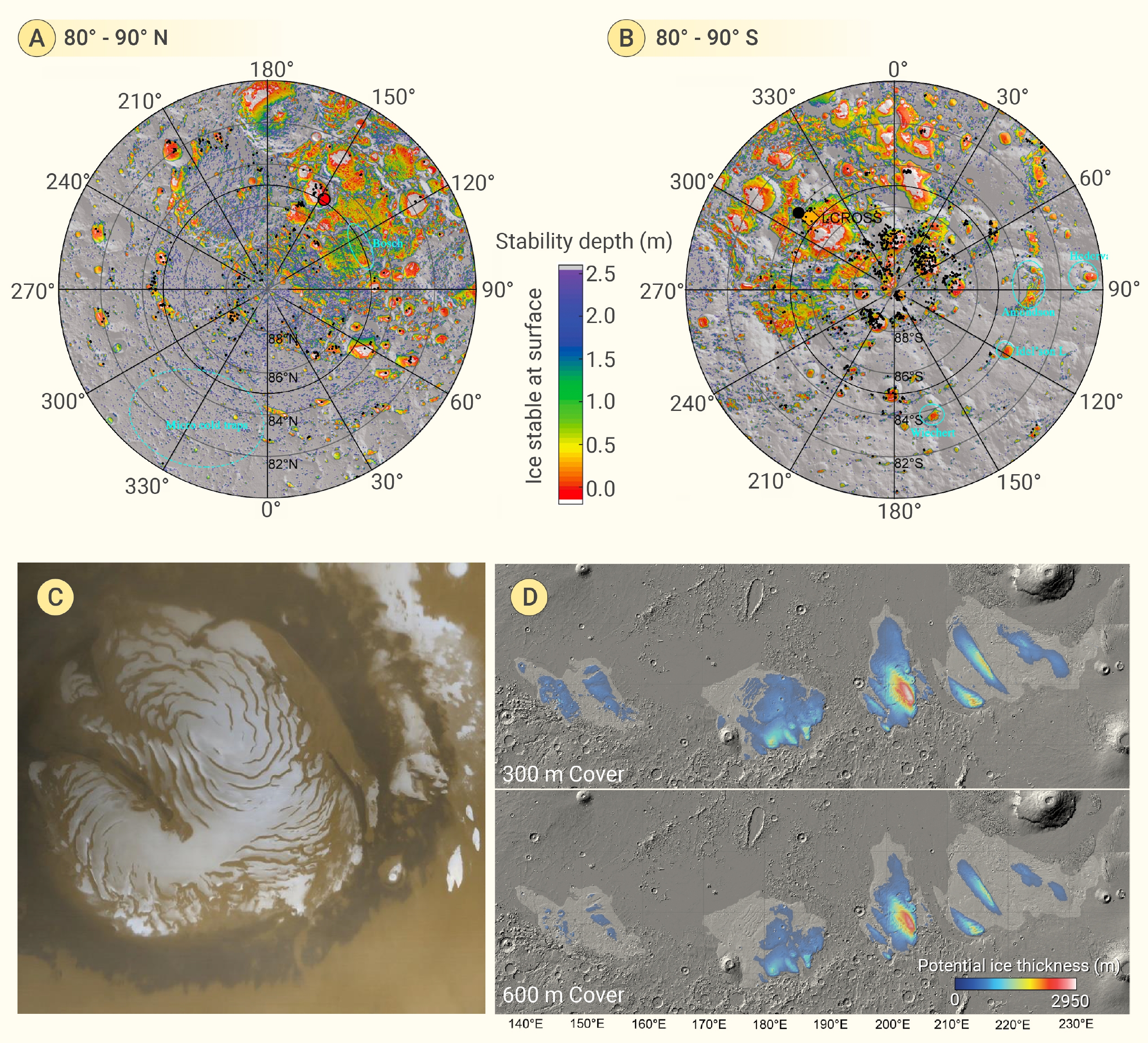
Figure 2.
Maps of water resources distribution of Moon and Mars
-
Figure 3.
Illustration of thermal mining (A), drill-based excavation methods (B). Schematics of EAP for oxygen extraction. (C) Illustration of EAP. (D-H) Mechanism schemes of photocatalysis (D), photo electrocatalysis (E and F), photovoltaic electrocatalysis (G),100 and photothermal catalysis (H)101 with the catalysts from lunar soil.
-
Figure 4.
Illustration for 3He extraction on lunar surface
-
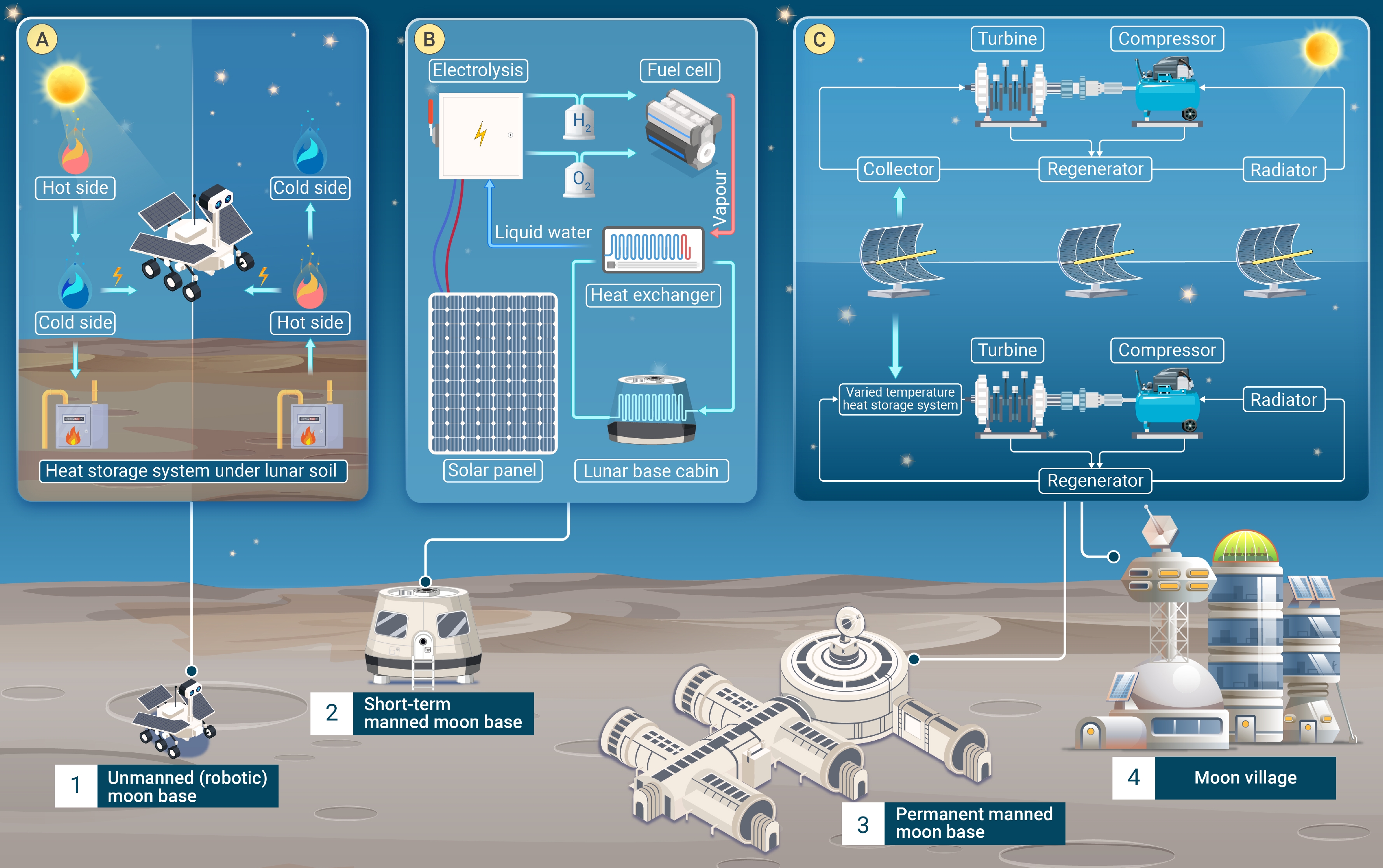
Figure 5.
Power generation technologies corresponding to different lunar base periods
-
Figure 6.
Lunar base multi-energy combined supply system
-
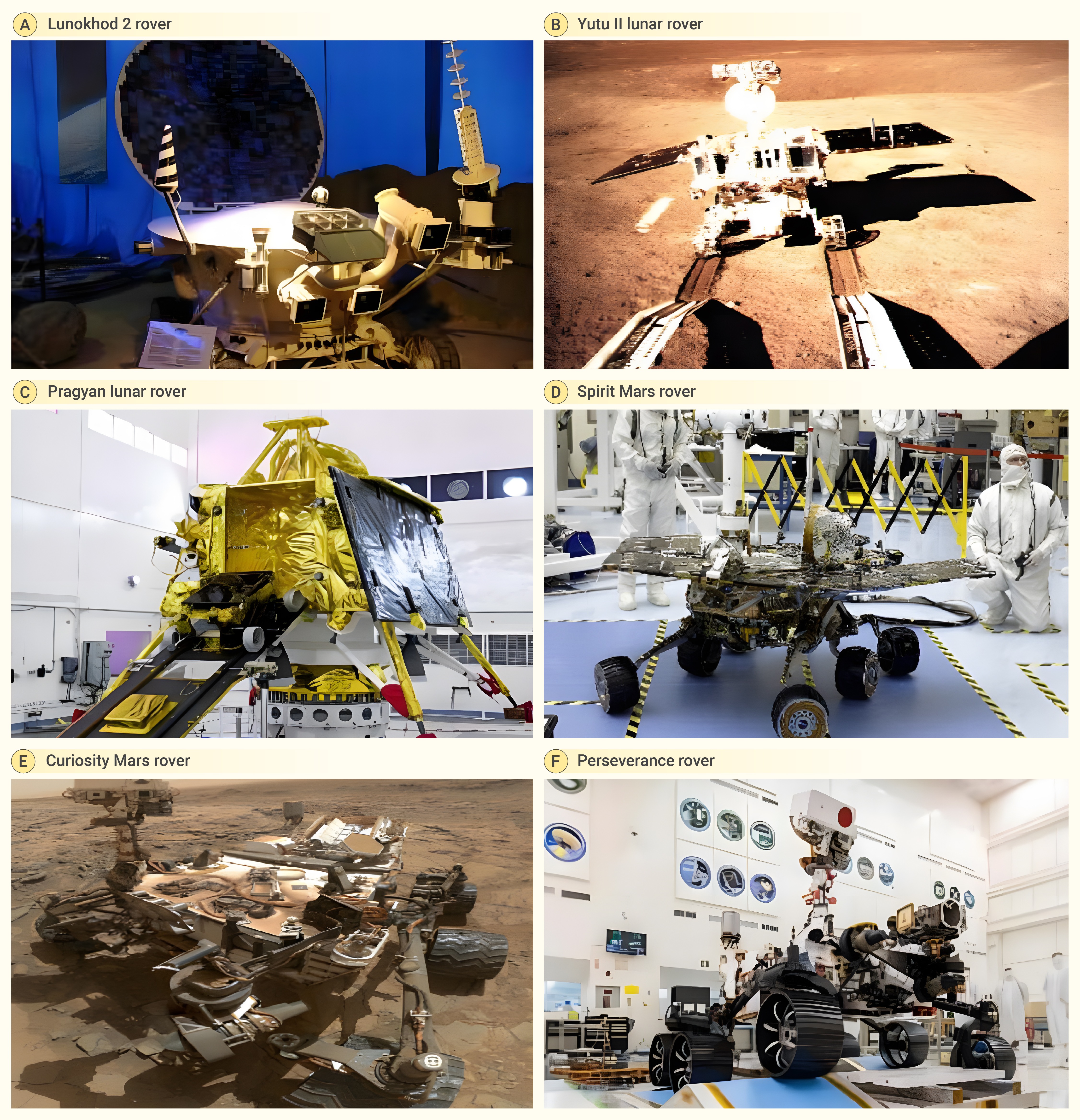
Figure 7.
Mainstream planetary rovers
-
Figure 8.
Traveling, environment perception and path planning technologies in low-gravity and complex road conditions.220,208-211
-
Figure 9.
Cartoon showing the space mining equipment
