
Graph computing technology for ultra-large-scale discrete optimization: A case study on security constrained unit commitment in energy system
-
GRAPHICAL ABSTRACT

 DownLoad:
Full size image
DownLoad:
Full size image
-
PUBLIC SUMMARY
-
Introduces a graph computing method for security constrained unit commitment (SCUC) in power systems.
Reduces computation time by up to 92% compared to conventional solvers.
Uses depth-first traversal and physics-informed edge weights to narrow the solution space.
Demonstrates high efficiency and solution quality in large-scale energy systems.
Provides an interpretable, scalable solution for complex mixed-integer programming problems.
-
-
ABSTRACT
This paper proposes a graph computing-based method to address the ultra-large-scale discrete optimization problem of security constrained unit commitment in power systems. Feasible unit commitment states are modeled as nodes in a graph, with edge weights defined based on operational priorities and physical information. The search is guided via depth-first traversal and cumulative weight maximization, effectively reducing the number of state solutions to be computed. Meanwhile, graph parallel computing techniques are employed on the grid graph model to accelerate the solution process at each node. Case studies demonstrate that the proposed method significantly reduces computation time by up to 92% compared to conventional solvers, while ensuring solution quality, particularly in large-scale systems. This approach offers an interpretable, efficient, and scalable paradigm for addressing complex mixed integer programming problems in energy systems. -

-
REFERENCES
[1] Ramesh A. V. and Li X. (2024). Spatio-Temporal Deep Learning-Assisted Reduced Security-Constrained Unit Commitment. IEEE Trans. Power Sys. 2:4735−4746. DOI:10.1109/TPWRS.2023.3313430 [2] Kamboj V. K. and Malik O. P. (2023). Optimal Unit Commitment of Integrated Power System with Demand of Medical Oxygen and Renewable Energy Sources. IEEE SMART 12:529−535. DOI:10.1109/SMART59791.2023.10428678 [3] Yang N., Yang C., Wu L., et al. (2022). Intelligent Data-Driven Decision-Making Method for Dynamic Multisequence: An E-Seq2Seq-Based SCUC Expert System. IEEE Trans. Ind. Inform. 5:3126−3137. DOI:10.1109/TII.2021.3107406 [4] Korekane S. and Nishi T. (2021). Neural Network Assisted Branch-and-Bound Method for Dynamic Berth Allocation Problems. IEEE SMC :208-213. DOI: 10.1109/SMC52423.2021.9658903. [5] Hamid Hosseini Dolatabadi S., Bhuiyan T. H. and Golshan M. E. H. (2024) . A Heuristic Solution Algorithm for a Comprehensive Optimal Phasor Measurement Unit Placement Considering Zero-Injection Buses and Practical Constraints in Power System State Observability Problem. IEEE Access :79919-79936. DOI: 10.1109/ACCESS.2024.3409651. [6] Gurobi Optimization. (2025). Mixed-Integer Programming (MIP) – A Primer on the Basics. https://www.gurobi.com/resources/mixed-integer-programming-mip-a-primer-on-the-basics/. [7] Yeoh W.Z., Teh J. S. and Chen J. (2020). Automated Search for Block Cipher Differentials: A GPU-Accelerated Branch-and-Bound Algorithm. Information Security and Privacy. ACISP 2020:7453−7456. DOI:10.1007/978-3-030-55304-3_9 [8] Shen J., Shigeoka K., Ino F., et al. (2017). An Out-of-Core Branch and Bound Method for Solving the 0-1 Knapsack Problem on a GPU. Algorithms and Architectures for Parallel Processing. ICA3PP :254-267. DOI: 10.1007/978-3-319-65482-9_17. [9] Han J., Li T., He Y., et al. (2024). Predicting the effect of chemicals on fruit using graph neural networks. Sci. Rep. 14:8203. DOI:10.1038/s41598-024-58991-y [10] Schattgen S.A., Guion K., Crawford J.C., et al. (2022). Integrating T cell receptor sequences and transcriptional profiles by clonotype neighbor graph analysis (CoNGA). Nat. Biotechnol. 40:54−63. DOI:10.1038/s41587-021-00989-2 [11] HHolzer J.T., Coffrin C.J., DeMarco C., et al. (2024). Grid Optimization Competition Challenge 3 Problem Formulation. Richland, WA: Pacific Northwest National Laboratory. https://www.pnnl.gov/publications/grid-optimization-competition-challenge-3-problem-formulation -
ABOUT THIS ARTICLE
Cite this article:
Li Z., Cui Y., Pan D., et al. (2025). Graph computing technology for ultra-large-scale discrete optimization: A case study on security constrained unit commitment in energy system. The Innovation Energy 2:100108. https://doi.org/10.59717/j.xinn-energy.2025.100108
Welcome!
To request copyright permission to republish or share portions of our works, please visit Copyright Clearance Center's (CCC) Marketplace website at marketplace.copyright.com.

Export File
Citation
Li Z., Cui Y., Pan D., et al. (2025). Graph computing technology for ultra-large-scale discrete optimization: A case study on security constrained unit commitment in energy system. The Innovation Energy 2:100108. https://doi.org/10.59717/j.xinn-energy.2025.100108

Format
Content

-
Figure 1.
A simple power grid and its graphical model
-
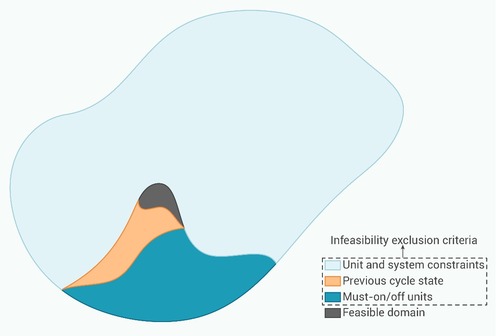
Figure 2.
Solution space of the unit
-
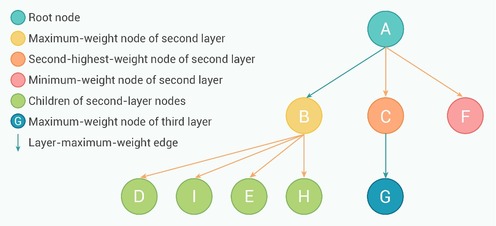
Figure 3.
Unit state diagram
-
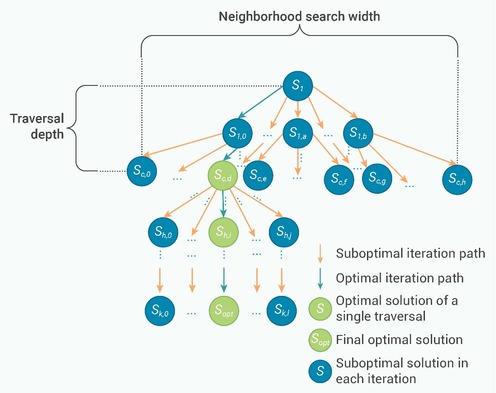
Figure 4.
Graph search iterative process
-
Figure 5.
Relationship between solution time and number of units
