
Innovative biogas reforming in catalytic membrane reactor for CO-free green hydrogen production with carbon capture
-
GRAPHICAL ABSTRACT
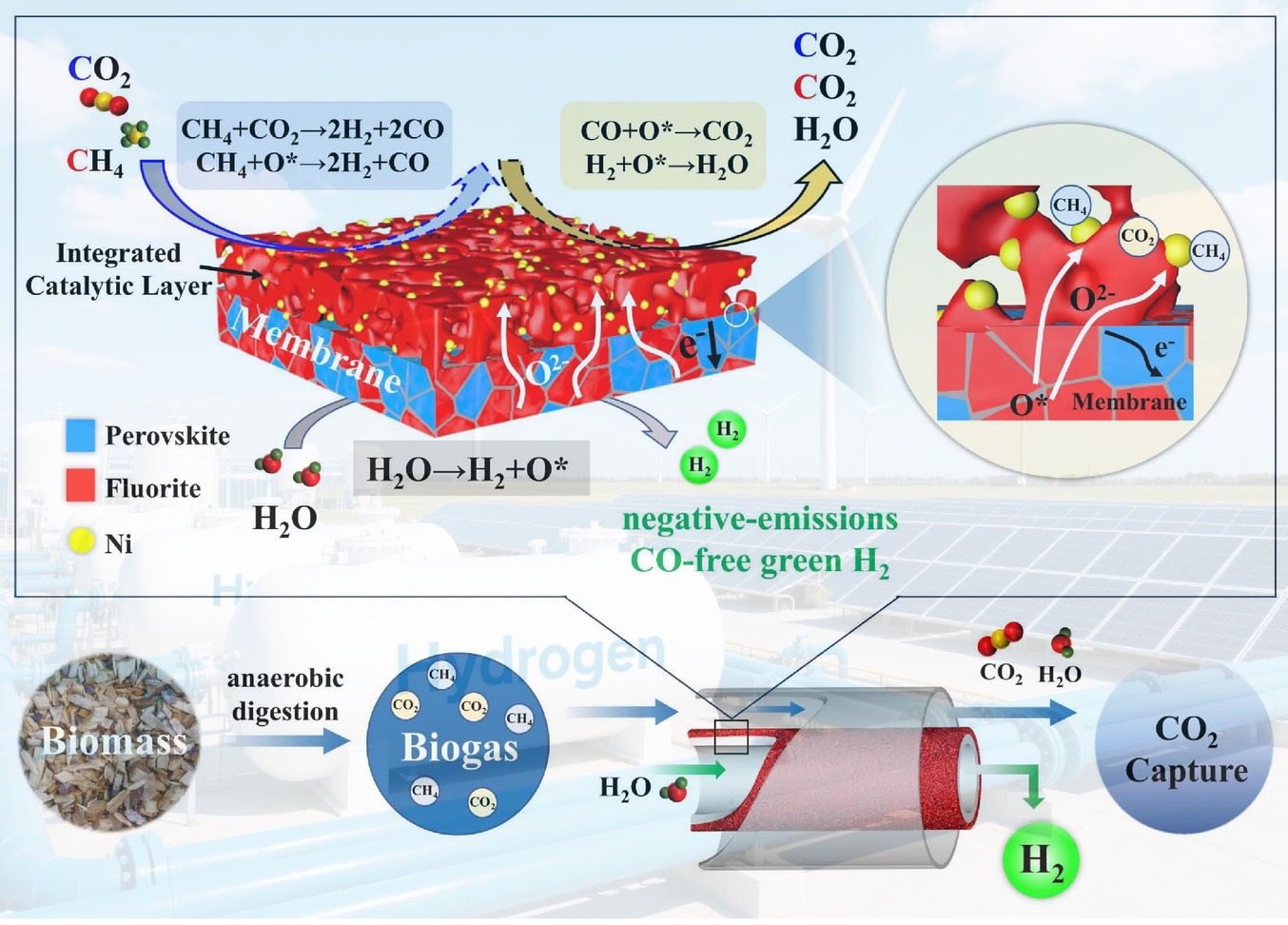
 DownLoad:
Full size image
DownLoad:
Full size image
-
PUBLIC SUMMARY
-
An innovative strategy for one-step CO-free H2 production from biogas was proposed.
The Ce0.8Sm0.15Ni0.05O2-δ catalytic layer was compatible with the ceramic membrane.
An accumulative production rate of 10.35 mL min-1 cm-2 of CO-free H2 was achieved.
A remarkably high hydrogen yield of 94.5% was achieved.
-
-
ABSTRACT
Biogas reforming is an attractive process for green hydrogen production; however, CO residual in the obtained hydrogen is usually eliminated by multiple post-treatment units. Herein, we report an innovative route by coupling water splitting with biogas reforming in a catalytic membrane reactor to directly produce CO-free H2 and capture CO2 on opposite sides of the membrane. Notably, a hollow fiber composite membrane consisting of doped ceria and perovskite is employed, integrated with porous catalytic layer Ce0.8Sm0.15Ni0.05O2-δ over which Ni nanoparticles can be in-situ exsolved. The catalytic layer's compatibility with the ceramic membrane ensures low ionic resistance and effective reaction-diffusion synergy. An accumulative production rate of 10.35 mL min-1 cm-2 of CO-free H2 was achieved from water splitting on the core side, while biogas reforming produced CO2 on the opposite side which was ready for capture. This work provides an alternative option for utilizing sustainable bioenergy to produce negative-emissions green hydrogen. -

-
REFERENCES
[1] Zhang S., Liu Y., Zhang M., et al. (2022). Sustainable Production of Hydrogen with High Purity from Methanol and Water at Low Temperatures. Nat. Commun. 13:5527. DOI:10.1038/s41467-022-33186-z [2] Clark D., Malerød-Fjeld H., Budd M., et al. (2022). Single-Step Hydrogen Production from NH3,CH4, and Biogas in Stacked Proton Ceramic Reactors. Science 376:390−393. DOI:10.1126/science.abj3951 [3] Das S., Ashok J., Bian Z., et al. (2018). Silica-Ceria Sandwiched Ni Core-Shell Catalyst for Low Temperature Dry Reforming of Biogas: Coke Resistance and Mechanistic Insights. Appl. Catal. B 230:220−236. DOI:10.1016/j.apcatb.2018.02.041 [4] Liu L., Jiang P., Qian H., et al. (2022). CO2-Negative Biomass Conversion: An Economic Route with Co-Production of Green Hydrogen and Highly Porous Carbon. Appl. Energy 311:118685. DOI:10.1016/j.apenergy.2022.118685 [5] Yan J. (2018). Negative-Emissions Hydrogen Energy. Nat. Clim. Chang. 8:560−561. DOI:10.1038/s41558-018-0215-9 [6] Liu Z., Shi S., Ji Y., et al. (2023). Opportunities of CO2-Based Biorefineries for Production of Fuels and Chemicals. Green Carbon 1:75−84. DOI:10.1016/j.greenca.2023.09.002 [7] Alayoglu S., Nilekar A.U., Mavrikakis M., et al. (2008). Ru-Pt Core-Shell Nanoparticles for Preferential Oxidation of Carbon Monoxide in Hydrogen. Nat. Mater. 7:333−338. DOI:10.1038/nmat2156 [8] Chen L., Qi Z., Peng X., et al. (2021). Insights into the Mechanism of Methanol Steam Reforming Tandem Reaction over CeO2 Supported Single-Site Catalysts. J. Am. Chem. Soc. 143:12074−12081. DOI:10.1021/jacs.1c03895 [9] Cheng H., Xia J., Wang M., et al. (2022). Surface Anion Promotes Pt Electrocatalysts with High CO Tolerance in Fuel-Cell Performance. J. Am. Chem. Soc. 144:22018−22025. DOI:10.1021/jacs.2c09147 [10] Voldsund M., Jordal K., Anantharaman R. (2016). Hydrogen Production with CO2 Capture. Int. J. Hydrogen Energy 41:4969−4992. DOI:10.1016/j.ijhydene.2016.01.009 [11] Helf A., Cloete S., Keller F., et al. (2022). Carbon-Negative Hydrogen from Biomass Using Gas Switching Integrated Gasification: Techno-Economic Assessment. Energy Convers. Manage. 270:114712. DOI:10.1016/j.enconman.2022.116248 [12] Wang S., Yang H., Shi Z., et al. (2022). Renewable Hydrogen Production from the Organic Fraction of Municipal Solid Waste through a Novel Carbon-Negative Process Concept. Energy 252:124056. DOI:10.1016/j.energy.2022.124056 [13] Smith P., Davis S.J., Creutzig F., et al. (2015). Biophysical and Economic Limits to Negative CO2 Emissions. Nat. Clim. Chang. 6:42−50. DOI:10.1038/nclimate2870 [14] Fuss S., Jones C.D., Kraxner F., et al. (2016). Research Priorities for Negative Emissions. Environ. Res. Lett. 11:115007. DOI:10.1088/1748-9326/11/11/115007 [15] Field C.B., Mach K.J. (2017). Rightsizing Carbon Dioxide Removal. Science 356:706−707. DOI:10.1126/science.aam9726 [16] Gao M., Fan J., Li X., et al. (2023). A Carbon-Negative Hydrogen Production Strategy: CO2 Selective Capture with H2 Production. Angew. Chem. Int. Ed. 62:e202216527. DOI:10.1002/anie.202216527 [17] Zhao Q., Su B., Wang H., et al. (2021). Mid/Low-Temperature Solar Hydrogen Generation Via Dry Reforming of Methane Enhanced in a Membrane Reactor. Energy Convers. Manage. 240:114254. DOI:10.1016/j.enconman.2021.114254 [18] Wang Y., Hu P., Yang J., et al. (2021). C-H Bond Activation in Light Alkanes: A Theoretical Perspective. Chem. Soc. Rev. 50:4299−4358. DOI:10.1039/d0cs01262a [19] Kim S.M., Abdala P.M., Margossian T., et al. (2017). Cooperativity and Dynamics Increase the Performance of NiFe Dry Reforming Catalysts. J. Am. Chem. Soc. 139:1937−1949. DOI:10.1021/jacs.6b11487 [20] Wortman J., Igenegbai V.O., Almallahi R., et al. (2023). Optimizing Hierarchical Membrane/Catalyst Systems for Oxidative Coupling of Methane Using Additive Manufacturing. Nat. Mater. 22:1523−1530. DOI:10.1038/s41563-023-01687-x [21] He G., Lan Q., Liu M., et al. (2023). Multilayered Ceramic Membrane with Ion Conducting Thin Layer Induced by Interface Reaction for Stable Hydrogen Production. Angew. Chem. Int. Ed. 62:e202210485. DOI:10.1002/anie.202210485 [22] Jia L., He G., Zhang Y., et al. (2021). Hydrogen Purification through Dual‐Phase Oxygen Permeable Membrane with Excellent Stability. Angew. Chem. Int. Ed. 60:5204−5208. DOI:10.1002/anie.202010184 [23] Yang N.-T., Kathiraser Y., Kawi S. (2013). La0.6Sr0.4Co0.8Ni0.2O3-δ Hollow Fiber Membrane Reactor: Integrated Oxygen Separation-CO2 Reforming of Methane Reaction for Hydrogen Production. Int. J. Hydrogen Energy 38: 4483-4491. DOI: 10.1016/j.ijhydene.2013.01.073. [24] Zhu N., Dong X., Liu Z., et al. (2012). Toward Highly-Effective and Sustainable Hydrogen Production: Bio-Ethanol Oxidative Steam Reforming Coupled with Water Splitting in a Thin Tubular Membrane Reactor. Chem. Commun. 48:7137−7139. DOI:10.1039/c2cc30184a [25] Sivtsev V., Lapushkina E., Kovalev I., et al. (2023). Microtubular Solid Oxide Fuel Cells with a Two-Layer LSCF/BSCFM5 Cathode. Green Carbon 1:154−159. DOI:10.1016/j.greenca.2023.11.002 [26] Jiang H., Wang H., Werth S., et al. (2008). Simultaneous Production of Hydrogen and Synthesis Gas by Combining Water Splitting with Partial Oxidation of Methane in a Hollow-Fiber Membrane Reactor. Angew. Chem. Int. Ed. 47:9341−9344. DOI:10.1002/anie.200803899 [27] Evdou A., Zaspalis V., Nalbandian L. (2010). La1-xSrxFeO3-δ Perovskites as Redox Materials for Application in a Membrane Reactor for Simultaneous Production of Pure Hydrogen and Synthesis Gas. Fuel 89:1265−1273. DOI:10.1016/j.fuel.2009.09.028 [28] He G., Hu T., Zhou H., et al. (2017). Syngas Production by Biogas Reforming in a Redox-Stable and CO2-Tolerant Oxygen Transporting Membrane Reactor. Ind. Eng. Chem. Res. 56:10134−10141. DOI:10.1021/acs.iecr.7b01422 [29] Liang W., Megarajan S.K., Liang F., et al. (2016). Coupling of N2O Decomposition with CO2 Reforming of CH4 in Novel Cobalt-Free BaFe0.9Zr0.05Al0.05O3-δ Oxygen Transport Membrane Reactor. Chem. Eng. J. 305: 176-181. DOI: 10.1016/j.cej.2015.10.067. [30] Slade D.A., Duncan A.M., Nordheden K.J., et al. (2007). Mixed-Conducting Oxygen Permeable Ceramic Membranes for the Carbon Dioxide Reforming of Methane. Green Chemistry 9:577−581. DOI:10.1039/b614232j [31] Wang H., Feldhoff A., Caro J., et al. (2009). Oxygen Selective Ceramic Hollow Fiber Membranes for Partial Oxidation of Methane. AlChE J. 55:2657−2664. DOI:10.1002/aic.11856 [32] Garcia-Fayos J., Lobera M.P., Balaguer M., et al. (2018). Catalyst Screening for Oxidative Coupling of Methane Integrated in Membrane Reactors. Front. Mater. 5:31. DOI:10.3389/fmats.2018.00031 [33] Cao Z., Jiang H., Luo H., et al. (2014). An Efficient Oxygen Activation Route for Improved Ammonia Oxidation through an Oxygen-Permeable Catalytic Membrane. ChemCatChem 6:1190−1194. DOI:10.1002/cctc.201400048 [34] Weng G., Ouyang K., Lin X., et al. (2022). Enhanced Hydrogen Permeability of Mixed Protonic-Electronic Conducting Membranes through an in‐Situ Exsolution Strategy. Adv. Funct. Mater. 32:2205255. DOI:10.1002/adfm.202205255 [35] Xiao Y., Xie K. (2022). Active Exsolved Metal-Oxide Interfaces in Porous Single-Crystalline Ceria Monoliths for Efficient and Durable CH4/CO2 Reforming. Angew. Chem. Int. Ed. 61:e202113079. DOI:10.1002/anie.202113079 [36] Kim J.H., Kim J.K., Liu J., et al. (2021). Nanoparticle Ex-Solution for Supported Catalysts: Materials Design, Mechanism and Future Perspectives. ACS Nano 15:81−110. DOI:10.1021/acsnano.0c07105 [37] Tang Y., Wei Y., Wang Z., et al. (2019). Synergy of Single-Atom Ni1 and Ru1 Sites on CeO2 for Dry Reforming of CH4. J. Am. Chem. Soc. 141:7283−7293. DOI:10.1021/jacs.8b10910 [38] Huang J., Yan Y., Saqline S., et al. (2020). High Performance Ni Catalysts Prepared by Freeze Drying for Efficient Dry Reforming of Methane. Appl. Catal. B 275:119109. DOI:10.1016/j.apcatb.2020.119109 [39] Zhou R., Mohamedali M., Ren Y., et al. (2022). Facile Synthesis of Multi-Layered Nanostructured Ni/CeO2 Catalyst Plus in-Situ Pre-Treatment for Efficient Dry Reforming of Methane. Appl. Catal. B 316:121696. DOI:10.1016/j.apcatb.2022.121696 [40] Ni Z., Djitcheu X., Gao X., et al. (2022). Effect of Preparation Methods of CeO2 on the Properties and Performance of Ni/CeO2 in CO2 Reforming of CH4. Sci. Rep. 12:5344. DOI:10.1038/s41598-022-09291-w [41] Padi S.P., Shelly L., Komarala E.P., et al. (2020). Coke-Free Methane Dry Reforming over Nano-Sized NiO-CeO2 Solid Solution after Exsolution. Catal. Commun. 138:105951. DOI:10.1016/j.catcom.2020.105951 [42] Liu Z., Zhang F., Rui N., et al. (2019). Highly Active Ceria-Supported Ru Catalyst for the Dry Reforming of Methane: In Situ Identification of Ruδ+–Ce3+ Interactions for Enhanced Conversion. ACS Catalysis 9:3349−3359. DOI:10.1021/acscatal.8b05162 [43] Hussien A.G.S., Damaskinos C.M., Dabbawala A.A., et al. (2022). Elucidating the Role of La3+/Sm3+ in the Carbon Paths of Dry Reforming of Methane over Ni/Ce-La(Sm)-Cu-O Using Transient Kinetics and Isotopic Techniques. Appl. Catal. B 304:121015. DOI:10.1016/j.apcatb.2021.121015 [44] Khajonvittayakul C., Tongnan V., Kangsadan T., et al. (2019). Thermodynamic and Mechanism Study of Syngas Production Via Integration of Nitrous Oxide Decomposition and Methane Partial Oxidation in the Presence of 10%NiO-La0.3Sr0.7Co0.7Fe0.3O3-δ. React. Kinet. Mech. Catal. 127: 839-855. DOI: 10.1007/s11144-019-01600-1. [45] Salcedo A., Iglesias I., Mariño F., et al. (2018). Promoted Methane Activation on Doped Ceria Via Occupation of Pr(4f) States. Appl. Surf. Sci. 458:397−404. DOI:10.1016/j.apsusc.2018.07.090 [46] Bhavani A.G., Kim W.Y., Lee J.S. (2013). Barium Substituted Lanthanum Manganite Perovskite for CO2 Reforming of Methane. ACS Catal. 3:1537−1544. DOI:10.1021/cs400245m [47] Wang Y., Zhang R., Yan B. (2022). Ni/Ce0.9Eu0.1O1.95 with Enhanced Coke Resistance for Dry Reforming of Methane. J. Catal. 407: 77-89. DOI: 10.1016/j.jcat.2022.01.020 [48] Teh L.P., Setiabudi H.D., Timmiati S.N., et al. (2021). Recent Progress in Ceria-Based Catalysts for the Dry Reforming of Methane: A Review. Chem. Eng. Sci. 242:116606. DOI:10.1016/j.ces.2021.116606 [49] Xie T., Zhao X., Zhang J., et al. (2015). Ni Nanoparticles Immobilized Ce-Modified Mesoporous Silica Via a Novel Sublimation-Deposition Strategy for Catalytic Reforming of Methane with Carbon Dioxide. Int. J. Hydrogen Energy 40:9685−9695. DOI:10.1016/j.ijhydene.2015.06.008 -
ABOUT THIS ARTICLE
Cite this article:
Liu M., Hu T., Zhang Y., et al. (2025). Innovative biogas reforming in catalytic membrane reactor for CO-free green hydrogen production with carbon capture. The Innovation Energy 2:100119. https://doi.org/10.59717/j.xinn-energy.2025.100119
Welcome!
To request copyright permission to republish or share portions of our works, please visit Copyright Clearance Center's (CCC) Marketplace website at marketplace.copyright.com.
Article Metrics
Relative Articles
Cited by
Export File
Citation
Liu M., Hu T., Zhang Y., et al. (2025). Innovative biogas reforming in catalytic membrane reactor for CO-free green hydrogen production with carbon capture. The Innovation Energy 2:100119. https://doi.org/10.59717/j.xinn-energy.2025.100119

Format
Content
-
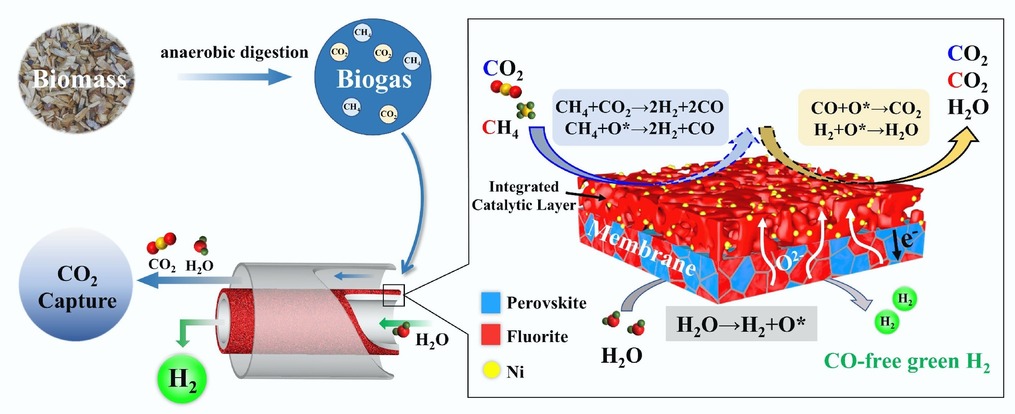
Figure 1.
Schematic diagram of CO-free green hydrogen production with carbon capture in a membrane reactor by coupling water splitting with biogas reforming.
-
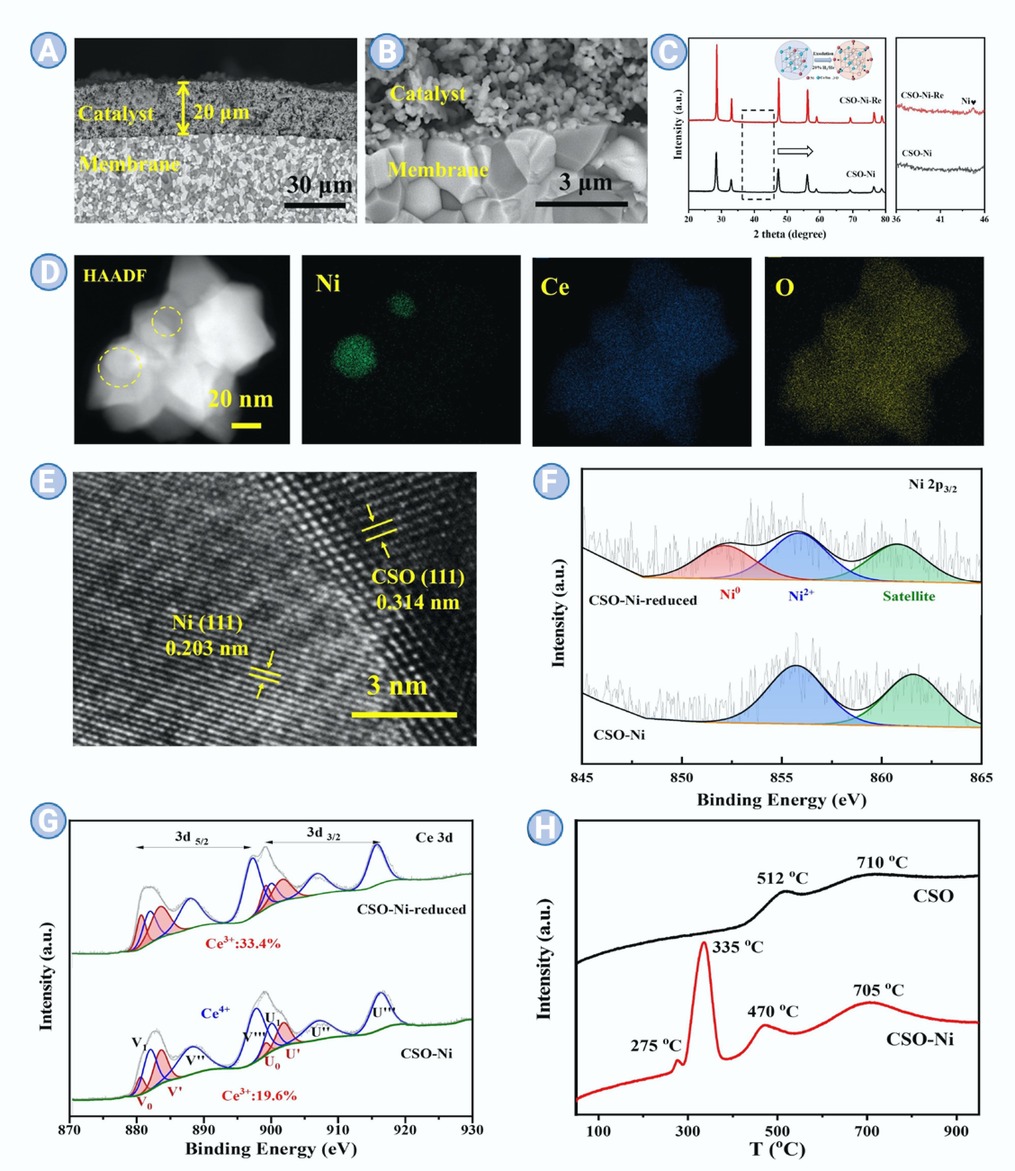
Figure 2.
(A&B) The cross section SEM images of the CSO-Ni@CSO-SSTF catalytic membrane. (C) XRD patterns of the CSO-Ni catalyst before and after reduction pretreatment. (D) HAADF-STEM image and corresponding elemental mappings and (E) HR-TEM image of CSO-Ni after 20% H2 reduction at 800 oC for 2h. XPS spectra of the fresh and the reduced CSO-Ni catalyst. (F) Ni 2p3/2, (G) Ce 3d. (H) H2-TPR profiles of CSO-Ni catalyst and CSO support.
-
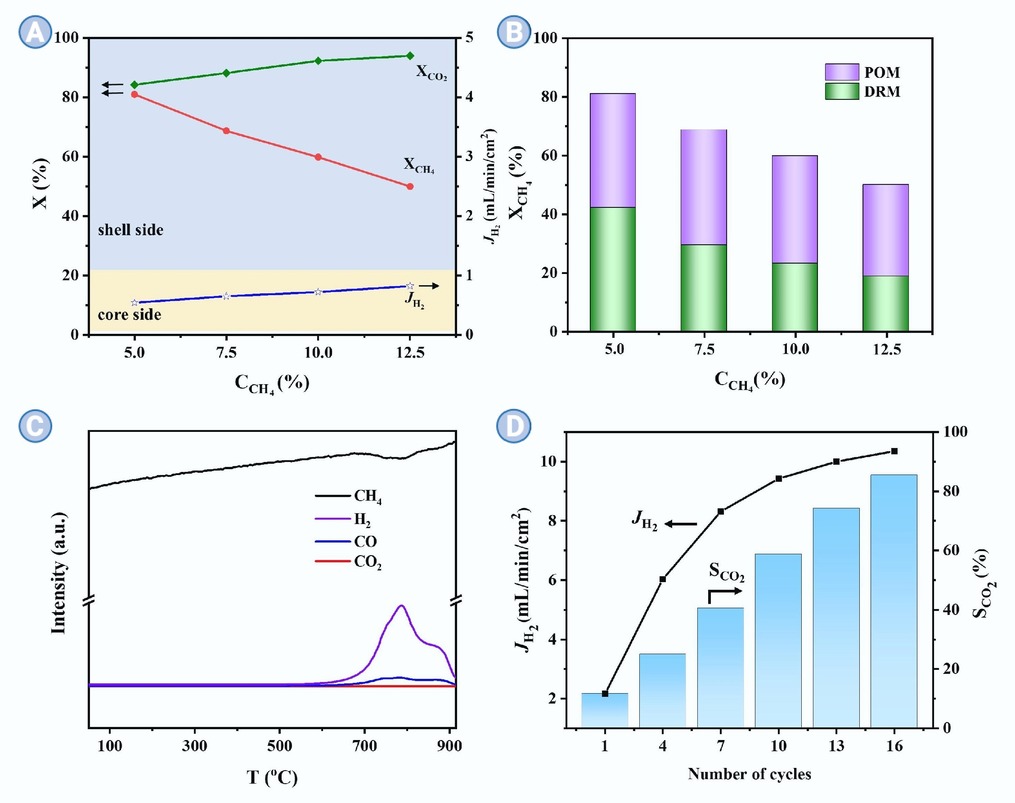
Figure 3.
(A) Effects of CH4 concentration in CSO-Ni@CSO-SSTF reactor. (B) The contribution of POM and DRM to methane conversion (XCH4) in (A) calculated based on the CO2 conversion. (C) CH4-TPSR profiles of CSO-Ni catalyst. (D) The accumulative production rate of CO-free green hydrogen and accumulative selectivity of CO2 in a CSO-Ni@CSO-SSAF reactor.
-
Figure 4.
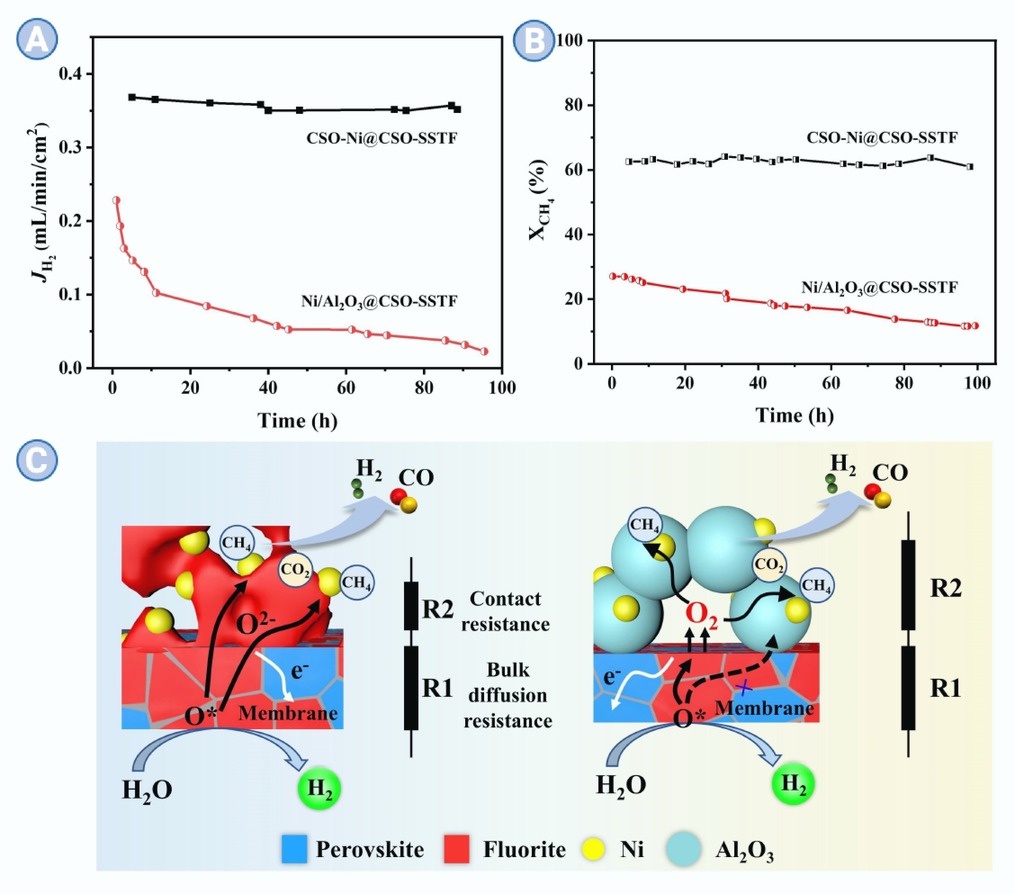
Long-term stability of the CSO-Ni@CSO-SSTF or the Ni/Al2O3@CSO-SSTF by coupling water splitting with biogas reforming at 930 oC. Shell side: 1.25 mL min−1 CO2, 2.5 mL min−1 CH4 and 16.25 mL min−1 N2; Core side: 20 mL min−1 H2O and 10 mL min−1 He.
-
Figure 5.
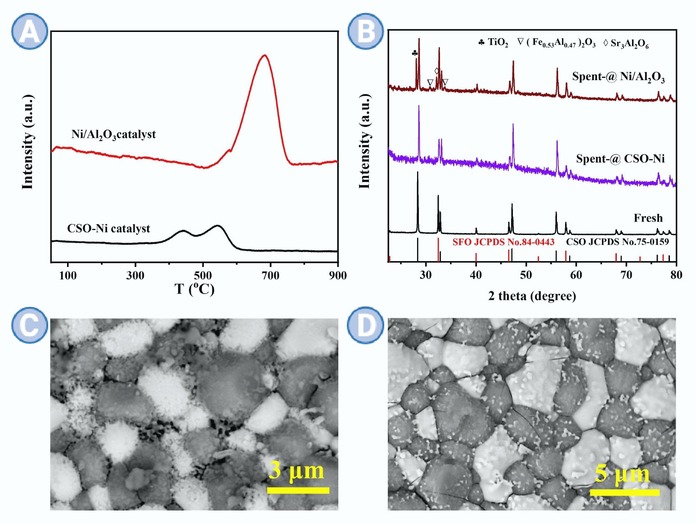
(A) The O2-TPO profiles of the spent CSO-Ni and Ni/Al2O3 catalysts after long-term stability tests. (B) XRD patterns of the outer surface of fresh and spent membranes. SEM images of the surface of the spent membranes in contact with (C) Ni/Al2O3 and (D) CSO-Ni catalysts.
