
Harvesting energy from ocean currents: A vortex induced motion energy conversion system
-
GRAPHICAL ABSTRACT
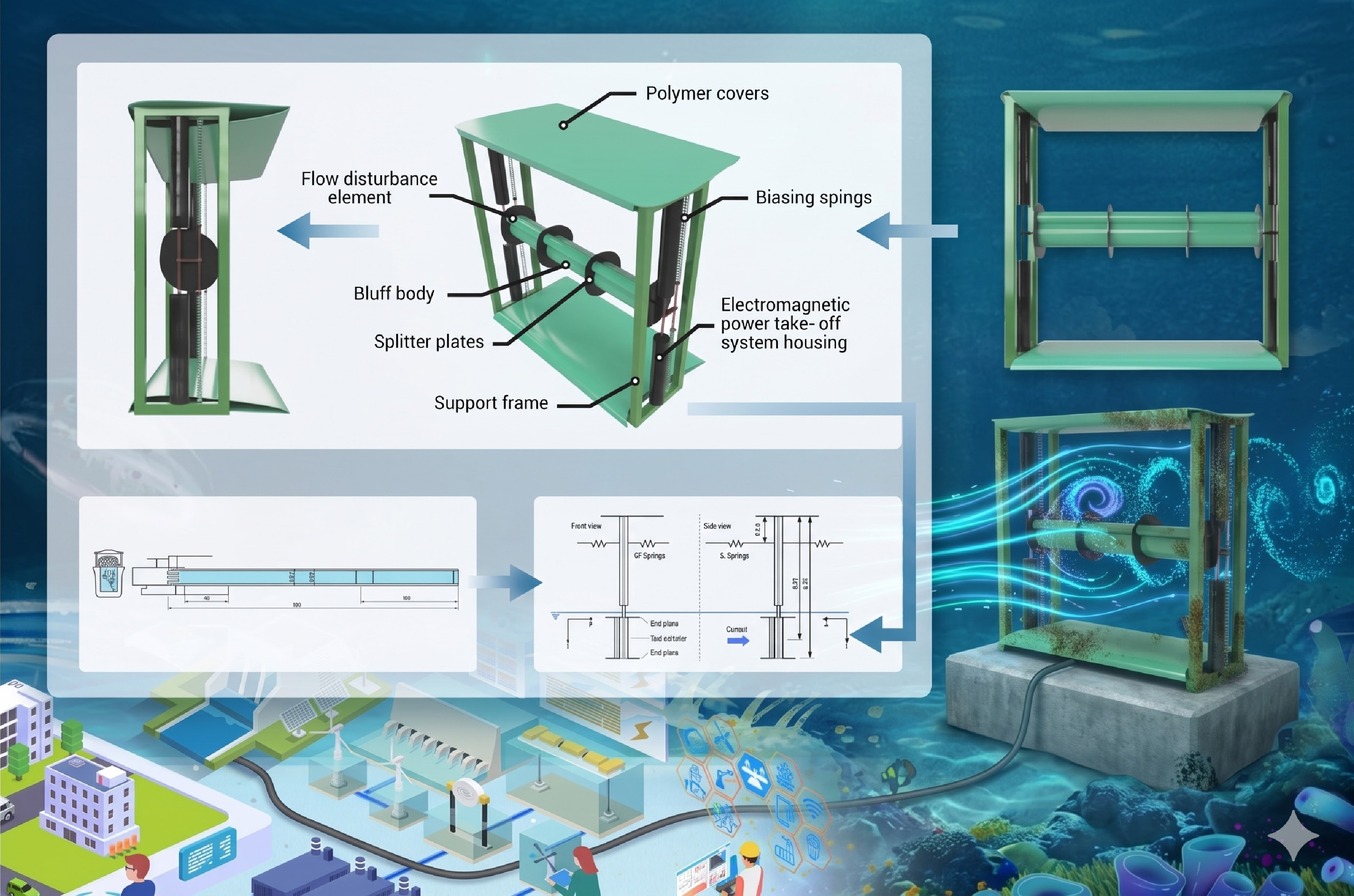
 DownLoad:
Full size image
DownLoad:
Full size image
-
PUBLIC SUMMARY
-
A novel VIM device harvests energy from water currents using fluid–structure interaction.
CFD simulations and experiments validate reliable performance across flow conditions.
The system works efficiently even near walls, enabling flexible seabed deployment.
Optimized damping improves energy conversion efficiency significantly.
Competitive LCOE shows strong potential for coastal and river renewable energy use.
-
-
ABSTRACT
Hydrokinetic energy harvesting represents a promising direction for sustainable renewable energy generation, leveraging complex fluid-structure interaction (FSI) phenomena to convert water current kinetic energy into electrical power. This study presents a comprehensive investigation of a novel Vortex-Induced Motion (VIM) energy converter designed to maximize power extraction from marine and riverine environments. The research methodology integrates advanced computational fluid dynamics (CFD) modeling with rigorous experimental validation to ensure reliable performance characterization. A CFD model is developed to simulate fluid-structure interactions under diverse hydrodynamic conditions. Experimental verification is conducted through towing tank experiments, enabling robust model calibration and performance assessment. Key findings demonstrate the concept is capable of operating under a wide range of flow velocities, with numerical results confirming minimal performance degradation in near-wall configurations. This characteristic suggests significant potential for seabed deployment across varied marine infrastructures. A detailed parametric analysis systematically evaluates damping configurations, identifying optimal parameters for maximizing energy conversion efficiency. Economic feasibility analysis reveals competitive levelized cost of energy (LCOE) metrics, positioning the proposed energy converter concept as a technically and economically viable renewable energy solution for remote coastal and riverine applications. -

-
REFERENCES
[1] Thennakoon T.M.T.N., Hewage H.T.M., Sandunika D.M.I., et al. (2023). Harnessing the power of ocean energy: A comprehensive review of power generation technologies. J. Res. Technol. Eng. 4:73−102. [2] International Energy Agency (2021). Global energy review 2021. IEA. Available online. [3] Flores P. and Mendoza E. (2025). A fuzzy logic technique for the environmental impact assessment of marine renewable energy power plants. Energies 18:272. DOI:10.3390/en18020272 [4] Sadoughipour M., VanZwieten J. and Tang Y. (2025). Drifter-based global ocean current energy resource assessment. Renew. Energy 244:122576. DOI:10.1016/j.renene.2025.122576 [5] Haas K., Fritz H.M., French S.P., et al. (2013). Assessment of energy production potential from ocean currents along the United States coastline. Report. DOI:10.2172/1093367. [6] Dodo Y. and Ochi F. (2023). Demonstration test of ocean current turbine system for reliability and economic performance evaluation. IHI Eng. Rev. 56. [7] Guo C., Sheng W., De Silva D.G., et al. (2023). A review of the levelized cost of wave energy based on a techno-economic model. Energies 16:2144. DOI:10.3390/en16052144 [8] Gu Y., Zou T., Liu H., et al. (2024). Status and challenges of marine current turbines: A global review. J. Mar. Sci. Eng. 12:884. DOI:10.3390/jmse12060884 [9] Barua A. and Rasel M.S. (2024). Advances and challenges in ocean wave energy harvesting. Sustain. Energy Technol. Assess. 61:103599. DOI:10.1016/j.seta.2023.103599 [10] Su X., Chen J., Yuan L., et al. (2025). Current status of development and application of ocean renewable energy technology. Sustainability 17:5648. DOI:10.3390/su17125648 [11] Boretti A. and Castelletto S. (2025). Advancements and challenges in tidal stream and oceanic current turbines: An overview of current technologies and future prospects. Mar. Dev. 3:10. DOI:10.1007/s44312-025-00054-5 [12] Roberts M., Nieuwenhuys C. and Guastella L. (2016). Circulation of shelf waters in the KwaZulu-Natal Bight, South Africa. Afr. J. Mar. Sci. 38:S7−S21. DOI:10.2989/1814232X.2016.1175383 [13] Wardhana W., Keniraras N., Pratama R.S., et al. (2021). Hydrodynamics performance analysis of vertical axis water turbine using CFD approach. IOP Conf. Ser. Earth Environ. Sci. 698:012022. DOI:10.1088/1755-1315/698/1/012022 [14] Xu P., Hong M., Li H., et al. (2025). Vortex-driven nanogenerators for marine energy harvesting. Phys. Fluids 37:027133. DOI:10.1063/5.0250873 [15] Zhu H., Chen Q., Tang T., et al. (2023). Flow structures around a circular cylinder with bilateral splitter plates. Ocean Eng. 269:113547. DOI:10.1016/j.oceaneng.2022.113547 [16] Wang J., Zhang C., Zhang M., et al. (2021). Enhancing energy harvesting from flow-induced vibrations of a circular cylinder using a downstream rectangular plate. Int. J. Mech. Sci. 211:106781. DOI:10.1016/j.ijmesec.2021.106781 [17] Margielewicz J., Gąska D., Trigona C., et al. (2026). The influence of magnet configuration on energy harvesting from torsional vibrations of drive systems. Appl. Math. Model. 151:116510. DOI:10.1016/j.apm.2025.116510 [18] Milne I.A., Day A.H., Sharma R.N., et al. (2016). The characterisation of the hydrodynamic loads on tidal turbines due to turbulence. Renew. Sustain. Energy Rev. 56:851−864. DOI:10.1016/j.rser.2015.11.095 [19] Song R., Xu P., Jiang C., et al. (2024). An experimental study on flow induced motion and energy harvesting of cylinders with different cross sections. Front. Mar. Sci. 11:1461020. DOI:10.3389/fmars.2024.1461020 [20] Zhang J., Xu G., Liu F., et al. (2016). Experimental investigation on the flow induced vibration of an equilateral triangle prism in water. Appl. Ocean Res. 61:92−100. DOI:10.1016/j.apor.2016.10.003 [21] Chang C.-C., Kumar R.A. and Bernitsas M.M. (2011). VIV and galloping of single circular cylinder with surface roughness at 3.0×10⁴≤Re≤1.2×10⁵. Ocean Eng. 38:1713–1732. DOI:10.1016/j.oceaneng.2011.07.013. [22] Sun H., Kim E.S., Nowakowski G., et al. (2016). Effect of mass-ratio, damping, and stiffness on optimal hydrokinetic energy conversion. Renew. Energy 99:936−959. DOI:10.1016/j.renene.2016.07.056 [23] Bernitsas M.M., Raghavan K., Ben-Simon Y., et al. (2006). VIVACE (Vortex Induced Vibration Aquatic Clean Energy): A new concept in generation of clean and renewable energy from fluid flow. Proc. Int. Conf. Offshore Mech. Arctic Eng. 2:619−637. DOI:10.1115/OMAE2006-92645 [24] Lian J., Wu Z., Yao S., et al. (2022). Experimental investigation of flow-induced motion and energy conversion for two rigidly coupled triangular prisms arranged in tandem. Energies 15:8190. DOI:10.3390/en15218190 [25] Xu J., Barrero-Gil A. and Velazquez A. (2016). Dual mass system for enhancing energy extraction from vortex-induced vibrations. Int. J. Mar. Energy 16:250−261. DOI:10.1016/j.ijome.2016.07.004 [26] Alam M.M., Moriya M. and Sakamoto H. (2003). Aerodynamic characteristics of two side-by-side circular cylinders and application of wavelet analysis on the switching phenomenon. J. Fluid Struct. 18:325−346. DOI:10.1016/j.jfluidstructs.2003.07.005 [27] Alam M.M., Moriya M., Takai K. and Sakamoto H. (2003). Fluctuating fluid forces acting on two circular cylinders in a tandem arrangement at a subcritical Reynolds number. J. Wind Eng. Ind. Aerodyn. 91:139−154. DOI:10.1016/S0167-6105(02)00341-0 [28] Alam M.M. and Sakamoto H. (2005). Investigation of Strouhal frequencies of two staggered bluff bodies and detection of multistable flow by wavelets. J. Fluid Struct. 20:425−449. DOI:10.1016/j.jfluidstructs.2004.11.003 [29] Tang B., Wang J., Yu X., et al. (2026). Energy harvesting of cylindrical FIV under multi prism wake. Renew. Energy 256:123918. DOI:10.1016/j.renene.2025.123918 [30] Rashki M.R., Hejazi K., Tamimi V., et al. (2024). Impacts of hard marine growth on 2DoF VIV-based piezoelectric energy harvesting. Renew. Energy 231:120913. DOI:10.1016/j.renene.2024.120913 [31] Huang X. and Zhong T. (2023). Hydrokinetic energy harvesting from flow-induced vibration of a hollow cylinder attached with a bi-stable energy harvester. Energy Convers. Manage. 278:116718. DOI:10.1016/j.enconman.2023.116718 [32] Zhang X., Huang X. and Wang B. (2024). A quad-stable nonlinear piezoelectric energy harvester with piecewise stiffness for broadband energy harvesting. Nonlinear Dyn. 112:19633−19652. DOI:10.1007/s11071-024-10077-0 [33] Huang X. and Yang B. (2023). Towards novel energy shunt inspired vibration suppression techniques: Principles, designs and applications. Mech. Syst. Signal Process. 182:109496. DOI:10.1016/j.ymssp.2022.109496 [34] Huang X. (2024). Exploiting multi-stiffness combination inspired absorbers for simultaneous energy harvesting and vibration mitigation. Appl. Energy 364:123124. DOI:10.1016/j.apenergy.2024.123124 [35] Huang X., Hua X. and Chen Z. (2025). Exploiting a novel magnetoelastic tunable bi-stable energy converter for vibration energy mitigation. Nonlinear Dyn. 113:2017−2043. DOI:10.1007/s11071-024-10337-z [36] Huang X., Wang B., Huang Z., et al. (2025). A theoretical model for a low-frequency two-stage hybrid vibration isolator with a nonlinear energy sink and a negative stiffness spring. Appl. Math. Model. 142:115948. DOI:10.1016/j.apm.2025.115948 [37] Mejia O.D.L., Quiñones J.J. and Laín S. (2018). RANS and hybrid RANS-LES simulations of an H-type Darrieus vertical axis water turbine. Energies 11:2348. DOI:10.3390/en11092348 [38] Iliev R., Todorov G., Kamberov K. and Zlatev B. (2025). Evaluation of the performance of optimized horizontal-axis hydrokinetic turbines. Water 17:1532. DOI:10.3390/w17101532 [39] Lee C.T. (2025). Advancing marine renewable energy for island nations: Design and development of a 20 kW floating Kuroshio turbine (FKT). J. Energy Power Technol. 7:017. DOI:10.21926/jept.2504017 [40] Ng C.Y., Maldar N.R. and Ong M.C. (2026). Effect of diffuser inlet angles on the power and torque coefficients of a hydrokinetic turbine. J. Offshore Mech. Arct. Eng. 148:012008. DOI:10.1115/1.4069635 [41] Hernández Montoya E.E., Mendoza E. and Stamhuis E.J. (2023). Biomimetic design of turbine blades for ocean current power generation. Biomimetics 8:118. DOI:10.3390/biomimetics8010118 [42] Zhou Z., Benbouzid M., Charpentier J.-F., et al. (2017). Developments in large marine current turbine technologies: A review. Renew. Sustain. Energy Rev. 71:852−858. DOI:10.1016/j.rser.2016.12.113 [43] Rashid H., Hanzla M., Berghout T., et al. (2025). RegStack machine learning model for accurate prediction of tidal stream turbine performance and biofouling. Expert Syst. Appl. 283:127766. DOI:10.1016/j.eswa.2025.127766 [44] Katsidoniotaki E., Psarommatis F. and Göteman M. (2022). Digital twin for the prediction of extreme loads on a wave energy conversion system. Energies 15:5464. DOI:10.3390/en15155464 [45] European Commission (2021). European Union’s Horizon 2020 MaRINET2 program. Available online. DOI:10.3030/731084. [46] Guðlaugsson B., Hocevar M., Secnik M., et al. (2026). Feasibility assessment of a DIY vortex-induced vibration energy harvester for remote and off-grid power supply. Energy Convers. Manage. X 30:101755. DOI:10.1016/j.ecmx.2026.101755 [47] Wu J. (2020). VIMEC test. Report No. 302005150. [48] Weller H.G., Tabor G., Jasak H. and Fureby C. (1998). A tensorial approach to computational continuum mechanics using object-oriented techniques. Comput. Phys. 12:620−631. DOI:10.1063/1.168744 [49] Menter F.R., Kuntz M. and Langtry R. (2003). Ten years of industrial experience with the SST turbulence model. Proc. Int. Symp. Turbulence Heat Mass Transfer: 625–632. [50] Lei C., Cheng L. and Kavanagh K. (1999). Re-examination of the effect of a plane boundary on force and vortex shedding of a circular cylinder. J. Wind Eng. Ind. Aerodyn. 80:263−286. DOI:10.1016/S0167-6105(98)00204-9 [51] Soti A.K., Zhao J., Thompson M.C., et al. (2018). Damping effects on vortex-induced vibration and implications for power extraction. J. Fluid Struct. 81:289−308. DOI:10.1016/j.jfluidstructs.2018.04.013 [52] Lee C.-Y. and Ahn J. (2020). Stochastic modeling of the levelized cost of electricity for solar PV. Energies 13:3017. DOI:10.3390/en13113017 [53] Touran A. and Wiser E.P. (1992). Monte Carlo technique with correlated random variables. J. Constr. Eng. Manag. 118:258−272. DOI:10.1061/(ASCE)0733-9364(1992)118:2(258 [54] Wall D.M. (1997). Distributions and correlations in Monte Carlo simulation. Constr. Manag. Econ. 15:241−258. DOI:10.1080/014461997372980 [55] Jenne D.S., Yu Y.-H. and Neary V. (2015). Levelized cost of energy analysis of marine and hydrokinetic models. Proc. Mar. Energy Technol. Symp. [56] Neary V.S., Previsic M., Jepsen R.A., et al. (2014). Methodology for design and economic analysis of marine energy conversion technologies. Report. [57] National Renewable Energy Laboratory (2024). Annual Technology Baseline: Financial Cases & Methods. NREL. https://atb.nrel.gov/electricity/2024/. [58] International Renewable Energy Agency (2023). The cost of financing for renewable power. IREA. -
ABOUT THIS ARTICLE
Cite this article:
Ong M. and Janocha M. (2026). Harvesting energy from ocean currents: A vortex induced motion energy conversion system. The Innovation Energy 3:100153. https://doi.org/10.59717/j.xinn-energy.2026.100153
Welcome!
To request copyright permission to republish or share portions of our works, please visit Copyright Clearance Center's (CCC) Marketplace website at marketplace.copyright.com.
Export File
Citation
Ong M. and Janocha M. (2026). Harvesting energy from ocean currents: A vortex induced motion energy conversion system. The Innovation Energy 3:100153. https://doi.org/10.59717/j.xinn-energy.2026.100153

Format
Content
-
Figure 1.
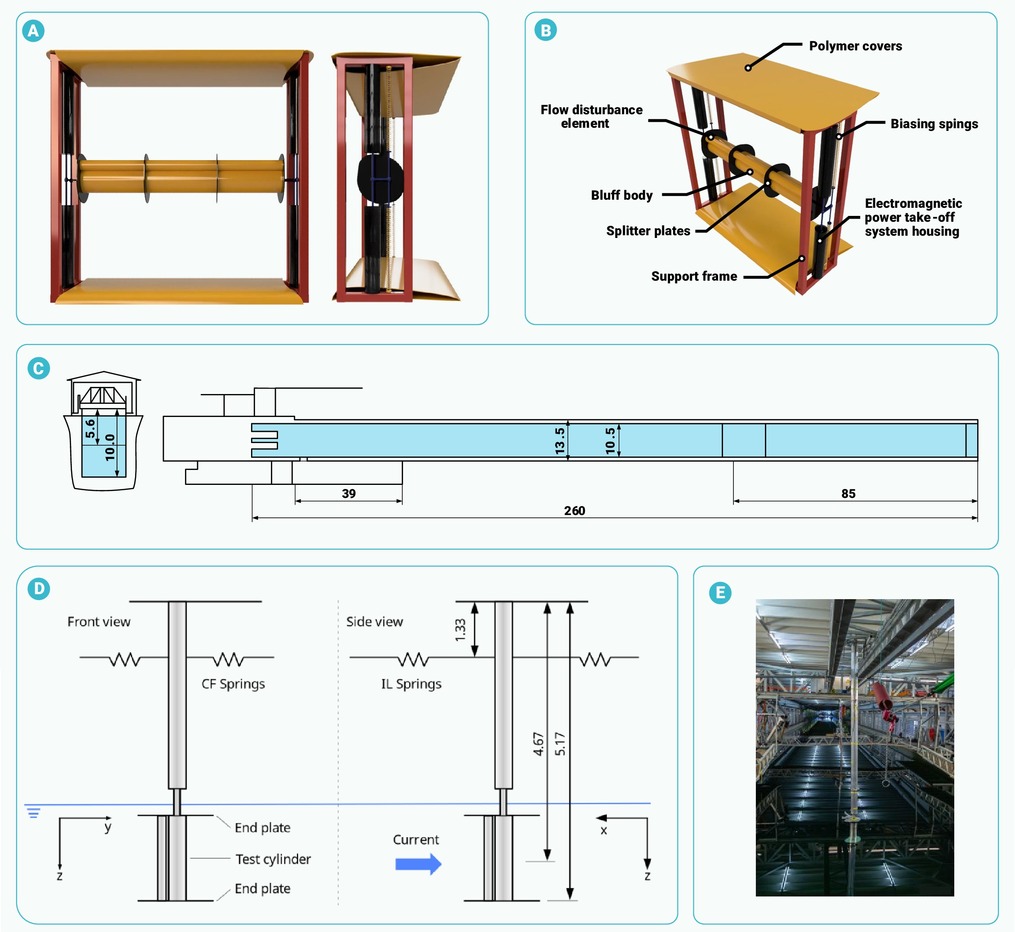
(A) & (B) Overview of the VIMEC device concept
-
Figure 2.
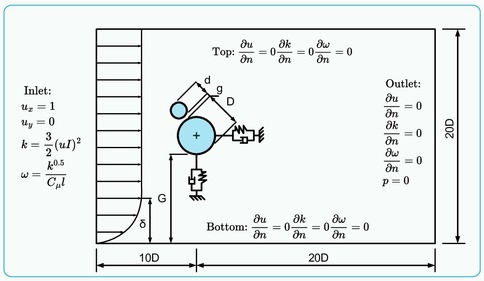
(A) Schematic diagram of the computational domain and imposed boundary conditions and (B) an overview of the computational mesh.
-
Figure 3.
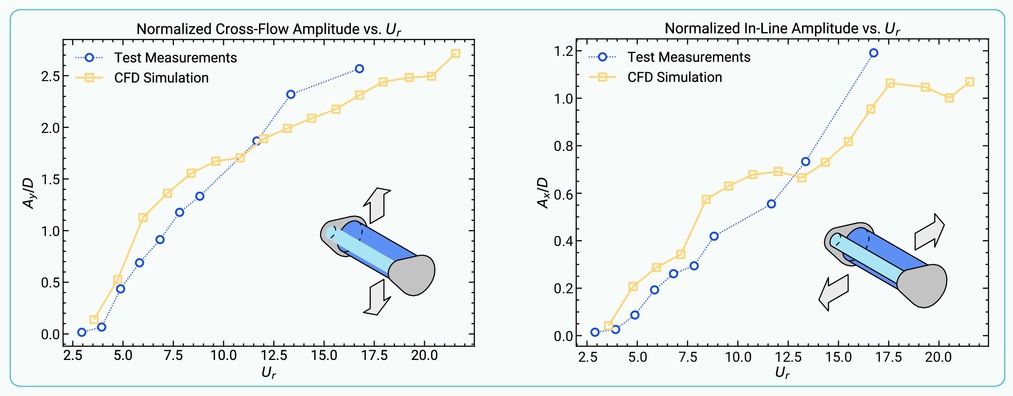
Comparison of the present numerical results with the present experimental test data.
-
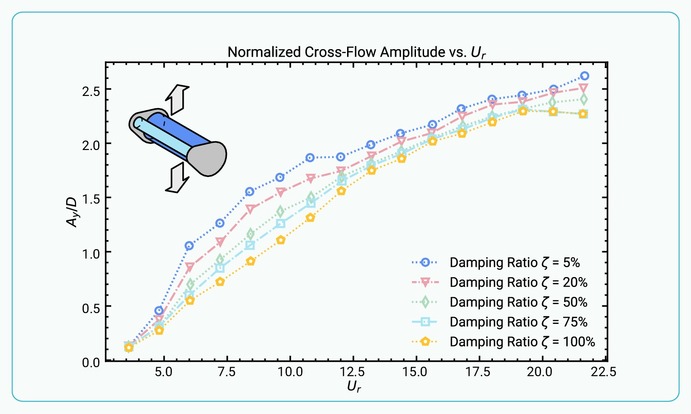
Figure 4.
Effect of damping (PTO load) on hydrodynamic response of the oscillator.
-
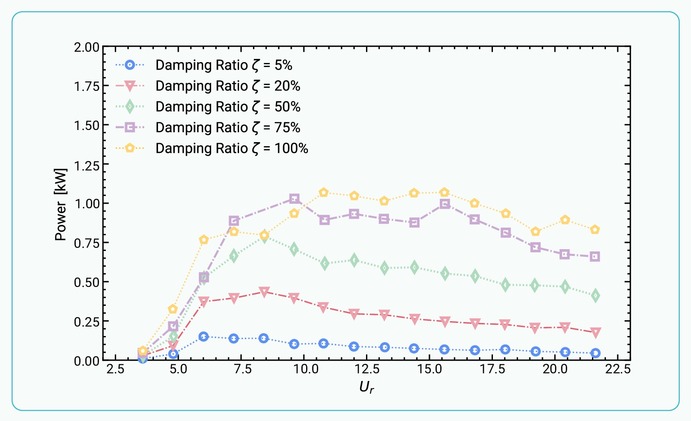
Figure 5.
Effect of damping (PTO load) on the time averaged mechanical power production.
-
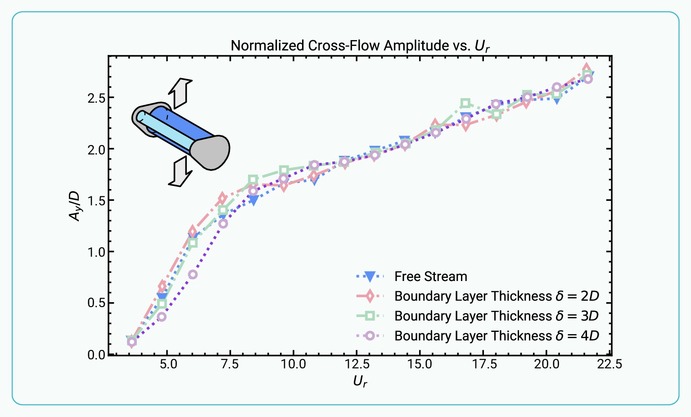
Figure 6.
Effect of bottom boundary layer thickness on hydrodynamic response of the oscillator.
-
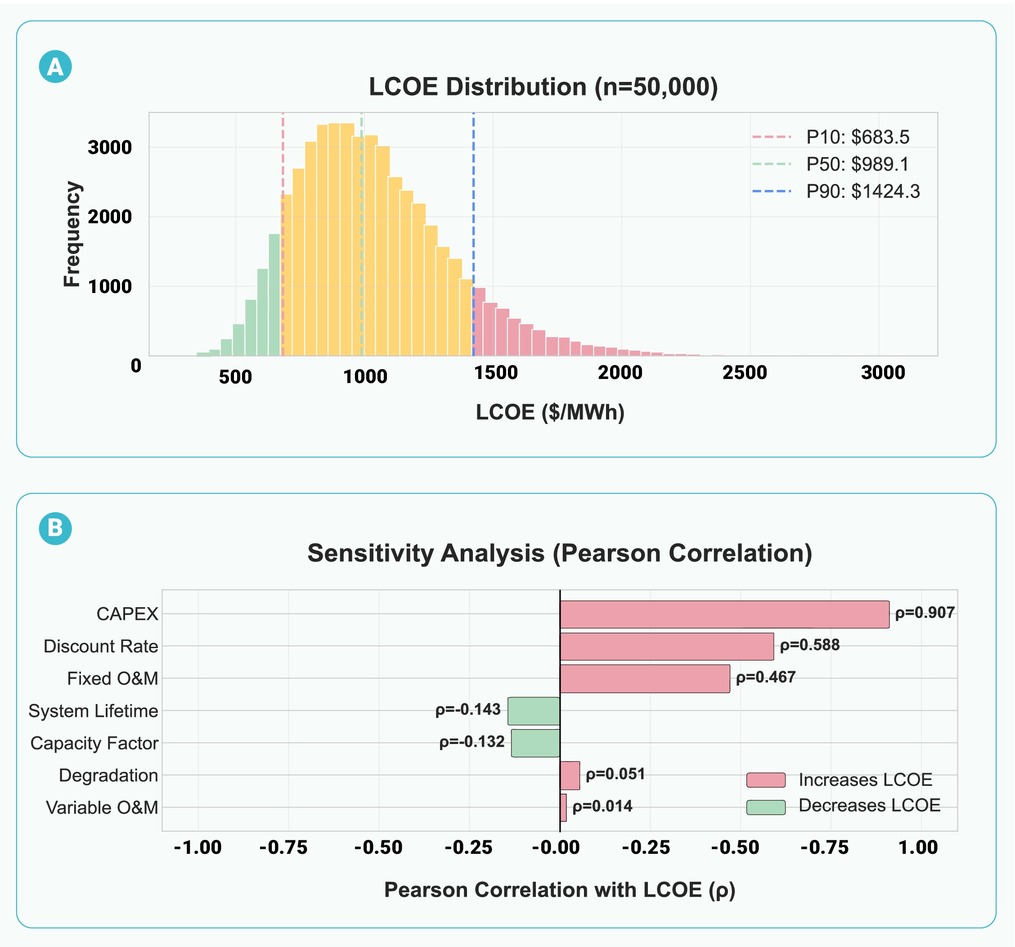
Figure 7.
Results of Monte Carlo simulations and resulting LCOE distribution (Model parameters detailed in Table S5).
-
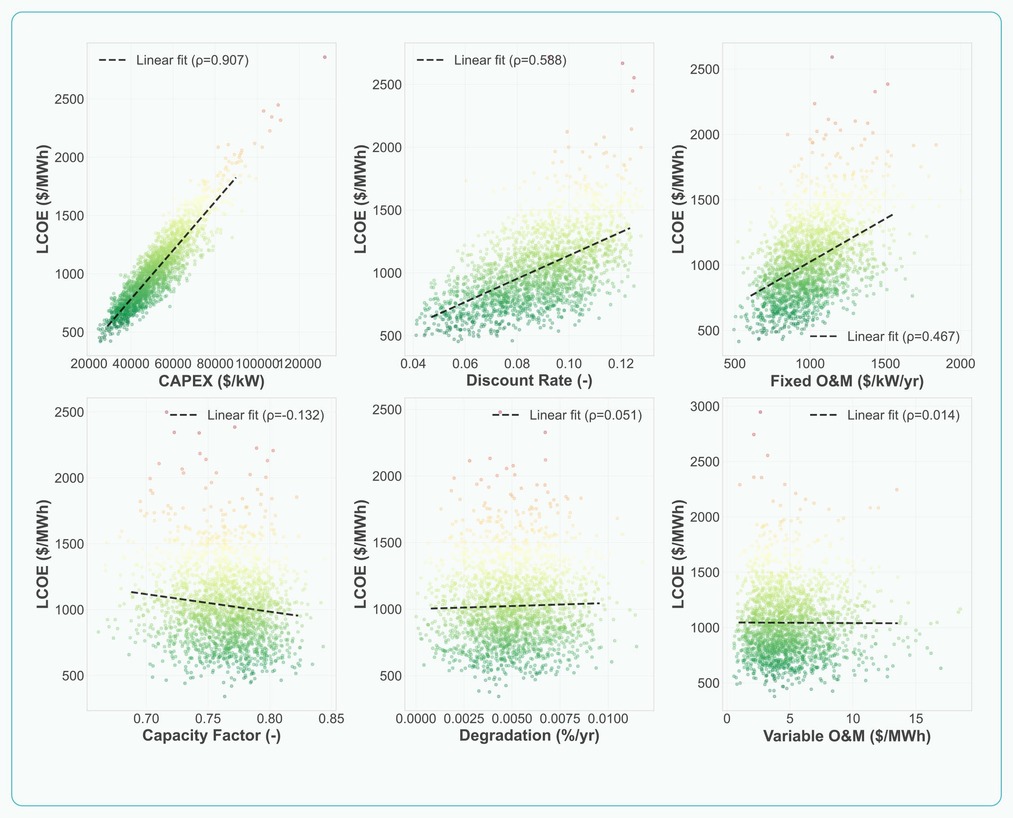
Figure 8.
Stochastic Monte Carlo analysis parameter correlation with predicted LCOE.
