
Human-environment interaction systems between regional and continental scales in mid-latitude Eurasia during 6000–3000 years ago
-
GRAPHICAL ABSTRACT

 DownLoad:
Full size image
DownLoad:
Full size image
-
PUBLIC SUMMARY
-
Centuries of archaeological studies reveal the ebb and flow of settlement centers across Eurasia.
The primary drivers encompass new technologies, human migration, and climate change.
Their concatenation progressively redefines the human-environment relation on various scales.
Multi-cycle interaction between local and continental networks integrates Eurasia as a whole.
-
-
ABSTRACT
The Late Neolithic and Bronze Ages witnessed the extensive expansion of human settlements, along with the dispersal of crops and livestock originating from West and East Asia. These events profoundly reshaped the human-environment relationship in mid-latitude Eurasia and the underlying trans-Eurasian exchange. While the processes and factors that underpin the interaction between human societies and ever-changing environments have been a heated debate in various regions of Eurasia, there is still a lack of synergistic discussion regarding human-environment interactions at regional and continental scales. To this end, we provide a comprehensive review and synthesis of updated radiocarbon dates and archaeobotanical and zooarchaeological data from sites dated between 6000 and 3000 cal. yr BP in mid-latitude Eurasia, coupled with associated archaeological and palaeoclimatic records. The results reveal the emergence and expansion of a number of regional settlement centers along the prehistoric Silk Roads and Eurasian Steppes during the 6th–4th millennium cal. yr BP. The prime drivers include the spread of new technologies, human migration, and climate change. As a result of successful food production and increasing social complexity, many areas have experienced rapid population growth, creating a foundation for subsequent widespread expansion of farming and herding communities across Eurasia. Under this overarching picture, many regional patterns arose due to specific natural and social conditions, weaving into broad spatiotemporal variations across Eurasia. A new conceptual model is proposed to depict this feedback loop of the interaction between human-environment systems at and between regional and continental scales. -

-
REFERENCES
[1] Spengler, R., Frachetti, M., Doumani, P., et al. (2014). Early agriculture and crop transmission among Bronze Age mobile pastoralists of Central Eurasia. Proc. R. Soc. Lond. B, 281, 20133382. [2] Sharifi, A., Pourmand, A., Canuel, E.A., et al. (2015). Abrupt climate variability since the last deglaciation based on a high-resolution, multi-proxy peat record from NW Iran: The hand that rocked the cradle of civilization. Quat. Sci. Rev. 123, 215−230. [3] Dixit, Y., Hodell, D.A., Giesche, A., et al. (2018). Intensified summer monsoon and the urbanization of Indus Civilization in northwest India. Sci. Rep. 8, 4225. [4] Zhou, X.Y., Yu, J.J., Spengler, R.N., et al. (2020). 5,200-year-old cereal grains from the eastern Altai Mountains redate the trans-Eurasian crop exchange. Nat. Plants 6, 78−87. [5] Dong, G.H., Lu, Y.X., Zhang, S.J., et al. (2022). Spatiotemporal variation in human settlements and their interaction with living environments in Neolithic and Bronze Age China. Prog. Phys. Geog. 46, 949−967. [6] Staubwasser, M., Sirocko, F., Grootes, P.M., et al. (2003). Climate change at the 4.2 ka BP termination of the Indus valley civilization and Holocene south Asian monsoon variability. Geophys. Res. Lett. 30 , 1425–1432. [7] Kuper, R., and Kröpelin, S. (2006). Climate-controlled Holocene occupation in the Sahara: Motor of Africa's evolution. Science 313, 803−807. [8] Weiss, H. (2017). Megadrought and Collapse: From Early Agriculture to Angkor (Oxford University Press). [9] Hou, J.Z., Ji, K., Zhu, E.L., et al. (2023). Climate change fostered rise and fall of the Tibetan Empire during 600–800 AD. Sci. Bull. 68, 1187−1194. [10] Lespez, L., Glais, A., Lopez-Saez, J.A., et al. (2016). Middle Holocene rapid environmental changes and human adaptation in Greece. Quat. Res. 85, 227−244. [11] Yang, Y.S., Wang, J., Li, G., et al. (2022). Shift in subsistence crop dominance from broomcorn millet to foxtail millet around 5500 BP in the western Loess Plateau. Front. Plant Sci. 13, 939340. [12] Scott, A., Reinhold, S., Hermes, T., et al. (2022). Emergence and intensification of dairying in the Caucasus and Eurasian steppes. Nat. Ecol. Evol. 6, 813−822. [13] Pollard, A.M., and Gosden, C. (2023). An archaeological perspective on the history of technology. CUP Elements. Cambridge University Press. [14] Qiu, M.H., Liu, R.L., Li, X.Y., et al. (2023). Earliest systematic coal exploitation for fuel extended to ~3600 B.P. Sci. Adv. 9, eadh0549. [15] Pashkevych, G. (2012). Environment and economic activities of Neolithic and Bronze Age populations of the northern Pontic area. Quat. Int. 261, 176−82. [16] Allentoft, M.E., Sikora, M., Sjögren. K., et al. (2015). Population genomics of Bronze Age Eurasia. Nature 522, 167−172. [17] Wilkin, S., Ventresca Miller, A.R., Fernandes, R., et al. (2021). Dairying enabled early bronze age Yamnaya steppe expansions. Nature 598, 629−633. [18] Wu, D., Ma, M.M., Lu, Y.X., et al. (2023). Out-of-phase relationship of Holocene moisture variations between the northeastern and southeastern Tibetan plateau and its societal impacts. Fundam. Res. https://doi.org/10.1016/j.fmre.2023.02.014. [19] Chen, F.H., Xu, Q.H., Chen, J.H., et al. (2015) East Asian summer monsoon precipitation variability since the last deglaciation. Sci. Rep. 5 , 11186. [20] Xiang, L.X., Huang, X.Z., Sun, M.J., et al. (2023). Prehistoric population expansion in Central Asia promoted by the Altai Holocene Climatic Optimum. Nat. Com. 14, 3102. [21] Zhang, H.W., Cheng, H., Sinha, A., et al. (2021). Collapse of the Liangzhu and other Neolithic cultures in the lower Yangtze region in response to climate change. Sci. Adv. 7, eabi9275. [22] Zaki, A.S., King, G.E., Haghipour, N., et al. (2021). Did increased flooding during the African Humid Period force migration of modern humans from the Nile Valley. Quat. Sci. Rev. 272, 107200. [23] Finley, M.I. (1965). Technical innovation and economic progress in the ancient world. Econ. Hist. Rev. 18, 29−45. [24] Diamond, J., and Bellwood, P. (2003). Farmers and their languages: The first expansions. Science 300, 597−603. [25] Ventresca Miller, A.R., Wilkin, S., Hendy, J., et al. (2022). The spread of herds and horses into the Altai: how livestock and dairying drove social complexity in Mongolia. PLOS ONE 17, e0265775. [26] Ventresca Miller, A.R., and Makarewicz, C.A. (2019). Intensification in pastoralist cereal use coincides with the expansion of trans-regional networks in the Eurasian Steppe. Sci. Rep. 9, 8363. [27] Dong, G.H., Yang, Y.S., Ren, L.L., et al. (2020). The human subsistence strategy patterns and human-environment interactions in prehistoric Hexi Corridor (in Chinese). (Science Press). [28] Dong, G.H., Liu, F.W., and Chen, F.H. (2017). Environmental and technological effects on ancient social evolution at different spatial scales. Sci. China Earth Sci. 60, 2067−2077. [29] Honeychurch, W., Rogers, L., Amartuvshin, C., et al. (2021). The earliest herders of East Asia: Examining Afanasievo entry to Central Mongolia. Archaeol. Res. Asia 26, 100264. [30] Frachetti, M.D., Smith, C.E., Traub, C.M., et al. (2017). Nomadic ecology shaped the highland geography of Asia’s Silk Roads. Nature 543 193–198. [31] Pollard, A.M., Bray, P., Hommel, P., et al. (2018). Beyond Provenance: New Approaches to Interpreting the Chemistry of Archaeological Copper Alloys (Leuven University Press). [32] Liu, X.Y., Jones, P.J., Motuzaite-Matuzeviciute, G., et al. (2019). From ecological opportunism to multi-cropping: Mapping food globalisation in prehistory. Quat. Sci. Rev. 206, 21−28. [33] Crawford, H. (1991). Sumer and the Sumerians (Cambridge University Press). [34] Hanks, B.K., and Linduff, K.M. (2009). Social complexity in prehistoric Eurasia: Monuments, metals, and mobility (Cambridge University Press). [35] Yan, W.M. (1996). Exploration of the origin of China civilization (in Chinese). Cult. Relics Cent. China 1, 10−16. [36] Dani, A.H., and Masson, V.M. (2002). History of Civilizations of Central Asia·I (Chinese Edition) (in Chinese). China Translation and Publishing Corporation. [37] Wittke, A.-M., Olshausen, E., and Szydlak, R. (2012). Historischer Atlas der antiken Welt. Stuttgart. [38] Brigand, R. and Weller, O. (2018). Kernel density estimation and transition maps of Moldavian Neolithic and Eneolithic settlement. Data Brief 17, 452−458. [39] Danese, M., Masini, N., Biscione, M., Lasaponara, R. (2014). Predictive modeling for preventive Archaeology: overview and case study. Cent. Eur. J. Geosci. 6, 42−55. [40] Guillemot, P., Jaillet, S., Chacón, M.G., Pois, V., Moncel, M. (2023). Spatial patterning of Middle Palaeolithic lithic assemblages at the Abri du Maras, Southeast France: Combining GIS analysis and 3D palaeotopographic reconstructions. J. Archaeol. Sci. Rep. 49, 103999. [41] McMahon, T. C. (2007). “Discerning Prehistoric Landscapes in Colorado and the Mesa Verde Region Using a Kernel Density Estimate (KDE) Method.” In Digital Discovery. Exploring New Frontiers in Human Heritage, CAA 2006, edited by J. T. Clark and E. M. Hagemeister, 151–166. Budapest: Archaeolingua. [42] Dong, G.H., Du, L.Y., Yang, L., et al. (2022). Dispersal of crop-livestock and geographical-temporal variation of subsistence along the Steppe and Silk Roads across Eurasia in prehistory. Sci. China Earth Sci. 65, 1187−1210. [43] Arbuckle, B.S. (2012). Animals and inequality in Chalcolithic central Anatolia. J. Anthropol. Archaeol. 31, 302−313. [44] Manning, K., Downey, S.S., Colledge, S., et al. (2013). The origins and spread of stock-keeping: the role of cultural and environmental influences on early Neolithic animal exploitation in Europe. Antiquity 87, 1046−1059. [45] Decaix, A., Mohaseb, F.A., Maziar, S., et al. (2019). Subsistence economy in kohneh Pasgah Tepesi (eastern Azerbaijan, Iran) during the late chalcolithic and the early Bronze age based on the faunal and botanical remains. In: Meyer, J.W., Vila, E., Mashkour, M., Casanova, M., Valle, R. (Eds.), The Iranian Plateau During the Bronze Age. Development Of Urbanisation, Production And Trade, MOM. Maison de l’Orient et de la M´editerran´ee, Lyon, pp. 75–88. [46] Zhao, Z.J. (2019). Introduction of the origin of agriculture in China (in Chinese). Res. Heritages Preservation 4, 1−7. [47] Kalieva, S. and Logvin, V. (2011) On the origins of nomadism in the Asian steppes. Archaeol. Ethnol. Anthropol. Eurasia 39 , 85–93. [48] Du, L.Y., Ma, M.M., Lu, Y.W., et al. (2020). How did human activity and climate change influence animal exploitation during 7500–2000 BP in the Yellow River Valley, China. Front. Ecol. Evol. 8, 161. [49] Anthony, D.W. (2008). The Horse, the Wheel, and Language: How Bronze-Age Riders from the Eurasian Steppes Shaped the Modern World (Princeton University Press). [50] Kirtcho, L.B. (2009). The earliest wheeled transport in Southwestern Central Asia: new finds from Altyn-Depe. Archaeol. Ethnol. Anthropol. Eurasia 37, 25−33. [51] Chen, F.H., Dong, G.H., Zhang, D.J., et al. (2015). Agriculture facilitated permanent human occupation of the Tibetan Plateau after 3600 BP. Science 347, 248−250. [52] Motuzaite-Matuzeviciute, G., Ananyevskaya, E., Sakalauskaite, J., et al. (2022). The integration of millet into the diet of Central Asian populations in the third millennium BC. Antiquity 96, 560−574. [53] Mazar, A. (1990). Chapter 4 - The emergence of cities: The early Bronze Age (ca. 3300–2300 BCE). In Archaeology of the Land of the Bible, (Doubleday), pp. 91–150. [54] Garfinkel, Y., Klimscha, F., Shalev, S., et al. (2014). The beginning of metallurgy in the Southern Levant: A late 6th millennium cal BC copper awl from Tel Tsaf, Israel. PLOS ONE 9, e96882. [55] Tan, L.C., Dong, G.H., An, Z.S., et al. (2021). Megadrought and cultural exchange along the proto-silk road. Sci. Bull. 66, 603−611. [56] Ma, M.M., Dong, J.J., Yang, Y.S., et al. (2023) Isotopic evidence reveals the gradual intensification of millet agriculture in Neolithic western Loess Plateau. Fundamental Research. [57] Berthon, R. (2014). Past, current and future contribution of Zooarchaeology to the knowledge of the Neolithic and chalcolithic cultures in South Caucasus. Stud. Caucasian Archaeol. 2, 4−30. [58] Sagona, A. (2017). The Archaeology of the Caucasus: From Earliest Settlements to the Iron Age (Cambridge University Press). [59] Akashi, C., Tanno, K., Guliyev, F., et al. (2018). Neolithisation processes of the South Caucasus: As viewed from macro-botanical analyses at Hacı Elamxanlı Tepe West Azerbaijan. Paléorient 44, 75−89. [60] Haak, W., Lazaridis, I., Patterson, N., et al. (2015). Massive migration from the steppe was a source for Indo-European languages in Europe. Nature 522, 207−211. [61] Scorrano, G., Yediay, F.E., Pinotti, T., et al. (2021). The genetic and cultural impact of the Steppe migration into Europe. Ann. Hum. Biol. 48, 223−233. [62] Hirose, M., Naito, Y.I., Kadowaki, S., et al. (2021). Early husbandry strategies in the southern Caucasus: intra-tooth sequential carbon and oxygen isotope analysis of Neolithic goats, sheep, and cattle from Göytepe and Hacı Elamxanlı Tepe. J. Archaeol. Sci. Rep. 36, 102869. [63] Hermes, T.R., Tishkin, A.A., Kosintsev, P.A., et al. (2020). Mitochondrial DNA of domesticated sheep confirms pastoralist component of Afanasievo subsistence economy in the Altai Mountains (3300–2900 cal BC). Archaeol. Res. Asia 24, 100232. [64] Chechushkov, I.V., and Epimakhov, A.V. (2018). Eurasian steppe chariots and social complexity during the Bronze Age. J. World Prehist. 31, 435−483. [65] Librado, P., Khan, N., Fages, A., et al. (2021). The origins and spread of domestic horses from the Western Eurasian steppes. Nature 598, 634−640. [66] Trautmann, M., Frînculeasa, A., Preda-Bălănică, B., et al. (2023). First bioanthropological evidence for Yamnaya horsemanship. Sci. Adv. 9, eade2451. [67] Bendrey, R. (2011). Some like it hot: environmental determinism and the pastoral economies of later prehistoric Eurasian steppe. Pastoralism: Research, Policy Pract. 1, 8. [68] Haruda, A. 2018. Regional pastoral practice in central and southeastern Kazakhstan in the Final Bronze Age (1300–900 BCE). Archaeol. Res. Asia 15 , 146–156. [69] Chernykh, E.N. (2008). Formation of the Eurasian “Steppe Belt” of stock: breeding cultures: viewed through the prism of archaeometallurgy and radiocarbon dating. Archaeol. Ethnol. Anthropol. Eurasia 35, 36−53. [70] Grigoriev, S.A. (2017). Social processes in Ancient Eurasia and development of types of alloys in metallurgical production. Archaeoastronomy Ancient Technol. 5, 17−44. [71] Stöllner, T., Özyarkent, H., and Gontscharov, A. (2023). Andronovo mobility revisited: New research on Bronze Age mining and metallurgical communities in Central Asia. Proc. Brit. Acad. 254, 110−141. [72] Koryakova, L., and Epimakhov, A. (2007). The Urals and Western Siberia in the Bronze and Iron Ages (Cambridge University Press). [73] Barton, L., Newsome, S.D., Chen, F.H., et al. (2009). Agricultural origins and the isotopic identity of domestication in northern China. Proc. Natl. Acad. Sci. U.S.A. 106, 5523−5528. [74] Tan, L.C., Li, Y.Z., Wang, X.Q., et al. (2020). Holocene monsoon change and abrupt events on the western Chinese Loess Plateau as revealed by accurately dated stalagmites. Geophys. Res. Lett. 47, e2020GL090273. [75] Chai, Y., and Feng, B. L. (2003). Present situation and developing strategies of minor grain crops in China (in Chinese). Agric. Res. Arid Areas 3, 145−151. [76] Yang, J.S., Zhang, D.J., Yang, X.Y., et al. (2022). Sustainable intensification of millet–pig agriculture in Neolithic North China. Nat. Sustain. 5, 780−786. [77] Ren, L., Yang, Y., Wang, Q., et al. (2021). The transformation of cropping patterns from late Neolithic to early Iron age (5900–2100 BP) in the Gansu–Qinghai region of northwest China. Holocene 31, 183−193. [78] Huan, X., Deng, Z., Zhou, Z., et al. (2022). The emergence of rice and millet farming in the Zang-Yi Corridor of southwest China dates back to 5000 years ago. Front. Earth Sci. 10, 874649. [79] Dong, G.H., Yang, Y.S., Liu, X.Y., et al. (2018) Prehistoric trans-continental cultural exchange in the Hexi Corridor, northwest China. Holocene 28 , 621–628. [80] Dodson, J., Li, X.Q., Zhou, X.Y., et al. (2013). Origin and spread of wheat in China. Quat. Sci. Rev. 72, 108−111. [81] Zhou, X.Y., Li, X.Q., Dodson, J., et al. (2016). Rapid agricultural transformation in the prehistoric Hexi corridor, China. Quat. Int. 426, 33−41. [82] Ma, M.M., Dong, G.H., Jia, X., et al. (2016). Dietary shift after 3600 cal yr BP and its influencing factors in northwestern China: Evidence from stable isotopes. Quat. Sci. Rev. 145, 57−70. [83] Marcott, S.A., Shakun, J.D., Clark, P.U., et al. (2013). A reconstruction of regional and global temperature for the past 11,300 years. Science 339, 1198−1201. [84] Yang, B., Qin, C., Bräuning, A., et al. (2021). Long-term decrease in Asian monsoon rainfall and abrupt climate change events over the past 6,700 years. Proc. Natl. Acad. Sci. U.S.A. 118, e2102007118. [85] He, K., Lu, H., Jin, G., et al. (2022). Antipodal pattern of millet and rice demography in response to 4.2 ka climate event in China. Quat. Sci. Rev. 295 , 107786. [86] Wang, W., Liu, Y., Duan, F., et al. (2020). A comprehensive investigation of Bronze Age human dietary strategies from different altitudinal environments in the Inner Asian Mountain Corridor. J. Archaeol. Sci. 121, e105201. -
ABOUT THIS ARTICLE
Cite this article:
Dong G., Du L., Liu R., et al., (2023). Human-environment interaction systems between regional and continental scales in mid-latitude Eurasia during 6000–3000 years ago. The Innovation Geoscience 1(3), 100038. https://doi.org/10.59717/j.xinn-geo.2023.100038
Welcome!
To request copyright permission to republish or share portions of our works, please visit Copyright Clearance Center's (CCC) Marketplace website at marketplace.copyright.com.

Article Metrics
Relative Articles
Cited by
Export File
Citation
Dong G., Du L., Liu R., et al., (2023). Human-environment interaction systems between regional and continental scales in mid-latitude Eurasia during 6000–3000 years ago. The Innovation Geoscience 1(3), 100038. https://doi.org/10.59717/j.xinn-geo.2023.100038

Format
Content
-
Figure 1.
Kernel density of mid-latitude Eurasia archaeological site distribution between 6000 and 3000 cal. yr BP
-
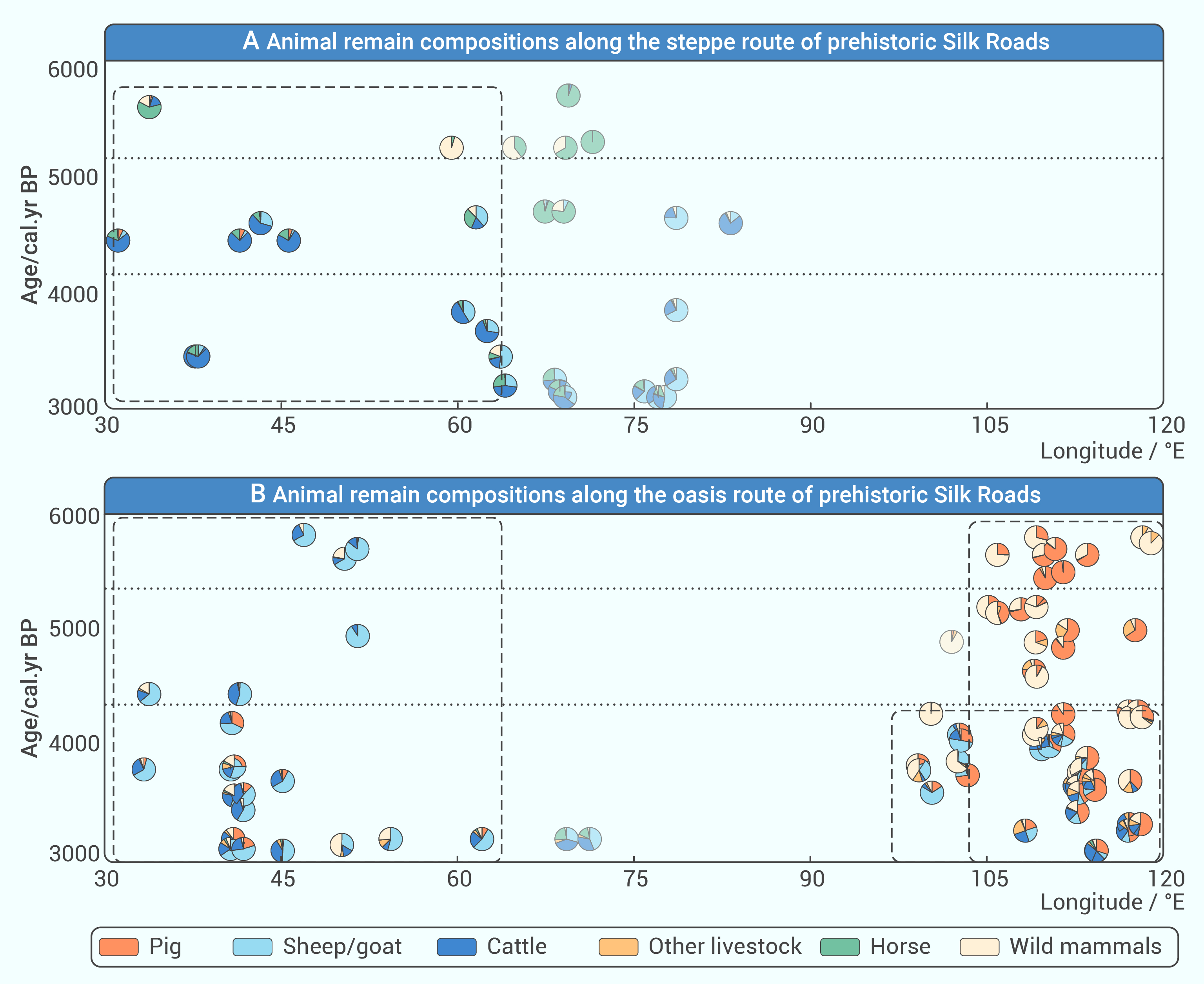
Figure 3.
Temporal and spatial changes in animal resources between 6000 and 3000 cal. yr BP
-
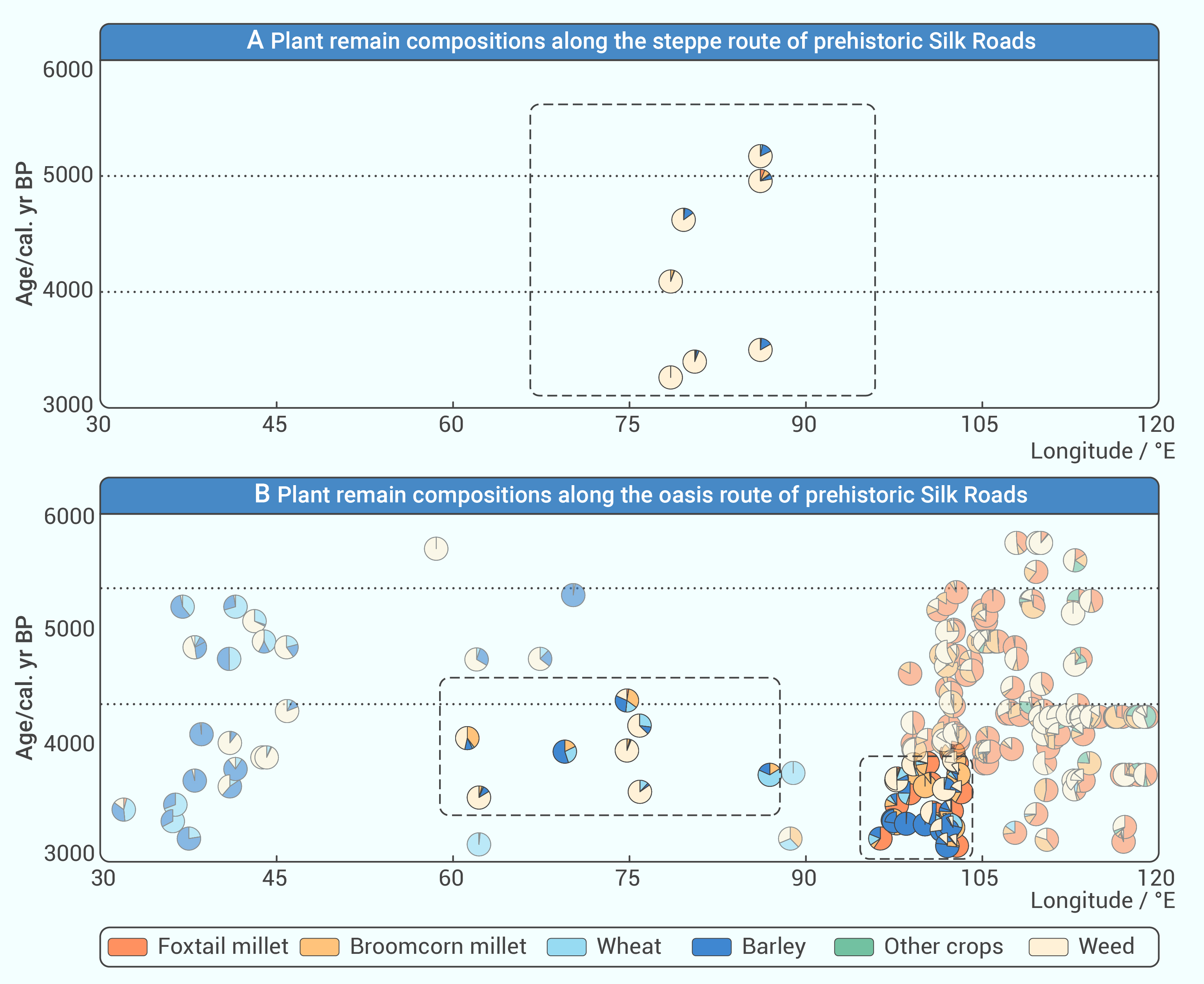
Figure 2.
Temporal and spatial changes in plant resources between 6000 and 3000 cal. yr BP
-
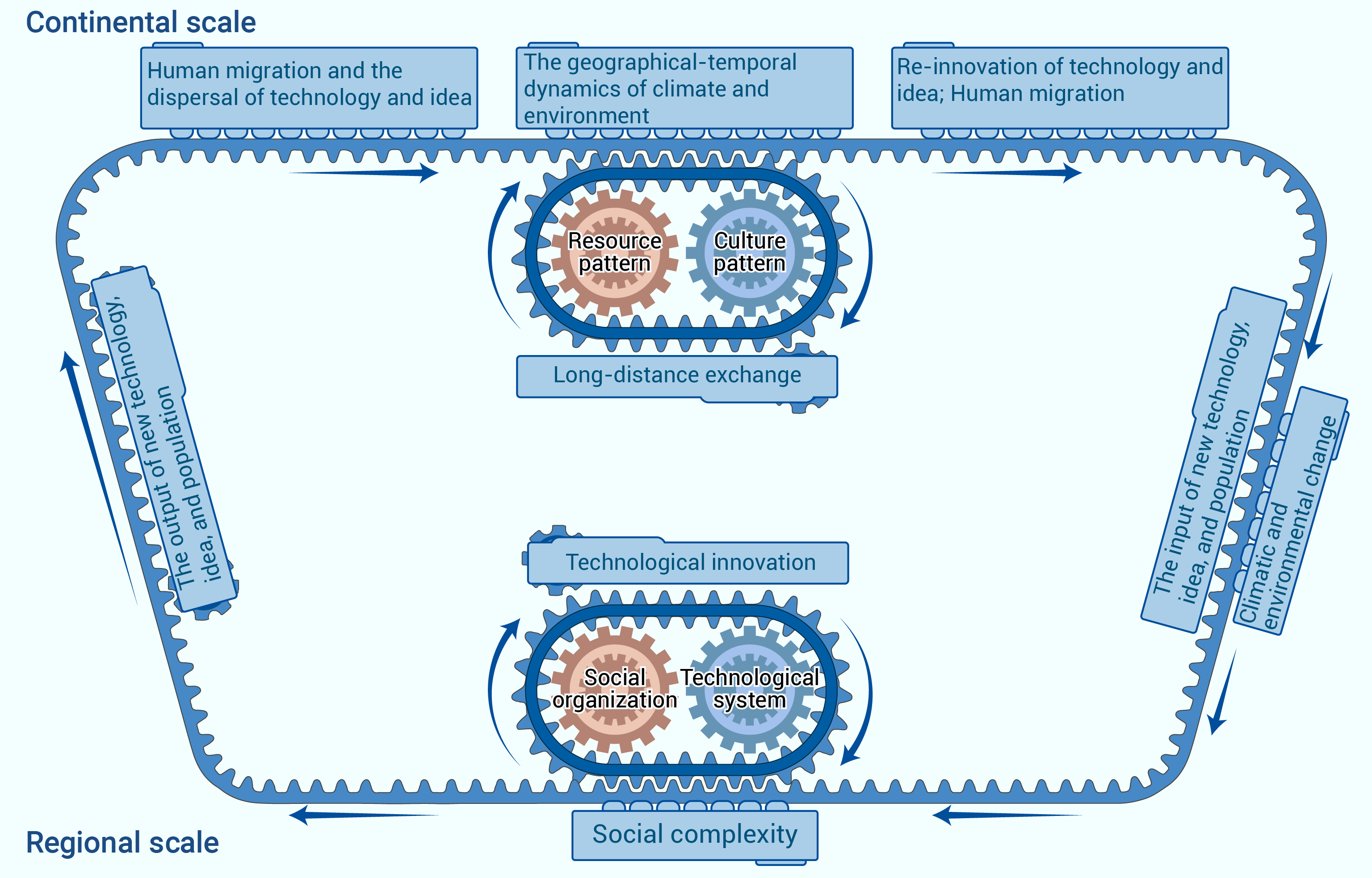
Figure 4.
Gear model of the dynamic feedback-loop for human-environment systems incorporating the regional and continental scales.
