
The effect of lunar declination on CO2 degassing from central Italian Apennines
-
GRAPHICAL ABSTRACT
 DownLoad:
Full size image
DownLoad:
Full size image
-
PUBLIC SUMMARY
-
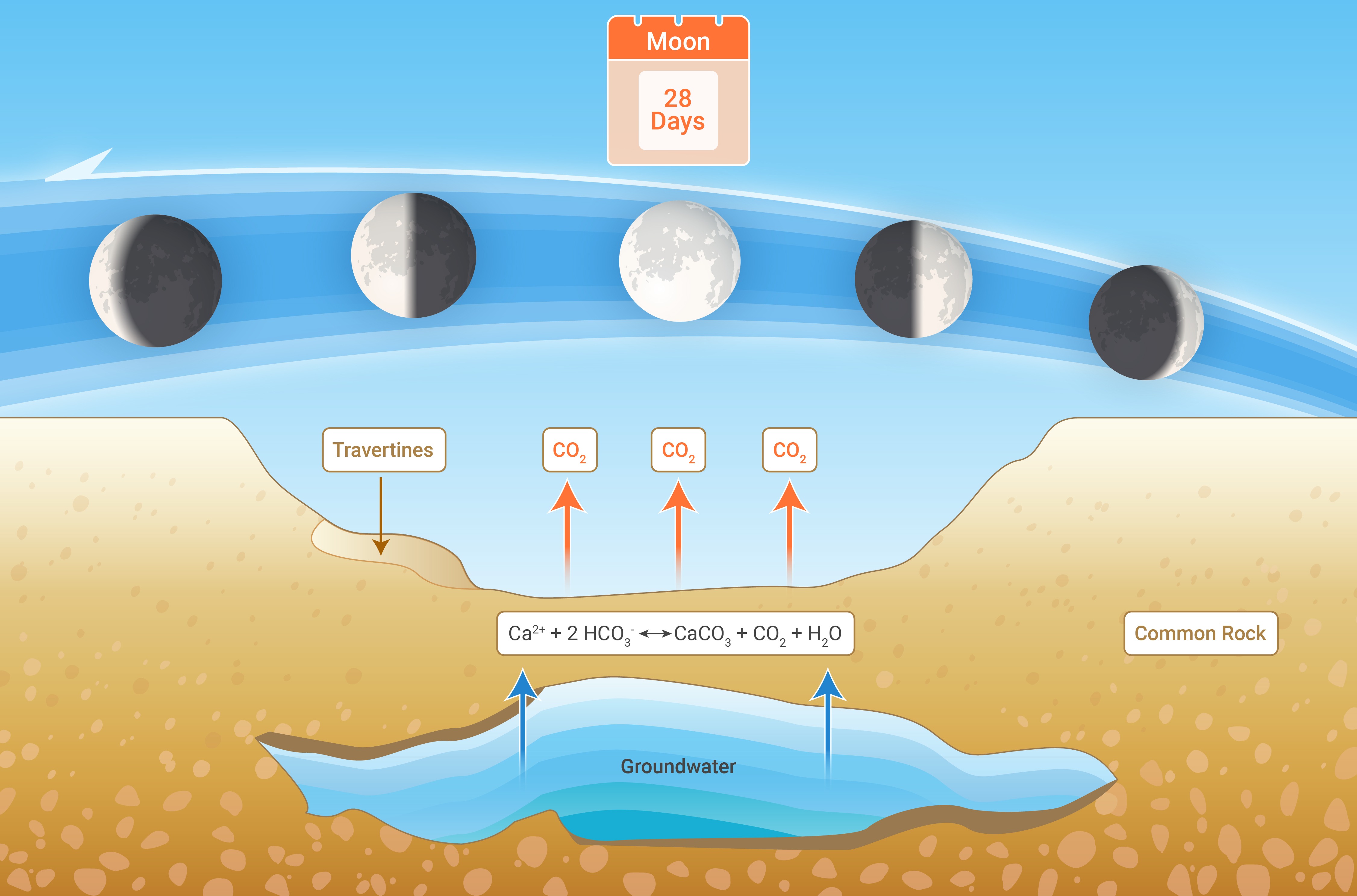
The variation of aquifer’s chemical composition is related on periodical lunar tides in central Italian Apennines.
Lunar tides trigger fluid movement leading to periodic CO2 degassing from over-pressured reservoirs.
-
-
ABSTRACT
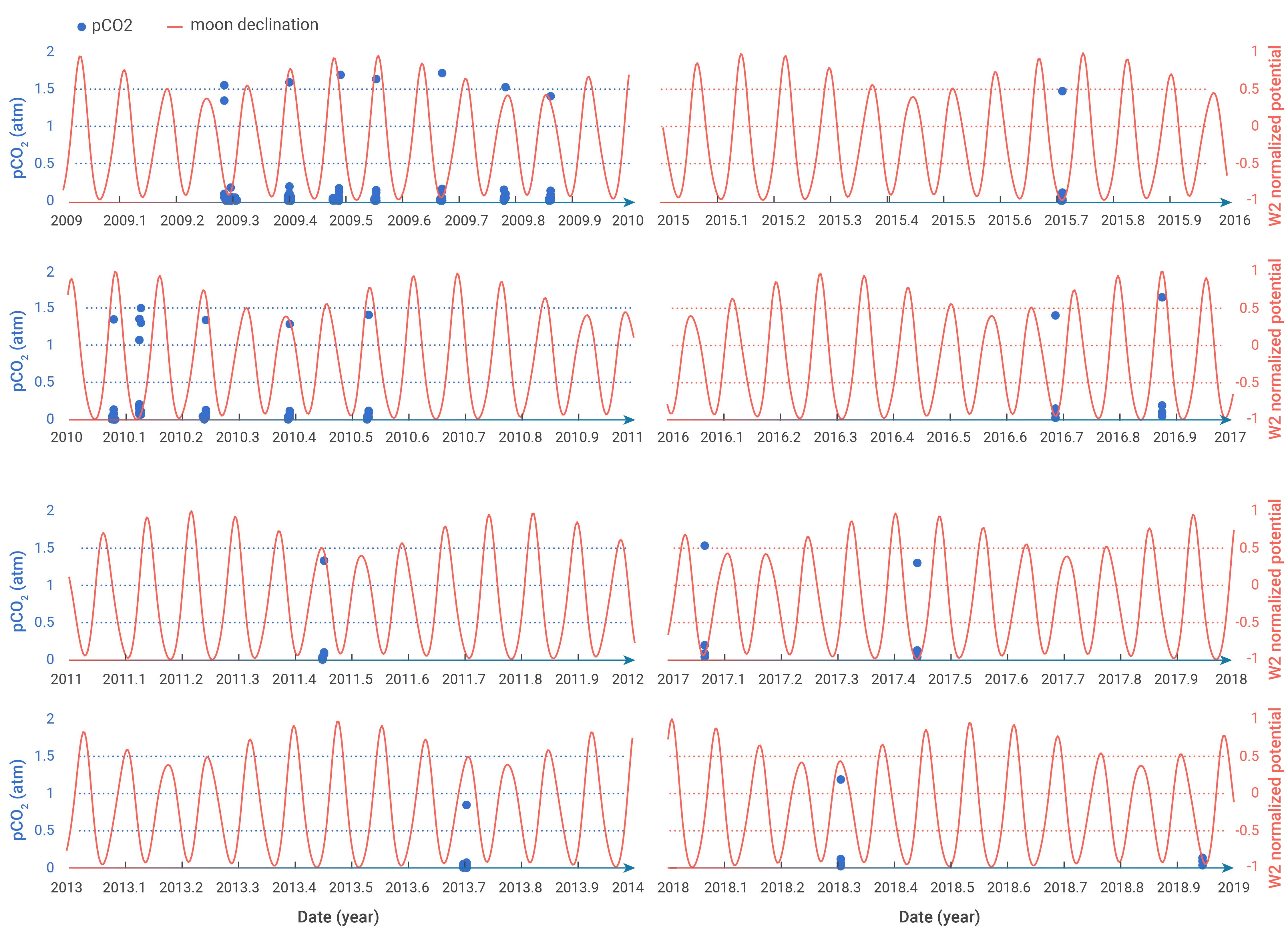
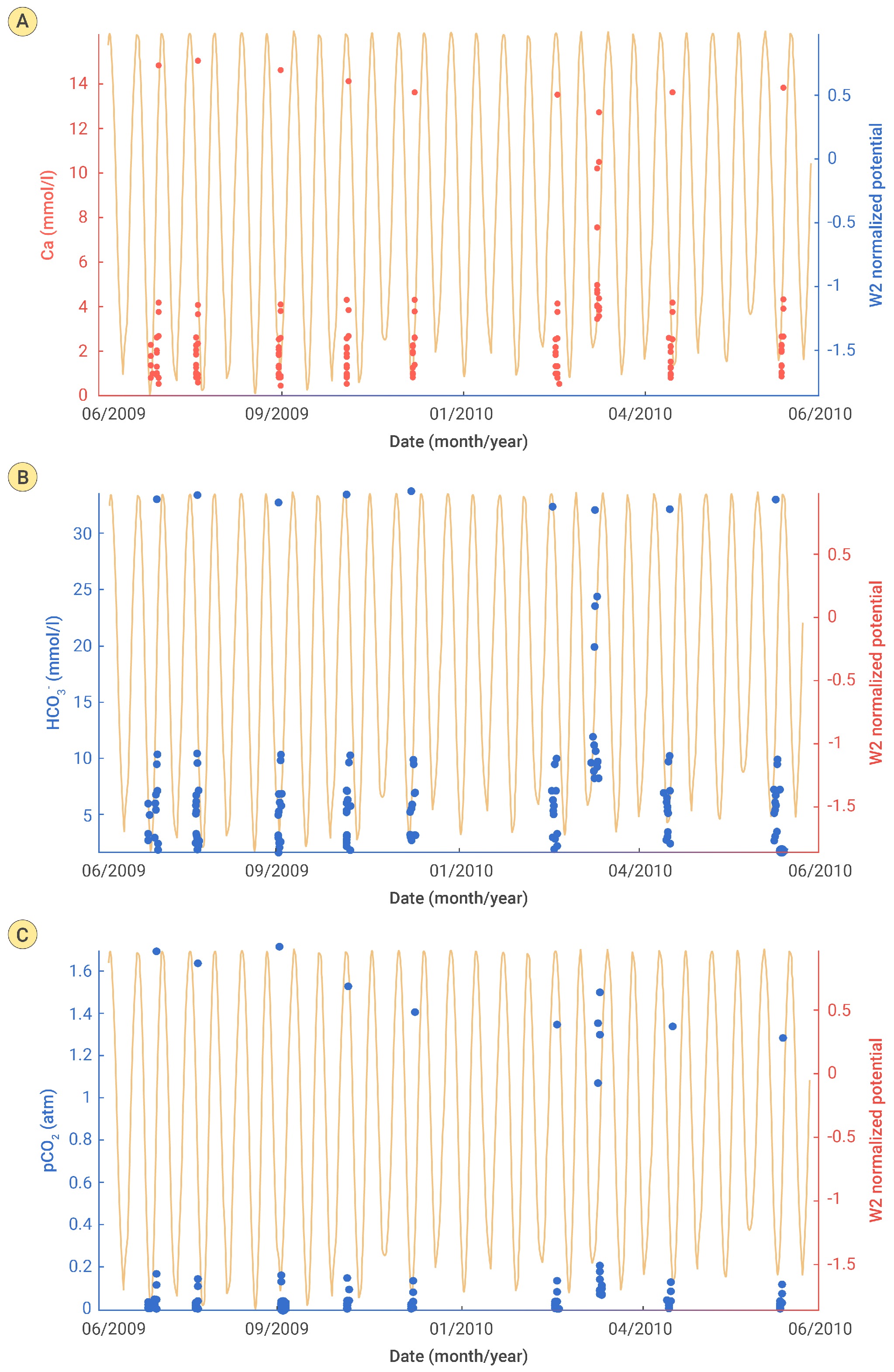
The periodical degassing from CO2 over-pressured reservoirs may have serious consequences for the environment making urgent understanding the processes and forecasting the frequency. Prediction though needs methods that depends from temporal and spatial properties of hydro-chemical and physical reservoir characteristics that unfortunately are often lacking. We have analyzed surface emissions of CO2 attributed to over-pressured CO2-rich reservoirs in the Central Italian Apennines a zone characterized by significant periodical CO2 degassing. Here aquifers are hosted in Mesozoic limestone with high pCO2 groundwater and travertine deposits. We analyzed a 10-year temporal series and found that in the Apennines CO2 flux and aquifer fluid composition are correlated with the lunar tides. In particular, our study reveals that low CO2 flux corresponds with low lunar tidal potential values. We found a similar trend for dissolved calcium and water alkalinity, while pH values display a linear correlation with tidal cycles. The forces associated with tidal potentials are not capable of fracturing rock. However, they can, under certain conditions, drive the flow of fluids in over-pressured reservoirs, triggering sub-surface fluid movements that in turn modify the water–rock reactivity. In the central Apennines, we show that these movements result in increased dolomite dissolution and an eventual return to calcite equilibrium. In this case, dolomite dissolution breaks the rock releasing calcium into ground water, which leads to calcite equilibrium and in turn to the formation of significant quantities of travertine and the concomitant release of CO2 in the atmosphere. -

-
REFERENCES
[1] Klomme, F. (1880). Die periodischen Schwankungen des Wasserspiegels in den inundierten Kohlenschachten von Dux in der Periode. Wien, Mathematisch-Naturwlssenschaftllchen Classe 8(1): 1−5. [2] Meizer, O.E. (1928). Compressibility and elasticity of artesian aquifers. Economic Geology 23(3): 263−291. [3] Allègre, V., Brodsky, E. E., Xue, L.,et al. (2016). Using earth-tide induced water pressure changes to measure in situ permeability: A comparison with long-term pumping tests. Water Resources Research 52(4): 3113−3126. DOI: 10.1002/2015WR017346. [4] McMillan, T.C, Rau, G.C., Timms, W.A, et al. (2019). Utilizing the impact of earth and atmospheric tides on groundwater systems: A review reveals the future potential. Rev in Geophysics 57 (2): 281-315. DOI: 10.1029/2018RG000630. [5] Lake, L.W. and Lotfollahi, Bryant S.L.(2019). CO2 enhanced oil recovery experience and its messages for CO2 storage. In Science of Carbon storage in deep saline formations, Elsevier: 15-31. DOI: 10.1016/B978-0-12-812752-0.00002-2. [6] Uysal, I. T., Feng, Y. X., Zhao, J. X. et al. (2009). Hydrothermal CO2 degassing in seismically active zones during the late Quaternary. Chemical Geology 265(3-4): 442−454. DOI: 10.1016/j.chemgeo.2009.05.011. [7] Tamburello, G., Pondrelli, S., Chiodini, G., et al, (2018). Global-scale control of extensional tectonics on CO2 earth degassing. Nature Communications 9 (1): 1-9. DOI: 10.1038/s41467-018-07087-z. [8] Middleton, R.S., Ogland-Hand, J.D., Chen B. et al. (2020). Identifying geological characteristics and operational decisions to meet global carbon sequestration goals. Energy & Environmental Science 13(12): 5000−5016. DOI: 10.1039/d0ee02488k. [9] Giammarco S., Palano M., Scaltrito A., et al. (2008). Possible role of fluid overpressure in the generation of earthquake swarms in active tectonic areas: The case of the Peloritani Mts. (Sicily, Italy). Journal of Volcanology and Geothermal Research: 178(4): 795−806. DOI: 10.1016/j.jvolgeores.2008.09.005. [10] Chiodini, G., Cardellini, C., Di Luccio, F.,et al. (2020). Correlation between tectonic CO2 Earth degassing and seismicity is revealed by a 10-year record in the Apennines, Italy. Science Advances 6(35): eabc2938. DOI: 10.1126/sciadv.abc2938. [11] Hsieh, P. A., Bredehoeft, J. D., and Farr, J. M. (1987). Determination of aquifer transmissivity from Earth tide analysis. Water Resources Research, 23 (10): 1824-1832. DOI: 10.1029/WR023i010p01824. [12] Galloway, D. L. and Rojstaczer, S. A., (1988). Inferences about formation elastic and fluid flow properties from the frequency response of water levels to atmospheric loads and earth tides: 4th Canadian/American conference on hydrogeology: Fluid flow”, Heat Transfer and Mass Transport in Fractured Rocks, Banff, Alberta, Canada, June, 21-24:100–113. [13] Roeloffs, E., (1996). Poroelastic techniques in the study of earthquake-related hydrologic phenomena. Advances in Geophysics, 37 : 135-195. DOI: 10.1016/S0065-2687(08)60270-8. [14] Christenson, S., Osborn, N. I., Neel, C. R., et al. (2011). Hydrogeology and simulation of groundwater flow in the Arbuckle-Simpson aquifer, south-central Oklahoma, U. S. Geological Survey. https://pubs.usgs.gov/sir/2011/5029/SIR2011-5029.pdf. [15] Wang, C. Y., Doan, M. L. et al. (2018). Tidal response of groundwater in a leaky aquifer—Application to Oklahoma. Water Resources Research 54(10): 8019−8033. DOI: 10.1029/2018WR022793. [16] Craig, T.J., Chanard, K., and Calais, E. (2017). Hydrologically-driven crustal stresses and seismicity in the New Madrid Seismic Zone. Nature Communications 8 : 2143. DOI: 10.1038/s41467-017-01696-w. [17] Rogie, J. D., Kerrick, D. M., et al. (2000). Flux measurements of nonvolcanic CO2 emission from some vents in central Italy. Journal of Geophysical Research: Solid Earth 105 (B4): 8435-8445. DOI: 10.1029/1999JB900430. [18] Chiodini, G., Granieri, D., et al. (2010). Non‐volcanic CO2 Earth degassing: Case of Mefite d'Ansanto (southern Apennines), Italy. Geophysical Research Letters 37 : L11303. DOI: https://doi.org/10.1029/2010GL042858. [19] Merritt, M. L. (2004). Estimating hydraulic properties of the Floridan aquifer system by analysis of earth-tide, ocean-tide, and barometric effects, Collier and Hendry Counties, Florida”, No. 3. US Department of the Interior, US Geological Survey. https://pubs.usgs.gov/wri/wri034267/wri03_4267.pdf. [20] Robinson, Edwin S., and R. Thomas Bell. (1971). Tides in confined well‐aquifer systems. Journal of Geophysical Research 76 (8): 1857-1869. DOI: 10.1029/JB076i008p01857. [21] Dean, G. A., Hardy, R., and Eltvik, P. (1994). Monitoring compaction and compressibility changes in offshore chalk reservoirs”, SPE Formation Evaluation, 9 (01): 73-76. DOI:10.2118/23142-PA. [22] Morland, L. W., and E. C. Donaldson (1984). Correlation of porosity and permeability of reservoirs with well oscillations induced by earth tides. Geophysical Journal International 79 (3): 705-725. DOI: 10.1111/j.1365-246X.1984.tb02864.x. [23] Bredehoeft, J. D. (1967). Response of well‐aquifer systems to Earth tides. Journal of Geophysical Research 72(12): 3075−3087. DOI: 10.1029/JZ072i012p03075. [24] Jacob, C. E. (1940). On the flow of water in an elastic artesian aquifer. Eos, Transactions American Geophysical Union 21(2): 574−586. DOI: 10.1029/TR021i002p00574. [25] Allard, P., Carbonnelle, J., Dajlevic, D., et al. (1991). Eruptive and diffuse emissions of CO2 from Mount Etna. Nature 351(6325): 387−391. DOI: 10.1038/351387a0. [26] Bonfanti P. Genzano N., Heinicke, et al. (2012). Evidence of CO2-gas emission variations in the Central Apennines (Italy) during the L’Aquila seismic sequence (March-April 2009). Bollettino di Geofisica Teorica ed Applicata 53(1): 147−168. DOI: 10.4430/bgta0043. [27] Parkhurst, D.L., Appelo, C.A.J., et al., (2013). Description of input and examples for PHREEQC version 3 - a computer program for speciation, batch-reaction, one-dimensional transport, and inverse geochemical calculations. U.S. Geological Survey Techniques and Methods. 6 (A43): 497. DOI: 10.1016/0029-6554(94)90020-5. [28] Morse J.W. and Mackenzie F.T. (1990). Geochemistry of sedimentary carbonates. Developments in Sedimentology 48: 707p. [29] Stewart, R. H. (2007). Introduction to Physical Oceanography. Texas A&M University. 345pp. https://hdl.handle.net/1969.1/160216. [30] Mauk F.J. and Johnston M.J.S. (1973). On the triggering of volcanic eruptions by Earth tides. Journal of Geophysical Research 78 (17): 3356. DOI: 10.1029/JB078i017p03356. [31] Schultz, R.A. (1996). Relative scale and the strength and deformability of rock masses. Journal of Structural Geology 18(9): 1139−1149. DOI: 10.1016/0191-8141(96)00045-4. [32] Stillings, M., Lunn, R. J., Pytharouli, S., et al. (2020). Microseismic events cause significant pH drops in groundwater. Geophysical Research Letters 48(2): e2020GL089885. DOI: 10.1029/2020GL089885. [33] Frondini F., Cardellini C., et al. (2019). Measuring and interpreting CO2 fluxes at regional scale: The case of Apennines, Italy. Journal of the Geological Society 176 (2): 408-416. 10.1144/jgs2017-169. [34] Girault, F., Adhikari, L. B., et al. (2018). Persistent CO2 emissions and hydrothermal unrest following the 2015 earthquake in Nepal. Nature communications 9(1): 1−10. DOI: 10.1038/s41467-018-05138-z. [35] Métivier, L., de Viron, O., et al. (2009). Evidence of earthquake triggering by the solid earth tides. Earth and Planetary Science Letters 278 (3-4): 370-375. DOI: 10.1016/j.jpgl.2008.12.024. [36] Lix C., Zuddas P., Guichet X., et al. (2020). Role of CO2 in low to medium enthalpy geothermal systems in the Central Betic Cordillera (Spain). Science of the Total Envrionment 705: 13652. DOI: 10.1016/j.scitotenv.2019.135652. -
ABOUT THIS ARTICLE
Cite this article:
Zuddas P. and Lopes F. (2024). The effect of lunar declination on CO2 degassing from central Italian Apennines. The Innovation Geoscience 2(2): 100073. https://doi.org/10.59717/j.xinn-geo.2024.100073
Welcome!
To request copyright permission to republish or share portions of our works, please visit Copyright Clearance Center's (CCC) Marketplace website at marketplace.copyright.com.
Export File
Citation
Zuddas P. and Lopes F. (2024). The effect of lunar declination on CO2 degassing from central Italian Apennines. The Innovation Geoscience 2(2): 100073. https://doi.org/10.59717/j.xinn-geo.2024.100073

Format
Content
-
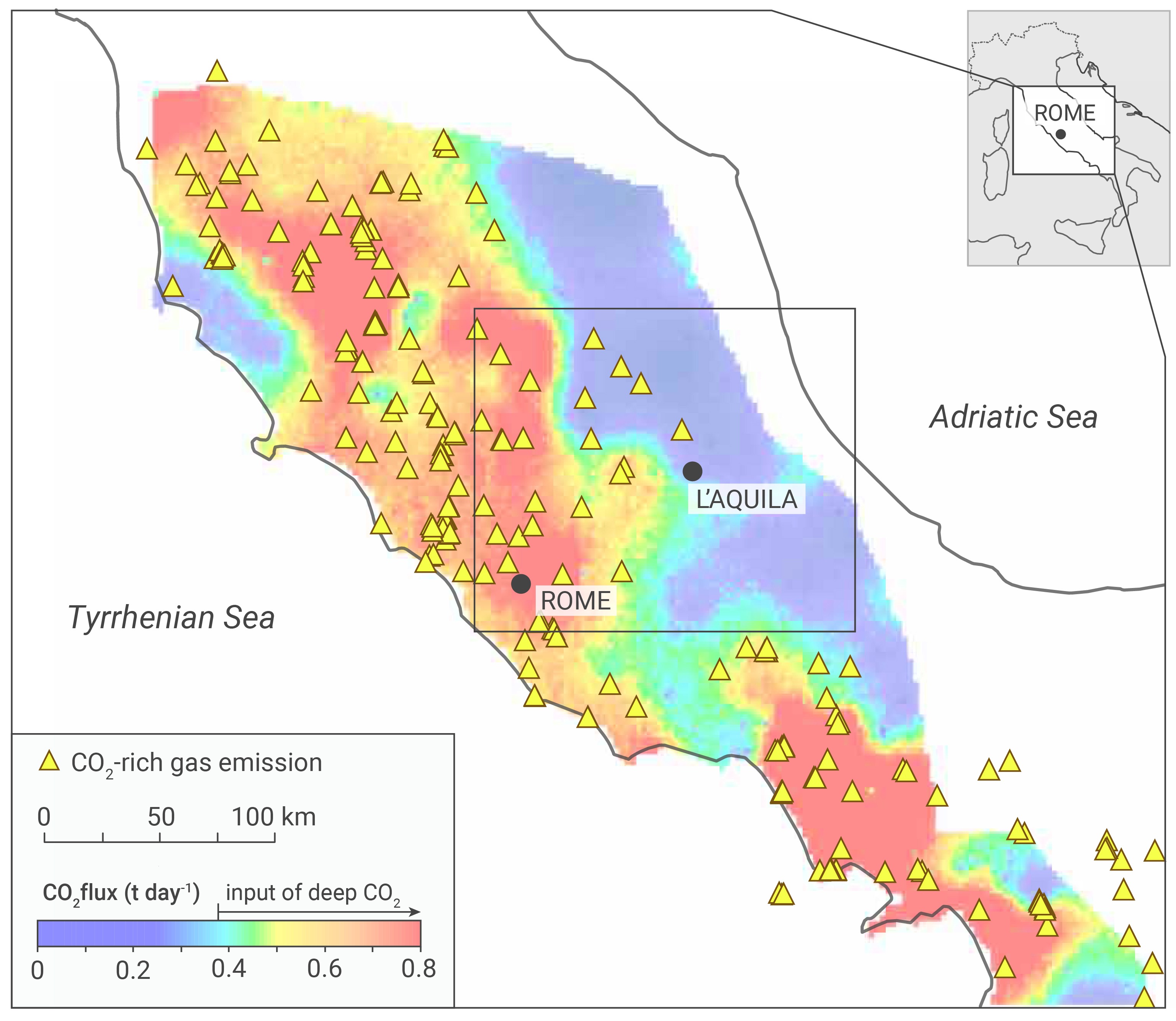
Figure 1.
Map of CO2 degassing and location of the investigated aquifers (from Chiodini et al. 2020).
-
Figure 2.
Evolution of pCO2 partial pressure and Lunar tide potential estimated by Eqn.5 during the 10 years of investigation.
-
Figure 3.
Evolution of calcium, HCO3-, and pCO2 over time
-
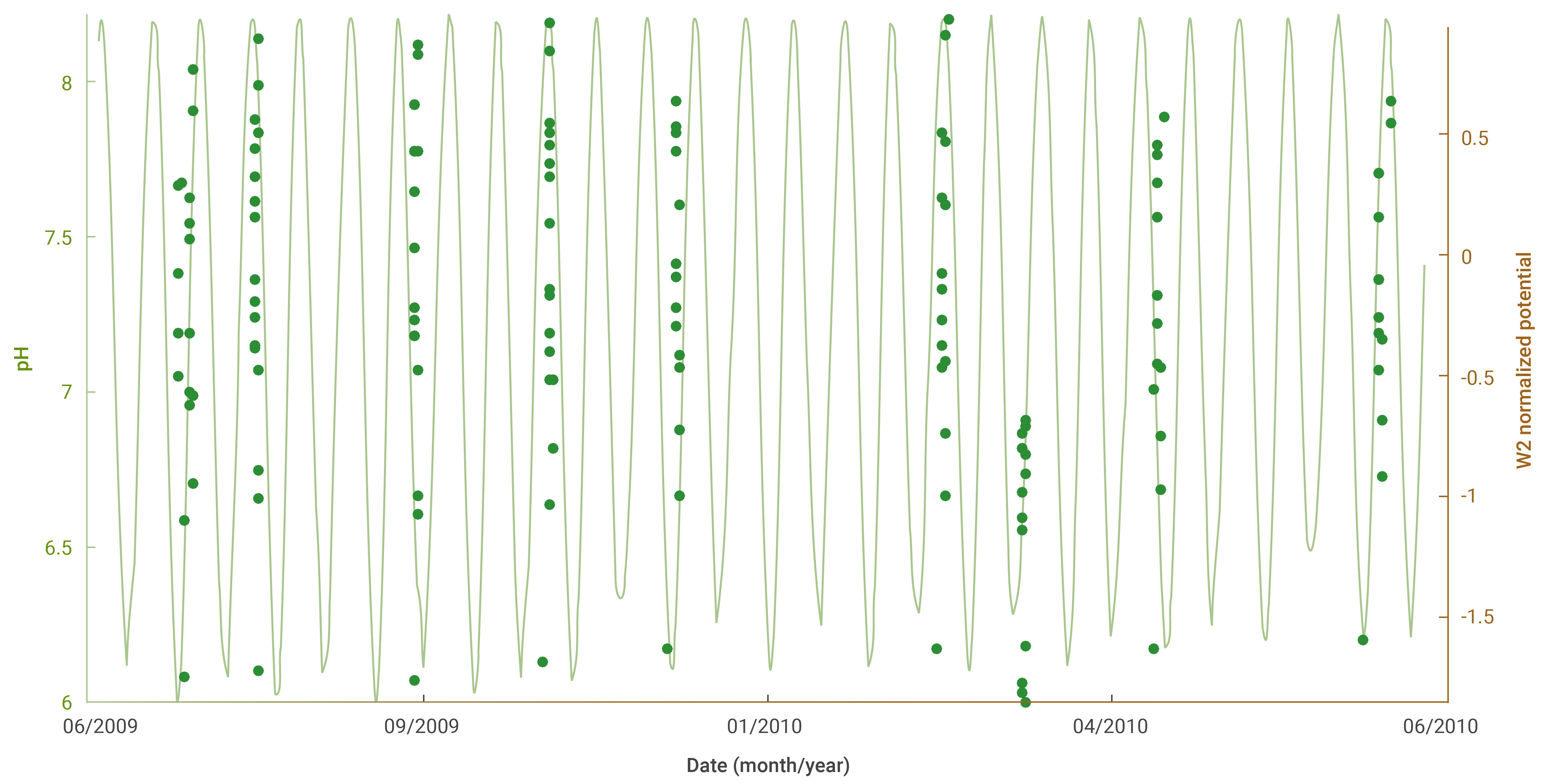
Figure 4.
Evolution of pH (green dots) as function of time for the year: June 2009-June 2010
