
Body mass evolution of the Quaternary giant panda coincides with climate change of southern China
-
GRAPHICAL ABSTRACT

 DownLoad:
Full size image
DownLoad:
Full size image
-
PUBLIC SUMMARY
-
Comprehensive model comparisons confirm the m1 as a reliable body size indicator in Quaternary giant pandas.
The body mass of Quaternary giant pandas first increased, then decreased, reaching its peak around 0.3 Ma.
Quaternary giant panda body mass evolution was shaped by morphology and paleoclimate changes.
-
-
ABSTRACT
The trend of giant panda (Ailuropoda, Ursidae) body size evolution during the Quaternary has long been observed primarily through dental size analysis. However, exact body mass estimations have been lacking, whereas the dental size is generally viewed as a poor index for body mass estimation. In this study, we assess the accuracy of body mass prediction based on dentition using data from extensive cranial, dental, and postcranial fossil remains recovered in the Shuanghe Cave, Guizhou, southwestern China. Our results support a high degree of accuracy in body mass estimation based on m1 length, likely due to the relatively stable proportion of this tooth to the whole body in the Quaternary Ailuropoda. Our analyses of the body mass evolution of giant pandas since the earliest Pleistocene reveal rapid growth in body mass from A. microta to A. melanoleuca in the Early Pleistocene. This was followed by an initial increase and subsequent decrease in body mass, leading to the modern form since the Middle Pleistocene. The initial period of rapid growth is likely driven by the increasing feeding efficiency on bamboo, facilitating larger body sizes. In contrast, the later fluctuation in body mass coincides with climatic and monsoon change in the Middle and Late Pleistocene, directly impacting bamboo availability. The body mass evolution of the giant panda offers insights into its historical adaptation, highlighting the correlation of evolution and paleoclimatic change during the Quaternary.-
Keywords:
- Pleistocene /
- Ailuropoda /
- linear model /
- paleoecology
-

-
REFERENCES
[1] Schaller, G.B., Hu, J.C., Pan, W.S., et al. (1985). The Giant Pandas of Wolong (University of Chicago Press). [2] Beijing Zoo, Beijing University, Beijing Agricultural University, Beijing Second Medical College, Beijing Natural History Museum, and Shaanxi Zoology Institute. (1986). Morphology of the giant panda-systematic anatomy and organ-histology (Science Press). [3] Huang, W.B. (1993). The skull, mandible and dentition of giant pandas (Ailuropoda): morphological characters and their evolutionary implications. Vertebr. Palasiat. 31: 191−207. DOI: 10.19615/j.cnki.1000-3118.1993.03.004. [4] Endo, H., Yamagiwa, D., Hayashi, Y., et al. (1999). Role of the giant panda's ‘pseudo-thumb’. Nature 397: 309−310. DOI: 10.1038/16830. [5] Li, T., Lai, X., Wang, W., et al. (2004). Taxonomy and evolution of giant panda. Geol. Sci. Tech. Inform. 23: 40−46. CNKI:SUN:DZKQ.0.2004-03-008. (in Chinese) [6] Wei, F., Feng, Z., Wang, Z., et al. (1999). Feeding strategy and resource partitioning between giant and red pandas. Mammalia 63: 417−429. DOI: 10.1515/mamm.1999.63.4.417. [7] Long, Y., Lü, Z., Wang, D.J., et al. (2004). Nutritional strategy of giant pandas in the Qinling Mountains of China. In Giant pandas: biology and conservation, D. Lindburg, and K. Baragona, eds. (University of California press), pp. 90-100. [8] Van Valkenburgh, B., Wang, X., and Damuth, J. (2004). Cope's rule, hypercarnivory, and extinction in North American canids. Science 306: 101−104. DOI: 10.1126/science.1102417. [9] Jiangzuo, Q. and Flynn, J. (2020). The Earliest Ursine Bear Demonstrates the Origin of Plant-Dominated Omnivory in Carnivora. iScience 23: 101235. DOI: 10.1016/j.isci.2020.101235. [10] Nie, Y., Wei, F., Zhou, W., et al. (2019). Giant Pandas Are Macronutritional Carnivores. Curr. Biol. 29: 1677−1682. DOI: 10.1016/j.cub.2019.03.067. [11] Pei, W. Z. (1987). Carnivora, Proboscidea and Rodentia from Liucheng Gigantopithecus Cave and other caves in Guangxi. Memoirs of Institute of Vertebrate Palaeontology and Palaeoanthropology, Chinese Academy of Sciences 18: 5e118. (Chinese with English summary [12] Jin, C., Qin, D., Pan, W., et al. (2008). A newly discovered Gigantopithecus fauna from Sanhe Cave, Chongzuo, Guangxi, South China. Sci. Bull. 54: 788−797. DOI: 10.1007/s11434-008-0531-y. [13] Jin, C., Wang, Y., Deng, C., et al. (2014). Chronological sequence of the early Pleistocene Gigantopithecus faunas from cave sites in the Chongzuo, Zuojiang River area, South China. Quatern. Int. 354: 4−14. DOI: 10.1016/j.quaint.2013.12.051. [14] Pan, Y., Zhang, Y., Yang, L., et al. (2023). Preliminary description of a late Middle Pleistocene mammalian fauna prior to the extinction of Gigantopithecus blacki from the Yixiantian Cave, Guangxi ZAR, South China. Anat. Rec. DOI: 10.1002/ar.25200. [15] Zhang, B., Zou, S., Chen, X., et al. (2017). Mammalian fossils from Yangjiawan Cave 2 of Pingxiang, Jiangxi Province and their age estimation. Quatern. Sci. 37: 155−165. DOI: 10.11928/j.issn.1001-7410.2017.01.14. [16] Jiangzuo, Q., Zhang, B., Deng, L., et al. (2018). Fossil Carnivora (Mammalia) from Yangjiawan Cave 2, Pingxiang, Jiangxi, with remarks about the tooth identification of quaternary carnivores. In Proceedings of the Sixteenth Annual Meeting of the Chinese Society of Vertebrate Paleontology, W. Dong, ed. (China Ocean Press), pp. 119-146. [17] Jin, C., Ciochon, R.L., Dong, W., et al. (2007). The first skull of the earliest giant panda. Proc. Natl. Acad. Sci. USA 104: 10932−10937. DOI: 10.1073/pnas.0704198104. [18] Van Valkenburgh, B. (1990). Skeletal and dental predictors of body mass in carnivores. In body size in mammalian paleobiology: Estimation and biological implications, J. Damuth, and B.J. MacFadden, eds. (Cambridge University Press), pp. 181-205. [19] Li, S., Jiangzuo, Q., and Deng, T. (2022). Body mass of the giant rhinos (Paraceratheriinae, Mammalia) and its tendency in evolution. Hist Biol. DOI: 10.1080/08912963.2022.2095908. [20] Wang, D., Gao, Z., Bottazzi, J., et al. (2022). Significance of the preservation of ‘pseudo-thumb’ in fossil skeletons of giant panda (Ailuropoda melanoleuca) in Shuanghe Cave, Guizhou Province, southern China. Hist Biol. 34: 2188−2194. DOI: 10.1080/08912963.2021.2006195. [21] Li, P., He, W., Qian, Z., et al. (2008). Study on Shuanghe Cave Geopark (Guizhourenmin Press). [22] Yang, B., Cao, X., Cheng, J., et al. (2021). Community structure and diversity of Fagus lucida in Kuankuoshui National Nature Reserve of Guizhou Province, China. Acta Ecolo. Sin. 42: 2685−2697. DOI: 10.5846/stxb202101080083. (in Chinese) [23] Chen, J. and Zhang, Y. (1994). Formation and development of Shuanghe Cave System, Suiyang, Guizhou. Carsol. Sin. 13: 247−255. CNKI:SUN:zgyr.0.1994-03-009. (in Chinese) [24] Wang, D., Gao, Z., Li, Y., et al. (2021). High fossil aggregation and its significance of giant panda (Ailuropoda melanoleuca) in late Pleistocene in Shuanghe Cave, Guizhou Province. Carsol. Sin. 40: 1038−1045. DOI: 10.11932/karst20210614. [25] Gao, Z., Bottazzi, J., Zhao, X., et al. (2016). Discoveries of Ailuropoda-Stegodon Fauna from Shuanghe Cave. Carsol. Sin. 35: 402−406. DOI: 10.11932/karst20160407. [26] Huang, W. and Zhong, Z. (1991). Carnivora. In Wushan Hominid Site, W.B. Huang, and Q.R. Fang, eds. (China Ocean Press), pp. 92-113. [27] Zhang, Z. and Feng, X. (2004). Mammalia. In Jianshi Hominid Site, S.H. Zheng, ed. (Science Press), pp. 67-308. [28] Wu, X. (2010). The giant panda from the Yunxian Man Site. In Proceedings of the Twelfth Annual Meeting of the Chinese Society of Vertebrate Paleontology, W. Dong, ed. (China Ocean Press), pp. 69-76. [29] Echassoux, A., Moigne, A.M., Moullé, P.É., et al. (2008). Les faunes de grands mammifères du site de l'homme de Yunxian. In Le site de l'homme de Yunxian, Quyuanhekou, Quingqu, Yunxian, province du Hubei, H. de Lumley, and L. Tianyuan, eds. (Éditions Recherche sur les Civilisations), pp. 253-365. [30] Hu, H., Tong, H., Shao, Q., et al. (2022). New remains of Ailuropoda melanoleuca baconi from Yanjinggou, China: Throwing light on the evolution of giant pandas during the Pleistocene. J. Mamm. Evol. 30: 1−18. DOI: 10.1007/s10914-022-09637-1. [31] Matthew, W.D. (1923). New fossil mammals from the Pleistocene of Sze-chuan, China. Bull. Am. Mus. Nat. Hist. 48: 563−598. [32] Colbert, E.H., Hooijer, D.A., and Granger, W. (1953). Pleistocene mammals from the limestone fissures of Szechwan, China. Bull. Am. Mus. Nat. Hist. 102: 1−134. [33] Chen, D. and Qi, G. (1978). Fossil human and mammalian fauna from Xichou, Yunnan. Vertebr. Palasiat. 16: 33−46. DOI: 10.19615/j.cnki.1000-3118.1978.01.007. [34] Chorn, J. and Hoffmann, R.S. (1978). Ailuropoda melanoleuca. Mamm. Spec. 110: 1−6. DOI: 10.2307/3503982. [35] Zhang, M., Zhou, X., Wu, H., et al. (2021). Variation of body weight in all age groups of captive giant pandas (Ailuropoda melanoleuca). Acta Theriol. Sin. 41: 468−475. DOI: 10.16829/j.slxb.150491. [36] Jiangzuo, Q., Liu, J., and Chen, J. (2019). Morphological homology, evolution and proposed nomenclature for bear dentition. Acta Palaeontol. Pol. 64: 693−710. DOI: 10.4202/app.00629.2019. [37] Jiangzuo, Q., Huang, Z., Yu, C., et al. (2024). Dental shape evolution of the giant panda (Ailuropoda, Ursidae) during the Quaternary. Hist Biol. DOI: 10.1080/08912963.2024.2324446. [38] Thenius, E. (1979). Zur systematischen und phylogenetischen Stellung des Bambusbären: Ailuropoda melanoleuca David (Carnivora, Mammalia). Zeit Säugetier 44: 286−305. [39] Hunt, R.J. (2004). A paleontologist’s perspective on the origin and relationships of the giant panda. In Giant pandas: Biology and conservation, D. Lindburg, and K. Baragona, eds. (University of California press), pp. 45-52. [40] Abella, J., Alba, D.M., Robles, J.M., et al. (2012). Kretzoiarctos gen. nov., the oldest member of the giant panda clade. PLoS One 7: e48985. DOI: 10.1371/journal.pone.0048985. [41] Abella, J., Montoya, P., and Morales, J. (2011). A New species of Agriarctos (Ailuropodinae, Ursidae, Carnivora) in the locality of Nombrevilla 2 (Zaragoza, Spain). Estud Geol-Madrid. 67: 187−191. DOI: 10.3989/egeol.40714.182. [42] Jiangzuo, Q. and Spassov, N. (2022). A late Turolian giant panda from Bulgaria and the early evolution and dispersal of the panda lineage. J. Vertebr Paleontol. 42: e2054718. DOI: 10.1080/02724634.2021.2054718. [43] Huang, W. and Wei, G. (2010). The origin of the giant panda (Science Press). [44] He, Y. (1998). The rise and down of giant panda. Collections of Essays on Chinese Hist Geogr. 13: 111−127. CNKI:SUN:ZGLD.0.1998-04-008. (In Chinese) [45] Wang, J. (1974). On the taxonomic status of species, geological distribution and evolutionary history of Ailuropoda. Acta Zool Sin 20: 191−201. CNKI:SUN:BEAR.0.1974-02-010. (In Chinese) [46] Zhu, J. and Long, Z. (1983). The vicissitudes of the giant panda. Acta Zool Sin. 29: 93−104. CNKI:SUN:BEAR.0.1983-01-014. (In Chinese) [47] Han, F., Bahain, J.-J., Deng, C., et al. (2017). The earliest evidence of hominid settlement in China: Combined electron spin resonance and uranium series (ESR/U-series) dating of mammalian fossil teeth from Longgupo cave. Quatern Int. 434: 75−83. DOI: 10.1016/j.quaint.2015.02.025. [48] Hu, H., Tong, H., Yu, H., et al. (2023). New study sheds light on the impressive intraspecific variation of Quaternary Asiatic black bears in China. Quatern. Int. 646: 22−33. DOI: 10.1016/j.quaint.2022.10.007. [49] Ji, X., Jablonski, N.G., Tong, H, et al. (2015). Tapirus yunnanensis from Shuitangba, a terminal Miocene hominoid site in Zhaotong, Yunnan Province of China. Vertebr. Palasiat. 53: 177−192. DOI: 10.19615/j.cnki.1000-3118.2015.03.002. [50] Davis, D.D. (1964). The Giant Panda: A morphological study of evolutionary mechanisms (Fieldiana Zoology Memoirs Vol 3) (Chicago Natural History Museum). [51] Wei, F., Hu, Y., Yan, L., et al. (2015). Giant pandas are not an evolutionary cul-de-sac: Evidence from multidisciplinary research. Mol. Biol. Evol. 32: 4−12. DOI: 10.1093/molbev/msu278. [52] Pei, W. (1974). Development history of giant panda. Acta Zool. Sin. 20: 82−84. [53] Endo, H., Sasaki, M., Hayashi, Y., et al. (2001). Carpal bone movements in gripping action of the giant panda (Ailuropoda melanoleuca). J. Anat. 198: 243−246. DOI: 10.1046/j.1469-7580.2001.19820243.x. [54] Wang, X., Su, D.F., Jablonski, N.G., et al. (2022). Earliest giant panda false thumb suggests conflicting demands for locomotion and feeding. Sci. Rep. 12: 10538. DOI: 10.1038/s41598-022-13402-y. [55] Abella, J., Perez-Ramos, A., Valenciano, A., et al. (2015). Tracing the origin of the panda's thumb. Sci. Nat. 102: 35. DOI: 10.1007/s00114-015-1286-3. [56] Sun, F., Wang, Y., Wang, Y., et al. (2019). Paleoecology of Pleistocene mammals and paleoclimatic change in South China: Evidence from stable carbon and oxygen isotopes. Palaeogeogr. Palaeoclimatol. Palaeoecol. 524: 1−12. DOI: 10.1016/j.palaeo.2019.03.021. [57] Stacklyn, S., Wang, Y., Jin, C., et al. (2016). Carbon and oxygen isotopic evidence for diets, environments and niche differentiation of early Pleistocene pandas and associated mammals in South China. Palaeogeogr. Palaeoclimatol. Palaeoecol. 468: 351−361. DOI: 10.1016/j.palaeo.2016.12.015. [58] Han, H., Wei, W., Hu, Y., et al. (2019). Diet Evolution and Habitat Contraction of Giant Pandas via Stable Isotope Analysis. Curr Biol. 29 :664-669. DOI: 10.1016/j.cub.2018.12.051. [59] Li, S., Ferguson, D.K., Wang, N., et al. (2020). Pleistocene vegetation in Guangxi, south China, based on palynological data from seven karst caves. Grana. 59: 94−106. DOI: 10.1080/00173134.2019.1690040. [60] Li, R., Xu, M., Wong, M.H.G. et al. (2015). Climate change-induced decline in bamboo habitats and species diversity: Implications for giant panda conservation. Divers. Distrib. 21: 379−391. DOI: 10.1111/ddi.12284. [61] Yin, Q. and Guo, Z. (2006). Mid-Pleistocene vermiculated red soils in southern China as an indication of unusually strengthened East Asian monsoon. Chinese Sci. Bull. 51: 213−220. DOI: 10.1007/s11434-005-0490-5. [62] Hu, C., Li, W., Cao, L., et al. (2019). Evidence for wetter climate recorded in the Jingxian red clay section since approximately 840 ka ago and its relationship with the East Asian summer monsoon intensity. Quatern. Int. 532: 57−65. DOI: 10.1016/j.quaint.2019.09.031. [63] Gu, Y., Huang, X., Zhang, W., et al. (2013). Red palaeosols development in response to the enhanced east asia summer monsoon since the mid-Pleistocene in South China: Evidence derived from magnetic properties and molecular fossil records. J. Earth Sci-China. 24: 382−396. DOI: 10.1007/s12583-013-0331-4. [64] Yin, K., Hong, H., Churchman, G.J., et al. (2018). Mixed-layer illite-vermiculite as a paleoclimatic indicator in the Pleistocene red soil sediments in Jiujiang, southern China. Palaeogeogr. Palaeocl. 510: 140−151. DOI: 10.1016/j.palaeo.2017.06.034. [65] Hong, H., Gu, Y., Yin, K., et al. (2013). Clay record of climate change since the mid-Pleistocene in Jiujiang, south China. Boreas 42: 173−183. DOI: 10.1111/j.1502-3885.2012.00276.x. [66] Takai, M., Zhang, Y., Kono, R.T., et al. (2014). Changes in the composition of the Pleistocene primate fauna in southern China. Quatern. Int. 354: 75−85. DOI: 10.1016/j.quaint.2014.02.021. [67] Zhang, Y., Westaway, K., Haberle, S., et al. (2024). The demise of the giant ape Gigantopithecus blacki. Nature 625: 1−5. DOI: 10.1038/s41586-023-06900-0. -
ABOUT THIS ARTICLE
Cite this article:
Jiangzuo Q., Wang D., Zhang C., et al., (2024). Body mass evolution of the Quaternary giant panda coincides with climate change of southern China. The Innovation Geoscience 2(4): 100096. https://doi.org/10.59717/j.xinn-geo.2024.100096
Welcome!
To request copyright permission to republish or share portions of our works, please visit Copyright Clearance Center's (CCC) Marketplace website at marketplace.copyright.com.
Export File
Citation
Jiangzuo Q., Wang D., Zhang C., et al., (2024). Body mass evolution of the Quaternary giant panda coincides with climate change of southern China. The Innovation Geoscience 2(4): 100096. https://doi.org/10.59717/j.xinn-geo.2024.100096

Format
Content

-
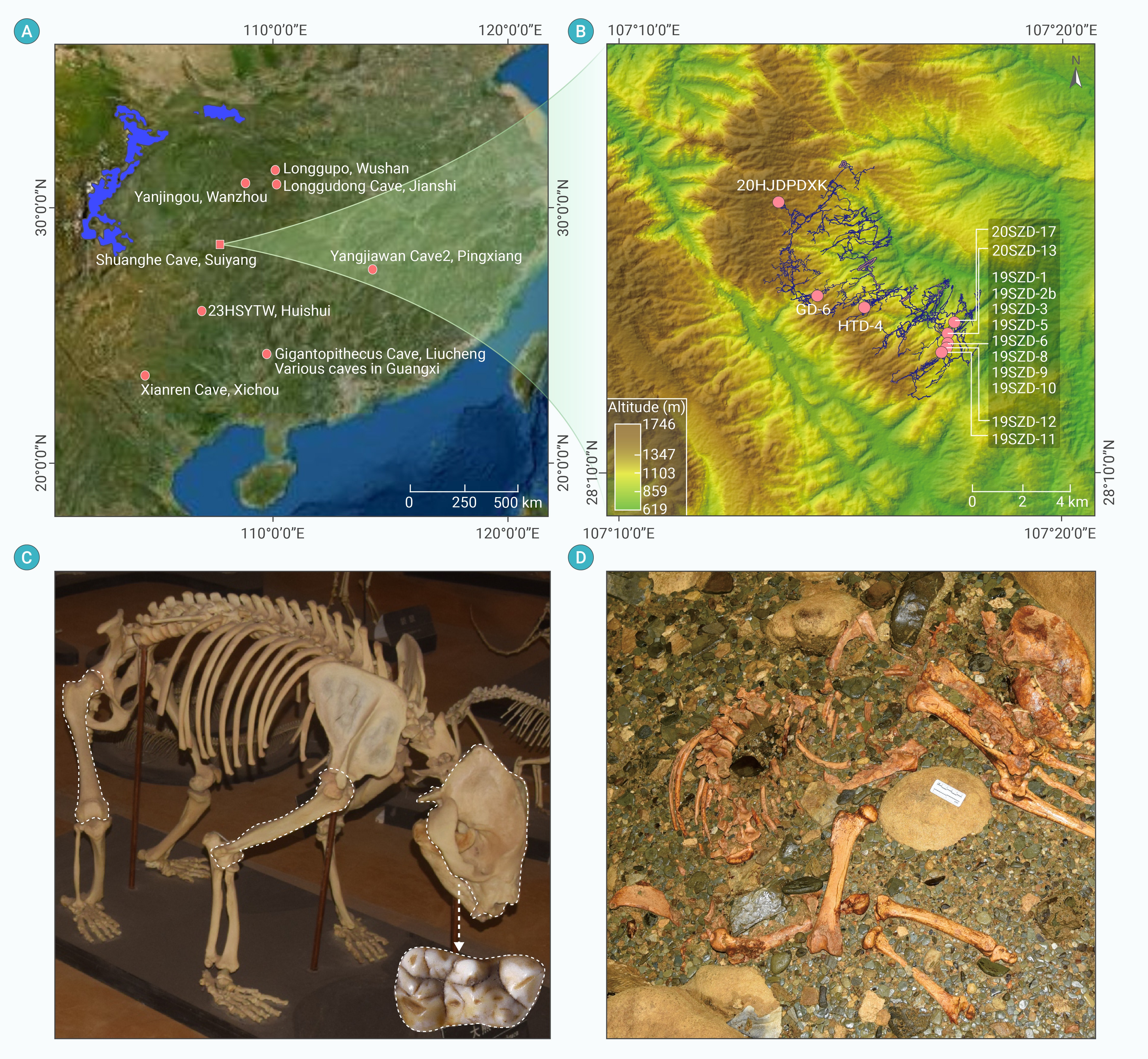
Figure 1.
Overview of Giant Panda Fossil Sites and Skeletal Elements
-
Figure 2.
Body mass evolution of the Quaternary giant panda.
