
Elevated melting temperature and superionic transition of H2O ice
-
GRAPHICAL ABSTRACT
 DownLoad:
Full size image
DownLoad:
Full size image
-
PUBLIC SUMMARY
-
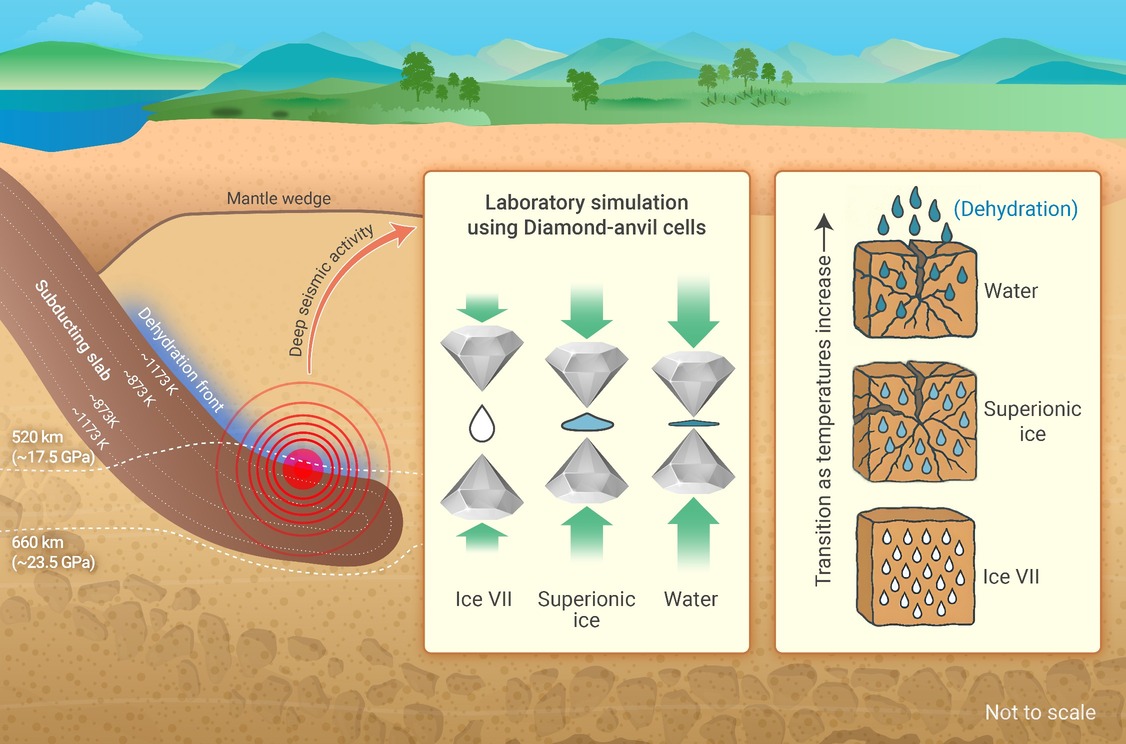
Superionic body-centered-cubic ice forms at ~9.5 GPa, a lower pressure than previously expected.
Diamond anvil cell experiments mapped the elevated melting boundary of H2O ice.
Superionic ice in cold subducting slabs may affect deep Earth processes and contribute to deep earthquakes.
-
-
ABSTRACT
Subduction of oceanic lithosphere effectively transports substantial amounts of water deep into the Earth, altering the properties of the surrounding mantle minerals and facilitating chemical interactions between the subducting lithosphere and mantle. Ice-VII is considered the stable phase of H2O released from minerals within the cold subducting slabs by progressive dehydration. This study investigates the melting boundary of high-pressure ices and the transformation of ice-VII to superionic (SI) states under the specific pressure-temperature (P-T) conditions of subducting slabs. We conducted X-ray diffraction measurements on H2O phases up to 42 GPa and1400 K using a newly developed externally-heated diamond anvil cell system with precise P-T control. The experiments confirm the elevated melting temperature of high-pressure ice starting at 9.5 GPa, likely due to the appearance of SI body-centered cubic ice phase. The phase diagram of H2O, particularly the elevated melting temperatures and transition to SI state, provides crucial insights into the role of water in cold subducting slabs and its possible association with deep-seated seismic activity and mantle dynamics.-
Keywords:
- high-pressure /
- ice VII /
- SI-bcc ice /
- phase diagram of ice /
- diamond anvil cell
-

-
REFERENCES
[1] Salzmann C. G. (2019). Advances in the experimental exploration of water’s phase diagram. J. Chem. Phys. 150:060901. DOI:10.1063/1.5085163 [2] Lai X., Zhu F., Zhang D., et al. (2023). Thermal equation of state of ice-VII revisited by single-crystal X-ray diffraction. Am. Mineral. 108:1530−1537. DOI:10.2138/am-2022-8554 [3] Fei Y., Mao H. and Hemley R. J. (1993). Thermal expansivity, bulk modulus, and melting curve of H2O–ice VII to 20 GPa. J. Chem. Phys. 99:5369−5373. DOI:10.1063/1.465980 [4] Sugimura E., Komabayashi T., Hirose K., et al. (2010). Simultaneous high-pressure and high-temperature volume measurements of ice VII and its thermal equation of state. Phys. Rev. B. 82:134103. DOI:10.1103/PhysRevB.82.134103 [5] Frank M. R., Fei Y. and Hu J. (2004). Constraining the equation of state of fluid H2O to 80 GPa using the melting curve, bulk modulus, and thermal expansivity of Ice VII. Geochim. Cosmochim. Acta. 68:2781−2790. DOI:10.1016/j.gca.2003.12.007 [6] Somayazulu M., Shu J., Zha C., et al. (2008). In situ high-pressure x-ray diffraction study of H2O ice VII. J. Chem. Phys. 128:064510. DOI:10.1063/1.2813890 [7] Hemley R. J., Jephcoat A. P., Mao H. K., et al. (1987). Static compression of H2O-ice to 128 GPa (1.28 Mbar). Nature 330:737–740. DOI:10.1038/330737a0 [8] Liu L. (1982). Compression of ice VII to 500 kbar. Earth Planet. Sci. Lett. 61:359−364. DOI:10.1016/0012-821X(82)90066-8 [9] Wolanin E., Pruzan Ph., Chervin J. C., et al. (1997). Equation of state of ice VII up to 106 GPa. Phys. Rev. B 56:5781−5785. DOI:10.1103/PhysRevB.56.5781 [10] Redmer R., Mattsson T. R., Nettelmann N., et al. (2011). The phase diagram of water and the magnetic fields of Uranus and Neptune. Icarus 211:798−803. DOI:10.1016/j.icarus.2010.08.008 [11] Sun J., Clark B. K., Torquato S., et al. (2015). The phase diagram of high-pressure superionic ice. Nat. Commun. 6:8156. DOI:10.1038/ncomms9156 [12] Prakapenka V. B., Holtgrewe N., Lobanov S. S., et al. (2021). Structure and properties of two superionic ice phases. Nat. Phys. 17:1233−1238. DOI:10.1038/s41567-021-01351-8 [13] Hernandez J.A. and Caracas R. (2016). Superionic–superionic phase transitions in body-centered cubic H2O ice. Phys. Rev. Lett. 117:135503. DOI:10.1103/PhysRevLett.117.135503 [14] Sugimura E., Komabayashi T., Ohta K., et al. (2012). Experimental evidence of superionic conduction in H2O ice. J. Chem. Phys. 137:194505. DOI:10.1063/1.4766816 [15] Guo Z., Wang T., Wei H., et al. (2019). Ice as solid electrolyte to conduct various kinds of ions. Angew. Chem. Int. Ed. 58:12569–12573. DOI:10.1002/anie.201907832 [16] Millot M., Hamel S., Rygg J. R., et al. (2018). Experimental evidence for superionic water ice using shock compression. Nat. Phys. 14:297–302. DOI:10.1038/s41567-017-0017-4 [17] Datchi F., Loubeyre P. and LeToullec R. (2000). Extended and accurate determination of the melting curves of argon, helium, ice H2O and hydrogen H2. Phys. Rev. B. 61:6535−6546. DOI:10.1103/PhysRevB.61.6535 [18] Dubrovinskaia N. and Dubrovinsky L. (2002). Melting curve of water studied in externally heated diamond-anvil cell. High Press. Res. 23:307−311. DOI:10.1080/0895795031000139226 [19] Lin J. F., Militzer B., Struzhkin V. V., et al. (2004). High pressure-temperature Raman measurements of H2O melting to 22 GPa and 900 K. J. Chem. Phys. 121:8423–8427. DOI:10.1063/1.1784438 [20] Schwager B., Chudinovskikh L., Gavriliuk A., et al. (2004). Melting curve of H2O to 90 GPa measured in a laser-heated diamond cell. J. Phys.: Condens. Matter 16:S1177. DOI:10.1088/0953-8984/16/14/028 [21] Schwager B. and Boehler R. (2008). H2O: Another ice phase and its melting curve. High Press. Res. 28:431−433. DOI:10.1080/08957950802347973 [22] Weck G., Queyroux J.A., Ninet S., et al. (2022). Evidence and stability field of fcc superionic water ice using static compression. Phys. Rev. Lett. 128:165701. DOI:10.1103/PhysRevLett.128.165701 [23] Hernandez J.A. and Caracas R. (2018). Proton dynamics and the phase diagram of dense water ice. J. Chem. Phys. 148:214501. DOI:10.1063/1.5028389 [24] Zhang L., Wang H., Car R., et al. (2021). Phase diagram of a deep potential water model. Phys. Rev. Lett. 126:236001. DOI:10.1103/PhysRevLett.126.236001 [25] Karato S., Karki B. and Park J. (2020). Deep mantle melting, global water circulation and its implications for the stability of the ocean mass. Prog. Earth Planet. Sci. 7:76. DOI:10.1186/s40645-020-00379-3 [26] Liu Z., Park J. and Karato S. (2018). Seismic evidence for water transport out of the mantle transition zone beneath the European Alps. Earth Planet. Sci. Lett. 482:93−104. DOI:10.1016/j.jpgl.2017.10.054 [27] Ni H., Zhang L. and Guo X. (2016). Water and partial melting of Earth’s mantle. Sci. China Earth Sci. 59:720−730. DOI:10.1007/s11430-015-5254-8 [28] Liu Z., Park J. and Karato S. (2016). Seismological detection of low-velocity anomalies surrounding the mantle transition zone in Japan subduction zone. Geophys. Res. Lett. 43:2480−2487. DOI:10.1002/2015GL067097 [29] Ohtani E. and Zhao D. (2009). The role of water in the deep upper mantle and transition zone: Dehydration of stagnant slabs and its effects on the big mantle wedge. Russ. Geol. Geophys. 50:1073−1078. DOI:10.1016/j.rgg.2009.11.006 [30] Tauzin B., Kim S. and Kennett B. L. N. (2017). Pervasive seismic low-velocity zones within stagnant plates in the mantle transition zone: Thermal or compositional origin. Earth Planet. Sci. Lett. 477:1−13. DOI:10.1016/j.jpgl.2017.08.006 [31] Lai Y., Chen L., Wang T., et al. (2019). Mantle transition zone structure beneath Northeast Asia from 2-D triplicated waveform modeling: Implication for a segmented stagnant slab. J. Geophys. Res. Solid Earth 124:1871−1888. DOI:10.1029/2018JB016642 [32] Goes S., Agrusta R., van Hunen J., et al. (2017). Subduction-transition zone interaction: A review. Geosphere 13:644−664. DOI:10.1130/GES01476.1 [33] Zhan Z. (2020). Mechanisms and implications of deep earthquakes. Annu. Rev. Earth Planet. Sci. 48:147−174. DOI:10.1146/annurev-earth-053018-060314 [34] Cai N. and Wang D. (2022). Sound velocity of (Mg0.91Fe0.09)2SiO4 wadsleyite and its implications to water distribution in mantle transition zone. Geophys. Res. Lett. 49:e2022GL100302. DOI:10.1029/2022GL100302 [35] Das T., Chatterjee S., and Saha-Dasgupta T. (2022). First-principles study of water incorporation in Fe-containing wadsleyite. Phys. Earth Planet. Inter. 333:106940. DOI:10.1016/j.pepi.2022.106940 [36] Kim H., Lee Y., Kim D., et al. (2022). Roles of partial hydration of mantle transition zone and wadsleyite–olivine phase transition in wet plume development: Origin of quaternary intraplate volcanoes in Korea. Tectonophysics 837:229467. DOI:10.1016/j.tecto.2022.229467 [37] Miladinova I., Kurz W., and Hilmbauer-Hofmarcher T. (2023). Fluid–mantle interaction along the Mariana convergent margin. Geochem. Geophys. Geosyst. 24:e2023GC010968. DOI:10.1029/2023GC010968 [38] Wang Z. and Wang Y. (2022). Global water distribution in the mantle transition zone from a seismic isotropic velocity model and mineral physics modeling. Front. Earth Sci. (Lausanne) 10. DOI:10.3389/feart.2022.984063 [39] Zelenski M., Plyasunov A. V., Kamenetsky V. S., et al. (2022). High-temperature water–olivine interaction and hydrogen liberation in the subarc mantle. Contrib. Mineral. Petrol. 177:47. DOI:10.1007/s00410-022-01910-z [40] Mezouar M., Giampaoli R., Garbarino G., et al. (2017). Methodology for in situ synchrotron X-ray studies in the laser-heated diamond anvil cell. High Press. Res. 37:170−180. DOI:10.1080/08957959.2017.1306626 [41] Andrault D. and Fiquet G. (2001). Synchrotron radiation and laser heating in a diamond anvil cell. Rev. Sci. Instrum. 72:1283−1288. DOI:10.1063/1.1343866 [42] Yan J., Doran A., MacDowell A. A., et al. (2021). A tungsten external heater for BX90 diamond anvil cells with a range up to 1700 K. Rev. Sci. Instrum. 92:013903. DOI:10.1063/5.0009663 [43] Wang S., Berrada M., Chao K.H., et al. (2023). Externally-heated diamond anvil cell experimentation (EH-DANCE) for studying materials and processes under extreme conditions. Rev. Sci. Instrum. 94:123902. DOI:10.1063/5.0180103 [44] Fei Y., Ricolleau A., Frank M., et al. (2007). Toward an internally consistent pressure scale. Proc. Natl. Acad. Sci. U.S.A. 104:9182−9186. DOI:10.1073/pnas.0609013104 [45] Seto Y., Nishio-Hamane D., Nagai T., et al. (2010). Development of a software suite on X-ray diffraction experiments. Rev. High Press. Sci. Technol. 20:269−276. DOI:10.4131/jshpreview.20.269 [46] Prescher C. and Prakapenka V. B. (2015). DIOPTAS: A program for reduction of two-dimensional X-ray diffraction data and data exploration. High Press. Res. 35:223−230. DOI:10.1080/08957959.2015.1059835 [47] Gonzalez-Platas J., Alvaro M., Nestola F., et al. (2016). EosFit7-GUI: A new graphical user interface for equation of state calculations, analyses and teaching. J. Appl. Crystallogr. 49:1377−1382. DOI:10.1107/S1600576716008050 [48] Shim D. (2017). Pytheos – A Python tool set for equations of state. Zenodo. DOI: 10.5281/zenodo.802392 [49] Birch F. (1952). Elasticity and constitution of the Earth’s interior. J. Geophys. Res. (1896–1977) 57:227–286. DOI:10.1029/JZ057i002p00227 [50] Jackson I. and Rigden S. M. (1996). Analysis of P–V–T data: Constraints on the thermoelastic properties of high-pressure minerals. Phys. Earth Planet. Inter. 96:85−112. DOI:10.1016/0031-9201(96)03143-3 [51] Pankov L. V., Ullmann W., Heinrich R., et al. (1998). Thermodynamics of deep geophysical media. Russ. J. Earth Sci. 1:11−49. DOI:10.2205/1998ES000002 [52] Debye P. (1912). Zur theorie der spezifischen wärmen. Ann. Phys. 344:789−839. DOI:10.1002/andp.19123441404 [53] Grüneisen E. (1912). Theorie des festen zustandes einatomiger elemente. Ann. Phys. 344:257−306. DOI:10.1002/andp.19123441202 [54] Grüneisen E. (1908). Über die thermische ausdehnung und die spezifische wärme der metalle. Ann. Phys. 331:211−216. DOI:10.1002/andp.19083310611 [55] Bezacier L., Journaux B., Perrillat J.P., et al. (2014). Equations of state of ice VI and ice VII at high pressure and high temperature. J. Chem. Phys. 141:104505. DOI:10.1063/1.4894421 [56] Holmes N. C., Nellis W. J., Graham W. B., et al. (1985). Spontaneous Raman scattering from shocked water. Phys. Rev. Lett. 55:2433. DOI:10.1103/PhysRevLett.55.2433 [57] Maeda F., Ohtani E., Kamada S., et al. (2017). Diamond formation in the deep lower mantle: A high-pressure reaction of MgCO3 and SiO2. Sci. Rep. 7:40602. DOI:10.1038/srep40602 [58] Dubrovinskaia N. and Dubrovinsky L. (2003). Whole-cell heater for the diamond anvil cell. Rev. Sci. Instrum. 74:3433−3437. DOI:10.1063/1.1578151 [59] Sobisevich L. E., Sobisevich A. L. and Kanonidi K. Kh. (2014). Mechanism of source formation of deep focus earthquakes. Dokl. Earth Sci. 459:1391−1396. DOI:10.1134/S1028334X14110063 [60] Fukuyama K., Ohtani E., Shibazaki Y., et al. (2017). Stability field of phase Egg, AlSiO3OH at high pressure and high temperature: Possible water reservoir in mantle transition zone. J. Mineral. Petrol. Sci. 112:31−35. DOI:10.2465/jmps.160719e [61] Shieh S. R., Mao H., Hemley R. J., et al. (1998). Decomposition of phase D in the lower mantle and the fate of dense hydrous silicates in subducting slabs. Earth Planet. Sci. Lett. 159:13−23. DOI:10.1016/S0012-821X(98)00062-4 [62] Frost D. J. and Fei Y. (1998). Stability of phase D at high pressure and high temperature. J. Geophys. Res. Solid Earth 103:7463−7474. DOI:10.1029/98JB00077 [63] Nishi M., Irifune T., Tsuchiya J., et al. (2014). Stability of hydrous silicate at high pressures and water transport to the deep lower mantle. Nat. Geosci. 7:224−227. DOI:10.1038/ngeo2074 [64] Tsuchiya J. and Mookherjee M. (2015). Crystal structure, equation of state and elasticity of phase H (MgSiO4H2) at Earth’s lower mantle pressures. Sci. Rep. 5:15534. DOI:10.1038/srep15534 [65] Mookherjee M., Tsuchiya J. and Hariharan A. (2016). Crystal structure, equation of state, and elasticity of hydrous aluminosilicate phase, topaz-OH (Al2SiO4(OH)2) at high pressures. Phys. Earth Planet. Inter. 251:24−35. DOI:10.1016/j.pepi.2015.11.006 [66] Grützner T., Klemme S., Rohrbach A., et al. (2018). The effect of fluorine on the stability of wadsleyite: Implications for the nature and depths of the transition zone in the Earth’s mantle. Earth Planet. Sci. Lett. 482:236−244. DOI:10.1016/j.jpgl.2017.11.011 [67] Tsujino N., Yoshino T., Yamazaki D., et al. (2019). Phase transition of wadsleyite–ringwoodite in the Mg2SiO4–Fe2SiO4 system. Am. Mineral. 104:588−594. DOI:10.2138/am-2019-6823 [68] Wang W. and Wu Z. (2022). A first-principles study of water in wadsleyite and ringwoodite: Implication for the 520 km discontinuity. Am. Mineral. 107:1361−1368. DOI:10.2138/am-2021-7929 [69] Zhou W.Y., Zhang J. S., Huang Q., et al. (2022). High pressure–temperature single-crystal elasticity of ringwoodite: Implications for detecting the 520 discontinuity and metastable ringwoodite at depths greater than 660 km. Earth Planet. Sci. Lett. 579:117359. DOI:10.1016/j.jpgl.2021.117359 [70] Qiu R., Zeng Q., Wang H., et al. (2023). Anomalous thermal transport across the superionic transition in ice. Chin. Phys. Lett. 40:116301. DOI:10.1088/0256-307X/40/11/116301 [71] Shirey S. B., Wagner L. S., Walter M. J., et al. (2021). Slab transport of fluids to deep focus earthquake depths—Thermal modeling constraints and evidence from diamonds. AGU Adv. 2:e2020AV000304. DOI:10.1029/2020AV000304 -
ABOUT THIS ARTICLE
Cite this article:
Berrada M., Chao K.-H., Wang S., et al. (2025). Elevated melting temperature and superionic transition of H2O ice. The Innovation Geoscience 3:100154. https://doi.org/10.59717/j.xinn-geo.2025.100154
Welcome!
To request copyright permission to republish or share portions of our works, please visit Copyright Clearance Center's (CCC) Marketplace website at marketplace.copyright.com.
Supplementary Information
-
download_supplementary
Supporting_Information_Appendix_2
Article Metrics
Relative Articles
Cited by
Export File
Citation
Berrada M., Chao K.-H., Wang S., et al. (2025). Elevated melting temperature and superionic transition of H2O ice. The Innovation Geoscience 3:100154. https://doi.org/10.59717/j.xinn-geo.2025.100154

Format
Content


-
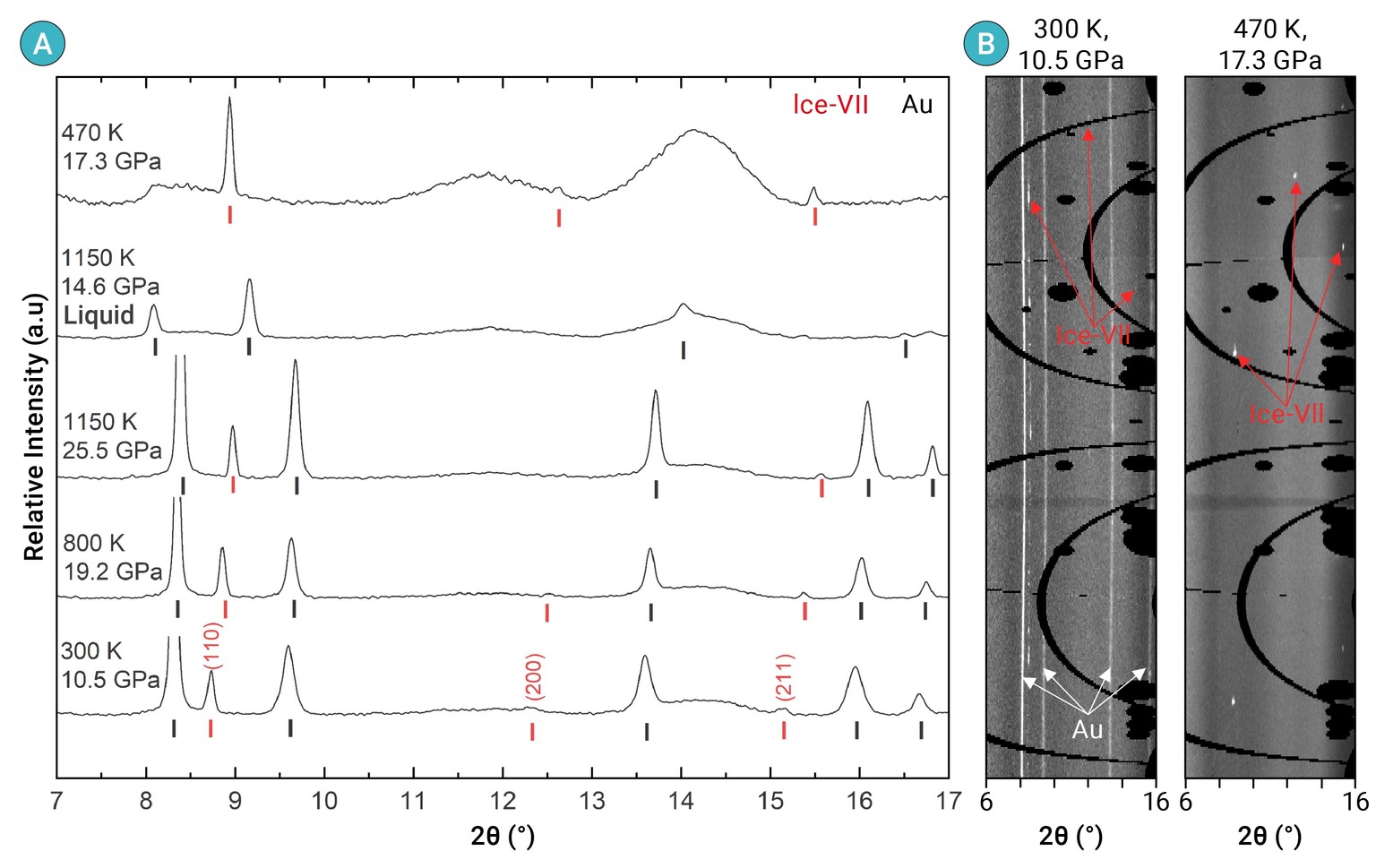
Figure 1.
Representative X-ray diffraction data of ice-VII at high P-T conditions
-
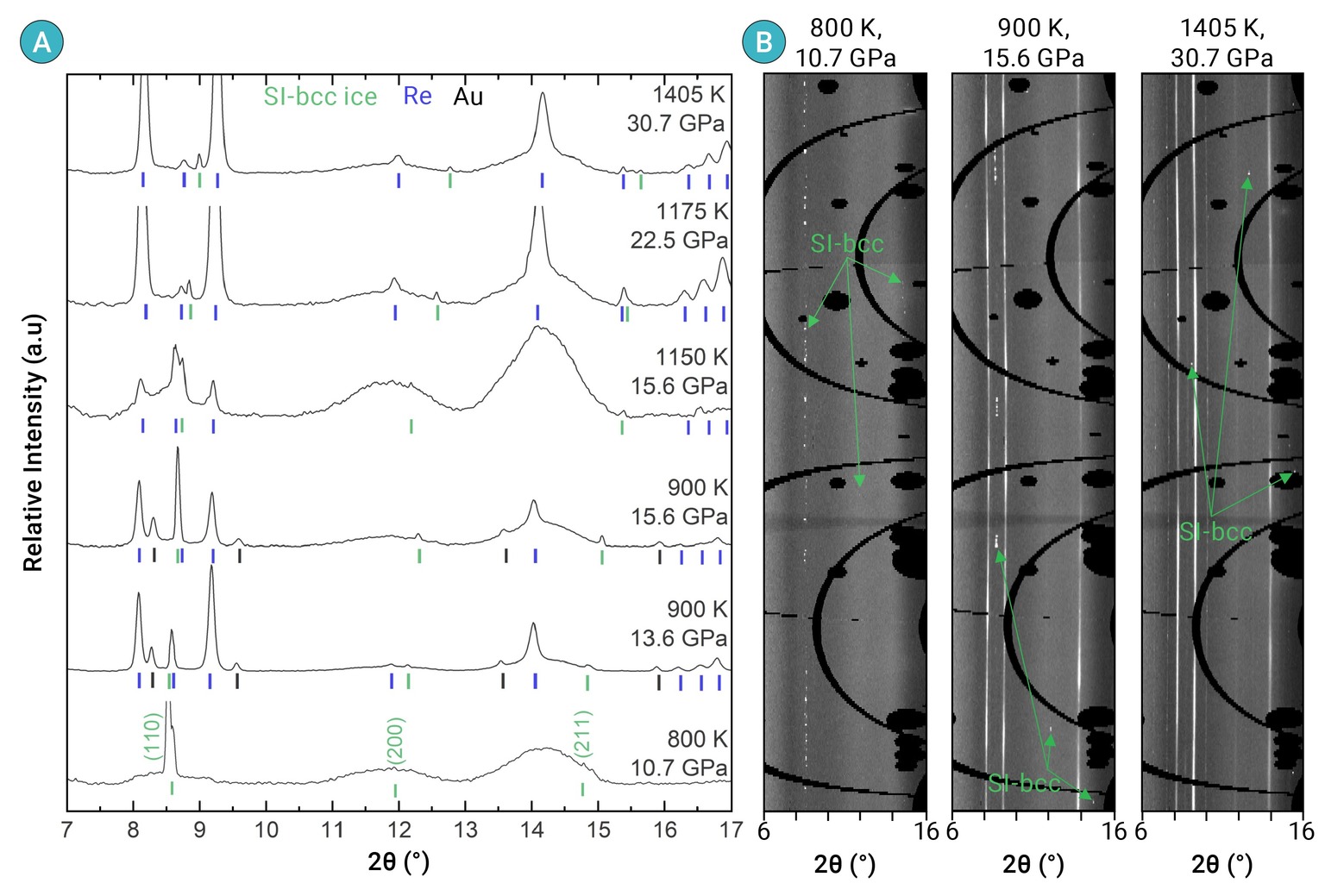
Figure 2.
Representative X-ray diffraction data of SI-bcc ice at high P-T conditions
-
Figure 3.
Equation of state following the HTBM3 models
-
Figure 4.
Phase diagram of H2O ice, superimposed on the P-T conditions of subducting slabs and compared with literature results
