
-

-
REFERENCES
[1] Zheng, B., Ciais, P., Chevallier, F., et al. (2023). Record-high CO2 emissions from boreal fires in 2021. Science 379:912−917. DOI:10.1126/science.ade0805 [2] Wang, F., Harindintwali, J.D., Wei, K., et al. (2023). Climate change: Strategies for mitigation and adaptation. Innov. Geosci. 1:100015. DOI: 10.59717/j.xinn-geo.2023.100015 [3] Liang, L., Liang, S. and Zeng, Z. (2024). Extreme climate sparks record boreal wildfires and carbon surge in 2023. The Innovation 5:100631. DOI:10.1016/j.xinn.2024.100631 [4] Rogelj J, Shindell D, Jiang K, et al. (2018). Mitigation pathways compatible with 1.5 C in the context of sustainable development. Global warming of 1.5 C. Intergovernmental Panel on Climate Change. Masson-Delmotte, V., Zhai P., Pörtner, H.-O. et al.(eds)pp:93-174. DOI: 10.1017/9781009157940.004 [5] Byrne, B., Liu, J., Bowman, K.W., et al. (2024). Carbon emissions from the 2023 Canadian wildfires. Nature 633:835−839. DOI:10.1038/s41586-024-07878-z -
ABOUT THIS ARTICLE
Cite this article:
Xiang W., Ouyang C., An H., et al. (2025). 2023 Canadian wildfires produced extreme CO2 emissions. The Innovation Geoscience 3:100176. https://doi.org/10.59717/j.xinn-geo.2025.100176
Welcome!
To request copyright permission to republish or share portions of our works, please visit Copyright Clearance Center's (CCC) Marketplace website at marketplace.copyright.com.
Export File
Citation
Xiang W., Ouyang C., An H., et al. (2025). 2023 Canadian wildfires produced extreme CO2 emissions. The Innovation Geoscience 3:100176. https://doi.org/10.59717/j.xinn-geo.2025.100176

Format
Content
 DownLoad:
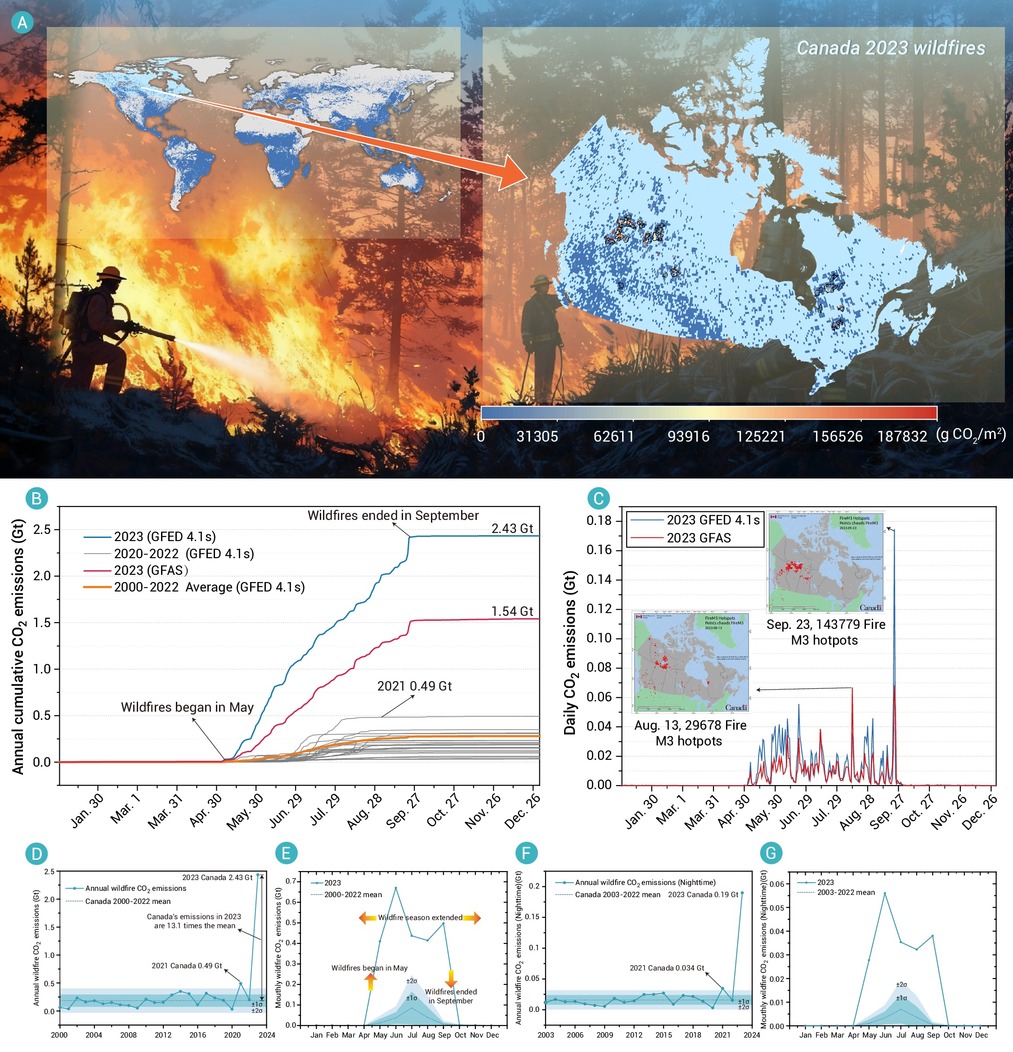
- Figure 1.
