
Rock uplift increased sensitivity of fluvial response to suborbital climatic fluctuations
-
GRAPHICAL ABSTRACT
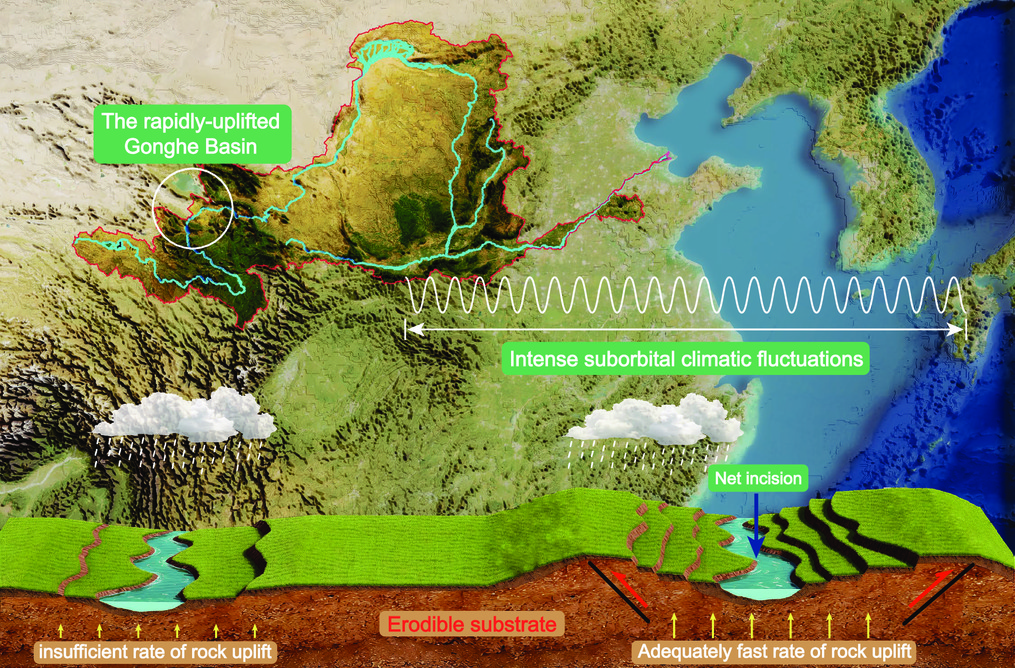
 DownLoad:
Full size image
DownLoad:
Full size image
-
PUBLIC SUMMARY
-
The Yellow River excavated through the Gonghe Basin located in the NE Tibetan Plateau at 238–200 ka.
The rock uplift over the Gonghe Basin has been rapid, but not uniform since the late Mid-Pleistocene.
Rapid rock uplift can induce a more sensitive fluvial response to suborbital climatic fluctuations.
-
-
ABSTRACT
Terrace formation ages in a river system reveal that incision of large rivers is unevenly distributed, but the underlying forcing mechanisms are not entirely clear. One key challenge is to understanding the coupling mechanism of how uplift and climate interact in controlling terrace generation. Lack of well-dated fluvial terrace sequences allowing direct comparison with available uplift and climate data prevents resolving this issue. Here we reported a most densely distributed fluvial terrace sequence from the NE Tibetan Plateau. The results reveal two periods of frequent incisions at 90–80 and 55–45 ka, synchronous with indications from other rivers originating from the inner plateau. These two intervals do not align with climatic anomalies, thus indicating accelerated rock uplift. This work demonstrates that the coupling between rapid uplift and erodible substrate increases the sensitivity of fluvial response to suborbital climatic fluctuations to create more terraces in the Yellow River and likely other large rivers. -

-
REFERENCES
[1] Maddy D., Bridgland D. R. and Green C. P. (2000). Crustal uplift in southern England: Evidence from the river terrace records. Geomorphology 33:167−181. DOI:10.1016/S0169-555X(99)00120-8 [2] Bridgland D. R. and Westaway R. (2008). Climatically controlled river terrace staircases: A worldwide Quaternary phenomenon. Geomorphology 98:285−315. DOI:10.1016/j.geomorph.2006.12.032 [3] Cunha P. P., Martins A. A., Huot S., et al. (2008). Dating the Tejo River lower terraces in the Ródão area (Portugal) to assess the role of tectonics and uplift. Geomorphology 102:43−54. DOI:10.1016/j.geomorph.2007.05.019 [4] Hoorn C., Wesselingh F., ter Steege H., et al. (2010). Amazonia through time: Andean uplift, climate change, landscape evolution, and biodiversity. Science 330:927−931. DOI:10.1126/science.1194585 [5] Bender A. M., Lease R. O., Corbett L. B., et al. (2020). Late Cenozoic climate change paces landscape adjustments to Yukon River capture. Nat. Geosci. 13:571−575. DOI:10.1038/s41561-020-0611-4 [6] Bull W B. (1991). Geomorphic responses to climatic change (Oxford University Press), pp: 4–42. DOI:10.1177/095968369300300217 [7] Pazzaglia F. J. and Brandon M. T. (2001). A fluvial record of long-term steady-state uplift and erosion across the Cascadia forearc high, western Washington state. Am. J. Sci. 301:385−431. DOI:10.2475/ajs.301.4-5.385 [8] Wegmann K. W. and Pazzaglia F. J. (2002). Holocene strath terraces, climate change, and active tectonics: The clearwater river basin, Olympic peninsula, Washington state. Geol. Soc. Am. Bull. 114:731−744. DOI:2.0.CO;2">10.1130/0016-7606(2002)114<0731:HSTCCA>2.0.CO;2 [9] Starkel L. (2003). Climatically controlled terraces in uplifting mountaines areas. Quat. Sci. Rev. 22:2189−2198. DOI:10.1016/S0277-3791(03)00148-3 [10] Maddy D., Demir T., Bridgland D. R., et al. (2008). The early Pleistocene development of the Gediz river, western Turkey: An uplift-driven, climate-controlled system. Quat. Int. 189:115−128. DOI:10.1016/j.quaint.2007.08.045 [11] Pan B., Su H., Hu Z., et al. (2009). Evaluating the role of climate and tectonics during non-steady incision of the yellow river: Evidence from a 1.24 ma terrace record near Lanzhou, China. Quat. Sci. Rev. 28:3281–3290. DOI:10.1016/j.quascirev.2009.09.003 [12] Vandenberghe J. (1995). Timescales, climate and river development. Quat. Sci. Rev. 14:631−638. DOI:10.1016/0277-3791(95)00043-O [13] Maddy D., Demir T., Bridgland D., et al. (2005). An obliquity-controlled early Pleistocene river terrace record from western Turkey. Quat. Res. 63:339−346. DOI:10.1016/j.yqres.2005.01.004 [14] Vandenberghe J. (2015). River terraces as a response to climatic forcing: Formation processes, sedimentary characteristics and sites for human occupation. Quat. Int. 370:3−11. DOI:10.1016/j.quaint.2014.05.046 [15] Wang X., Vandenberghe J., Yi S., et al. (2015). Climate-dependent fluvial architecture and processes on a suborbital timescale in areas of rapid tectonic uplift: An example from the NE Tibetan Plateau. Glob. Planet. Change. 133:318−329. DOI:10.1016/j.gloplacha.2015.09.009 [16] Tao Y., Xiong J., Zhang H., et al. (2020). Climate-driven formation of fluvial terraces across the Tibetan plateau since 200 kya: A review. Quat. Sci. Rev. 237:106303. DOI:10.1016/j.quascirev.2020.106303 [17] Erkens G., Dambeck R., Volleberg K. P., et al. (2009). Fluvial terrace formation in the northern Upper Rhine Graben during the last 20000 years as a result of allogenic controls and autogenic Evolution. Geomorphology 103:476−495. DOI:10.1016/j.geomorph.2008.07.021 [18] Viveen W., Schoorl J. M., Veldkamp A., et al. (2014). Modelling the impact of regional uplift and local tectonics on fluvial terrace preservation. Geomorphology 210:119−135. DOI:10.1016/j.geomorph.2013.12.026 [19] van den Berg M. W. (1994). Neotectonics of the Roer Valley rift system. Style and rate of crustal deformation inferred from syn-tectonic sedimentation. Geol. Mijnb. 73:143−156. DOI:10.1016/s0921-8181(01)00063-7 [20] Demir T., Westaway R. and Bridgland D. (2018). The influence of crustal properties on patterns of Quaternary fluvial stratigraphy in Eurasia. Quaternary 1:28. DOI:10.3390/quat1030028 [21] Fang X., Yan M., Van der Voo R., et al. (2005). Late Cenozoic deformation and uplift of the NE Tibetan Plateau: Evidence from high-resolution magneto stratigraphy of the Guide basin, Qinghai province, China. Geol. Soc. Am. Bull. 117:1208−1225. DOI:10.1130/B25727.1 [22] Craddock W. H., Kirby E. and Harkins N. W. (2010). Rapid fluvial incision along the Yellow River during headward basin integration. Nat. Geosci. 3:209−213. DOI:10.1038/ngeo777 [23] Perrineau A., Van Der Woerd J., Gaudemer Y., et al. (2011). Incision rate of the yellow river in northeastern Tibet constrained by 10Be and 26Al cosmogenic isotope dating of fluvial terraces: Implications for catchment evolution and plateau building. Geol. Soc. Spec. Publ. 353:189−219. DOI:10.1144/SP353.10 [24] Jia L., Hu D., Wu H., et al. (2017). Yellow River terrace sequences of the Gonghe-Guide section in the northeastern Qinghai-Tibet: Implications for plateau uplift. Geomorphology 295:323−336. DOI:10.1016/j.geomorph.2017.06.007 [25] Su Q., Wang X., Yuan D., et al. (2023). Fluvial entrenchment of the Gonghe basin and integration of the upper Yellow River-evidence from the cosmogenically dated geomorphic surfaces. Geomorphology 429:108654. DOI:10.1016/j.geomorph.2023.108654 [26] Cheng H., Edwards R., Sinha A., et al. (2016). The Asian monsoon over the past 640,000 years and ice age terminations: Nature 534: 640–646. DOI:10.1038/nature18591 [27] Zhao Y., Tzedakis P. C., Li Q., et al. (2020). Evolution of vegetation and climate variability on the Tibetan Plateau over the past 1.74 million years. Sci. Adv. 6:eaay6193. DOI:10.1126/sciadv.aay6193 [28] Sun Y., McManus J. F. and Clemens S. C. (2021). Persistent orbital influence on millennial climate variability through the Pleistocene. Nat. Geosci. 14:812−818. DOI:10.1038/s41561-021-00794-1 [29] Hu X., Garzanti E. and Wang, J. (2016). The timing of India-Asia collision onset - facts, theories, controversies. Earth. Sci. Rev. 160:264−299. DOI:10.1016/j.earscirev.2016.07.014 [30] Yuan D., Ge W. and Chen Z. (2013). The growth of northeastern Tibet and its relevance to large-scale continental geodynamics: A review of recent studies. Tectonics 32:1358−1370. DOI:10.1002/tect.20081 [31] Li C., Zhang P., Yin J. et al. (2009). Late Quaternary left-lateral slip rate of the Haiyuan fault, northeastern margin of the Tibetan Plateau. Tectonics 28:TC5010. DOI:10.1029/2008TC002302 [32] Chen P. and Lin A. (2019). Tectonic topography and Late Pleistocene activity of the west Qinling fault, northeastern Tibetan Plateau. J. Asian Earth Sci. 176:68−78. DOI:10.1016/j.jseaes.2019.02.007 [33] Xu S., Xu D. and Shi S. (1984). A discussion on the development of landforms and evolution of environments in the Gonghe Basin. J. Lanzhou Univ., Nat. Sci. 20:146−157. DOI:10.13885/j.issn.0455-2059.1984.01.015 [34] Pan B. (1994). A study on the geomorphic evolution and development of the upper reaches of Yellow River in Guide Basin. J. Arid Land. 17:43−50. DOI:10.13826/j.cnki.cn65-1103/x.1994.03.006 [35] Bridgland D. R., Westaway R. and Hu Z. (2020). Basin inversion: A worldwide Late Cenozoic phenomenon. Glob. Planet. Change. 193:103260. DOI:10.1016/j.gloplacha.2020.103260 [36] Metivier F., Gaudemer Y., Tapponnier P., et al. (1998). Northeastward growth of the Tibet Plateau deduced from balanced reconstruction of two depositional areas: The Qaidam and Hexi Corridor basins, china. Tectonics 17:823−842. DOI:10.1029/98TC02764 [37] Craddock W. H., Kirby E., Zhang H., et al. (2014). Rates and style of Cenozoic deformation around the Gonghe Basin, northeastern Tibetan Plateau. Geosphere 10:1255−1282. DOI:10.1130/GES01024.1 [38] Zhang H., Zhang P. and Champagnac J. D. (2014). Pleistocene drainage reorganization driven by the isostatic response to deep incision into the northeastern Tibetan Plateau. Geology 42:303−306. DOI:10.1130/G35115.1 [39] Prescott J. R. and Hutton J. T. (1994). Cosmic-ray contributions to dose-rates for luminescence and ESR dating - large depths and long-term time variations. Radiat. Meas. 23:497−500. DOI:10.1016/1350-4487(94)90086-8 [40] Aitken M. J. (1998). Introduction to optical dating: The dating of Quaternary sediments by the use of photon-stimulated luminescence (Clarendon Press). pp: 6–36. DOI:10.1093/oso/9780198540922.001.0001. [41] Lai Z., Mischke S. and Madsen D. (2014). Paleoenvironmental implications of new DSL dates on the formation of the "shell bar" in the Qaidam basin, northeastern Qinghai-Tibetan plateau. J. Paleolimnol. 51:197−210. DOI:10.1007/s10933-013-9710-1 [42] Corbett L B., Bierman P R. and Rood D H. (2016). An approach for optimizing in situ cosmogenic 10Be sample preparation. Quat. Geochronol. 33:24−34. DOI:10.1016/j.quageo.2016.02.001 [43] Balco G., Stone J O., Lifton N. A., et al. (2008). A complete and easily accessible means of calculating surface exposure ages or erosion rates from 10Be and 26Al measurements. Quat. Geochronol. 3:174−195. DOI:10.1016/j.quageo.2007.12.001 [44] Harkins N., Kirby E., Heimsath A., et al. (2007). Transient fluvial incision in the headwaters of the Yellow River, northeastern Tibet, China. J. Geophys. Res. Earth Surf. 112:F03S04. DOI:10.1029/2006JF000570 [45] Qiang M., Jin Y., Liu X., et al. (2016). Late Pleistocene and Holocene aeolian sedimentation in Gonghe Basin, northeastern Qinghai-Tibetan plateau: Variability, processes, and climatic implications. Quat. Sci. Rev. 132:57−73. DOI:10.1016/j.quascirev.2015.11.010 [46] Wegmann K. W., and Pazzaglia F. J. (2009). Late Quaternary fluvial terraces of the Romagna and Marche Apennines, Italy: Climatic, lithologic, and tectonic controls on terrace genesis in an active Orogen. Quat. Sci. Rev. 28:137−165. DOI:10.1016/j.quascirev.2008.10.006 [47] Hu Z., Pan B., Wang J., et al. (2012). Fluvial terrace formation in the eastern Fenwei Basin, china, during the past 1.2 Ma as a combined archive of tectonics and climate change. J. Asian Earth Sci. 60:235–245. DOI:10.1016/j.jseaes.2012.09.016. [48] Heslop D., Dekkers M. J. and Langereis C. G. (2002). Timing and structure of the mid-Pleistocene transition: Records from the loess deposits of northern china. Palaeogeogr. Palaeoclimatol. Palaeoecol. 185:133−143. DOI:10.1016/S0031-0182(02)00282-1 [49] Wang Z., Zeng Z., Liu Z., et al. (2021). Heat flow distribution and thermal mechanism analysis of the Gonghe Basin based on gravity and magnetic methods. Acta Geol. Sin-engl. 95:1892−1901. DOI:10.1111/1755-6724.14884 [50] Clark M. K., Schoenbohm L. M., Royden L. H., et al. (2004). Surface uplift, tectonics, and erosion of eastern Tibet from large-scale drainage patterns. Tectonics 23:TC1006. DOI:10.1029/2002TC001402 [51] Moragoda N., and Cohen S. (2020). Climate-induced trends in global riverine water discharge and suspended sediment dynamics in the 21st Century. Global. Planet. Change 191:103199. DOI:10.1016/j.gloplacha.2020.103199 [52] Westaway R. (2002). The Quaternary evolution of the Gulf of Corinth, central Greece: Coupling between surface processes and flow in the lower continental crust. Tectonophysics 348:269−318. DOI:10.1016/S0040-1951(02)00032-X [53] Ji Y., Su S. and Huang Q. (2022). Active tectonics in the upper reaches of the Yellow River from Lagan Gorge to Liujia Gorge, northwestern China: Insights from geomorphic indices. Geol. J. 57:2379−2396. DOI:10.1002/gj.4417 [54] Hassenruck-Gudipati H. J., Ellis T. S., Goudge T. A., et al. (2021). A multi-proxy assessment of terrace formation in the lower Trinity River valley, Texas. Earth Surf. Dyn. 10:635−651. DOI:10.5194/esurf-2021-37 [55] Zhang J., Yang H., Liu-Zeng J., et al. (2021). Reconstructing the incision of the Lancang River (Upper Mekong) in southeastern Tibet below its prominent knickzone using fluvial terraces and transient tributary profiles. Geomorphology 376:107551. DOI:10.1016/j.geomorph.2020.107551 [56] Veldkamp A. and van Dijke J. J. (2000). Simulating internal and external controls on fluvial terrace stratigraphy: A qualitative comparison with the Maas record. Geomorphology 33:225−236. DOI:10.1016/S0169-555X(99)00125-7 -
ABOUT THIS ARTICLE
Cite this article:
Hu Z., Li M., Mo Q., et al. (2026). Rock uplift increased sensitivity of fluvial response to suborbital climatic fluctuations. The Innovation Geoscience 4:100205. https://doi.org/10.59717/j.xinn-geo.2026.100205
Welcome!
To request copyright permission to republish or share portions of our works, please visit Copyright Clearance Center's (CCC) Marketplace website at marketplace.copyright.com.
Export File
Citation
Hu Z., Li M., Mo Q., et al. (2026). Rock uplift increased sensitivity of fluvial response to suborbital climatic fluctuations. The Innovation Geoscience 4:100205. https://doi.org/10.59717/j.xinn-geo.2026.100205

Format
Content
-
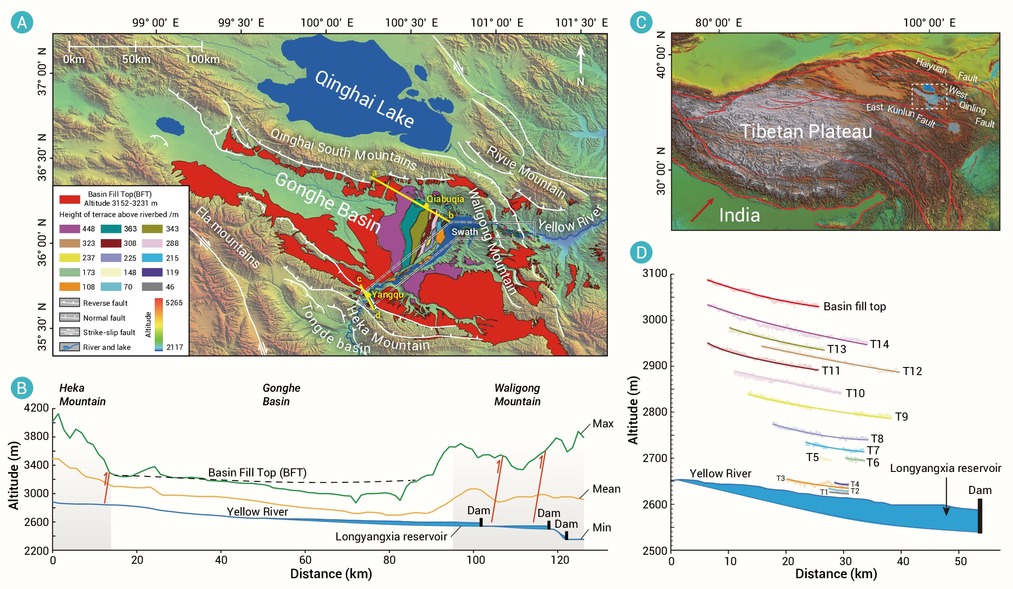
Figure 1.
Topographic map, terrace distribution and ancient longitudinal profiles of the riverbed within the Gonghe Basin
-
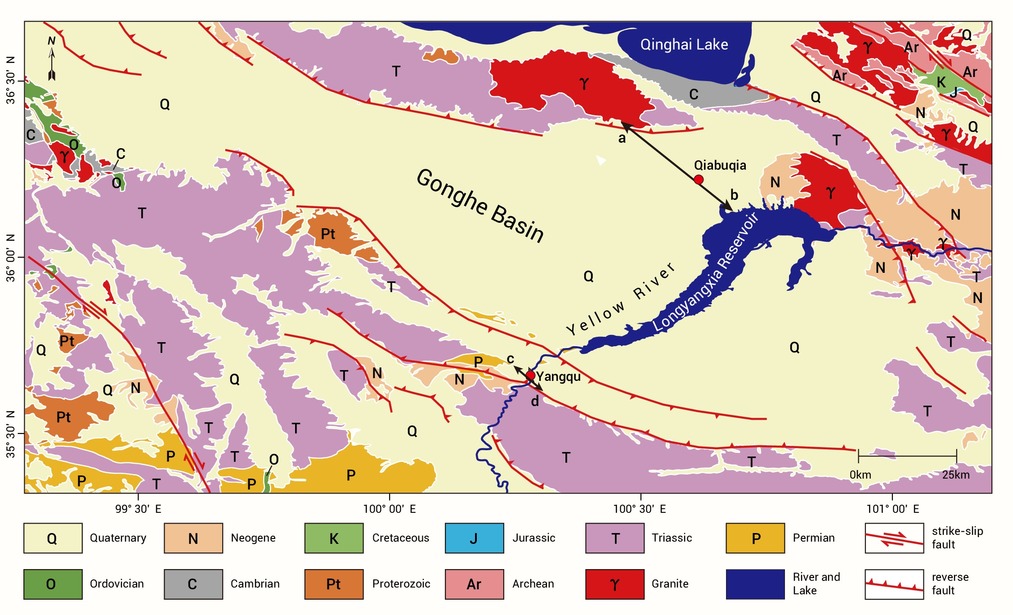
Figure 2.
Lithological distribution map of the Gonghe Basin
-
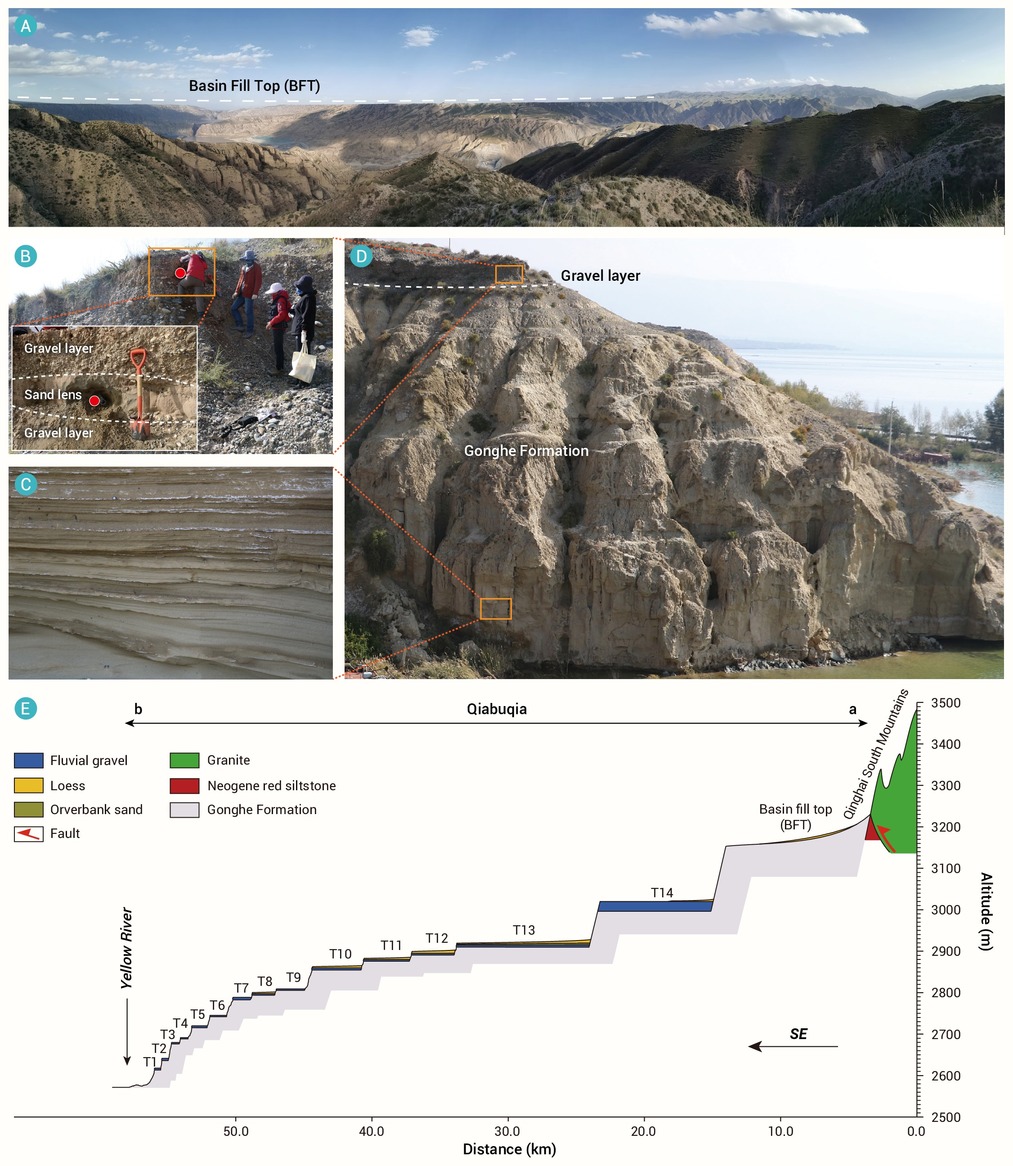
Figure 3.
Schematic cross-section a-b traversing Qiabuqian within the inner Gonghe Basin
-
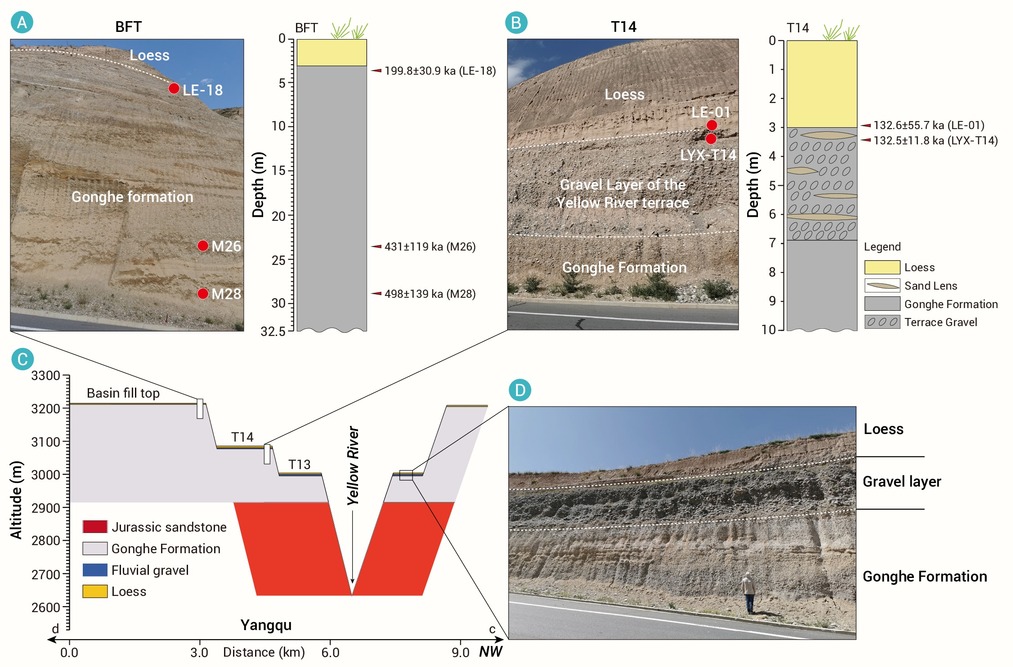
Figure 4.
Schematic cross-section c-d traversing Yangqu at the north front of the Heka Mountain
-
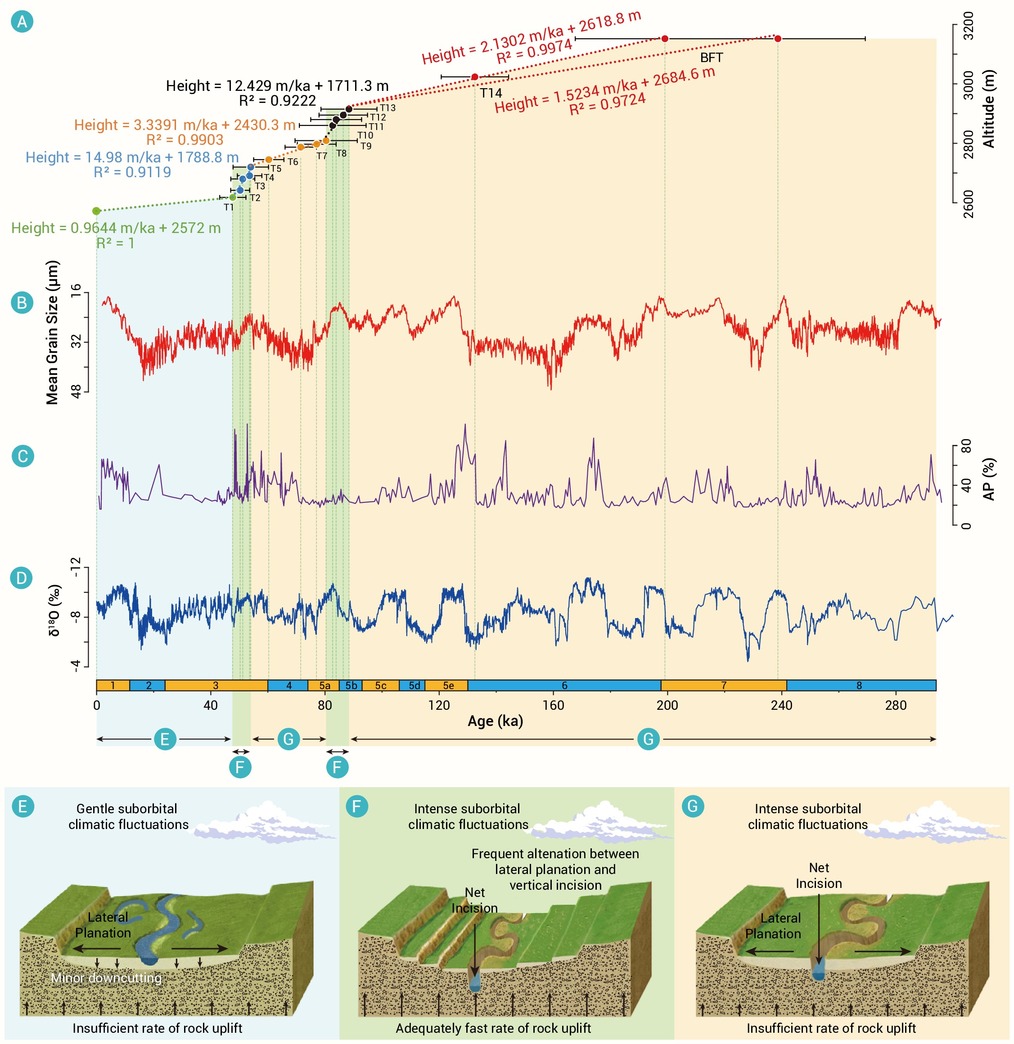
Figure 5.
Calculated fluvial incision rates correlated with regional climatic archives, and Mechanistic pattern of the geomorphic processes of fluvial response to coupling of rock uplift and suborbital climatic fluctuation with a background of loose substrate
