
Enhanced influence of tropical Atlantic variability on East Asian summer monsoon in warming climate
-
GRAPHICAL ABSTRACT
 DownLoad:
Full size image
DownLoad:
Full size image
-
PUBLIC SUMMARY
-
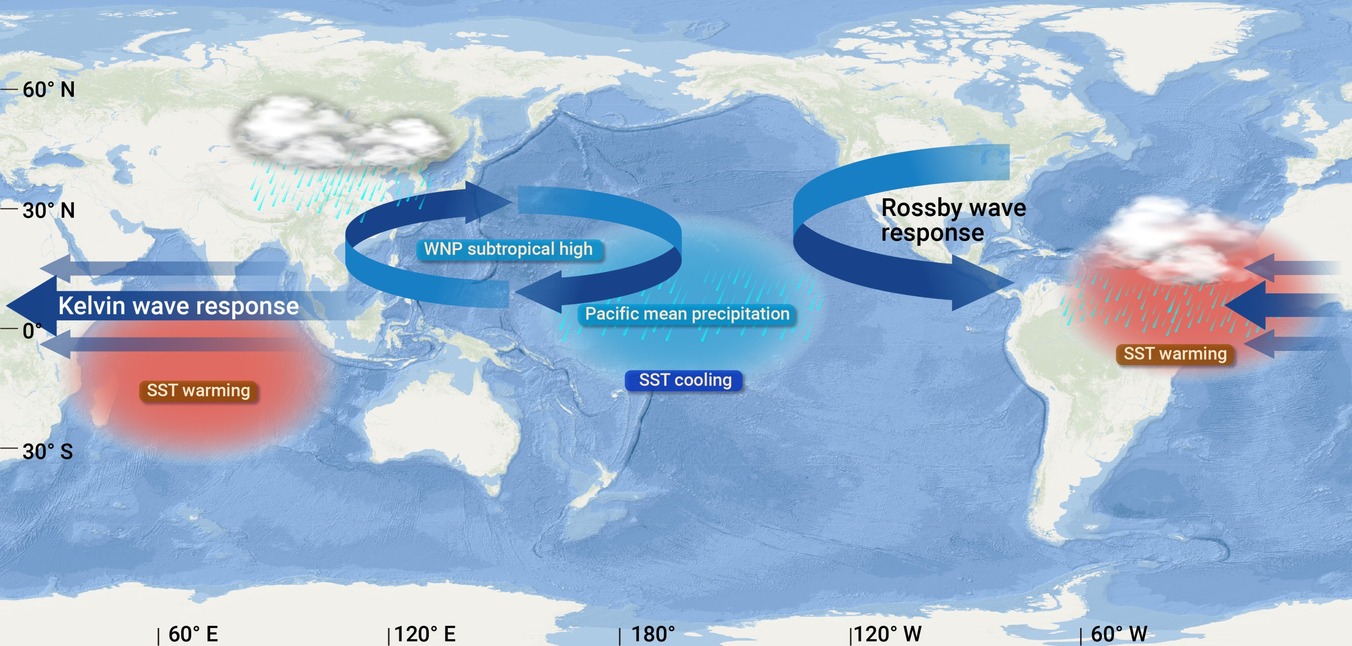
Spring North tropical Atlantic (SNTA) sea surface temperature (SST) variability enhances in a warming climate.
Larger SNTA SST variability has greater impacts on East Asian Summer Monsoon (EASM) via Kelvin wave response.
Wetter tropical Pacific in a warming climate also amplifies SNTA SST impact on EASM via Rossby wave response.
-
-
ABSTRACT
The spring North tropical Atlantic (SNTA) sea surface temperature (SST) anomalies act as a critical precursor to the East Asian summer monsoon (EASM) and East Asian climate variability. However, how the influence of SNTA SST on the EASM changes in a warming climate remains unclear. Here, using multiple climate model simulations, we demonstrate a significant intensification of the impact of SNTA SST on EASM and East Asian climate under greenhouse warming. In a warmer climate, atmospheric and precipitation responses over East Asia to SNTA SST anomalies are remarkably amplified, contributing to a higher frequency of extreme EASM events following SNTA SST anomalies. Greenhouse warming increases SNTA SST variability, which enhances the response of tropical Indian Ocean SST anomalies via atmospheric teleconnection, thereby strengthening the impact on EASM through the stimulation of anomalous anticyclone over tropical western North Pacific. Meanwhile, a wetter tropical Pacific mean state in a warmer climate further amplifies the influence of SNTA SST-induced tropical central Pacific SST anomalies on the EASM. Our findings suggest that under continued greenhouse warming, the EASM will be increasingly modulated by SNTA SST, providing an opportunity to improve the predictability of East Asian climate. -

-
REFERENCES
[1] Tao S. and Chen L. (1987). A review of recent research on the East Asian summer monsoon in China. Chang C.-P. and Krishnamurti T.N. (eds). Monsoon Meteorology (Oxford Univ. Press), pp:60–92. https://www.researchgate.net/publication/266375342_A_Review_of_Recent_Research_on_the_East_Asian_Summer_Monsoon_in_China [2] Ding Y.-H. and Chan J.C.L. (2005). The East Asian summer monsoon: An overview. Meteor. Atmos. Phys. 89:117−142. DOI:10.1007/s00703-005-0125-z [3] Ha K.-J., Heo K.-Y., Lee S.-S., et al. (2012). Variability in the East Asian Monsoon: A review. Meteorol. Appl. 19:200−215. DOI:10.1002/met.1320 [4] Zhang Q., Zheng Y., Singh V.P., et al. (2017). Summer extreme precipitation in eastern China: Mechanisms and impacts. J. Geophys. Res. 122:2766−2778. DOI:10.1002/2016JD025913 [5] Liang P., Hu Z., Ding Y., et al. (2021). The extreme Mei-Yu season in 2020: Role of the Madden-Julian oscillation and the cooperative influence of the Pacific and Indian Oceans. Adv. Atmos. Sci. 38:2040−2054. DOI:10.1007/s00376-021-1078-y [6] Zhou Z.-Q., Xie S.-P. and Zhang R.-H. (2021). Historic Yangtze flooding of 2020 tied to extreme Indian Ocean conditions. Proc. Natl. Acad. Sci. USA 118:e2022255118. DOI:10.1073/pnas.2022255118 [7] Lau K. and Weng H. (2001). Coherent modes of global SST and summer rainfall over China: An assessment of the regional impacts of the 1997–98 El Niño. J. Clim. 14:1294−1308. DOI:2.0.CO;2">10.1175/1520-0442(2001)014<1294:CMOGSA>2.0.CO;2 [8] Zhai P., Yu R., Guo Y., et al. (2016). The strong El Niño of 2015/16 and its dominant impacts on global and China’s climate. J. Meteor. Res. 30:283−297. DOI:10.1007/s13351-016-6101-3 [9] Zhang R.-H., Sumi A. and Kimoto M. (1996). Impact of El Nino on the East Asian monsoon: A diagnostic study of the 86/87 and 91/92 events. J. Meteor. Soc. Jap. 74:49−62. DOI:10.2151/jmsj1965.74.1_49 [10] Wang B., Wu R. and Fu X. (2000). Pacific–East Asian teleconnection: How does ENSO affect East Asian climate. J. Clim. 13:1517−1536. DOI:2.0.CO;2">10.1175/1520-0442(2000)013<1517:PEATHD>2.0.CO;2 [11] Xie S.-P., Hu K.-M., Hafner J., et al. (2009). Indian Ocean capacitor effect on Indo–Western Pacific climate during the summer following El Niño. J. Clim. 22:730−747. DOI:10.1175/2008JCLI2544.1 [12] Xie S.-P., Kosaka Y., Du Y., et al. (2016). Indo-western Pacific ocean capacitor and coherent climate anomalies in post-ENSO summer: A review. Adv. Atmos. Sci. 33:411−432. DOI:10.1007/s00376-015-5192-6 [13] Zhang P.-C., Xie S.-P., Kosaka Y., et al. (2024). Why East Asian monsoon anomalies are more robust in post El Niño than in post La Niña summers. Nat. Commun. 15:7401. DOI:10.1038/s41467-024-51885-7 [14] Yang K., Cai W.-J., Huang G., et al. (2022). Increased variability of the western Pacific subtropical high under greenhouse warming. Proc. Natl. Acad. Sci. USA 119:e2120335119. DOI:10.1073/pnas.2120335119 [15] Wang C.-Y., Zheng X.-T. and Xie S.-P. (2023). Enhanced ENSO-unrelated summer variability in the Indo-western Pacific under global warming. J. Clim. 36:1749−1765. DOI:10.1175/JCLI-D-22-0450.1 [16] Song F. and Zhou T. (2014). The climatology and inter-annual variability of East Asian summer monsoon in CMIP5 coupled models: Does air-sea coupling improve the simulations. J. Clim. 27:8761−8777. DOI:10.1175/JCLI-D-14-00396.1 [17] Song F. and Zhou T. (2014). Inter-annual variability of East Asian summer monsoon simulated by CMIP3 and CMIP5 AGCMs: Skill dependence on Indian Ocean-western Pacific anticyclone teleconnection. J. Clim. 27:1679−1697. DOI:10.1175/JCLI-D-13-00248.1 [18] Lu Z., Dong L., Song F., et al. (2024). Quantifying the relative contributions of three tropical oceans to the western North Pacific anomalous anticyclone. Environ. Res. Lett. 19:104016. DOI:10.1088/1748-9326/ad677d [19] Rong X.Y., Zhang R.H. and Li T. (2010). Impacts of Atlantic sea surface temperature anomalies on Indo-East Asian summer monsoon-ENSO relationship. Chin. Sci. Bull. 55:2458−2468. DOI:10.1007/s11434-010-3098-3 [20] Hong C.-C., Lee M.-Y., Hsu H.-H., et al. (2014). Tropical SST forcing on the anomalous WNP subtropical high during July–August 2010 and the record-high SST in the tropical Atlantic. Clim. Dyn. 45:633−650. DOI:10.1007/s00382-014-2275-5 [21] Wang C.-Z. (2006). An overlooked feature of tropical climate: Inter-Pacific-Atlantic variability. Geophys. Res. Lett. 33:L12702. DOI:10.1029/2006GL026324 [22] Wang C.-Z. (2019). Three-ocean interactions and climate variability: A review and perspective. Clim. Dyn. 53:5119−5136. DOI:10.1007/s00382-019-04930-x [23] Jin D.-C. and Huo L.-W. (2018). Influence of tropical Atlantic sea surface temperature anomalies on the East Asian summer monsoon. Quart. J. Roy. Meteor. Soc. 144:1490−1500. DOI:10.1002/qj.3296 [24] Keenlyside N.S., Ding H. and Latif M. (2013). Potential of equatorial Atlantic variability to enhance El Niño prediction. Geophys. Res. Lett. 40:2278−2283. DOI:10.1002/grl.50362 [25] Martín-Rey M., Rodríguez-Fonseca B. and Polo I. (2015). Atlantic opportunities for ENSO prediction. Geophys. Res. Lett. 42:6802−6810. DOI:10.1002/2015GL065062 [26] Chikamoto Y., Timmermann A., Luo J., et al. (2015). Skillful multi-year predictions of tropical trans-basin climate variability. Nat. Commun. 6:6869. DOI:10.1038/ncomms7869 [27] Liang P. and Lin H. (2018). Sub-seasonal prediction over East Asia during boreal summer using the ECCC monthly forecasting system. Clim. Dyn. 50:1007−1022. DOI:10.1007/s00382-017-3658-1 [28] Hong C.-C., Chang T.-C. and Hsu H.-H. (2014). Enhanced relationship between the tropical Atlantic SST and the summertime western North Pacific subtropical high after the early 1980s. J. Geophys. Res. 119:3715−3722. DOI:10.1002/2013JD021394 [29] Chang T., Hsu H.-H. and Hong C. (2016). Enhanced influences of tropical Atlantic SST on WNP–NIO atmosphere–ocean coupling since the early 1980s. J. Clim. 29:6509−6525. DOI:10.1175/JCLI-D-15-0807.1 [30] Jin D.-C., Huo L.-W., Yan Z., et al. (2024). Enhanced influence of tropical Atlantic Sea surface temperature anomalies on east Asian summer monsoon since the late 1970s. Clim. Dyn. 62:5745−5757. DOI:10.1007/s00382-024-07173-7 [31] Wang H., Li Z., Li J.-P., et al. (2023). Interannual variation in the East Asian summer monsoon-tropical Atlantic SST relationship modulated by the Interdecadal Pacific Oscillation. npj Clim. Atmos. Sci. 6:169. DOI:10.1038/s41612-023-00497-x [32] Wallace J.M., Deser C., Smoliak B.V., et al. (2013). Attribution of climate change in the presence of internal variability. Chang C.-P., Ghil M., Latif M. and Wallace J.M. (eds). Climate Change: Multidecadal and Beyond (World Scientific), pp:1–29. DOI:10.1142/9789814579933_0001 [33] Kay J.E., Deser C., Phillips A., et al. (2015). The community Earth system model (CESM) large ensemble project: A community resource for studying climate change in the presence of internal climate variability. Bull. Amer. Meteor. Soc. 96:1333−1349. DOI:10.1175/BAMS-D-13-00255.1 [34] Kalnay E., Kanamitsu M., Kistler R., et al. (1996). The NCEP/NCAR 40-year reanalysis project. Bull. Amer. Meteor. Soc. 77:437−471. DOI:2.0.CO;2">10.1175/1520-0477(1996)077<0437:TNYRP>2.0.CO;2 [35] Huang B., Thorne P.W., Banzon V.F., et al. (2017). Extended reconstructed sea surface temperature version 5 (ERSSTv5), upgrades, validations, and intercomparisons. J. Clim. 30:8179−8205. DOI:10.1175/JCLI-D-16-0836.1 [36] Adler R.F., Huffman G.J., Chang A., et al. (2003). The version-2 global precipitation climatology project (GPCP) monthly precipitation analysis (1979–present). J. Hydrometeor. 4:1147−1167. DOI:2.0.CO;2">10.1175/1525-7541(2003)004<1147:TVGPCP>2.0.CO;2 [37] Eyring V., Bony S., Meehl G.A., et al. (2016). Overview of the coupled model intercomparison project phase 6 (CMIP6) experimental design and organization. Geosci. Model. Dev. 9:1937−1958. DOI:10.5194/gmd-9-1937-2016 [38] Cai W.-J., Ng B., Geng T., et al. (2023). Anthropogenic impacts on twentieth-century ENSO variability changes. Nat. Rev. Earth & Environ. 4:407−418. DOI:10.1038/s43017-023-00427-8 [39] Austin P.C. and Tu J.V. (2004). Bootstrap methods for developing predictive models. Am. Stat. 58:131−137. DOI:10.1198/0003130043277 [40] Jia F., Cai W.-J., Gan B.-L., et al. (2021). Enhanced North Pacific impact on El Niño/Southern Oscillation under greenhouse warming. Nat. Clim. Chang. 11:840−849. DOI:10.1038/s41558-021-01139-x [41] Wang B. and Fan Z. (1999). Choice of South Asian summer monsoon indices. Bull. Amer. Meteor. Soc. 80:629−638. DOI:2.0.CO;2">10.1175/1520-0477(1999)080<0629:COSASM>2.0.CO;2 [42] Wu A.M. and Ni Y.Q. (1997). The influence of Tibetan Plateau on the interannual variability of Asian monsoon. Adv. Atmos. Sci. 14:491−504. DOI:10.1007/s00376-997-0067-0 [43] Zhang Q.Y., Tao S.Y. and Chen L.T. (2003). The interannual variability of East Asian summer monsoon indices and its association with the pattern of general circulation over East Asia (in Chinese). Acta Meteor. Sin. 61:559−568. DOI:10.11676/qxxb2003.056 [44] Ham Y.-G., Kug J.-S., Park J.-Y., et al. (2013). Sea surface temperature in the north tropical Atlantic as a trigger for El Niño/Southern Oscillation events. Nat. Geosci. 6:112−116. DOI:10.1038/ngeo1686 [45] Huang B., Schopf P.S. and Shukla J. (2004). Intrinsic ocean–atmosphere variability of the tropical Atlantic Ocean. J. Clim. 17:2058−2077. DOI:2.0.CO;2">10.1175/1520-0442(2004)017<2058:IOVOTT>2.0.CO;2 [46] Amaya D.J., DeFlorio M.J., Miller A.J., et al. (2017). WES feedback and the Atlantic Meridional Mode: observations and CMIP5 comparisons. Clim. Dyn. 49:1665−1679. DOI:10.1007/s00382-016-3411-1 [47] Cai W.-J., Wu L., Lengaigne M., et al. (2019). Pantropical climate interactions. Science 363:eaav4236. DOI:10.1126/science.aav4236 [48] Li X., Xie S.-P., Gille S., et al. (2016). Atlantic induced pan-tropical climate change over the past three decades. Nat. Clim. Chang. 6:275−279. DOI:10.1038/nclimate2840 [49] Zhang G.-L., Wang X., Xie Q., et al. (2022). Strengthening impacts of spring sea surface temperature in the north tropical Atlantic on Indian Ocean dipole after the mid-1980s. Clim. Dyn. 59:185−200. DOI:10.1007/s00382-021-06128-6 [50] Miyamoto A. and Xie S.-P. (2024). Low cloud–SST variability over the summertime subtropical Northeast Pacific: Role of extratropical atmospheric modes. J. Clim. 38:165−180. DOI:10.1175/JCLI-D-24-0015.1 [51] Wang B., Xiang B. and Lee J.-Y. (2013). Subtropical high predictability establishes a promising way for monsoon and tropical storm predictions. Proc. Natl. Acad. Sci. USA 110:2718−2722. DOI:10.1073/pnas.1214626110 [52] Tang S., Qiao S., Wang B., et al. (2023). Linkages of unprecedented 2022 Yangtze River Valley heatwaves to Pakistan flood and triple-dip La Niña. npj Clim. Atmos. Sci. 6:8. DOI:10.1038/s41612-023-00386-3 [53] Neale R.B., Chen C.-C., Gettelman A., et al. (2010). Description of the NCAR community atmosphere model (CAM 5.0). NCAR Tech. Note NCAR/TN-486+STR. DOI: 10.5065/wgtk-4g06. [54] Huang P., Xie S.-P., Hu K.-M., et al. (2013). Patterns of the seasonal response of tropical rainfall to global warming. Nat. Geosci. 6:357−361. DOI:10.1038/ngeo1792 [55] Wang G.-J., Cai W.-J., Gan B.-L., et al. (2017). Continued increase of extreme El Nino frequency long after 1.5oC warming stabilization. Nat. Clim. Chang. 7:568–572. DOI:10.1038/nclimate3351 [56] Watanabe M., Chikira M., Imada Y., et al. (2011). Convective control of ENSO simulated in MIROC. J. Clim. 24:543−562. DOI:10.1175/2010JCLI3878.1 [57] Xiang B., Wang B., Yu W., et al. (2013). How can anomalous western North Pacific subtropical high intensify in late summer. Geophys. Res. Lett. 40:2349−2354. DOI:10.1002/grl.50431 [58] Chen S.-F., Chen W., Xie S.-P., et al. (2024). Strengthened impact of boreal winter North Pacific oscillation on ENSO development in warming climate. npj Clim. Atmos. Sci. 7:69. DOI:10.1038/s41612-024-00615-3 [59] Yang Y., Wu L.-X., Guo Y., et al. (2021). Greenhouse warming intensifies north tropical Atlantic climate variability. Sci. Adv. 7:eabg9690. DOI:10.1126/sciadv.abg9690 [60] Czaja A., Van der Vaart P. and Marshall J. (2002). A diagnostic study of the role of remote forcing in tropical Atlantic variability. J. Clim. 15:3280−3290. DOI:2.0.CO;2">10.1175/1520-0442(2002)015<3280:ADSOTR>2.0.CO;2 [61] Wu L. and Liu Z. (2002). Is tropical Atlantic variability driven by the North Atlantic oscillation. Geophys. Res. Lett. 29:1653. DOI:10.1029/2002GL014939 [62] Xiang Y.S., Dong L., Song F.F., et al. (2025). Improved simulation of East Asian summer monsoon in the high-resolution CESM1 and its causes. Adv. Atmos. Sci. 42:1110−1126. DOI:10.1007/s00376-024-4229-0 -
ABOUT THIS ARTICLE
Cite this article:
Chen S., Chen W., Wu R., et al. (2026). Enhanced influence of tropical Atlantic variability on East Asian summer monsoon in warming climate. The Innovation Geoscience 4:100207. https://doi.org/10.59717/j.xinn-geo.2026.100207
Welcome!
To request copyright permission to republish or share portions of our works, please visit Copyright Clearance Center's (CCC) Marketplace website at marketplace.copyright.com.
Export File
Citation
Chen S., Chen W., Wu R., et al. (2026). Enhanced influence of tropical Atlantic variability on East Asian summer monsoon in warming climate. The Innovation Geoscience 4:100207. https://doi.org/10.59717/j.xinn-geo.2026.100207

Format
Content
-
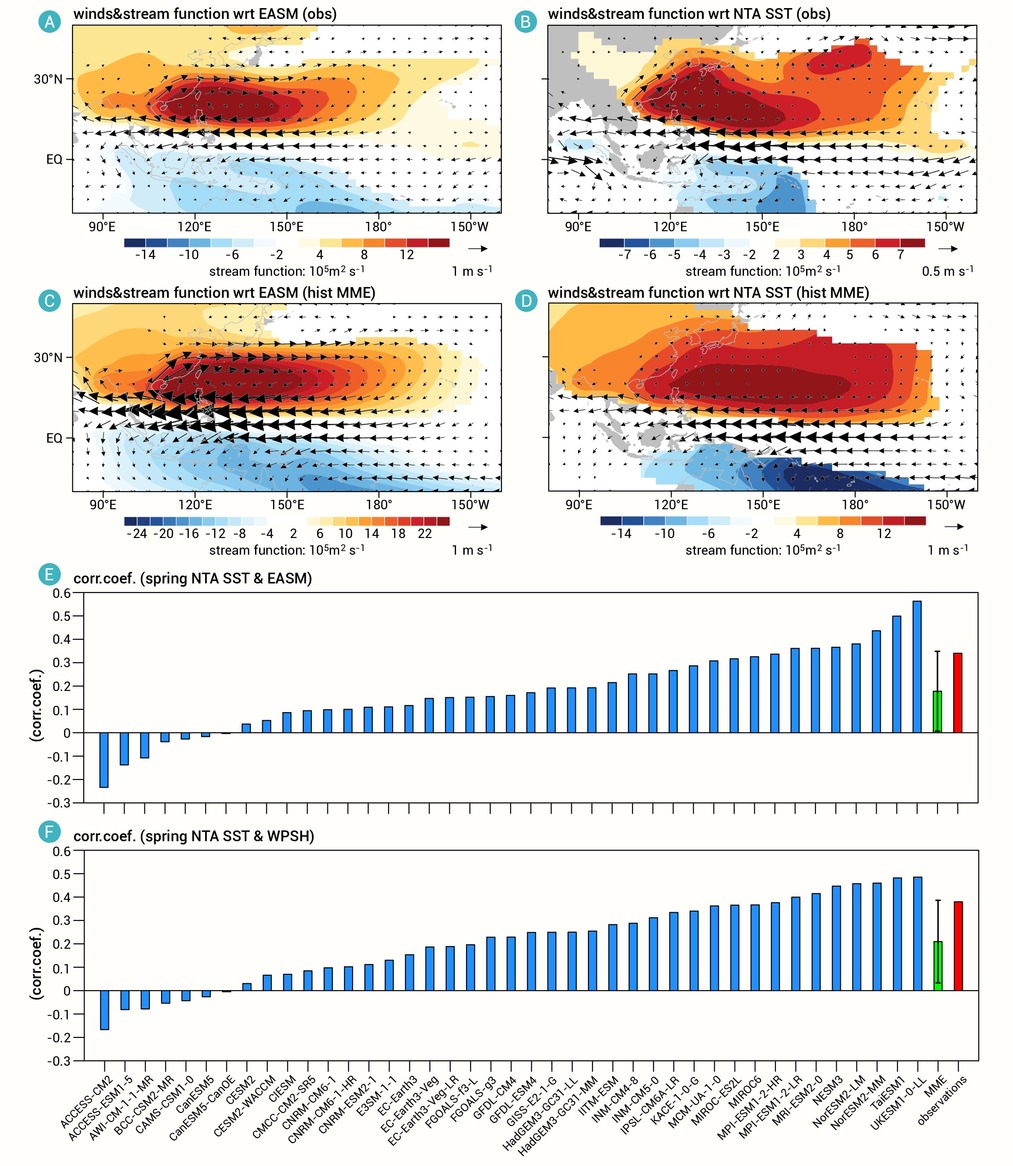
Figure 1.
Relationship between SNTA SST and EASM in observations and CMIP6 models
-
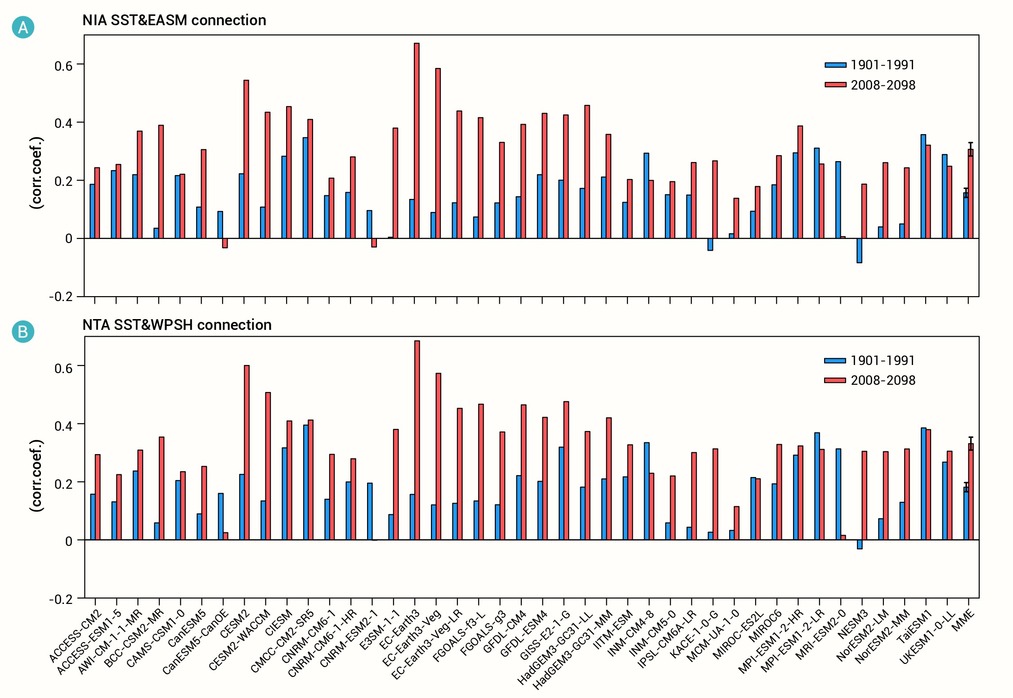
Figure 2.
Enhanced influence of SNTA SST on EASM in a warmer climate
-
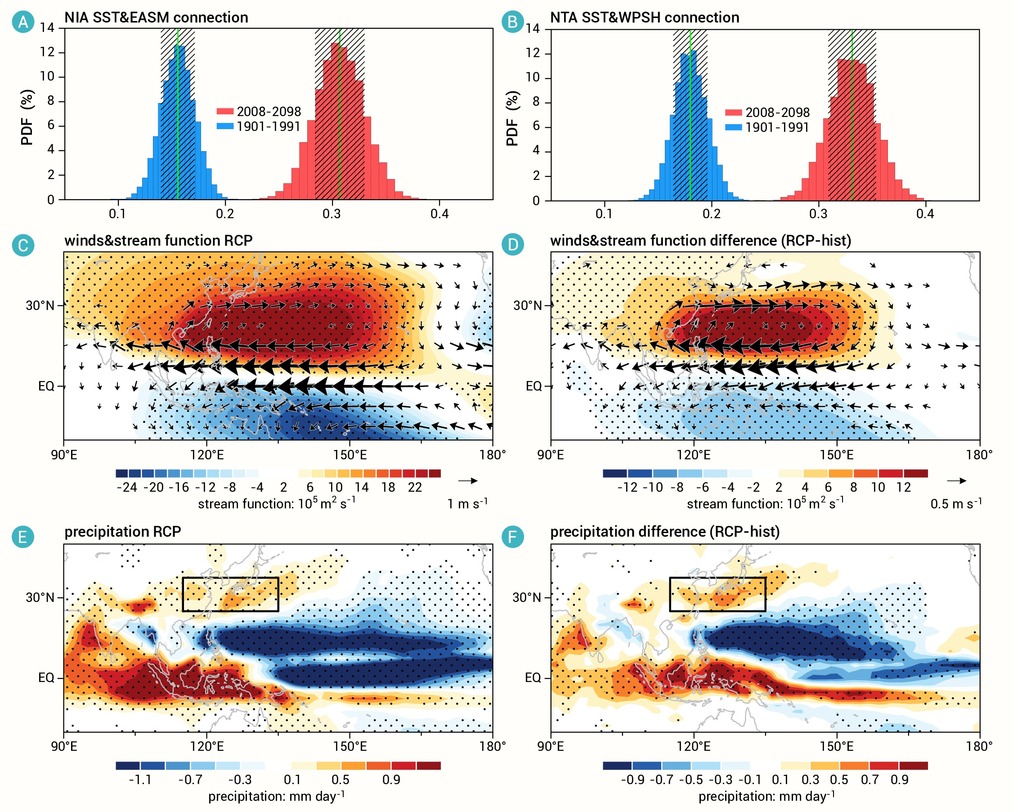
Figure 3.
Enhanced influence of SNTA SST on East Asian climate in a warmer climate
-
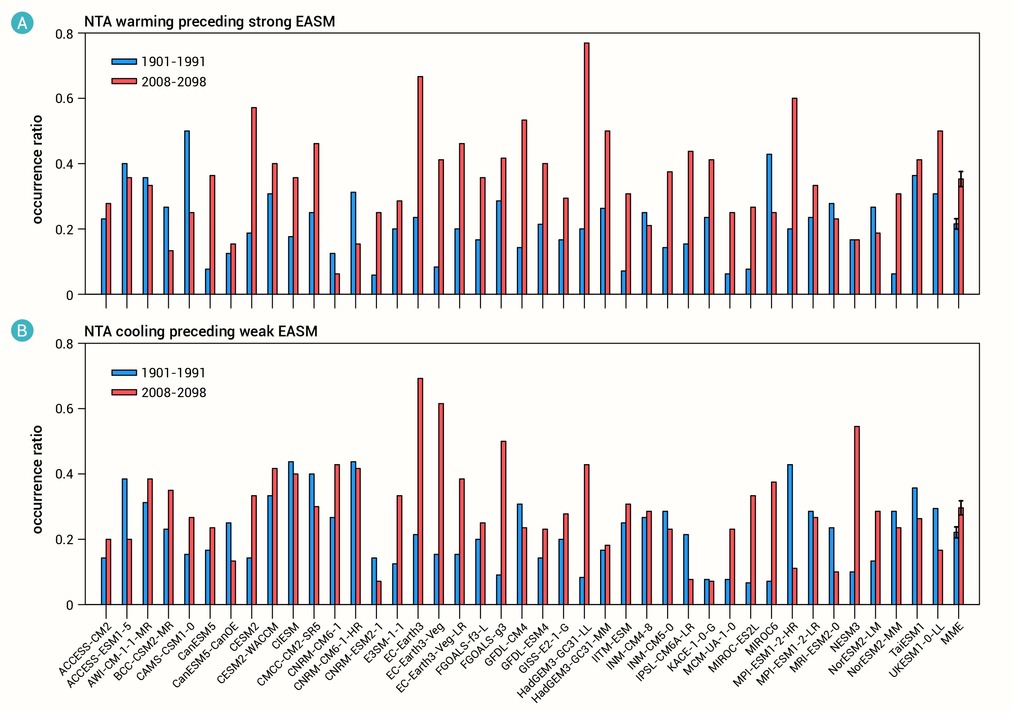
Figure 4.
Increased frequency of SNTA SSTAs followed by anomalous EASM events under greenhouse warming
-
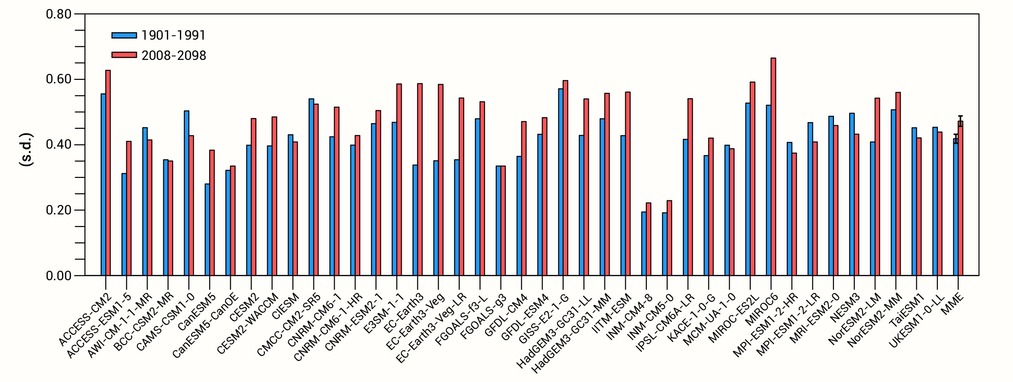
Figure 5.
Enhanced SNTA SST variability in a warmer climate
-
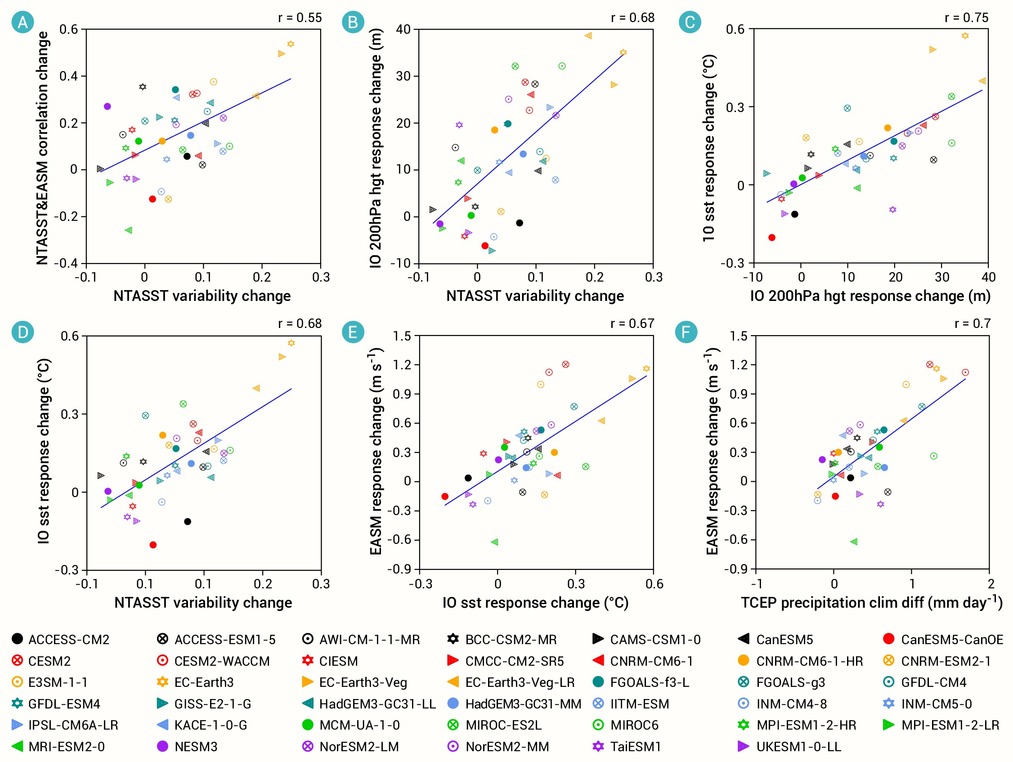
Figure 6.
Mechanisms for enhanced impact of SNTA SST on EASM in a warmer climate
-
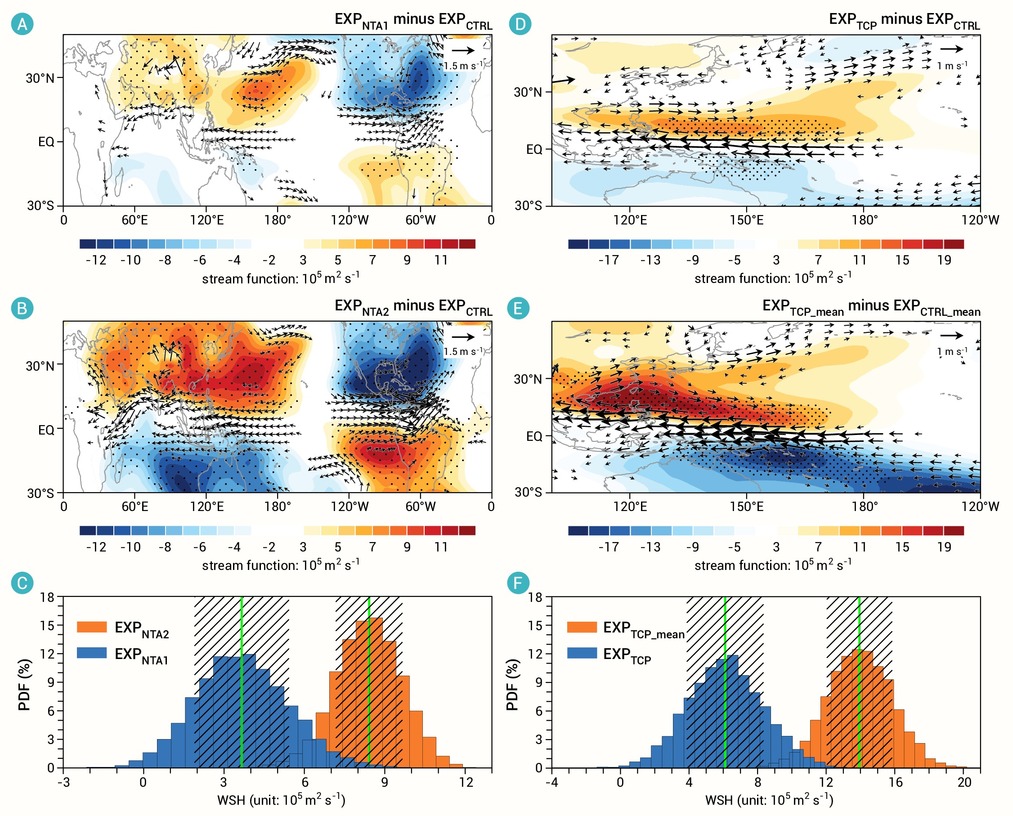
Figure 7.
Numerical experiments confirming enhanced impact of SNTA SSTAs on EASM due to increased NTA SST variability and wetter mean state in tropical Pacific
