
The rising high-mountain snowline — A global imprint of climate warming
-

-
REFERENCES
[1] Pepin N., Apple M., Knowles J., et al. (2025). Elevation-dependent climate change in mountain environments. Nat. Rev. Earth Environ. 6:772−788. DOI:10.1038/s43017-025-00740-4 [2] Schuster L., Maussion F., Rounce D.R., et al. (2025). Irreversible glacier change and trough water for centuries after overshooting 1.5°C. Nat. Clim. Change 15:634–641. DOI:10.1038/s41558-025-02318-w [3] Potapov P., Hansen M.C., Pickens A., et al. (2022). The global 2000-2020 land cover and land use change dataset derived from the landsat archive: First results. Front. Remote Sens. 3:856903. DOI:10.3389/frsen.2022.856903 [4] Ombadi M., Risser M.D., Rhoades A.M.,et al. (2023). A warming-induced reduction in snow fraction amplifies rainfall extremes. Nature 619:305−310. DOI:10.1038/s41586-023-06092-7 [5] Rhoades A.M., Hatchett B.J., Risser M.D.,et al. (2022). Asymmetric emergence of low-to-no snow in the midlatitudes of the American Cordillera. Nat. Clim. Change 12:1151−1159. DOI:10.1038/s41558-022-01518-y -
ABOUT THIS ARTICLE
Cite this article:
Li J., Tang S., He T., et al. (2026). The rising high-mountain snowline — A global imprint of climate warming. The Innovation Geoscience 4:100223. https://doi.org/10.59717/j.xinn-geo.2026.100223
Welcome!
To request copyright permission to republish or share portions of our works, please visit Copyright Clearance Center's (CCC) Marketplace website at marketplace.copyright.com.
Export File
Citation
Li J., Tang S., He T., et al. (2026). The rising high-mountain snowline — A global imprint of climate warming. The Innovation Geoscience 4:100223. https://doi.org/10.59717/j.xinn-geo.2026.100223

Format
Content
 DownLoad:
-
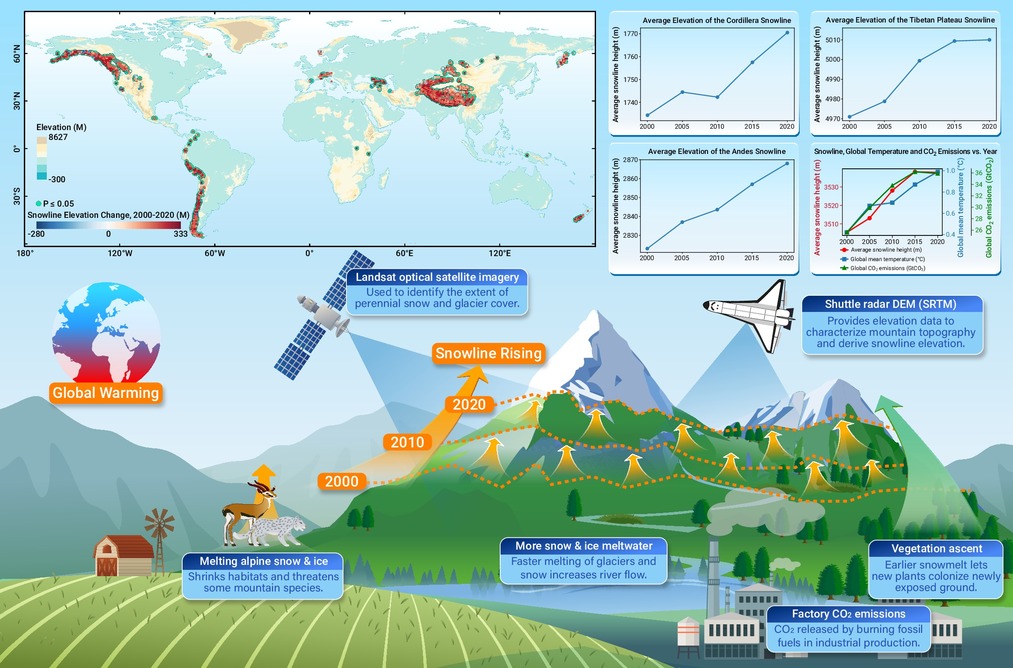
Figure 1.
Schematic illustration of the upward shift of high-mountain snowlines under global warming
