
Mid-Holocene rainfall heterogeneity in subtropical East Asia
-
GRAPHICAL ABSTRACT
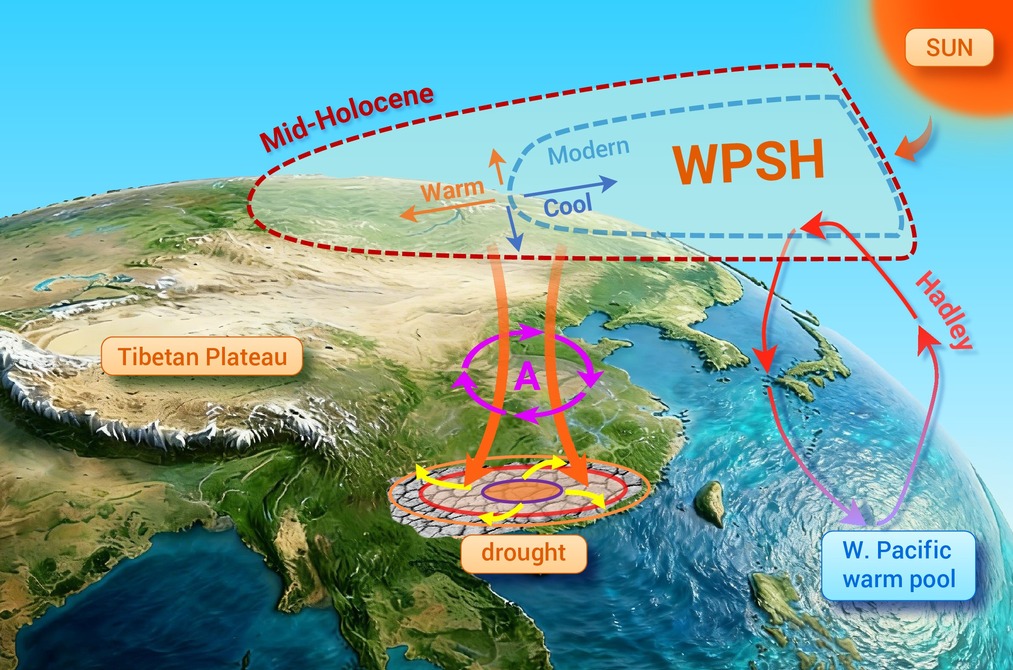
 DownLoad:
Full size image
DownLoad:
Full size image
-
PUBLIC SUMMARY
-
Western Pacific Subtropical High (WPSH) shapes the long-term rainfall heterogeneity in subtropical East Asia.
Mid-Holocene warming intensified the WPSH and led to prolonged droughts in subtropical East Asia.
Late Holocene cooling resulted in a weakened WPSH and increased precipitation in subtropical East Asia.
Solar forcing and the related temperature gradients likely regulate the long-term WPSH behaviors.
-
-
ABSTRACT
Growing lines of evidence reveal an unexpectedly dry mid-Holocene but wetting late Holocene in subtropical East Asia, which is anti-phase/out-of-phase to the widely recognized northern hemisphere solar-insolation-forced Asia summer monsoon precipitation trend. This asynchrony implies that some key processes are missing in the current understanding of the Asia summer monsoon dynamics across different monsoon subsystems. Here we further confirm this spatial rainfall heterogeneity with robust biogeological evidence, corroborated by archeological evidence and simulations of transient climatic models. We propose that the location and intensity of the western Pacific subtropical high (WPSH) are most likely responsible for the observed orbital/suborbital spatial hydroclimatic heterogeneity, while the tropical Indo-Pacific sea surface temperature (SST), the SST gradients between the west-east equatorial Pacific, as well as the temperature gradients between southern-northern hemispheres, are the governing factors that combinedly regulate the WPSH behaviors and ultimately modulate the orbital/suborbital rainfall heterogeneity in subtropical East Asia. -

-
REFERENCES
[1] Guo Z. (2017). Loess Plateau attests to the onsets of monsoon and deserts (in Chinese). Sci. China Earth Sci. 47:421−437. DOI:10.1360/n072017-00037 [2] Wu F., Fang X., Yang Y., et al. (2022). Reorganization of Asian climate in relation to Tibetan Plateau uplift. Nat. Rev. Earth Environ. 3:684−700. DOI:10.1038/s43017-022-00331-7 [3] Ding L., Kapp P., Cai F., et al. (2022). Timing and mechanisms of Tibetan Plateau uplift. Nat. Rev. Earth Environ. 3:652−667. DOI:10.1038/s43017-022-00318-4 [4] Guo Z. T., Ruddiman W. F., Hao Q. Z., et al. (2002). Onset of Asian desertification by 22 Myr ago inferred from loess deposits in China. Nature 416:159−163. DOI:10.1038/416159a [5] Hao L., Ma N. and He L. (2022). Circulation anomalies characteristics of the abnormal drought and high temperature event in the middle and lower reaches of the Yangtze River in summer of 2022 (in Chinese). J. Arid Meteorol. 40:721−732. DOI:10.11755/j.issn.1006-7639(2022)-05-0721 [6] Zhang H., Cheng H., Sinha A., et al. (2021). Collapse of the Liangzhu and other Neolithic cultures in the lower Yangtze region in response to climate change. Sci. Adv. 7:eabi9275. DOI:10.1126/sciadv.abi9275 [7] Ding Y., Wang Z. and Sun Y. (2008). Inter‐decadal variation of the summer precipitation in East China and its association with decreasing Asian summer monsoon. Part I: Observed evidences. Int. J. Climatol. 28:1139−1161. DOI:10.1002/joc.1615 [8] Xu H., Song Y., Cao J., et al. (2024). Heterogeneity of the East Asian rainfall influenced by solar-forced western Pacific subtropical high. Commun. Earth Environ. 5:1−9. DOI:10.1038/s43247-024-01660-9 [9] Wang Y., Cheng H., Edwards R. L., et al. (2008). Millennial- and orbital-scale changes in the East Asian monsoon over the past 224,000 years. Nature 451:1090−1093. DOI:10.1038/nature06692 [10] Hosner D., Wagner M., Tarasov P.E., et al. (2016). Spatiotemporal distribution patterns of archaeological sites in China during the Neolithic and Bronze Age: An overview. Holocene 26:1576−1593. DOI:10.1177/0959683616641743 [11] Xie S., Evershed R.P., Huang X., et al. (2013). Concordant monsoon-driven postglacial hydrological changes in peat and stalagmite records and their impacts on prehistoric cultures in central China. Geology 41:827−830. DOI:10.1130/g34318.1 [12] Xu H., Goldsmith Y., Lan J., et al. (2020). Juxtaposition of western Pacific subtropical high on Asian summer monsoon shapes subtropical East Asian precipitation. Geophys Res Lett. 47:e2019GL084705. DOI:10.1029/2019GL084705 [13] Berger A. L. (1978). Long-term variations of caloric insolation resulting from the Earth's orbital elements. Quat. Res. 9:139−167. DOI:10.1016/0033-5894(78)90064-9 [14] Goldsmith Y., Broecker W. S., Xu H., et al. (2017). Northward extent of East Asian monsoon covaries with intensity on orbital and millennial timescales. Proc. Natl. Acad. Sci. USA 114:1817−1821. DOI:10.1073/pnas.1616708114 [15] Dykoski C. A., Edwards R. L., Cheng H., et al. (2005). A high-resolution, absolute-dated Holocene and deglacial Asian monsoon record from Dongge Cave, China. Earth Planet. Sci. Lett. 233:71−86. DOI:10.1016/j.epsl.2005.01.036 [16] Liu Z., Otto-Bliesner B. L., He F., et al. (2009). Transient simulation of last deglaciation with a new mechanism for Bolling-Allerod warming. Science 325:310−314. DOI:10.1126/science.1171041 [17] Zhu C., Wu L., Li L., et al. (2014). Research progress on Holocene environmental archaeology in the Yangtze River Valley, China. Acta Geogr. Sin. 69:1268−1283. DOI:10.11821/dlxb201409003 [18] Wu D., Chen X., Lv F., et al. (2018). Decoupled early Holocene summer temperature and monsoon precipitation in southwest China. Quat. Sci. Rev. 193:54−67. DOI:10.1016/j.quascirev.2018.05.038 [19] Yancheva G., Nowaczyk N. R., Mingram J., et al. (2007). Influence of the intertropical convergence zone on the East Asian monsoon. Nature 445:74−77. DOI:10.1038/nature05431 [20] Lan J., Wang T., Chawchai S., et al. (2020). Time marker of 137Cs fallout maximum in lake sediments of Northwest China. Quat. Sci. Rev. 241:106413. DOI:10.1016/j.quascirev.2020.106413 [21] Xu H., Ai L., Tan L., et al. (2006). Geochronology of a surface core in the northern basin of Lake Qinghai: Evidence from 210Pb and 137Cs radionuclides. Chin. J. Geochem. 25:301−306. DOI:10.1007/s11631-006-0301-y [22] Zhang E., Zhao C., Xue B., et al. (2017). Millennial-scale hydroclimate variations in southwest China linked to tropical Indian Ocean since the Last Glacial Maximum. Geology 45:435−438. DOI:10.1130/g38309.1 [23] Li T., Zhang H., Cai M., et al. (2019). The composition of carbonate matters in the sediments from Lake Fuxian and significance of paleoclimate and water level changes. Quat. Sci. 39:642−654. DOI:10.11928/j.issn.1001-7410.2019.3.11 [24] Huang X., Zhang H., Griffiths M. L., et al. (2022). Holocene forcing of East Asian hydroclimate recorded in a subtropical peatland from southeastern China. Clim. Dyn. 60:981−993. DOI:10.1007/s00382-022-06333-x [25] Liu H., Gu Y., Huang X., et al. (2019). A 13,000-year peatland palaeohydrological response to the ENSO-related Asian monsoon precipitation changes in the middle Yangtze Valley. Quat. Sci. Rev. 212:80−91. DOI:10.1016/j.quascirev.2019.03.034 [26] Zhu Z., Feinberg J. M., Xie S., et al. (2017). Holocene ENSO-related cyclic storms recorded by magnetic minerals in speleothems of central China. Proc. Natl. Acad. Sci. USA 114:852−857. DOI:10.1073/pnas.1610930114 [27] Zhong W., Wei Z., Chen Y., et al. (2016). A 15.4-ka paleoclimate record inferred from δ13C and δ15N of organic matter in sediments from the sub-alpine Daping Swamp, western Nanling Mountains, South China. J. Paleolimnol. 57:127-139. DOI:10.1007/s10933-016-9935-x. [28] Yao S., Li C., Ling C., et al. (2019). About 3000 years of lake sediment hiatus due to relatively stable water level of the Yangtze River in the middle Holocene. Quat. Sci. 39:1148−1158. DOI:10.11928/j.issn.1001-7410.2019.05.07 [29] Chen T., Ryves D. B., Wang Z., et al. (2018). Mid- to late Holocene geomorphological and hydrological changes in the south Taihu area of the Yangtze delta plain, China. Palaeogeogr. Palaeoclimatol. Palaeoecol. 498:127−142. DOI:10.1016/j.palaeo.2018.03.012 [30] Liu Y., Sun Q., Thomas I., et al. (2015). Middle Holocene coastal environment and the rise of the Liangzhu City complex on the Yangtze delta, China. Quat. Res. 84:326−334. DOI:10.1016/j.yqres.2015.10.001 [31] Ling G., Ma C., Yang Q., et al. (2021). Landscape evolution in the Liangzhu area since the early Holocene: A comprehensive sedimentological approach. Palaeogeogr. Palaeoclimatol. Palaeoecol. 562:110141. DOI:10.1016/j.palaeo.2020.110141 [32] Liu J., Shen Z., Chen W., et al. (2021). Dipolar mode of precipitation changes between north China and the Yangtze River Valley existed over the entire Holocene: Evidence from the sediment record of Nanyi Lake. Int. J. Climatol. 41:1667−1681. DOI:10.1002/joc.6906 [33] Wu X., Shen J. and Wang Y. (2011). The Holocene climate linkage between low latitude area and north Atlantic: Case study on element and element ratios of Huguangyan Maar lake. Acta Sedimentol. Sin. 29:926−934. http://www.cjxb.ac.cn/en/article/id/282 [34] Chen H., Wen S., Song S., et al. (2012). Strengthening of paleo-typhoon and autumn rainfall in Taiwan corresponding to the Southern Oscillation at late Holocene. J. Quat. Sci. 27:964−972. DOI:10.1002/jqs.2590 [35] Zhong W., Xue J., Cao J., et al. (2010). Bulk organic carbon isotopic record of lacustrine sediments in Dahu Swamp, eastern Nanling Mountains in South China: Implication for catchment environmental and climatic changes in the last 16,000 years. J. Asian Earth Sci. 38:162−169. DOI:10.1016/j.jseaes.2009.12.011 [36] Zhou W., Yu X., Jull A. J. T., et al. (2004). High-resolution evidence from southern China of an early holocene optimum and a mid-holocene dry event during the past 18,000 Years. Quat. Res. 62:39−48. DOI:10.1016/j.yqres.2004.05.004 [37] Song Y., Xu H., Lan J., et al. (2022). Enhanced human activity altered the late Holocene vegetation composition in subtropical East Asia. Global Planet. Change 214:103850. DOI:10.1016/j.gloplacha.2022.103850 [38] Lin P., Xu X., Yan C., et al. (2022). Holocene sedimentary of the Pearl River Delta in South China: OSL and radiocarbon dating of cores from Zhuhai. Front. Mar. Sci. 9:1031456. DOI:10.3389/fmars.2022.1031456 [39] Xia Z. (2012). Environmental Archaeology - Theory and Practice (in Chinese) (Peking University Press). DOI:10.4324/9780203784471 [40] Zhang X. (2009). The course of the Taihu Lake’s evolution in historical period (in Chinese). J. Chin. Hist. Geogr. 24:5−12. https://zgld.cbpt.cnki.net/portal/journal/portal/client/paper/1cbafbe5501284e57b2a84b45556da45 [41] Ding J. (2015). Ancient wells of the Liangzhu culture (in Chinese) (Zhejiang Ancient Books Publishing House). https://www.lzmuseum.cn/WenHuaYanJiu/2019162158169.html [42] Zhu C., Song J., Long K., et al. (1996). Study on the Interruptions of the Shanghai Maqiao Culture (in Chinese). Chin. Sci. Bull. 41:148−152. DOI:10.1360/csb1996-41-2-148 [43] An Z., Porter S. C., Kutzbach J. E., et al. (2000). Asynchronous Holocene optimum of the East Asian monsoon. Quat. Sci. Rev. 19:743−762. DOI:10.1016/s0277-3791(99)00031-1 [44] Liu Z., Wen X., Brady E. C., et al. (2014). Chinese cave records and the East Asia Summer Monsoon. Quat. Sci. Rev. 83:115−128. DOI:10.1016/j.quascirev.2013.10.021 [45] Rao Z., Li Y., Zhang J., et al. (2016). Investigating the long-term palaeoclimatic controls on the δD and δ18O of precipitation during the Holocene in the Indian and East Asian monsoonal regions. Earth-Sci. Rev. 159:292−305. DOI:10.1016/j.earscirev.2016.06.007 [46] Ning L., Xing F., Liu Z., et al. (2025). Mega‐tripolar precipitation change accompanying water isotopes in Holocene Asian summer monsoon reanalysis. Geophys. Res. Lett. 52:e2025GL116451. DOI:10.1029/2025gl116451 [47] Chiang J. C. H., Fung I. Y., Wu C.-H., et al. (2015). Role of seasonal transitions and westerly jets in East Asian paleoclimate. Quat. Sci. Rev. 108:111−129. DOI:10.1016/j.quascirev.2014.11.009 [48] Zhang H., Griffiths M. L., Chiang J. C. H., et al. (2018). East Asian hydroclimate modulated by the position of the westerlies during Termination Ⅰ. Science 362:580−583. DOI:10.1126/science.aat9393 [49] Dai G., Zhang Z., Otterå O. H., et al. (2021). A modeling study of the tripole pattern of East China precipitation over the past 425 ka. J. Geophys. Res. Atmos. 126:e2020JD033513. DOI:10.1029/2020jd033513 [50] Wen Q., Liu Z., Jing Z., et al. (2024). Grand dipole response of Asian summer monsoon to orbital forcing. npj Clim. Atmos. Sci. 7:202. DOI:10.1038/s41612-024-00749-4 [51] Sun Y., Wu H., Ramstein G., et al. (2023). Revisiting the physical mechanisms of East Asian summer monsoon precipitation changes during the mid-Holocene: A data–model comparison. Clim. Dyn. 60:1009−1022. DOI:10.1007/s00382-022-06359-1 [52] Wu Y., Liu Y., Zhou W., et al. (2022). The mid-Holocene East Asian summer monsoon simulated by PMIP4-CMIP6 and PMIP3-CMIP5: Model uncertainty and its possible sources. Global Planet. Change 219:103986. DOI:10.1016/j.gloplacha.2022.103986 [53] Piao J., Chen W., Wang L., et al. (2020). Northward extension of the East Asian summer monsoon during the mid-Holocene. Global Planet. Change 184:103046. DOI:10.1016/j.gloplacha.2019.103046 [54] Liu Y., Ding Y., Gao H., et al. (2013). Tropospheric biennial oscillation of the western Pacific subtropical high and its relationships with the tropical SST and atmospheric circulation anomalies. Chin. Sci. Bull. 58:3664−3672. DOI:10.1007/s11434-013-5854-7 [55] Zhou T., Yu R., Zhang J., et al. (2009). Why the Western Pacific subtropical high has extended westward since the late 1970s. J. Clim. 22:2199−2215. DOI:10.1175/2008JCLI2527.1 [56] Zhang Q. and Tao S. (2003). The anomalous subtropical anticyclone in Western Pacific and their association with circulation over East Asia during summer (in Chinese). Chin. J. Atmos. Sci. 27:369−380. DOI:10.3878/j.issn.1006-9895.2003.03.07 [57] Huang R. and Sun F. (1994). Impacts of the thermal state and the convective activities in the tropical western warm pool on the summer climate anomalies in East Asia. Sci. Atmos. Sin. 18:141−151. DOI:10.3878/j.issn.1006-9895.1994.02.02 [58] Jin C., Liu J., Wang B., et al. (2019). Decadal variations of the East Asian summer monsoon forced by the 11-year insolation cycle. J. Clim. 32:2735−2745. DOI:10.1175/JCLI-D-18-0288.1 [59] Zhang H., Cheng H., Cai Y., et al. (2018). Hydroclimatic variations in southeastern China during the 4.2 ka event reflected by stalagmite records. Clim. Past 14:1805-1817. DOI:10.5194/cp-14-1805-2018 [60] Wang T., Li D., Cheng X., et al. (2022). Hydroclimatic changes in south-central China during the 4.2 ka event and their potential impacts on the development of Neolithic culture. Quat. Res. 109:39-52. DOI:10.1017/qua.2022.11 [61] Goldsmith Y., Xu H., Torfstein A., et al. (2022). Abrupt contraction of the Indo‐East Asian monsoons ended the Holocene humid period. Geophys. Res. Lett. 49:e2022GL100137. DOI:10.1029/2022gl100137 [62] Zhang Q., Berntell E., Axelsson J., et al. (2021). Simulating the mid-Holocene, last interglacial and mid-Pliocene climate with EC-Earth3-LR. Geosci. Model Dev. 14:1147−1169. DOI:10.5194/gmd-14-1147-2021 [63] Koutavas A. and Joanides S. (2012). El Niño-Southern Oscillation extrema in the Holocene and Last Glacial Maximum. Paleoceanography 27:PA4208. DOI:10.1029/2012PA002378 [64] McGee D., Donohoe A., Marshall J., et al. (2014). Changes in ITCZ location and cross-equatorial heat transport at the Last Glacial Maximum, Heinrich Stadial 1, and the mid-Holocene. Earth Planet. Sci. Lett. 390:69−79. DOI:10.1016/j.epsl.2013.12.043 [65] Osman M. B., Tierney J. E., Zhu J., et al. (2021). Globally resolved surface temperatures since the Last Glacial Maximum. Nature 599:239−244. DOI:10.1038/s41586-021-03984-4 [66] Shakun J. D., Clark P. U., He F., et al. (2012). Global warming preceded by increasing carbon dioxide concentrations during the last deglaciation. Nature 484:49−54. DOI:10.1038/nature10915 [67] Marcott S. A., Shakun J. D., Clark P. U., et al. (2013). A reconstruction of regional and global temperature for the past 11,300 years. Science 339:1198−1201. DOI:10.1126/science.1228026 -
ABOUT THIS ARTICLE
Cite this article:
Xu H., Cao J., Wang J., et al. (2026). Mid-Holocene rainfall heterogeneity in subtropical East Asia. The Innovation Geoscience 4:100225. https://doi.org/10.59717/j.xinn-geo.2026.100225
Welcome!
To request copyright permission to republish or share portions of our works, please visit Copyright Clearance Center's (CCC) Marketplace website at marketplace.copyright.com.
Export File
Citation
Xu H., Cao J., Wang J., et al. (2026). Mid-Holocene rainfall heterogeneity in subtropical East Asia. The Innovation Geoscience 4:100225. https://doi.org/10.59717/j.xinn-geo.2026.100225

Format
Content
-
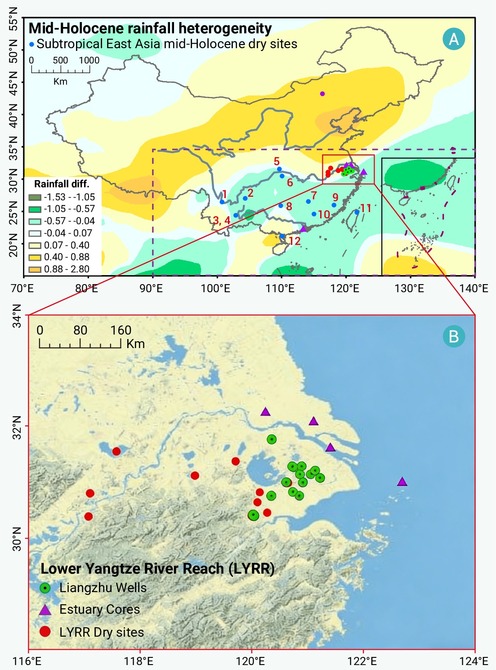
Figure 1.
Mid-Holocene rainfall heterogeneity in subtropical East Asia
-
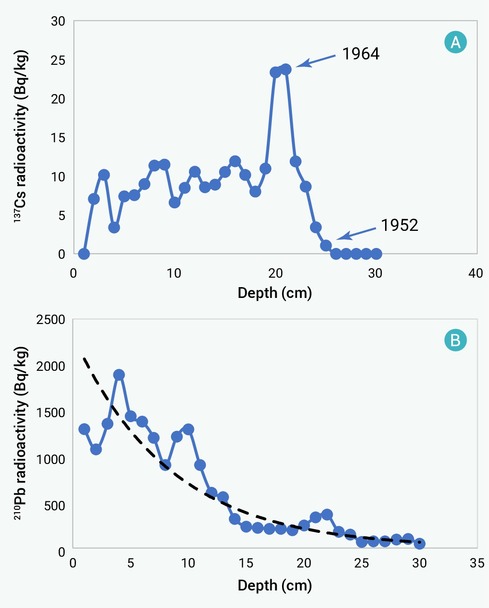
Figure 2.
Radioactivity of 137Cs (A) and 210Pb (B) in Core CH18-3-4 in Lake Caohai
-
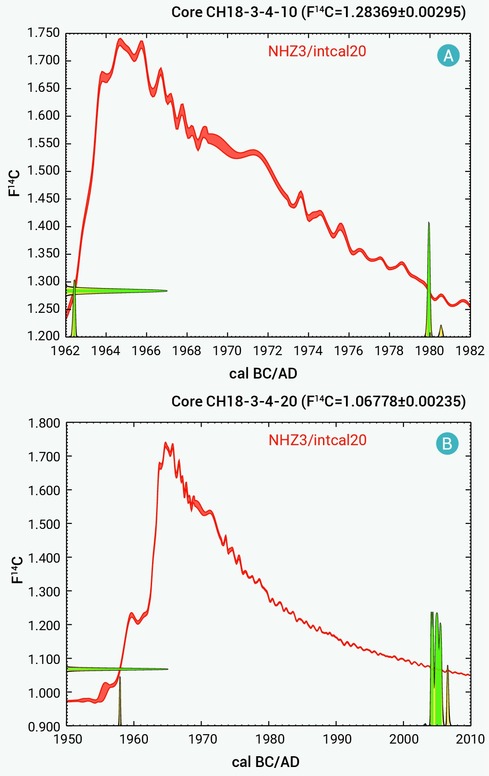
Figure 3.
The fraction modern carbon (F14C) of two surface samples (CH18-3-4-10:1979AD, left; CH18-3-4-20:1958AD, right) in Core CH18-3-4 in Lake Caohai
-
Figure 4.
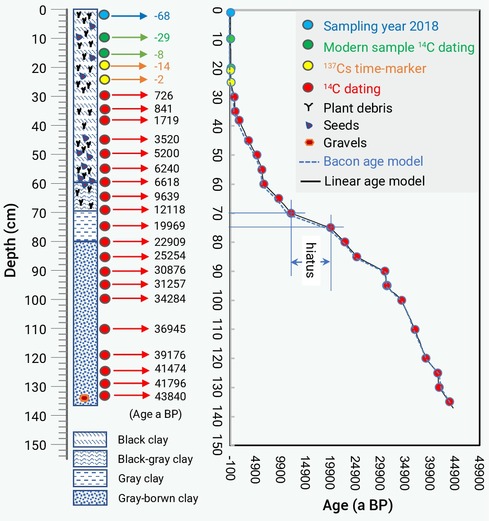
Age model of Core CH18-3-4 in Lake Caohai.
-
Figure 5.
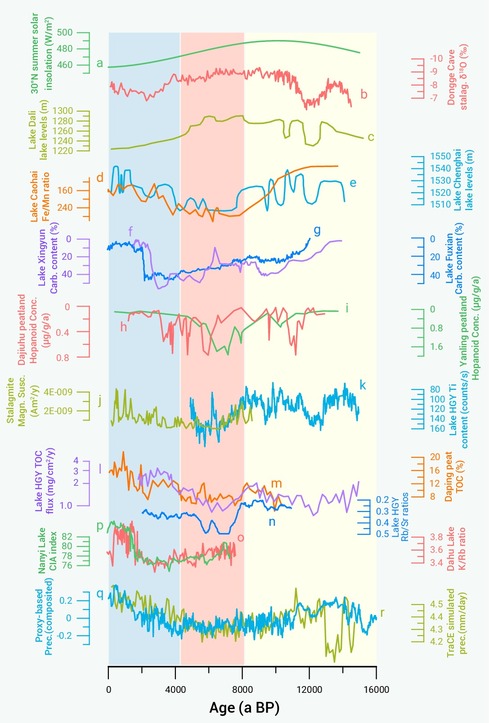
Comparison between hydroclimates in subtropical East Asia, NH summer solar insolation (curve a),13 and ASM precipitation inferred from stalagmite δ18O (curve b)15
-
Figure 6.
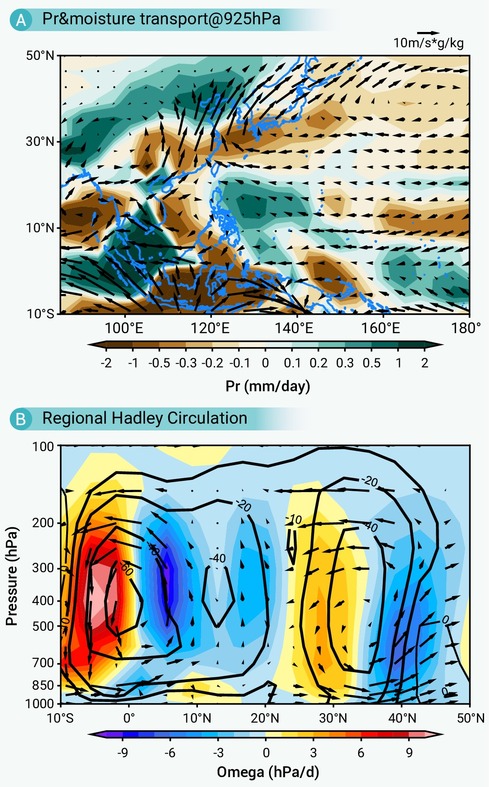
Differences in climate states between mid-Holocene (
8000 -6000 a BP) and4200 a BP -
Figure 7.
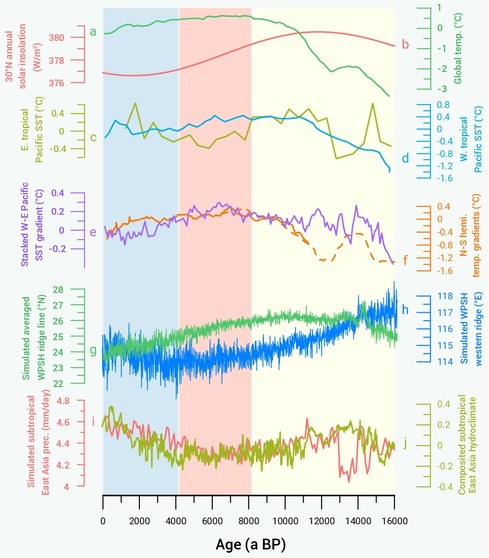
Comparison between orbital/suborbital WPSH behaviors, the hydroclimates in subtropical East Asia, and possible forcing
