
NUIST-WE: A foundation architecture for weather and energy forecasting integrating meteorological physics and generative pre-training
-

-
REFERENCES
[1] Zhang Z., Lin L., Gao S., et al. (2025). A machine learning model for hub-height short-term wind speed prediction. Nat. Commun. 16:3195. DOI:10.1038/s41467-025-58456-4 [2] Dean N. (2022). Collaborating on clean energy action. Nat. Energy 7:785−787. DOI:10.1038/s41560-022-01118-2 [3] Supran G., Rahmstorf S. and Oreskes N. (2023). Assessing ExxonMobil’s global warming projections. Science 379:eabk0063. DOI:10.1126/science.abk0063 [4] Bodnar C., Bruinsma W. P., Lucic A., et al. (2025). A foundation model for the Earth system. Nature 641:1180−1187. DOI:10.1038/s41586-025-09005-y [5] Jimenez P. A., Hacker J. P., Dudhia J., et al. (2016). WRF-Solar: Description and clear-sky assessment of an augmented NWP model for solar power prediction. Bull. Amer. Meteor. Soc. 97:1249−1264. DOI:10.1175/BAMS-D-14-00279.1 [6] Hersbach H., Bell B., Berrisford P., et al. (2020). The ERA5 global reanalysis. Q. J. R. Meteorol Soc. 146:1999−2049. DOI:10.1002/qj.3803 [7] Reichstein M., Camps-Valls G., Stevens B., et al. (2019). Deep learning and process understanding for data-driven Earth system science. Nature 566:195−204. DOI:10.1038/s41586-019-0912-1 [8] Moon J., Kim J., Kang P., et al. (2020). Solving the cold-start problem in short-term load forecasting using tree-based methods. Energies 13:886. DOI:10.3390/en13040886 -
ABOUT THIS ARTICLE
Cite this article:
Chen H., Liu Y., Zhu H., et al. (2026). NUIST-WE: A foundation architecture for weather and energy forecasting integrating meteorological physics and generative pre-training. The Innovation Geoscience 4:100232. https://doi.org/10.59717/j.xinn-geo.2026.100232
Welcome!
To request copyright permission to republish or share portions of our works, please visit Copyright Clearance Center's (CCC) Marketplace website at marketplace.copyright.com.
Export File
Citation
Chen H., Liu Y., Zhu H., et al. (2026). NUIST-WE: A foundation architecture for weather and energy forecasting integrating meteorological physics and generative pre-training. The Innovation Geoscience 4:100232. https://doi.org/10.59717/j.xinn-geo.2026.100232

Format
Content
 DownLoad:
-
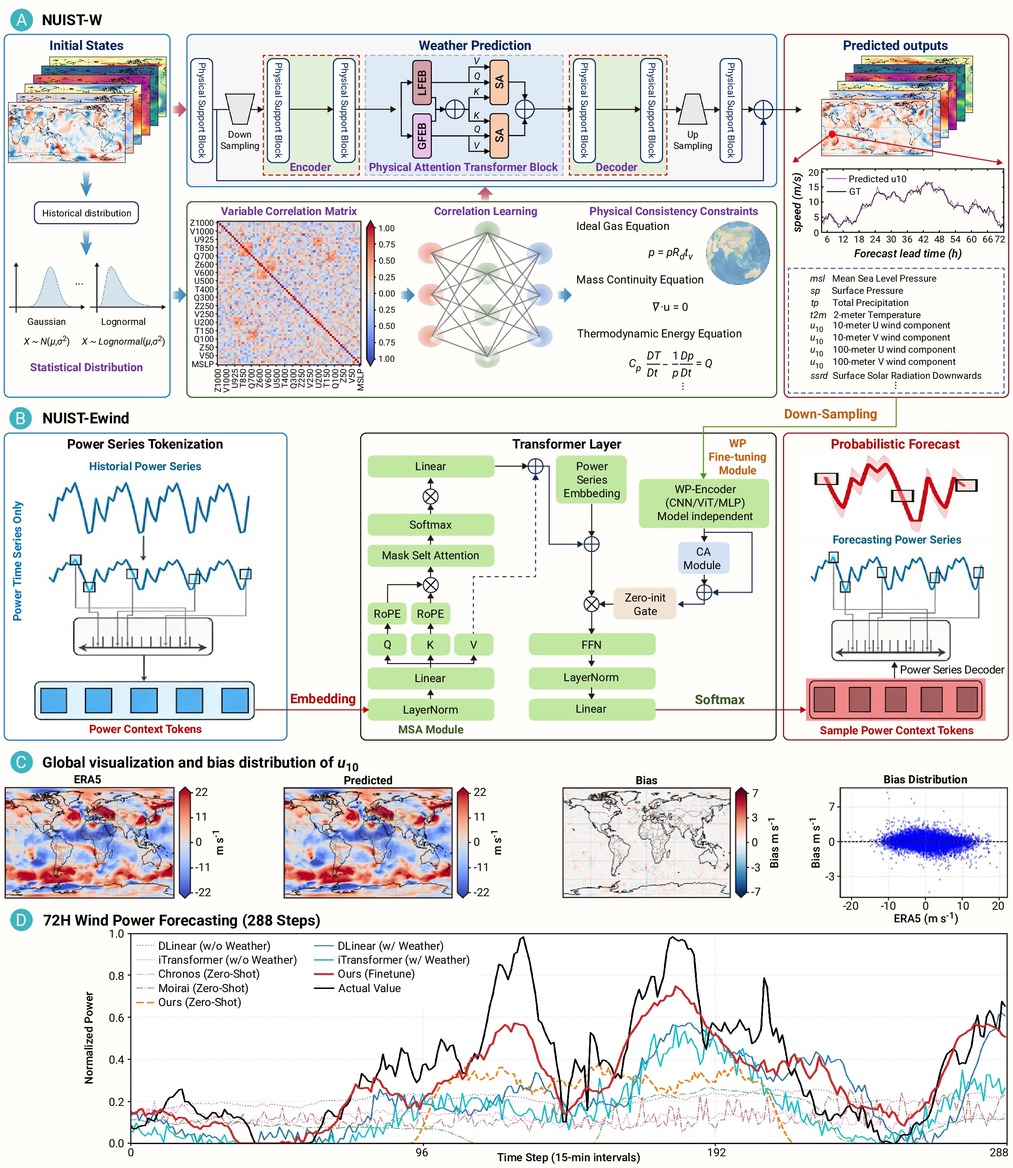
Figure 1.
The overall architecture and experiment results of NUIST-WE
