
Contrasting responses of fish taxonomic and functional diversity to eutrophication in Danish shallow lakes
-
GRAPHICAL ABSTRACT
 DownLoad:
Full size image
DownLoad:
Full size image
-
PUBLIC SUMMARY
-
We present fish diversity in 96 Danish shallow lakes that varied greatly in nutrient levels and morphometry.
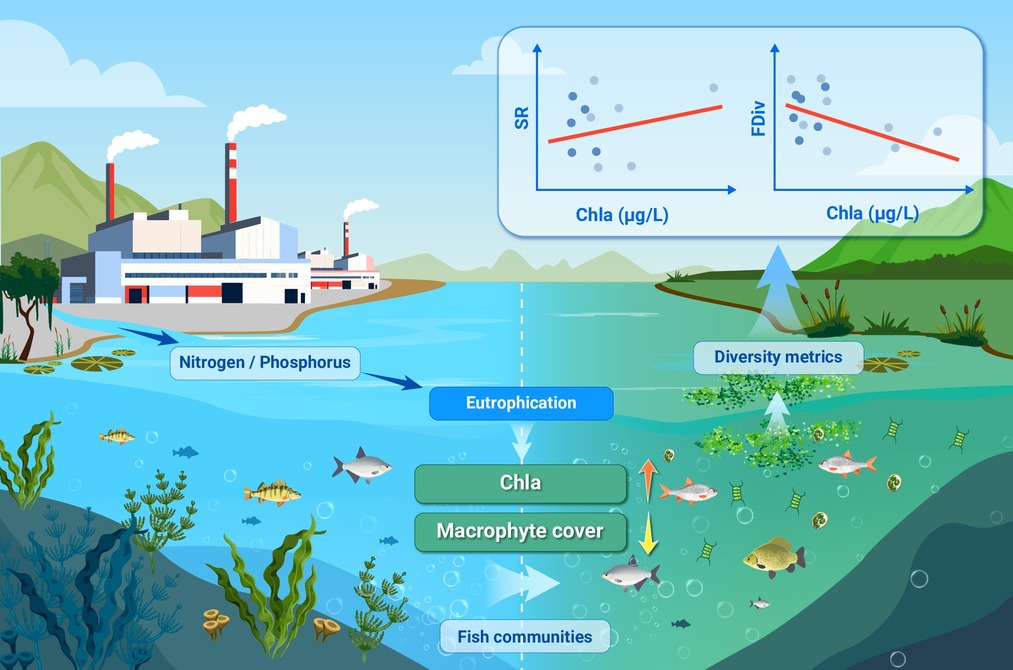
Functional divergence fell with lower macrophyte cover and higher chlorophyll a, but species richness rose.
Functional diversity may better detect habitat degradation in lake ecosystems than taxonomic diversity.
-
-
ABSTRACT
Shallow lakes may shift from a clear state dominated by submerged macrophytes to a turbid state dominated by phytoplankton under increasing nutrient stress. The implications of such an ecosystem state shift for fish taxonomic and functional diversity remain poorly understood. To address this question, we analyzed fish diversity in 96 Danish shallow lakes that varied greatly in nutrient levels and morphometry. We first fit a multiple linear model and used hierarchical variance partitioning to examine the relative importance of multiple environmental variables for changes in fish diversity metrics. Then we used the results to guide the construction of a piecewise structural equation model (pSEM) to quantify the direct and indirect effects of abiotic and biotic variables on fish diversity. Liner regression models demonstrated that the functional divergence of fish communities increased with chlorophyll a and decreased with reduced submerged macrophyte cover, whereas species richness and other diversity measures showed the opposite response. Chlorophyll a explained more variance in the selected fish diversity metrics than any other predictor. Loss of macrophytes due to eutrophication could lead to habitat homogenization and food resource simplification and, in turn, replacement of species belonging to the functionally diverse benthic and lithophilic species guilds by members of the more species rich but functionally redundant pelagic guild. Our study showed that functional divergence may better detect habitat degradation in lake ecosystems than taxonomic diversity, and it highlights the importance of macrophytes for maintaining the ecosystem functions of shallow lakes. -

-
REFERENCES
[1] Barbarossa V., Bosmans J., Wanders N., et al. (2021). Threats of global warming to the world’s freshwater fishes. Nat. Commun. 12:1701. DOI:10.1038/s41467-021-21655-w [2] Dudgeon D., Arthington A.H., Gessner M.O., et al. (2006). Freshwater biodiversity: Importance, threats, status and conservation challenges. Biol. Rev. 81:163−182. DOI:10.1017/s1464793105006950 [3] Mouillot D., Graham N.A.J., Villéger S., et al. (2013). A functional approach reveals community responses to disturbances. Trends Ecol. Evol. 28:167−177. DOI:10.1016/j.tree.2012.10.004 [4] Cardinale B.J., Duffy J.E., Gonzalezand A., et al. (2012). Biodiversity loss and its impact on humanity. Nature 486:59−67. DOI:10.1038/nature11148 [5] Scheffer M., Hosper S.H., Meijer M.L., et al. (1993). Alternative equilibria in shallow lakes. Trends Ecol. Evol. 8:275−279. DOI:10.1016/0169-5347(93)90254-m [6] Hobbs J.M.R., Hobbs W.O., Edlund M.B., et al. (2016). The legacy of large regime shifts in shallow lakes. Ecol. Appl. 26:2660−2674. DOI:10.1002/eap.1382 [7] Jeppesen E., Søndergaard M., Meerhoff M., et al. (2007). Shallow lake restoration by nutrient loading reduction - some recent findings and challenges ahead. Hydrobiologia 584:239−252. DOI:10.1007/s10750-007-0596-7 [8] Hillebrand H., Donohue I., Harpole W.S., et al. (2020) Thresholds for ecological responses to global change do not emerge from empirical data. Nat. Ecol. Evol. 4:1502-1509. DOI:10.1038/s41559-020-1256-9 [9] Davidson T.A., Sayer C.D., Jeppesen E., et al. (2023) Bimodality and alternative equilibria do not help explain long-term patterns in shallow lake chlorophyll-a. Nat. Commun. 14:398. DOI:10.1038/s41467-023-36043-9 [10] Stuart-Smith R.D., Bates A.E., Lefcheck J.S., et al. (2013). Integrating abundance and functional traits reveals new global hotspots of fish diversity. Nature 501:539−542. DOI:10.1038/nature12529 [11] Hilt S., Brothers S., Jeppesen E., et al. (2017). Translating regime shifts in shallow lakes into changes in ecosystem functions and services. BioScience 67:928−936. DOI:10.1038/s41559-020-1216-4 [12] Janssen A.B.G., Hilt S., Kosten S., et al. (2021). Shifting states, shifting services: Linking regime shifts to changes in ecosystem services of shallow lakes. Freshwater Biol. 66:1−12. DOI:10.1111/fwb.13582 [13] Thomaz S.M. (2023). Ecosystem services provided by freshwater macrophytes. Hydrobiologia 850:2757−2777. DOI:10.1007/s10750-021-04739-y [14] Chase J.M. and Leibold M.A. (2002). Spatial scale dictates the productivity-biodiversity relationship. Nature 416:427−430. DOI:10.1038/416427a [15] Menezes R.F., Borchsenius F., Svenning J.C., et al. (2015). Homogenization of fish assemblages in different lake depth strata at local and regional scales. Freshwater Biol. 60:745−757. DOI:10.1111/fwb.12526 [16] Jeppesen E., Jensen J.P., Søndergaard M., et al. (2000). Trophic structure, species richness and biodiversity in Danish lakes: Changes along a phosphorus gradient. Freshwater Biol. 45:201−218. DOI:10.1046/j.1365-2427.2000.00675.x [17] Villéger S., Miranda J.R., Hernández D.F., et al. (2010). Contrasting changes in taxonomic vs. functional diversity of tropical fish communities after habitat degradation. Ecol. Appl. 20:1512−1522. DOI:10.1890/09-1310.1 [18] Arantes C.C., Winemiller K.O., Petrere M., et al. (2018). Relationships between forest cover and fish diversity in the Amazon River floodplain. J. Appl. Ecol. 55:386−395. DOI:10.1111/1365-2664.12967 [19] Mittelbach G.G., Steiner C.F., Scheiner S.M., et al. (2001). What is the observed relationship between species richness and productivity. Ecology 82:2381−2396. DOI:10.1890/0012-9658(2001)082[2381:witorb]2.0.co;2 [20] Quirino B.A., Lansac-Tôha F.M., Thomaz S.M., et al. (2021). Macrophyte stand complexity explains the functional α and β diversity of fish in a tropical river-floodplain. Aquat. Sci. 83:12. DOI:10.1007/s00027-020-00768-2 [21] Mehner T., Diekmann M., Brämick U., et al. (2005). Composition of fish communities in German lakes as related to lake morphology, trophic state, shore structure and human-use intensity. Freshwater Biol. 50:70−85. DOI:10.1111/j.1365-2427.2004.01294.x [22] Martinsen K.T., Kristensen E., Baastrup-Spohr L., et al. (2023). Environmental predictors of lake fish diversity across gradients in lake age and spatial scale. Freshwater Biol. 68:1122−1135. DOI:10.1111/fwb.14090 [23] Brucet S., Pédron S., Mehner T., et al. (2013). Fish diversity in European lakes: Geographical factors dominate over anthropogenic pressures. Freshwater Biol. 58:1779−1793. DOI:10.1111/fwb.12167 [24] Olden J.D., Kennard M.K., Leprieur F., et al. (2010). Conservation biogeography of freshwater fishes: Recent progress and future challenges. Divers. Distrib. 16:496−513. DOI:10.1111/j.1472-4642.2010.00655.x [25] Mason N.W.H., Mouillot D., Lee W.G., et al. (2005). Functional richness, functional evenness and functional divergence: The primary components of functional diversity. Oikos 111:112−118. DOI:10.1111/j.0030-1299.2005.13886.x [26] Villéger S., Mason N.W. and Mouillot D. (2008). New multidimensional functional diversity indices for a multifaceted framework in functional ecology. Ecology 89:2290−2301. DOI:10.1890/07-1206.1 [27] Cadotte M.W., Carscadden K. and Mirotchnick N. (2011). Beyond species: Functional diversity and the maintenance of ecological processes and services. J. Appl. Ecol. 48:1079−1087. DOI:10.1111/j.1365-2664.2011.02048.x [28] Mao Z., Gu X., Cao Y., et al. (2021). How does fish functional diversity respond to environmental changes in two large shallow lakes. Sci. Total Environ. 753:142158. DOI:10.1016/j.scitotenv.2020.142158 [29] Moi D.A., Romero G.Q., Jeppesen E., et al. (2022). Regime shifts in a shallow lake over 12 years: Consequences for taxonomic and functional diversities, and ecosystem multifunctionality. J. Anim. Ecol. 91:551−565. DOI:10.1111/1365-2656.13658 [30] Jeppesen E., Søndergaard M., Kronvang B., et al. (1999). Lake and catchment management in Denmark. Hydrobiologia 395:419−432. DOI:10.1023/A:1017071602549 [31] Persson L., Diehl S., Johansson L., et al. (1991). Shifts in fish communities along the productivity gradient of temperate lakes - patterns and the importance of size-structured interactions. J. Fish Biol. 38:281−293. DOI:10.1111/j.1095-8649.1991.tb03114.x [32] Smokorowski K.E. and Pratt T.C. (2007). Effect of a change in physical structure and cover on fish and fish habitat in freshwater ecosystems - A review and meta-analysis. Environ. Rev. 15:15−41. DOI:10.1139/a06-007 [33] Suding K.N., Lavorel S., Chapin Iii F.S., et al. (2008). Scaling environmental change through the community level: A trait-based response-and effect framework for plants. Global Change Biol. 14:1125-1140. DOI:10.1111/j.1365-2486.2008.01557.x [34] SDFE. (2021). Danish map supply, SDFE (Agency for Datasupply and Efficiency). https://dataforsyn ingen.dk/data [35] Riis T. and Sand-Jensen K. (2001). Historical changes in species composition and richness accompanying perturbation and eutrophication of Danish lowland streams over 100 years. Freshwater Biol. 46:269−280. DOI:10.1046/j.1365-2427.2001.00656.x [36] Svendsen L., van der Bijl L., Boutrup S., et al. (2005). NOVANA. National Monitoring and assessment Programme for the aquatic and terrestrial environments. Programme description, part 2. NERI technical report No. 537. National Environmental Research Institute, Aarhus. https://www2.dmu.dk/1_viden/2_publikationer/3_fagrapporter [37] Søndergaard M., Jeppesen E., Jensen J.P., et al. (2005). Water framework directive: Ecological classification of Danish lakes. J. Appl. Ecol. 42:616−629. DOI:10.1111/j.1365-2664.2005.01040.x [38] Quirino B.A., Søndergaard M., Lauridsen T.L., et al. (2023). Associations between submerged macrophytes and fish communities at two spatial scales in 88 temperate shallow lakes. Freshwater Biol. 68:1211−1223. DOI:10.1111/fwb.14098 [39] European Committee for Standardization. (2015). Water quality - Sampling of fish with multi-mesh gill nets. European standard EN 14757, 2015. https://standards.iteh.ai/catalog/standards/cen/52310e21-ca81-49b1-9eec-05554e59178d/en-14757-2015 [40] Jeppesen E., Pekcan-Hekim Z., Lauridsen T.L., et al. (2006). Habitat distribution of fish in late summer: Changes along a nutrient gradient in Danish lakes. Ecol. Freshw. Fish 15:180−190. DOI:10.1111/j.1600-0633.2006.00142.x [41] Mortensen E., Jerl-Jensen H., Müller J.P., et al. (1990). Fiskeundersøgelser i søer. Undersøgelsesprogram, fiskeredskaber og metoder (Fish investigations in lakes Monitoring programme fish gear and methods). National Environmental Research Institute. Technical Report 3:57. (in Danish). https://www2.dmu.dk/Pub/TA03.pdf [42] Chao A., Gotelli N.J., Hsieh T.C., et al. (2014). Rarefaction and extrapolation with Hill numbers: A framework for sampling and estimation in species diversity studies. Ecol. Monogr. 84:45−67. DOI:10.1890/13-0133.1 [43] Hill M. (1973). Diversity and evenness: A unifying notation and its consequences. Ecology 54:427−432. DOI:10.2307/1934352 [44] Chao A. and Chiu C.H. (2016). Nonparametric Estimation and Comparison of Species Richness. Wiley Online Reference in the Life Sciences. In: eLS. John Wiley & Sons, Ltd: Chichester. DOI:10.1002/9780470015902.a0026329 [45] Parker J., Cao Y., Sass G.G., et al. (2018). Large river fish functional diversity responses to improved water quality over a 28-year period. Ecol. Indic. 88:322−331. DOI:10.1016/j.ecolind.2018.01.035 [46] Vila-Gispert A. and Moreno-Amich R. (2002). Life-history patterns of 25 species from European freshwater fish communities. Environ. Biol. Fishes 65:387−400. DOI:10.1023/A:1021181022360 [47] Blanck A., Tedesco P.A. and Lamouroux N. (2007). Relationships between life-history strategies of European freshwater fish species and their habitat preferences. Freshwater Biol. 52:843−859. DOI:10.1111/j.1365-2427.2007.01736.x [48] Santos R., Poulet N. and Besnard A. (2021). Life-history traits correlate with temporal trends in freshwater fish populations for common European species. Freshwater Biol. 66:317−331. DOI:10.1111/fwb.13640 [49] Mao Z., Gu X., Zeng Q., et al. (2024). Effects of habitat regime type on fish diversity in a large eutrophic lake. Hydrobiologia 851:1807−1823. DOI:10.1007/s10750-023-05416-y [50] R Core Team. (2022). R: A language and environment for statistical computing. R Foundation for Statistical Computing, Vienna, Austria. https://www.R-project.org [51] Laliberté E., Wells J.A., Declerck F., et al. (2010). Land-use intensification reduces functional redundancy and response diversity in plant communities. Ecol. Lett. 13:76−86. DOI:10.1111/j.1461-0248.2009.01403.x [52] Chevan A. and Sutherland M. (1991). Hierarchical partitioning. Am. Stat. 45:90−96. DOI:10.2307/2684366 [53] Lambert S.J. and Davy A.J. (2011). Water quality as a threat to aquatic plants: Discriminating between the effects of nitrate, phosphate, boron and heavy metals on charophytes. New Phytol. 189:1051−1059. DOI:10.1111/j.1469-8137.2010.03543.x [54] South E. J., DeWalt R.E. and Cao Y. (2019). Relative importance of Conservation Reserve Programs to aquatic insect biodiversity in an agricultural watershed in the Midwest, USA. Hydrobiologia 829:323−340. DOI:10.1007/s10750-018-3842-2 [55] Lefcheck J.S. (2016). piecewiseSEM: Piecewise structural equation modelling in r for ecology, evolution, and systematics. Methods Ecol. Evol. 7:573−579. DOI:10.1111/2041-210X.12512 [56] Grace J.B. (2006). Structural equation modeling and natural systems. Cambridge University Press, New York. DOI:10.1017/CBO9780511617799 [57] Borcard D., Legendre P. and Drapeau P. (1992). Partialling out the spatial component of ecological variation. Ecology 73:1045−1055. DOI:10.2307/1940179 [58] Walsh C. and Mac Nally R. (2013). hier.part: Hierarchical partitioning. R package version 1.0-4. R Project for Statistical Computing, Vienna. https://cran.r-project.org/web/packages/hier.part/index.html [59] Oksanen J., Blanchet F.G., Friendly M., et al. (2019). Vegan: Community ecology package. R package version 2.5-4. https://cran.r-project.org/web/packages/vegan/index.html [60] Bivand R. (2002). Spatial econometrics functions in R: Classes and methods. J. Geogr. Syst. 4:405−421. DOI:10.1007/s101090300096 [61] Law A., Baker A., Sayer C., et al. (2019). The effectiveness of aquatic plants as surrogates for wider biodiversity in standing fresh waters. Freshwater Biol. 64:1664−1675. DOI:10.1111/fwb.13369 [62] Kuczyńska-Kippen N. and Joniak T. (2016). Zooplankton diversity and macrophyte biometry in shallow water bodies of various trophic state. Hydrobiologia 774:39−51. DOI:10.1007/s10750-015-2595-4 [63] Jeppesen E., Jensen J.P., Søndergaard M., et al. (1997). Top-down control in freshwater lakes: The role of nutrient state, submerged macrophytes and water depth. Hydrobiologia 342:151−164. DOI:10.1023/A:1017046130329 [64] Misteli B., Pannard A., Aasland E., et al. (2023). Short-term effects of macrophyte removal on aquatic biodiversity in rivers and lakes. J. Environ. Manage. 325:116442. DOI:10.1016/j.jenvman.2022.116442 [65] Warfe D.M. and Barmuta L.A. (2006). Habitat structural complexity mediates food web dynamics in a freshwater macrophyte community. Oecologia 150:141−154. DOI:10.1007/s00442-006-0505-1 [66] Hobbs W.O., Hobbs J.M.R., LaFrançois T., et al. (2012). A 200-year perspective on alternative stable state theory and lake management from a biomanipulation shallow lake. Ecol. Appl. 22:1483−1496. DOI:10.1890/11-1485.1 [67] Hayden B., Myllykangas J.P., Rolls R.J., et al. (2017). Climate and productivity shape fish and invertebrate community structure in subarctic lakes. Freshwater Biol. 62:990−1003. DOI:10.1111/fwb.12919 [68] Dala-Corte R.B., Giam X., Olden J.D., et al. (2016). Revealing the pathways by which agricultural land-use affects stream fish communities in South Brazilian grasslands. Freshwater Biol. 61:1921−1934. DOI:10.1111/fwb.12825 [69] Menezes R.F., Borchsenius F., Svenning J.C., et al. (2013). Variation in fish community structure, richness, and diversity in 56 Danish lakes with contrasting depth, size, and trophic state: does the method matter. Hydrobiologia 710:47−59. DOI:10.1007/s10750-012-1025-0 [70] Emmrich M., Brucet S., Ritterbusch D., et al. (2011). Size spectra of lake fish assemblages: Responses along gradients of general environmental factors and intensity of lake-use. Freshwater Biol. 56:2316−2333. DOI:10.1111/j.1365-2427.2011.02658.x [71] Leduc A.O.H.C., Da Silva E.M. and Rosenfeld J.S. (2014). Effects of species vs. functional diversity: Understanding the roles of complementarity and competition on ecosystem function in a tropical stream fish assemblage. Ecol. Indic. 48:627−635. DOI:10.1016/j.ecolind.2014.09.027 [72] Rocha B.S., Logez M., Jamoneau A., et al. (2023). Assessing resilience and sensitivity patterns for fish and phytoplankton in French lakes. Glob. Ecol. Conserv. 43:e02458. DOI:10.1016/j.gecco.2023.e02458 [73] Declerck S., Vandekerkhove J., Johansson L., et al. (2005). Multi-group biodiversity in shallow lakes along gradients of phosphorus and water plant cover. Ecology 86:1905−1915. DOI:10.2307/3450634 [74] Griffiths D. (1997). Local and regional species richness in North American lacustrine fish. J. Anim. Ecol. 66:49−56. DOI:10.2307/5963 [75] Heino J. (2008). Patterns of functional biodiversity and function‐environment relationships in lake littoral macroinvertebrates. Limnol. Oceanogr. 53:1446−1455. DOI:10.4319/lo.2008.53.4.1446 [76] Lin Y. and Wiegand K. (2023). Low R2 in ecology: Bitter, or B-side. Ecol. Indic. 153:110406. DOI:10.1016/j.ecolind.2023.110406 [77] Wilkie C., Law A., Thackeray S.J., et al. (2025). Landscape-scale responses of freshwater biodiversity to connectivity and stressors. Global Ecol. Biogeogr. 34:e70069. DOI:10.1111/geb.70069 [78] Cao Y. and Hawkins C. P. (2019). Weighting effective number of species measures by abundance weakens detection of diversity responses. J. Appl. Ecol. 56:1200−1209. DOI:10.1111/1365-2664.13345 [79] Hjelm J., Persson L. and Christensen B. (2000). Growth, morphological variation and ontogenetic niche shifts in perch (Perca fluviatilis) in relation to resource availability. Oecologia 122:190−199. DOI:10.1007/PL00008846 -
ABOUT THIS ARTICLE
Cite this article:
Mao Z., Cao Y., Quirino B. A., et al. (2026). Contrasting responses of fish taxonomic and functional diversity to eutrophication in Danish shallow lakes. The Innovation Geoscience 4:100237. https://doi.org/10.59717/j.xinn-geo.2026.100237
Welcome!
To request copyright permission to republish or share portions of our works, please visit Copyright Clearance Center's (CCC) Marketplace website at marketplace.copyright.com.
Export File
Citation
Mao Z., Cao Y., Quirino B. A., et al. (2026). Contrasting responses of fish taxonomic and functional diversity to eutrophication in Danish shallow lakes. The Innovation Geoscience 4:100237. https://doi.org/10.59717/j.xinn-geo.2026.100237

Format
Content
-
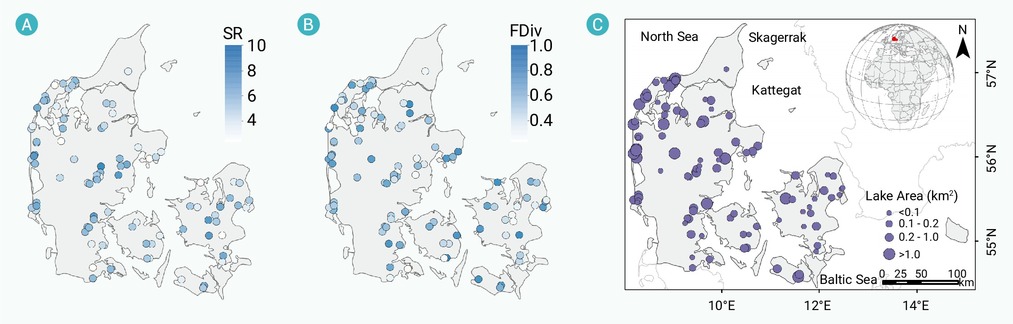
Figure 1.
Distribution of (A) species richness (SR), (B) functional divergence (FDiv) and (C) the 96 study lakes included in the analysis across Denmark
-
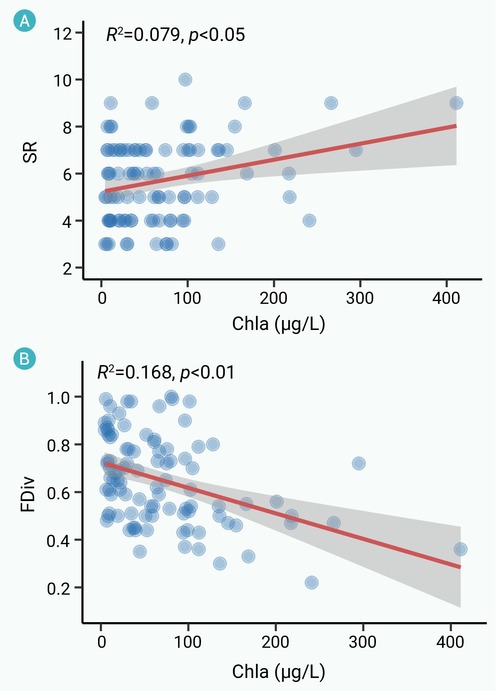
Figure 2.
Relationships between chlorophyll a (Chla) and (A) species richness (SR) and (B) functional divergence (FDiv)
-
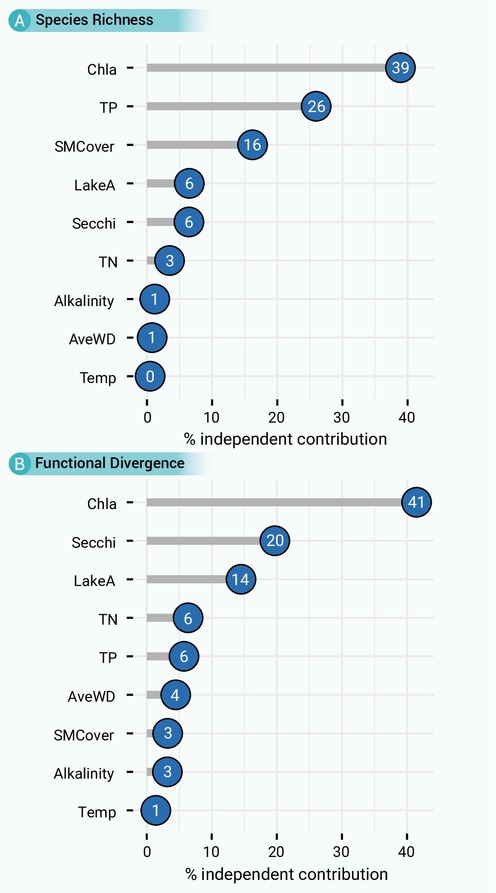
Figure 3.
Comparison of predictors explaining the variance of (A) species richness and (B) functional divergence in Danish lakes with % independent contribution (%I)
-
Figure 4.
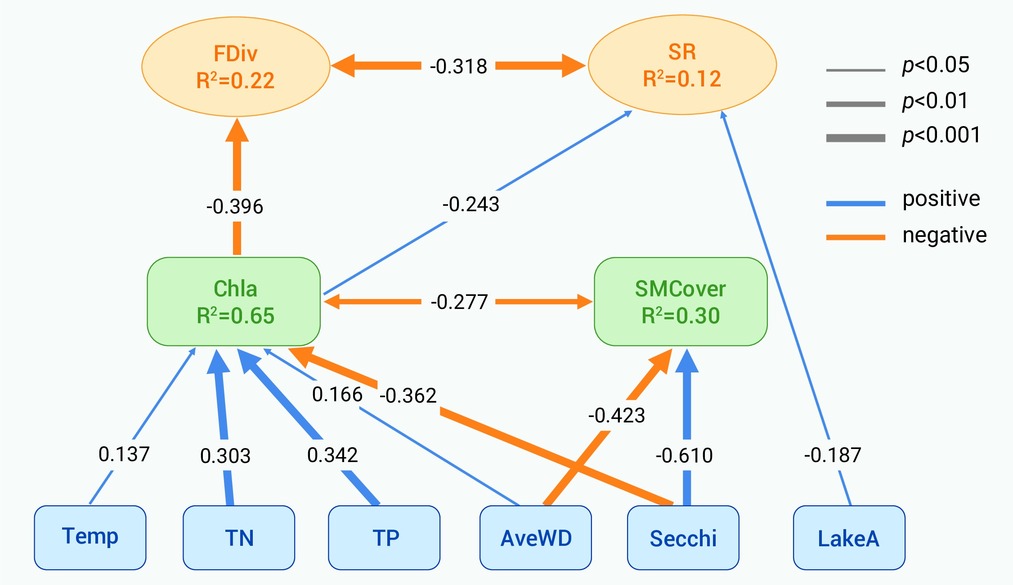
Results of piecewise structural equation modelling (pSEM) showing the effects of abiotic and biotic factors on fish species richness (SR) and functional divergence (FDiv) in the studied 96 Danish lakes
-
Figure 6.
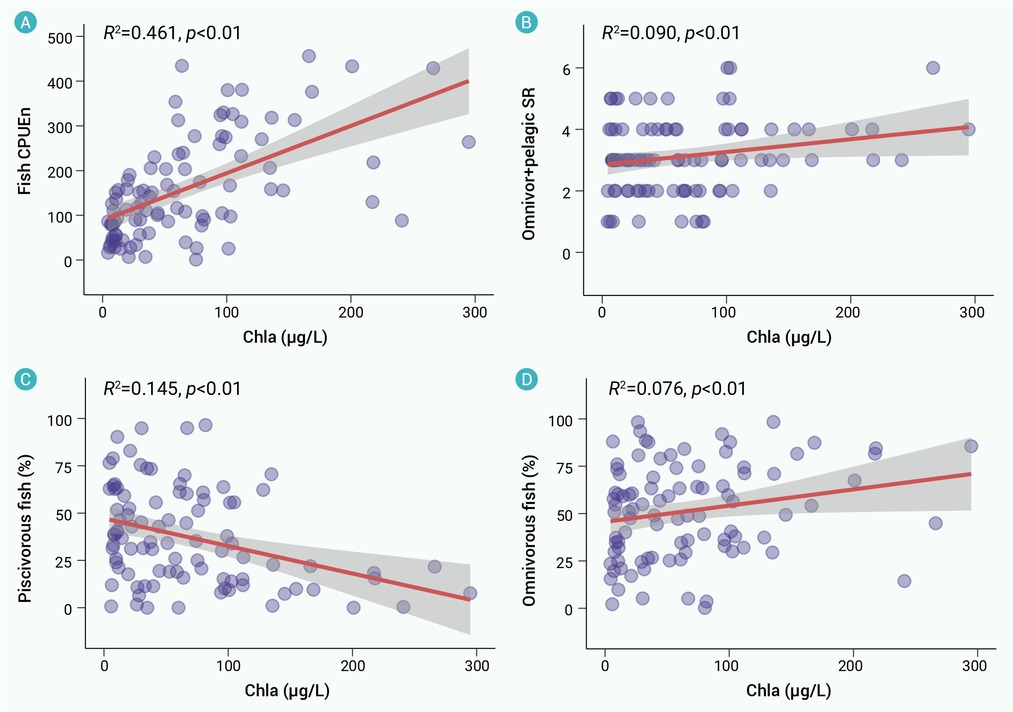
Responses of (A) fish abundance, (B) species richness of omnivorous and pelagic fish, (C) proportion of piscivorous fish and (D) omnivorous fish relative to chlorophyll a (Chla)
-
Figure 5.
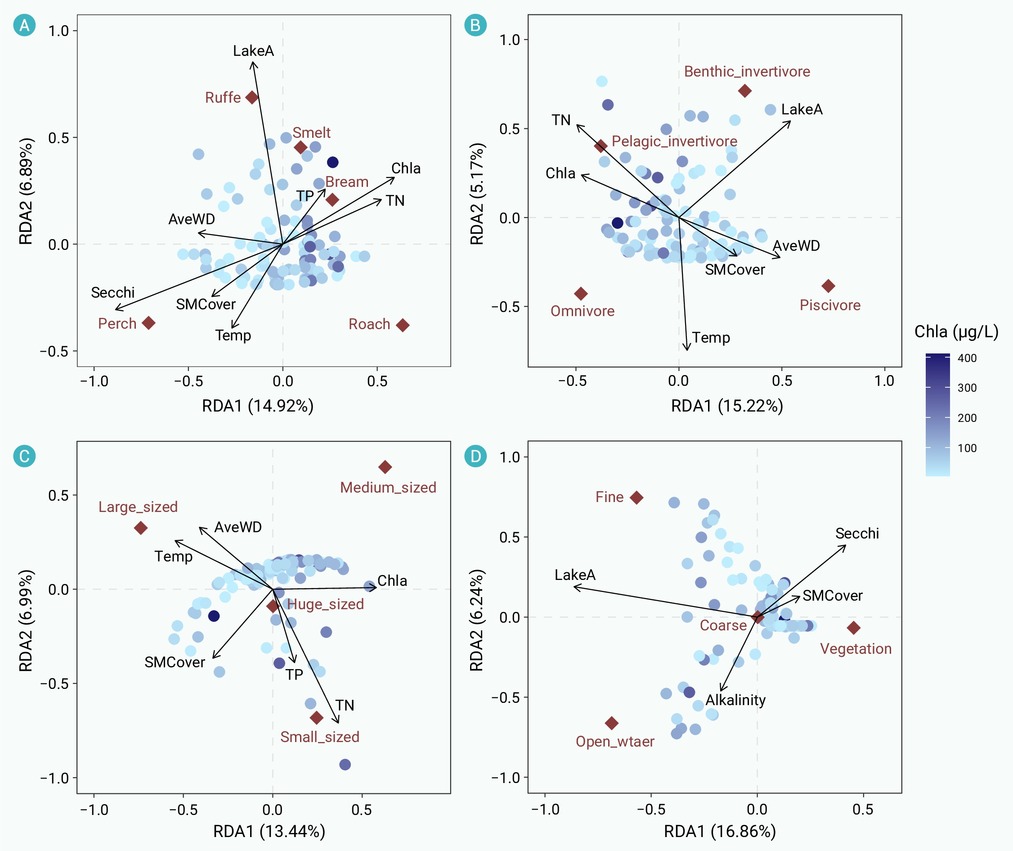
Redundancy analysis (RDA) biplots showing associations of fish communities in terms of (A) taxonomic composition and functional groups of (B) feeding behaviour, (C) body size and (D) substrate preference and statistically significant chlorophyll a (Chla) concentrations and environmental variables (arrows)
