
Food Informatics: Leveraging data and knowledge to advance food systems
-

-
REFERENCES
[1] Martinez-Mayorga K. and Medina-Franco J.L. (2014). Foodinformatics: Applications of chemical information to food chemistry. Martinez-Mayorga K. and Medina-Franco J.L. (eds). (Springer). DOI:10.1007/978-3-319-10226-9 [2] Krupitzer C. and Stein A. (2021). Food Informatics — Review of the current state-of-the-art, revised definition, and classification into the research landscape. Foods 10:2889. DOI:10.3390/foods10112889 [3] Ke Q., Zhang J., Huang X., et al. (2026). Machine learning unveils three layers of food complexity. npj Sci. Food 10:87. DOI:10.1038/s41538-026-00730-w [4] Poore J. and Nemecek T. (2018). Reducing food’s environmental impacts through producers and consumers. Science 360:987−992. DOI:10.1126/science.aaq0216 [5] Zhang D., Liu M., Yu Z., et al. (2025). Domain knowledge, just evaluation, and robust data standards are required to advance AI in food science. Trends Food Sci Technol 164:105272. DOI:10.1016/j.jpgs.2025.105272 -
ABOUT THIS ARTICLE
Cite this article:
Leow M. Z., Fu C. and Zhang D. (2026). Food Informatics: Leveraging data and knowledge to advance food systems. The Innovation Informatics 2:100038. https://doi.org/10.59717/j.xinn-inform.2026.100038
Welcome!
To request copyright permission to republish or share portions of our works, please visit Copyright Clearance Center's (CCC) Marketplace website at marketplace.copyright.com.
Export File
Citation
Leow M. Z., Fu C. and Zhang D. (2026). Food Informatics: Leveraging data and knowledge to advance food systems. The Innovation Informatics 2:100038. https://doi.org/10.59717/j.xinn-inform.2026.100038

Format
Content
 DownLoad:
-
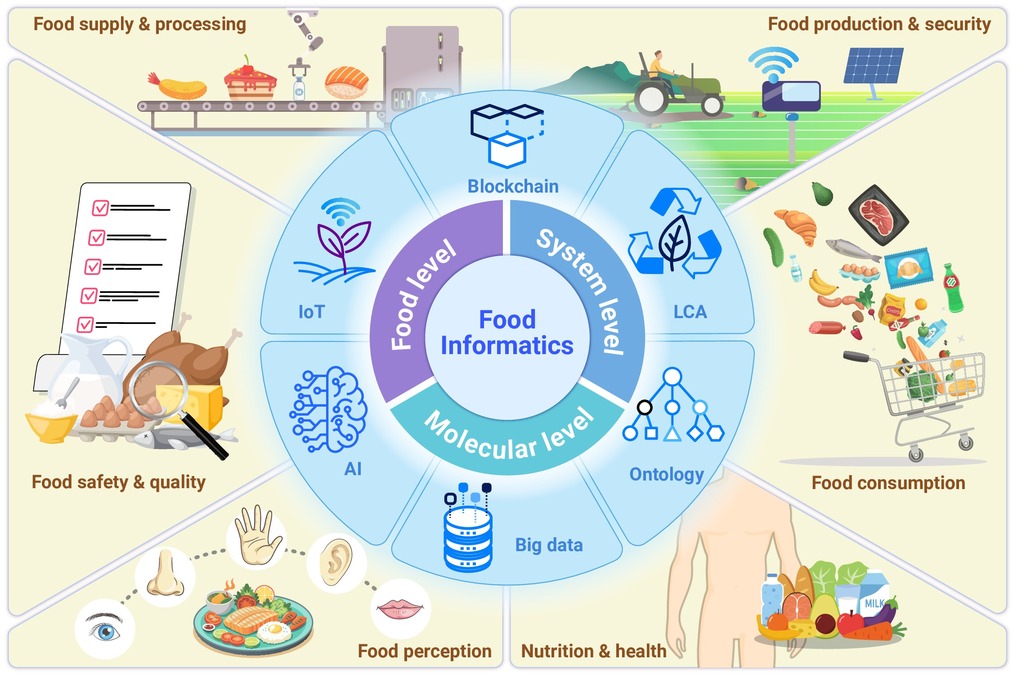
Figure 1.
Overview of the scope (central circle), key approaches (intermediate circle), and major research areas (surrounding sectors) in Food Informatics.
