
Generative AI literacy: Reframing educational knowledge in the algorithmic age
-

-
REFERENCES
[1] Ellis R., Han F., Kember D., et al. (2025). Towards a theory of materiality for quality learning and university education leadership. Rev. Educ. 13:e70094. DOI:10.1002/rev3.70094 [2] Long D. and Magerko B. (2020). What is AI literacy. Competencies and design considerations. CHI Conf. Hum. Factors Comput. Syst. 2020:1−16. DOI:10.1145/3313831.3376727 [3] Rapanta C., Bhatt I., Bozkurt A., et al. (2025). Critical GenAI literacy: Postdigital configurations. Postdigital Sci. Educ. 7:1296−1333. DOI:10.1007/s42438-025-00573-w [4] Bai H., Lin Y. and Wang J. (2024). Rethinking assessment in the age of generative artificial intelligence. Assess. Eval. High. Educ. 49:561−575. DOI:10.1080/02602938.2023.2267754 [5] UNESCO. (2023). Guidance for generative AI in education and research. UNESCO Publishing. https://unesdoc.unesco.org/ark:/48223/pf0000386693 -
ABOUT THIS ARTICLE
Cite this article:
Han F. (2026). Generative AI literacy: Reframing educational knowledge in the algorithmic age. The Innovation Informatics 2:100041. https://doi.org/10.59717/j.xinn-inform.2026.100041
Welcome!
To request copyright permission to republish or share portions of our works, please visit Copyright Clearance Center's (CCC) Marketplace website at marketplace.copyright.com.
Export File
Citation
Han F. (2026). Generative AI literacy: Reframing educational knowledge in the algorithmic age. The Innovation Informatics 2:100041. https://doi.org/10.59717/j.xinn-inform.2026.100041

Format
Content
 DownLoad:
-
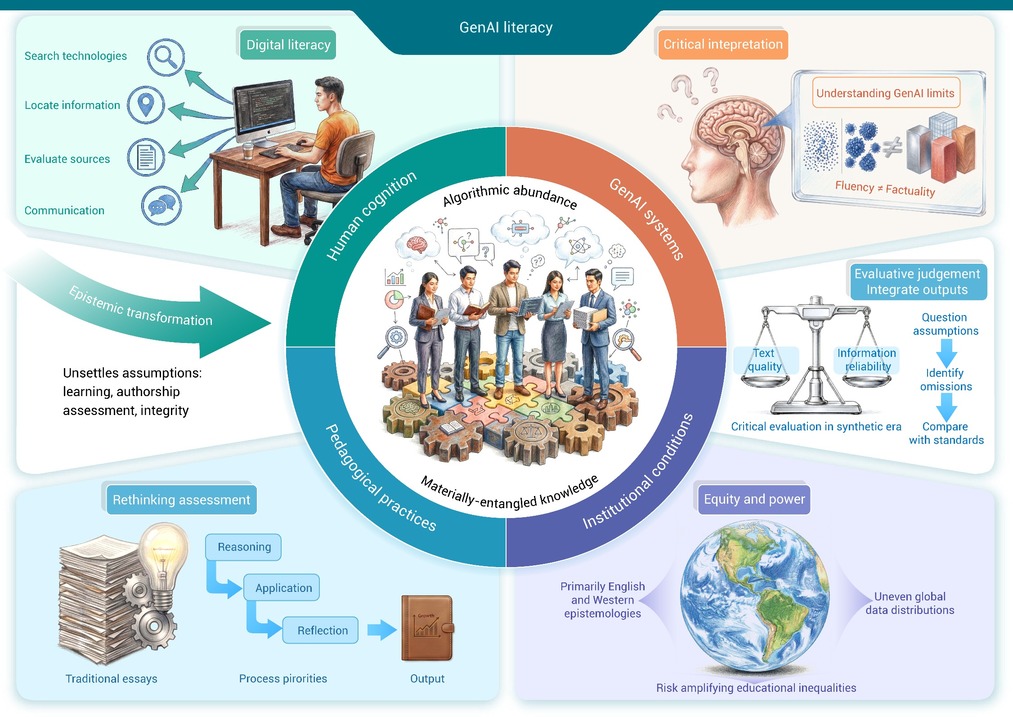
Figure 1.
A conceptual representation of GenAI literacy.
