
Lufengpithecus inner ear provides evidence of a common locomotor repertoire ancestral to human bipedalism
-
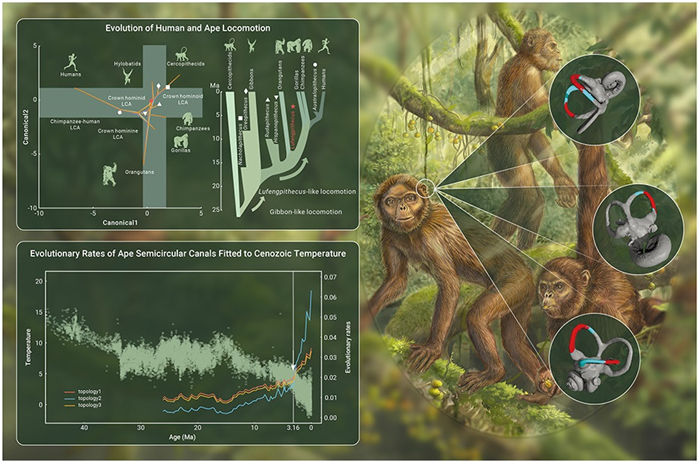
GRAPHICAL ABSTRACT
 DownLoad:
Full size image
DownLoad:
Full size image
-
ABSTRACT
-

-
REFERENCES
[1] Begun, D.R., Richmond, B.G., and Strait, D.S. (2007). Comment on "Origin of Human Bipedalism As an Adaptation for Locomotion on Flexible Branches". Science 318: 1066. https://doi.org/10.1126/science.1146446. [2] Crompton, R.H., Vereecke, E.E., and Thorpe, S.K.S. (2008). Locomotion and posture from the common hominoid ancestor to fully modern hominins, with special reference to the last common panin/hominin ancestor. J. Anat. 212: 501–543. https://doi.org/10.1111/j.1469-7580.2008.00870.x. [3] R.H., T. (2014) (Harvard University Press). https://doi.org/10.4159/harvard.9780674726536. [4] Richmond, B.G., and Strait, D.S. (2000). Evidence that humans evolved from a knuckle-walking ancestor. Nature 404: 382–385. https://doi.org/10.1038/35006045. [5] Thorpe, S.K.S., Holder, R.L., and Crompton, R.H. (2007). Origin of Human Bipedalism As an Adaptation for Locomotion on Flexible Branches. Science 316: 1328–1331. https://doi.org/10.1126/science.1140799. [6] Washburn, S.L. (1967). Behaviour and the Origin of Man (Proceedings of the Royal Anthropological Institute of Great Britain and Ireland), pp. 21–27. https://doi.org/10.2307/3031724. [7] Almécija, S., Smaers, J.B., and Jungers, W.L. (2015). The evolution of human and ape hand proportions. Nat. Commun. 6: 7717. [8] Almécija, S., Tallman, M., Alba, D.M., et al. (2013). The femur of Orrorin tugenensis exhibits morphometric affinities with both Miocene apes and later hominins. Nat. Commun. 4: 2888. https://doi.org/10.1038/ncomms3888. [9] Böhme, M., Spassov, N., Fuss, J., et al. (2019). A new Miocene ape and locomotion in the ancestor of great apes and humans. Nature 575: 489–493. https://doi.org/10.1038/s41586-019-1731-0. [10] Crompton, R.H. (2016). The hominins: a very conservative tribe? Last common ancestors, plasticity and ecomorphology in Hominidae. Or, What’s in a name? J. Anat. 228: 686–699. https://doi.org/10.1111/joa.12424. [11] Daver, G., Guy, F., Mackaye, H.T., et al. (2022). Postcranial evidence of late Miocene hominin bipedalism in Chad. Nature 609: 94–100. https://doi.org/10.1038/s41586-022-04901-z. [12] White, T.D., Asfaw, B., Beyene, Y., et al. (2009). Ardipithecus ramidus and the Paleobiology of Early Hominids. Science 326: 64–86. https://doi.org/10.1126/science.1175802. [13] White, T.D., Lovejoy, C.O., Asfaw, B., et al. (2015). Neither chimpanzee nor human, Ardipithecus reveals the surprising ancestry of both. Proc. Natl. Acad. Sci. USA 112: 4877–4884. https://doi.org/10.1073/pnas.1403659111. [14] Ekdale, E.G. (2016). Form and function of the mammalian inner ear. J. Anat. 228: 324–337. https://doi.org/10.1111/joa.12308. [15] Hanson, M., Hoffman, E.A., Norell, M.A., et al. (2022). Response to Comment on “The early origin of a birdlike inner ear and the evolution of dinosaurian movement and vocalization”. Science 376: eabl8181. https://doi.org/10.1126/science.abl8181. [16] Lebrun, R., Perier, A., Masters, J., et al. (2021). Lower Levels of Vestibular Developmental Stability in Slow-Moving than Fast-Moving Primates. Symmetry 13: 2305. [17] Ni, X., Flynn, J.J., and Wyss, A.R. (2010). The bony labyrinth of the early platyrrhine primate Chilecebus. J. Hum. Evol. 59: 595–607. https://doi.org/10.1016/j.jhevol.2010.06.008. [18] Spoor, F., Garland, T., Krovitz, G., et al. (2007). The primate semicircular canal system and locomotion. Proc. Natl. Acad. Sci. USA 104: 10808–10812. https://doi.org/10.1073/pnas. 0704250104. [19] Spoor, F., Wood, B., and Zonneveld, F. (1994). Implications of early hominid labyrinthine morphology for evolution of human bipedal locomotion. Nature 369: 645–648. https://doi.org/10.1038/369645a0. [20] Urciuoli, A., Zanolli, C., Almécija, S., et al. (2021). Reassessment of the phylogenetic relationships of the late Miocene apes Hispanopithecus and Rudapithecus based on vestibular morphology. Proc. Natl. Acad. Sci. USA 118: e2015215118. https://doi.org/10.1073/pnas. 2015215118. [21] Urciuoli, A., Zanolli, C., Beaudet, A., et al. (2020). The evolution of the vestibular apparatus in apes and humans. Elife 9: e51261. https://doi.org/10.7554/eLife.51261. [22] Rukang, W., and Olsen, J.W. (2009). Paleoanthropology and Paleolithic Archaeology in the People’s Republic of China (Left Coast Press). [23] Harrison, T., Xueping, J., and Su, D. (2002). On the systematic status of the late Neogene hominoids from Yunnan Province, China. J. Hum. Evol. 43: 207–227. https://doi.org/10.1006/jhev.2002.0570. [24] Pan, L., Ji, X., Liao, W., et al. (2021). Premolar enamel thickness and distribution of a Miocene hominid Lufengpithecus hudienensis compared with Pleistocene and extant hominids. J. Hum. Evol. 157: 103030. https://doi.org/10.1016/j.jhevol.2021.103030. [25] Schwartz, G.T., Liu, W., and Zheng, L. (2003). Preliminary investigation of dental microstructure in the Yuanmou hominoid (Lufengpithecus hudienensis), Yunnan Province, China. J. Hum. Evol. 44: 189–202. https://doi.org/10.1016/S0047-2484(02)00197-5. [26] Schwartz, J.H. (1997). Lufengpithecus and Hominoid Phylogeny. In Function, Phylogeny, and Fossils: Miocene Hominoid Evolution and Adaptations, D.R. Begun, C.V. Ward, and M.D. Rose, eds. (Springer US), pp. 363–388. https://doi.org/10.1007/978-1-4899-0075-3_17. [27] Kelley, J., and Gao, F. (2012). Juvenile hominoid cranium from the late Miocene of southern China and hominoid diversity in Asia. Proc. Natl. Acad. Sci. USA 109: 6882–6885. https://doi.org/10.1073/pnas.1201330109. [28] Andrews, P. (1992). Evolution and environment in the Hominoidea. Nature 360: 641–646. https://doi.org/10.1038/360641a0. [29] Kelley, J., and Etler, D. (1989). Hominoid dental variability and species number at the late Miocene site of Lufeng, China. Am. J. Primatol. 18: 15–34. https://doi.org/10.1002/ajp. 1350180103. [30] Pugh, K.D. (2022). Phylogenetic analysis of Middle-Late Miocene apes. J. Hum. Evol. 165: 103140. https://doi.org/10.1016/j.jhevol.2021.103140. [31] Zhao, L., Lu, Q., and Zhang, W. (2008). Age at first molar emergence in Lufengpithecus lufengensis and its implications for life-history evolution. J. Hum. Evol. 54: 251–257. https://doi.org/10.1016/j.jhevol.2007.09.019. [32] Xu, Q.-h., and Lu, Q.-w. (2008). Lufengpithecus Lufengensis–An Early Member of Hominidae (Science Press). https://books.google.com.hk/books?id=fHauNwAACAAJ. [33] David, R., Bronzati, M., and Benson, R.B.J. (2022). Comment on “The early origin of a birdlike inner ear and the evolution of dinosaurian movement and vocalization”. Science 376: eabl6710. https://doi.org/10.1126/science.abl6710. [34] Fleagle, J.G. (2013). Chapter 15 - Primitive Catarrhines and Fossil Apes. In Primate Adaptation and Evolution, Third Edition, J.G. Fleagle, ed. (Academic Press), pp. 311–343. https://doi.org/10.1016/B978-0-12-378632-6.00015-X. [35] Rook, L., Bondioli, L., Casali, F., et al. (2004). The bony labyrinth of Oreopithecus bambolii. J. Hum. Evol. 46: 349–356. https://doi.org/10.1016/j.jhevol.2004.01.001. [36] Beaudet, A., Carlson, K.J., Clarke, R.J., et al. (2018). Cranial vault thickness variation and inner structural organization in the StW 578 hominin cranium from Jacovec Cavern, South Africa. J. Hum. Evol. 121: 204–220. https://doi.org/10.1016/j.jhevol.2018.04.004. [37] Braga, J., Loubes, J.M., Descouens, D., et al. (2015). Disproportionate Cochlear Length in Genus Homo Shows a High Phylogenetic Signal during Apes’ Hearing Evolution. PLoS One 10: e0127780. https://doi.org/10.1371/journal.pone.0127780. [38] Almécija, S., Hammond, A.S., Thompson, N.E., et al. (2021). Fossil apes and human evolution. Science 372: eabb4363. https://doi.org/10.1126/science.abb4363. [39] Harrison, T. (2010). Apes Among the Tangled Branches of Human Origins. Science 327: 532–534. https://doi.org/10.1126/science.1184703. [40] Zachos, J.C., Dickens, G.R., and Zeebe, R.E. (2008). An early Cenozoic perspective on greenhouse warming and carbon-cycle dynamics. Nature 451: 279–283. https://doi.org/10.1038/nature06588. [41] Jungers, W.L. (1987). Body size and morphometric affinities of the appendicular skeleton in Oreopithecus bambolii (IGF 11778). J. Hum. Evol. 16: 445–456. https://doi.org/10.1016/0047-2484(87)90072-8. [42] Nakatsukasa, M., Almécija, S., and Begun, D.R. (2016). The Hands of Miocene Hominoids. In The Evolution of the Primate Hand: Anatomical, Developmental, Functional, and Paleontological Evidence, T.L. Kivell, P. Lemelin, and B.G. Richmond, et al., eds. (Springer New York), pp. 485–514. https://doi.org/10.1007/978-1-4939-3646-5_17. [43] Pfaff, C., Martin, T., and Ruf, I. (2015). Bony labyrinth morphometry indicates locomotor adaptations in the squirrel-related clade (Rodentia, Mammalia). Proc. Biol. Sci. 282: 20150744. https://doi.org/10.1098/rspb.2015.0744. [44] Fleagle, J.G. (1976). Locomotion and Posture of the Malayan Siamang and Implications for Hominoid Evolution. Folia Primatol. 26: 245–269. https://doi.org/10.1159/000155756. [45] Fleagle, J.G. (1980). Locomotion and Posture. In Malayan Forest Primates: Ten Years’ Study in Tropical Rain Forest, D.J. Chivers, ed. (Springer US), pp. 191–208. https://doi.org/10.1007/978-1-4757-0878-3_7. [46] Doran, D.M. (1993). Comparative locomotor behavior of chimpanzees and bonobos: The influence of morphology on locomotion. Am. J. Phys. Anthropol. 91: 83–98. https://doi.org/10.1002/ajpa.1330910106. [47] Drummond-Clarke, R.C., Kivell, T.L., Sarringhaus, L., et al. (2022). Wild chimpanzee behavior suggests that a savanna-mosaic habitat did not support the emergence of hominin terrestrial bipedalism. Sci. Adv. 8: eadd9752. https://doi.org/10.1126/sciadv.add9752. [48] Hunt, K.D. (1992). Positional behavior of Pan troglodytes in the Mahale Mountains and Gombe Stream National Parks, Tanzania. Am. J. Phys. Anthropol. 87: 83–105. https://doi.org/10.1002/ajpa.1330870108. [49] Hunt, K.D. (2016). Why are there apes? Evidence for the co-evolution of ape and monkey ecomorphology. J. Anat. 228: 630–685. https://doi.org/10.1111/joa.12454. [50] Hunt, K.D. (2020). Chimpanzee: Lessons from Our Sister Species (Cambridge University Press). [51] Meyer, M.R., Jung, J.P., Spear, J.K., et al. (2023). Knuckle-walking in Sahelanthropus? Locomotor inferences from the ulnae of fossil hominins and other hominoids. J. Hum. Evol. 179: 103355. https://doi.org/10.1016/j.jhevol.2023.103355. [52] Kikuchi, Y., Nakatsukasa, M., Nakano, Y., et al. (2015). Morphology of the thoracolumbar spine of the middle Miocene hominoid Nacholapithecus kerioi from northern Kenya. J. Hum. Evol. 88: 25–42. https://doi.org/10.1016/j.jhevol.2015.09.003. [53] Nakatsukasa, M., Kunimatsu, Y., Nakano, Y., et al. (2007). Postcranial bones of infant Nacholapithecus: ontogeny and positional behavioral adaptation. Anthropol. Sci. 115: 201–213. https://doi.org/10.1537/ase.070409. [54] Nakatsukasa, M., Kunimatsu, Y., Nakano, Y., et al. (2002). Morphology of the hallucial phalanges in extant anthropoids and fossil hominoids. Z. Morphol. Anthropol. 83: 361–372. [55] Nakatsukasa, M., Kunimatsu, Y., Nakano, Y., et al. (2007). Vertebral morphology of Nacholapithecus kerioi based on KNM-BG 35250. J. Hum. Evol. 52: 347–369. https://doi.org/10.1016/j.jhevol.2006.08.008. [56] Nakatsukasa, M., Kunimatsu, Y., Nakano, Y., et al. (2003). Comparative and functional anatomy of phalanges in Nacholapithecus kerioi, a Middle Miocene hominoid from northern Kenya. Primates 44: 371–412. https://doi.org/10.1007/s10329-003-0051-y. [57] Ogihara, N., Almécija, S., Nakatsukasa, M., et al. (2016). Carpal bones of Nacholapithecus kerioi, a Middle Miocene Hominoid From Northern Kenya. Am. J. Phys. Anthropol. 160: 469–482. https://doi.org/10.1002/ajpa.22984. [58] Takano, T., Nakatsukasa, M., Kunimatsu, Y., et al. (2018). Forelimb long bones of Nacholapithecus (KNM-BG 35250) from the middle Miocene in Nachola, northern Kenya. Anthropol. Sci. 126: 135–149. https://doi.org/10.1537/ase.181022. [59] Takano, T., Nakatsukasa, M., Pina, M., et al. (2020). New forelimb long bone specimens of Nacholapithecus kerioi from the Middle Miocene of northern Kenya. Anthropol. Sci. 128: 27–40. https://doi.org/10.1537/ase.200116. [60] Hammond, A.S., Rook, L., Anaya, A.D., et al. (2020). Insights into the lower torso in late Miocene hominoid Oreopithecus bambolii. Proc. Natl. Acad. Sci. USA 117: 278–284. https://doi.org/10.1073/pnas.1911896116. [61] Harrison, T. (1991). The implications of Oreopithecus bambolii for the origins of bipedalism. Origine (s) de la bipédie chez les hominidés 235: 244. [62] Harrison, T., and Rook, L. (1997). Enigmatic Anthropoid or Misunderstood Ape? In Function, Phylogeny, and Fossils: Miocene Hominoid Evolution and Adaptations, D.R. Begun, C.V. Ward, and M.D. Rose, eds. (Springer US), pp. 327–362. https://doi.org/10.1007/978-1-4899-0075-3_16. [63] Russo, G.A., and Shapiro, L.J. (2013). Reevaluation of the lumbosacral region of Oreopithecus bambolii. J. Hum. Evol. 65: 253–265. https://doi.org/10.1016/j.jhevol.2013. 05.004. [64] Sarmiento, E.E. (1987). The phylogenetic position of Oreopithecus and its significance in the origin of the Hominoidea. Am. Mus. Nat. Hist. Novit 2881: 1–44. [65] Ward, C.V. (2015). Postcranial and Locomotor Adaptations of Hominoids. In Handbook of Paleoanthropology, W. Henke, I. Tattersall, ed. (Springer Berlin Heidelberg), pp. 1363–1386. https://doi.org/10.1007/978-3-642-39979-4_34. [66] MacLatchy, L.M., Cote, S.M., Deino, A.L., et al. (2023). The evolution of hominoid locomotor versatility: Evidence from Moroto, a 21 Ma site in Uganda. Science 380: eabq2835. https://doi.org/10.1126/science.abq2835. [67] Zhang, Y., Harrison, T., and Ji, X. (2020). Inferring the locomotor behavior of fossil hominoids from phalangeal curvature using a novel method: Lufengpithecus as a case study. Acta Anthropol. Sin. 39: 532–554. [68] Agusti, J., and Moya-Sola, S. (1990). Mammal Extinctions in the Vallesian (Upper Miocene) (Springer Berlin Heidelberg). [69] Casanovas-Vilar, I., Alba, D.M., Garcés, M., et al. (2011). Updated chronology for the Miocene hominoid radiation in Western Eurasia. Proc. Natl. Acad. Sci. USA 108: 5554–5559. https://doi.org/10.1073/pnas.1018562108. [70] Strömberg, C.A., Werdelin, L., Friis, E.M., et al. (2007). The spread of grass-dominated habitats in Turkey and surrounding areas during the Cenozoic: Phytolith evidence. Palaeogeogr. Palaeoclimatol. Palaeoecol. 250: 18–49. https://doi.org/10.1016/j.palaeo. 2007.02.012. [71] Badgley, C. (1988). Paleoecology of a Miocene, tropical, upland fauna: Lufeng. China. Natl. Geogr. Res. 4: 178–195. [72] Biasatti, D., Wang, Y., Gao, F., et al. (2012). Paleoecologies and paleoclimates of late cenozoic mammals from Southwest China: Evidence from stable carbon and oxygen isotopes. J. Asian Earth Sci. 44: 48–61. https://doi.org/10.1016/j.jseaes.2011.04.013. [73] Chang, L., Guo, Z., Deng, C., et al. (2015). Pollen evidence of the palaeoenvironments of Lufengpithecus lufengensis in the Zhaotong Basin, southeastern margin of the Tibetan Plateau. Palaeogeogr. Palaeoclimatol. Palaeoecol. 435: 95–104. https://doi.org/10.1016/j. palaeo.2015.06.007. [74] Cheng, Y.-M., Wang, Y.-F., Li, C.-S., et al. (2014). Late Miocene wood flora associated with the Yuanmou hominoid fauna from Yunnan, southwestern China and its palaeoenvironmental implication. J. Palaeogeogr. 3: 323–330. https://doi.org/10.3724/SP.J.1261.2014.00059. [75] Han, W., Ye, C., Lü, S., et al. (2023). Middle-Late Miocene paleoenvironmental evolution and its implications for hominoid distribution in the southeastern Tibetan Plateau. Catena 220: 106676. https://doi.org/10.1016/j.catena.2022.106676. [76] Li, S., Ji, X., Harrison, T., et al. (2020). Uplift of the Hengduan Mountains on the southeastern margin of the Tibetan Plateau in the late Miocene and its paleoenvironmental impact on hominoid diversity. Palaeogeogr. Palaeoclimatol. Palaeoecol. 553: 109794. https://doi.org/10.1016/j.palaeo.2020.109794. [77] Zhang, C., Guo, Z., Deng, C., et al. (2016). Clay mineralogy indicates a mildly warm and humid living environment for the Miocene hominoid from the Zhaotong Basin, Yunnan, China. Sci. Rep. 6: 20012. https://doi.org/10.1038/srep20012. [78] Cheng, H., Li, H., Sha, L., et al. (2022). Milankovitch theory and monsoon. Innovation 3: 100338. https://doi.org/10.1016/j.xinn.2022.100338. [79] McClymont, E.L., Ho, S.L., Ford, H.L., et al. (2023). Climate Evolution Through the Onset and Intensification of Northern Hemisphere Glaciation. Rev. Geophys. 61: e2022RG000793. https://doi.org/10.1029/2022RG000793. [80] Fillion, E.N., and Harrison, T. (2023). Mixed models elucidate local- and regional-scale drivers of paleoenvironmental change in eastern Africa during the emergence of Paranthropus and Homo. Palaeogeogr. Palaeoclimatol. Palaeoecol. 616: 111479. https://doi.org/10.1016/j.palaeo.2023.111479. -
ABOUT THIS ARTICLE
Cite this article:
Yinan Zhang, Xijun Ni, Qiang Li, Thomas Stidham, Dan Lu, Feng Gao, Chi Zhang, Terry Harrison. Lufengpithecus inner ear provides evidence of a common locomotor repertoire ancestral to human bipedalism[J]. The Innovation, 2024, 5(2). https://doi.org/10.1016/j.xinn.2024.100580
Welcome!
To request copyright permission to republish or share portions of our works, please visit Copyright Clearance Center's (CCC) Marketplace website at marketplace.copyright.com.
Export File
Citation
Yinan Zhang, Xijun Ni, Qiang Li, Thomas Stidham, Dan Lu, Feng Gao, Chi Zhang, Terry Harrison. Lufengpithecus inner ear provides evidence of a common locomotor repertoire ancestral to human bipedalism[J]. The Innovation, 2024, 5(2). https://doi.org/10.1016/j.xinn.2024.100580

Format
Content


-
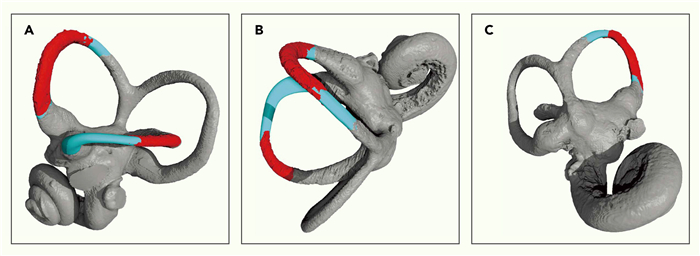
Figure 1.
The virtual left bony labyrinth of Lufengpithecus (PA844)
-
Figure 2.
The relative semicircular canal sizes of Lufengpithecus compared to other primates
-
Figure 3.
Between-group principal-component analysis on Procrustes shape coordinates of extant and fossil primates, including humans
-
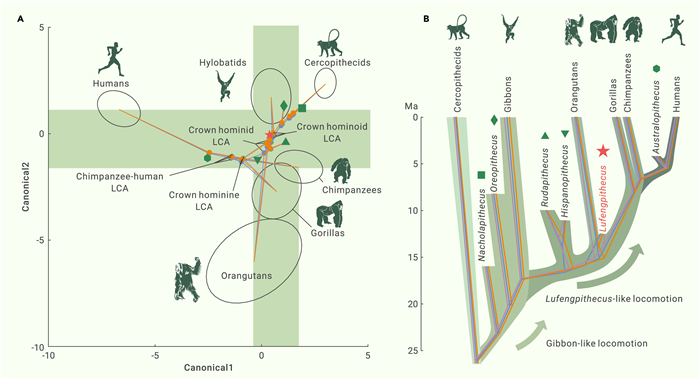
Figure 4.
Polymorphospace of the bony labyrinths and conceptual graph of hominoid locomotor evolution
-
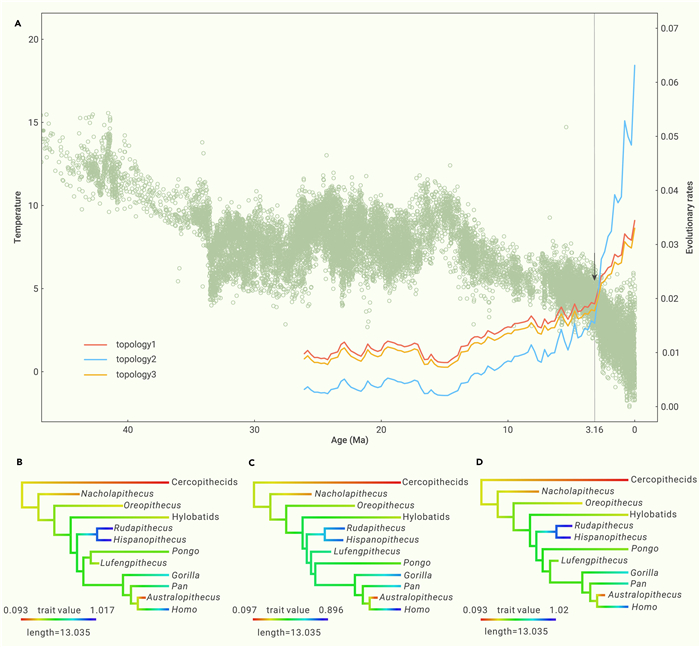
Figure 5.
Evolutionary rates of semicircular canals of apes
