
Bioprinting living organs: The next milestone in organ transplantation?
-
ABSTRACT
Organ failure remains a harsh problem, leading to millions of patients waiting on the transplantation list. Tissue engineering (TE) organ grafts hold great potential to cover the huge demand for organ transplantation. Combining with the advances in developmental biology, material science, and engineering, the emerging bioprinting technology enables TE grafts to replicate the complexity of human organs, from cell and extracellular matrix (ECM) composites to architecture features. This perspective provides a glimpse of how quickly and profoundly bioprinting can potentially be applied to address problems in TE organ grafts fabrication. -

-
REFERENCES
[1] Huang, J. (2020). Report on organ transplantation development in China (China science and technology press: Beijing). [2] Schlich, T. (2011). The origins of organ transplantation. The Lancet 378: 1372−1373. DOI: 10.1016/S0140-6736(11)61601-2. [3] Griffith, B. P., Goerlich, C. E., Singh, A. K., et al. (2022). Genetically modified porcine-to-human cardiac xenotransplantation. N. Engl. J. Med. 387: 35−44. DOI: 10.1056/NEJMoa2201422. [4] Wang, W., He, W., Ruan, Y., et al. (2022). First pig-to-human heart transplantation. The Innovation 3: 100223. DOI: 10.1016/j.xinn.2022.100223. [5] Noor, N., Shapira, A., Edri, R., et al. (2019). 3D Printing of personalized thick and perfusable cardiac patches and hearts. Adv. Sci. 6: 1900344. DOI: 10.1002/advs.201900344. [6] Lee, A., Hudson, A. R., Shiwarski, D. J., et al. (2019). 3D bioprinting of collagen to rebuild components of the human heart. Science 365: 482−487. DOI: 10.1126/science.aav9051. [7] Grigoryan, B., Paulsen, S. J., Corbett, D. C., et al. (2019). Multivascular networks and functional intravascular topologies within biocompatible hydrogels. Science 364: 458−464. DOI: 10.1126/science.aav9750. [8] Zhai, X. Y., Ruan, C. S., Ma, Y. F., et al. (2018). 3D-bioprinted osteoblast-laden nanocomposite hydrogel constructs with induced microenvironments promote cell viability, differentiation, and osteogenesis both in vitro and in vivo. Adv. Sci. 5: 1700550. DOI: 10.1002/advs.201700550. [9] Qu, H., Han, Z., Chen, Z., et al. (2021). Fractal design boosts extrusion-based 3D printing of bone-mimicking radial-gradient scaffolds. Research 2021: 9892689. DOI: 10.34133/2021/9892689. [10] Atala, A., Bauer, S. B., Soker, S., et al. (2006). Tissue-engineered autologous bladders for patients needing cystoplasty. The Lancet 367: 1241−1246. DOI: 10.1016/S0140-6736(06)68438-9. -
ABOUT THIS ARTICLE
Cite this article:
Wang P., Rui H., Gao C., et al., (2023). Bioprinting living organs: The next milestone in organ transplantation? The Innovation Life 1(2), 100019. https://doi.org/10.59717/j.xinn-life.2023.100019
Welcome!
To request copyright permission to republish or share portions of our works, please visit Copyright Clearance Center's (CCC) Marketplace website at marketplace.copyright.com.
Export File
Citation
Wang P., Rui H., Gao C., et al., (2023). Bioprinting living organs: The next milestone in organ transplantation? The Innovation Life 1(2), 100019. https://doi.org/10.59717/j.xinn-life.2023.100019

Format
Content
 DownLoad:
-
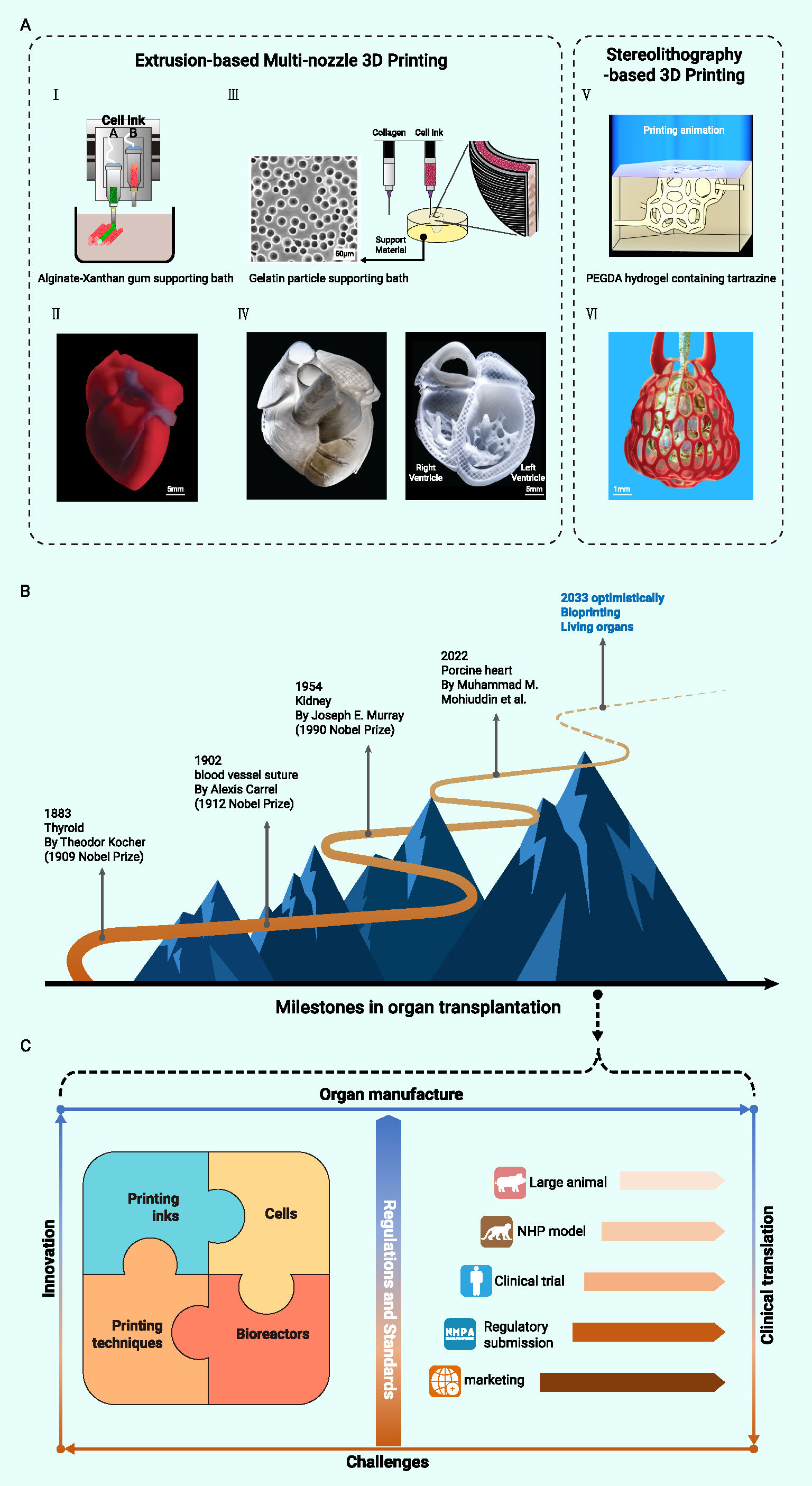
Figure 1.
Perspectives of bioprinting living organs
