
-

-
REFERENCES
[1] Dai B., Lv D., Chen E., et al. (2026). Resetting of a tandem microRNA156 enables vegetative perennial growth in rice. Science 391:1239−1245. DOI:10.1126/science.adv2188 [2] Zhai D., Zhang L.Y., Li L.Z., et al. (2024). Reciprocal conversion between annual and polycarpic perennial flowering behavior in the Brassicaceae. Cell 187:3319−3337. DOI:10.1016/j.cell.2024.04.047 [3] Zhang S., Huang G., Zhang Y., et al. (2023). Sustained productivity and agronomic potential of perennial rice. Nat. Sustain. 6:28−38. DOI:10.1038/s41893-022-00997-3 [4] Chuck G., Cigan A.M., Saeteurn K., et al. (2007). The heterochronic maize mutant Corngrass1 results from overexpression of a tandem microRNA. Nat. Genet. 39:544−549. DOI:10.1038/ng2001 [5] Wang W., Gao H., Liang Y., et al. (2022). Molecular basis underlying rice tiller angle: Current progress and future perspectives. Mol. Plant 15:125−137. DOI:10.1016/j.molp.2021.12.002 -
ABOUT THIS ARTICLE
Cite this article:
Tang J., Zhao Y. and Wu J. (2026). Epigenetic regulation of regrowth in perennial rice. The Innovation Life 4:100219. https://doi.org/10.59717/j.xinn-life.2026.100219
Welcome!
To request copyright permission to republish or share portions of our works, please visit Copyright Clearance Center's (CCC) Marketplace website at marketplace.copyright.com.
Export File
Citation
Tang J., Zhao Y. and Wu J. (2026). Epigenetic regulation of regrowth in perennial rice. The Innovation Life 4:100219. https://doi.org/10.59717/j.xinn-life.2026.100219

Format
Content
 DownLoad:
-
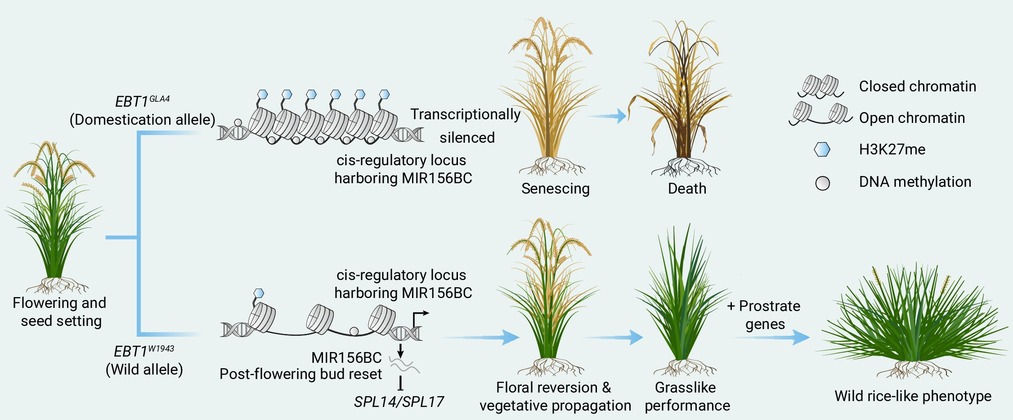
Figure 1.
Epigenetic resetting of EBT1–MIR156BC regulates post-flowering vegetative reversion in rice
