
Wearable microgrids empowered by single-atom materials
-
ABSTRACT
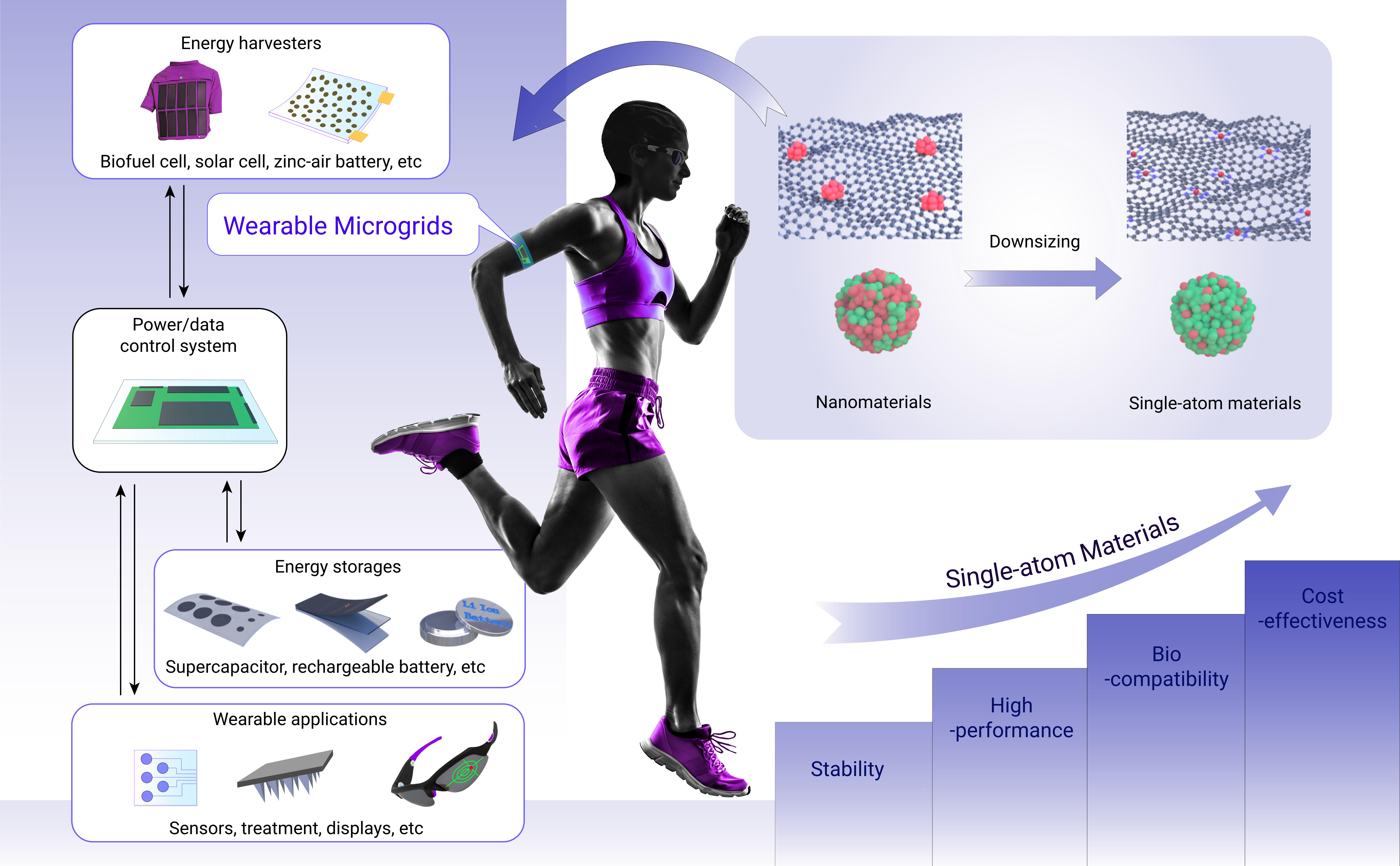
Wearable microgrids, a wearable system with integrated energy harvesting, storage, and regulation modules, and sensors, have potential to support human healthcare. However, wearable microgrids have not reached viability due to their high costs and limited performance, stability, and biocompatibility, awaiting significant breakthroughs, especially in material science filed. Single-atom materials (SAMs), one of the most promising forefronts of material, can overcome the shortcomings mentioned above and provide many extra advantages in various harvesters, energy storage devices, and wearable sensors. Herein, we discuss the potential of using SAMs in wearable devices to meet the demands of building practical energy-autonomous wearable microgrids towards extended comprehensive self-monitoring and human-machine interfacing. -

-
REFERENCES
[1] Research, G.V. (2020). Wearable technology market size, share & trends analysis report by product (wrist-wear, eye-wear & head-wear, foot-wear, neck-wear, body-wear), by application, by region, and segment forecasts, 2020–2027. Grand View Research San Francisco (CA). [2] Yin, L., Kim, K.N., Trifonov, A., et al. (2022). Designing wearable microgrids: towards autonomous sustainable on-body energy management. Energy Environ. Sci. 15: 82−101. DOI: 10.1039/D1EE03113A. [3] Qiao, B., Wang, A., Yang, X., et al. (2011). Single-atom catalysis of CO oxidation using Pt1/FeOx. Nat. Chem. 3: 634−641. DOI: 10.1038/nchem.1095. [4] Ji, S., Jiang, B., Hao, H., et al. (2021). Matching the kinetics of natural enzymes with a single-atom iron nanozyme. Nat. Catal. 4: 407−417. DOI: 10.1038/s41929-021-00609-x. [5] Jiao, L., Yan, H., Wu, Y., et al. (2020). When nanozymes meet single-atom catalysis. Angew. Chem. Int. Ed. 59: 2565−2576. DOI: 10.1002/anie.201905645. [6] Wang, Z.L. and Wu, W. (2012). Nanotechnology‐enabled energy harvesting for self‐powered micro‐/nanosystems. Angew. Chem. Int. Ed. 51: 11700−11721. DOI: 10.1002/anie.201201656. [7] Shi, Y., Zhao, C., Wei, H., et al. (2014). Single-atom catalysis in mesoporous photovoltaics: the principle of utility maximization. Adv. Mater. 26: 8147−8153. DOI: 10.1002/adma.201402978. [8] Zhao, W., Jin, K., Fu, L., et al. (2022). Mass production of pt single-atom-decorated bismuth sulfide for n-type environmentally friendly thermoelectrics. Nano Lett. 22: 4750−4757. DOI: 10.1021/acs.nanolett.2c00947. [9] Yi, H., Gao, A., Pang, X., et al. (2020). Preparation of single-atom ag-decorated mno2 hollow microspheres by redox etching method for high-performance solid-state asymmetric supercapacitors. ACS Appl. Energy Mater. 3: 10192−10201. DOI: 10.1021/acsaem.0c01969. [10] Jiao, L., Xu, W., Wu, Y., et al. (2021). Single-atom catalysts boost signal amplification for biosensing. Chem. Soc. Rev. 50: 750−765. DOI: 10.1039/D0CS00367K. -
ABOUT THIS ARTICLE
Cite this article:
Ding S., Yin L., Lyu Z., et al., (2023). Wearable microgrids empowered by single-atom materials. The Innovation Materials 1(2), 100023. https://doi.org/10.59717/j.xinn-mater.2023.100023
Welcome!
To request copyright permission to republish or share portions of our works, please visit Copyright Clearance Center's (CCC) Marketplace website at marketplace.copyright.com.
Export File
Citation
Ding S., Yin L., Lyu Z., et al., (2023). Wearable microgrids empowered by single-atom materials. The Innovation Materials 1(2), 100023. https://doi.org/10.59717/j.xinn-mater.2023.100023

Format
Content
 DownLoad:
-
Figure 1.
Opportunities for single-atom nanomaterials use in wearable microgrids.
