
Redox-regulated molecular design towards sustainable hot-melt adhesion
-

-
REFERENCES
[1] Zhao X. L., Wu X. W., Wang Q., et al. (2025). Ecological risks of biodegradable plastics. Science 388:1034−1034. DOI:10.1126/science.adw9060 [2] Sun X., Pang Z., Zhu Y., et al. (2023). All-cellulose hydrogel-based adhesive. Innov. Mater. 1:100040. DOI:10.59717/j.xinn-mater.2023.100040 [3] Yang G. X., Gong Z. G., Luo X. L., et al. (2023). Bonding wood with uncondensed lignins as adhesives. Nature 621:511−515. DOI:10.1038/s41586-023-06507-5 [4] Lv Z. W., Yan X. Q., Jia S. Y., et al. (2025). Bio-based hot-melt adhesive from xylan. Nat. Sustain. 8:827−836. DOI:10.1038/s41893-025-01579-9 [5] Lv J., Zhang D. X., Li X. K., et al. (2025). Reversible biobased adhesives enable closed-loop engineered composites. Nat. Commun. 16:7871. DOI:10.1038/s41467-025-62917-1 -
ABOUT THIS ARTICLE
Cite this article:
Yu L., Sun Y., Zhu M., et al. (2026). Redox-regulated molecular design towards sustainable hot-melt adhesion. The Innovation Materials 4:100211. https://doi.org/10.59717/j.xinn-mater.2026.100211
Welcome!
To request copyright permission to republish or share portions of our works, please visit Copyright Clearance Center's (CCC) Marketplace website at marketplace.copyright.com.
Export File
Citation
Yu L., Sun Y., Zhu M., et al. (2026). Redox-regulated molecular design towards sustainable hot-melt adhesion. The Innovation Materials 4:100211. https://doi.org/10.59717/j.xinn-mater.2026.100211

Format
Content
 DownLoad:
-
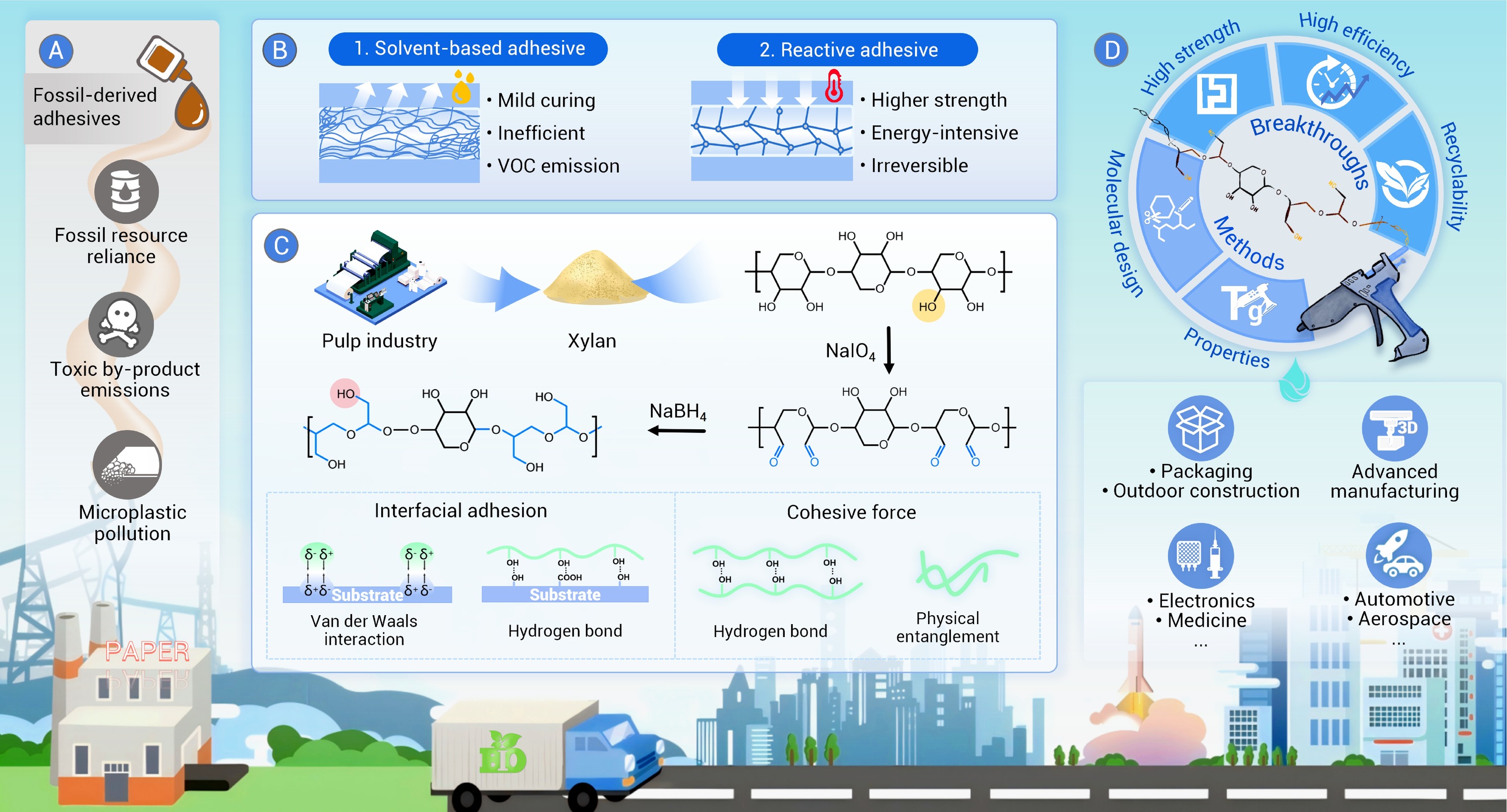
Figure 1.
Schematic illustration of the preparation strategy and adhesion mechanism of xylan-based hot-melt adhesives
