
Respiratory health outcomes and treatment of patients with mild-to-moderate COPD not eligible for previous major randomized controlled trials
-
GRAPHICAL ABSTRACT

 DownLoad:
Full size image
DownLoad:
Full size image
-
PUBLIC SUMMARY
-
Mild-to-moderate COPD not eligible for major trials have faster annual lung function decline than normal spirometry.
Tiotropium improved respiratory outcomes in patients with mild-to-moderate COPD not eligible for major trials.
Patients with mild-to-moderate COPD not eligible for previous major trials needs treatment and treatment is effective.
-
-
ABSTRACT
Many real-world patients with chronic obstructive pulmonary disease (COPD) are not eligible for previous major randomized clinical trials of COPD. Therefore, we aimed to explore the respiratory health outcomes and effectiveness of treatment among patients with mild-to-moderate COPD not eligible for previous major trials. In a cohort study, we explored the clinical characteristics and lung function decline of patients with mild-to-moderate COPD not eligible for previous major trials. In a post hoc analysis of multicenter clinical trial, we evaluated the effectiveness of tiotropium in patients with mild-to-moderate COPD not eligible for previous major trials. Patients not eligible for previous major trials were never-smokers; had a smoking index of <10 pack-years; or had a post-bronchodilator FEV1 of ≥80% predicted, or asthma. Overall, 475 patients with mild-to-moderate COPD not eligible for major trials and 398 symptomatic participants with normal spirometry were included. Patients not eligible for major trials have more severe small airway dysfunction, emphysema, and faster annual lung function decline than symptomatic participants with normal spirometry. From the multicenter clinical trial, 428 patients with mild-to-moderate COPD not eligible for major trials were included. Tiotropium significantly increased pre-bronchodilator FEV1 than placebo at 24 months (difference=128 [95% CI: 78–177] mL, P<0.001), reduced acute exacerbations (RR=0.55 [95% CI: 0.40–0.77], P<0.001), and ameliorated the annual decline in post-bronchodilator FEV1 in patients not eligible for previous major trials. Mild-to-moderate COPD patients not eligible for major trials had poor respiratory health outcomes than symptomatic participants with normal spirometry and long-term treatment with tiotropium can improve their respiratory health outcomes. -

-
REFERENCES
[1] Stolz D., Mkorombindo T., Schumann D., et al. (2022). Towards the elimination of chronic obstructive pulmonary disease: a Lancet Commission. Lancet 400:921−972. DOI:10.1016/S0140-6736(22)01273-9 [2] Safiri S., Carson-Chahhoud K., Noori M., et al. (2022). Burden of chronic obstructive pulmonary disease and its attributable risk factors in 204 countries and territories, 1990-2019: Results from the Global Burden of Disease Study 2019. BMJ 378:e069679. DOI:10.1136/bmj-2021-069679 [3] Tashkin D.P., Celli B., Senn S., et al. (2008). A 4-year trial of tiotropium in chronic obstructive pulmonary disease. N. Engl. J. Med. 359:1543−1554. DOI:10.1056/NEJMoa0805800 [4] Wedzicha J.A., Banerji D., Chapman K.R., et al. (2016). Indacaterol-Glycopyrronium versus Salmeterol-Fluticasone for COPD. N. Engl. J. Med. 374:2222−2234. DOI:10.1056/NEJMoa1516385 [5] Lipson D.A., Barnhart F., Brealey N., et al. (2018). Once-daily single-inhaler triple versus dual therapy in patients with COPD. N. Engl. J. Med. 378:1671−1680. DOI:10.1056/NEJMoa1713901 [6] Bhatt S.P., Rabe K.F., Hanania N.A., et al. (2023). Dupilumab for COPD with Type 2 Inflammation Indicated by Eosinophil Counts. N. Engl. J. Med. 389:205−214. DOI:10.1056/NEJMoa2303951 [7] Walker S., Fingleton J., Weatherall M., et al. (2013). Limited generalisability of UPLIFT findings to clinical practice. Thorax 68:1066−1067. DOI:10.1136/thoraxjnl-2013-203724 [8] Halpin D.M., Kerkhof M., Soriano J.B., et al. (2016). Eligibility of real-life patients with COPD for inclusion in trials of inhaled long-acting bronchodilator therapy. Respir. Res. 17:120. DOI:10.1186/s12931-016-0433-5 [9] Whittaker H.R., Torkpour A. and Quint J. (2024). Eligibility of patients with chronic obstructive pulmonary disease for inclusion in randomised control trials investigating triple therapy: A study using routinely collected data. Respir. Res. 25:43. DOI:10.1186/s12931-024-02672-x [10] De Soyza A. and Calverley P.M. (2015). Large trials, new knowledge: The changing face of COPD management. Eur. Respir. J. 45:1692−1703. DOI:10.1183/09031936.00179714 [11] US Department of Health and Human Services, Food and Drug Administration, Center for Drug Evaluation and Research, Center for Biology Evaluation and Research. (2022). Enhancing the Diversity of Clinical Trial Populations—Eligibility Criteria, Enrollment Practices, and Trial Designs. Guidance for Industry. https://www.fda.gov/media/127712/download. [12] Thakur N., Lovinsky-Desir S., Appell D., et al. (2021). Enhancing recruitment and retention of minority populations for clinical research in pulmonary, critical care, and sleep medicine: An official American thoracic society research statement. Am. J. Respir. Crit. Care Med. 204:e26−e50. DOI:10.1164/rccm.202105-1210ST [13] Li B.T., Daly B., Gospodarowicz M., et al. (2022). Reimagining patient-centric cancer clinical trials: A multi-stakeholder international coalition. Nat. Med. 28:620−626. DOI:10.1038/s41591-022-01775-6 [14] Çolak Y., Nordestgaard B.G., Lange P., et al. (2022). Prognosis of patients with chronic obstructive pulmonary disease not eligible for major clinical trials. Am. J. Respir. Crit. Care Med. 206:271−280. DOI:10.1164/rccm.202110-2441OC [15] Wu F., Zhou Y., Peng J., et al. (2021). Rationale and design of the early chronic obstructive pulmonary disease (ECOPD) study in Guangdong, China: A prospective observational cohort study. J. Thorac. Dis. 13:6924−6935. DOI:10.21037/jtd-21-1379 [16] Zhou Y., Zhong N.S., Li X., et al. (2017). Tiotropium in early-stage chronic obstructive pulmonary disease. N. Engl. J. Med. 377:923−935. DOI:10.1056/NEJMoa1700228 [17] Agustí A., Celli B.R., Criner G.J., et al. (2023). Global initiative for chronic obstructive lung disease 2023 report: GOLD executive summary. Am. J. Respir. Crit. Care Med. 207:819−837. DOI:10.1164/rccm.202301-0106PP [18] Zhong N., Wang C., Yao W., et al. (2007). Prevalence of chronic obstructive pulmonary disease in China: A large, population-based survey. Am. J. Respir. Crit. Care Med. 176:753−760. DOI:10.1164/rccm.200612-1749OC [19] Jones P.W., Harding G., Berry P., et al. (2009). Development and first validation of the COPD Assessment Test. Eur. Respir. J. 34:648−654. DOI:10.1183/09031936.00102509 [20] Miller M.R., Hankinson J., Brusasco V., et al. (2005). Standardisation of spirometry. Eur. Respir. J. 26:319−338. DOI:10.1183/09031936.05.00034805 [21] Quanjer P.H., Tammeling G.J., Cotes J.E., et al. (1993). Lung volumes and forced ventilatory flows. Report Working Party Standardization of Lung Function Tests, European Community for Steel and Coal. Official Statement of the European Respiratory Society. Eur. Respir. J. Suppl. 16:5−40. [22] Zheng J. and Zhong N. (2002). Normative values of pulmonary function testing in Chinese adults. Chin. Med. J. (Engl) 115:50−54. [23] Bowerman C., Bhakta N.R., Brazzale D., et al. (2023). A race-neutral approach to the interpretation of lung function measurements. Am. J. Respir. Crit. Care Med. 207:768−774. DOI:10.1164/rccm.202205-0963OC [24] Oostveen E., MacLeod D., Lorino H., et al. (2003). The forced oscillation technique in clinical practice: Methodology, recommendations and future developments. Eur. Respir. J. 22:1026−1041. DOI:10.1183/09031936.03.00089403 [25] Chiu H.Y., Hsiao Y.H., Su K.C., et al. (2020). Small airway dysfunction by impulse oscillometry in symptomatic patients with preserved pulmonary function. J. Allergy. Clin. Immunol. Pract. 8:229−235.e3. DOI:10.1016/j.jaip.2019.06.035 [26] Peng J., Wu F., Tian H., et al. (2021). Clinical characteristics of and risk factors for small airway dysfunction detected by impulse oscillometry. Respir. Med. 190:106681. DOI:10.1016/j.rmed.2021.106681 [27] Labaki W.W., Agusti A., Bhatt S.P., et al. (2024). Leveraging computed tomography imaging to detect chronic obstructive pulmonary disease and concomitant chronic diseases. Am. J. Respir. Crit. Care Med. 210:281−287. DOI:10.1164/rccm.202402-0407PP [28] Galbán C.J., Han M.K., Boes J.L., et al. (2012). Computed tomography-based biomarker provides unique signature for diagnosis of COPD phenotypes and disease progression. Nat. Med. 18:1711−1715. DOI:10.1038/nm.2971 [29] Wang J.M., Ram S., Labaki W.W., et al. (2022). CT-based commercial software applications: Improving patient care through accurate COPD subtyping. Int. J. Chron. Obstruct. Pulmon. Dis. 17:919−930. DOI:10.2147/COPD.S334592 [30] Bender R. and Lange S. (2001). Adjusting for multiple testing--when and how? J. Clin. Epidemiol. 54:343-349. DOI:10.1016/s0895-4356(00)00314-0 [31] Laird N.M. and Ware J.H. (1982). Random-effects models for longitudinal data. Biometrics 38:963−974. [32] Li X., Zhou Y., Chen S., et al. (2014). Early intervention with tiotropium in Chinese patients with GOLD stages I-II chronic obstructive pulmonary disease (Tie-COPD): Study protocol for a multicentre, double-blinded, randomised, controlled trial. BMJ Open 4:e003991. DOI:10.1136/bmjopen-2013-003991 [33] van der Molen T., Willemse B.W., Schokker S., et al. (2003). Development, validity and responsiveness of the clinical COPD questionnaire. Health Qual. Life Outcomes 1:13. DOI:10.1186/1477-7525-1-13 [34] Anthonisen N.R., Manfreda J., Warren C.P., et al. (1987). Antibiotic therapy in exacerbations of chronic obstructive pulmonary disease. Ann. Intern. Med. 106:196−204. DOI:10.7326/0003-4819-106-2-196 [35] Wu F., Dai C., Zhou Y., et al. (2024). Tiotropium reduces clinically important deterioration in patients with mild-to-moderate chronic obstructive pulmonary disease: A post hoc analysis of the Tie-COPD study. Respir. Med. 222:107527. DOI:10.1016/j.rmed.2024.107527 [36] Wu F., Jiang C., Zhou Y., et al. (2021). Association of total airway count on computed tomography with pulmonary function decline in early-stage COPD: A population-based prospective cohort study. Int. J. Chron. Obstruct. Pulmon. Dis. 16:3437−3448. DOI:10.2147/COPD.S339029 [37] Elbehairy A.F., Ciavaglia C.E., Webb K.A., et al. (2015). Pulmonary gas exchange abnormalities in mild chronic obstructive pulmonary disease. Implications for dyspnea and exercise intolerance. Am. J. Respir. Crit. Care Med. 191:1384−1394. DOI:10.1164/rccm.201501-0157OC [38] Neder J.A., Arbex F.F., Alencar M.C., et al. (2015). Exercise ventilatory inefficiency in mild to end-stage COPD. Eur. Respir. J. 45:377−387. DOI:10.1183/09031936.00135514 [39] Zou W., Ou J., Wu F., et al. (2025). Association of mild chronic obstructive pulmonary disease with all-cause mortality: A systematic review and meta-analysis. Pulmonology 31:2416813. DOI:10.1016/j.pulmoe.2023.09.002 [40] Rossi A., Butorac-Petanjek B., Chilosi M., et al. (2017). Chronic obstructive pulmonary disease with mild airflow limitation: current knowledge and proposal for future research - a consensus document from six scientific societies. Int. J. Chron. Obstruct. Pulmon. Dis. 12:2593−2610. DOI:10.2147/COPD.S132236 [41] Yang I.A., Jenkins C.R., Salvi S.S. (2022). Chronic obstructive pulmonary disease in never-smokers: risk factors, pathogenesis, and implications for prevention and treatment. Lancet Respir. Med. 10:497−511. DOI:10.1016/S2213-2600(21)00506-3 [42] Camp P.G., Ramirez-Venegas A., Sansores R.H., et al. (2014). COPD phenotypes in biomass smoke- versus tobacco smoke-exposed Mexican women. Eur. Respir. J. 43:725−734. DOI:10.1183/09031936.00206112 [43] Thomsen M., Nordestgaard B.G., Vestbo J., et al. (2013). Characteristics and outcomes of chronic obstructive pulmonary disease in never smokers in Denmark: A prospective population study. Lancet Respir. Med. 1:543−550. DOI:10.1016/S2213-2600(13)70137-1 [44] Çolak Y., Løkke A., Marott J.L., et al. (2024). Low smoking exposure and development and prognosis of COPD over four decades: A population-based cohort study. Eur. Respir. J. 64:2400314. DOI:10.1183/13993003.00314-2024 [45] Martinez F.J., Han M.K., Allinson J.P., et al. (2018). At the root: Defining and halting progression of early chronic obstructive pulmonary disease. Am. J. Respir. Crit. Care Med. 197:1540−1551. DOI:10.1164/rccm.201710-2028PP [46] Thomas D., McDonald V.M., Pavord I.D., et al. (2022). Asthma remission: What is it and how can it be achieved? Eur. Respir. J. 60:2102583. DOI:10.1183/13993003.02583-2021 [47] Taylor R., Al-Mrabeh A. and Sattar N. (2019). Understanding the mechanisms of reversal of type 2 diabetes. Lancet Diabetes Endocrinol. 7:726−736. DOI:10.1016/S2213-8587(19)30076-2 [48] Wang S., Yang Z., Tian L., et al. (2024). Remission to normal blood pressure in older adults with hypertension who did not receive antihypertensive medication: Analysis of data from two longitudinal cohorts. EClinicalMedicine 73:102678. DOI:10.1016/j.eclinm.2024.102678 [49] Cheng D.M. and Hogan J.W. (2024). The sense and sensibility of sensitivity analyses. N. Engl. J. Med. 391:972−974. DOI:10.1056/NEJMp2403318 [50] Huang K., Yang T., Xu J., et al. (2019). Prevalence, risk factors, and management of asthma in China: A national cross-sectional study. Lancet 394:407−418. DOI:10.1016/S0140-6736(19)31147-X -
ABOUT THIS ARTICLE
Cite this article:
Wu F., Deng Z., Wan Q., et al. (2025). Respiratory health outcomes and treatment of patients with mild-to-moderate COPD not eligible for previous major randomized controlled trials. The Innovation Medicine 3:100161. https://doi.org/10.59717/j.xinn-med.2025.100161
Welcome!
To request copyright permission to republish or share portions of our works, please visit Copyright Clearance Center's (CCC) Marketplace website at marketplace.copyright.com.

Article Metrics
Relative Articles
Cited by
Export File
Citation
Wu F., Deng Z., Wan Q., et al. (2025). Respiratory health outcomes and treatment of patients with mild-to-moderate COPD not eligible for previous major randomized controlled trials. The Innovation Medicine 3:100161. https://doi.org/10.59717/j.xinn-med.2025.100161

Format
Content


-
Figure 1.
Study flowchart
-
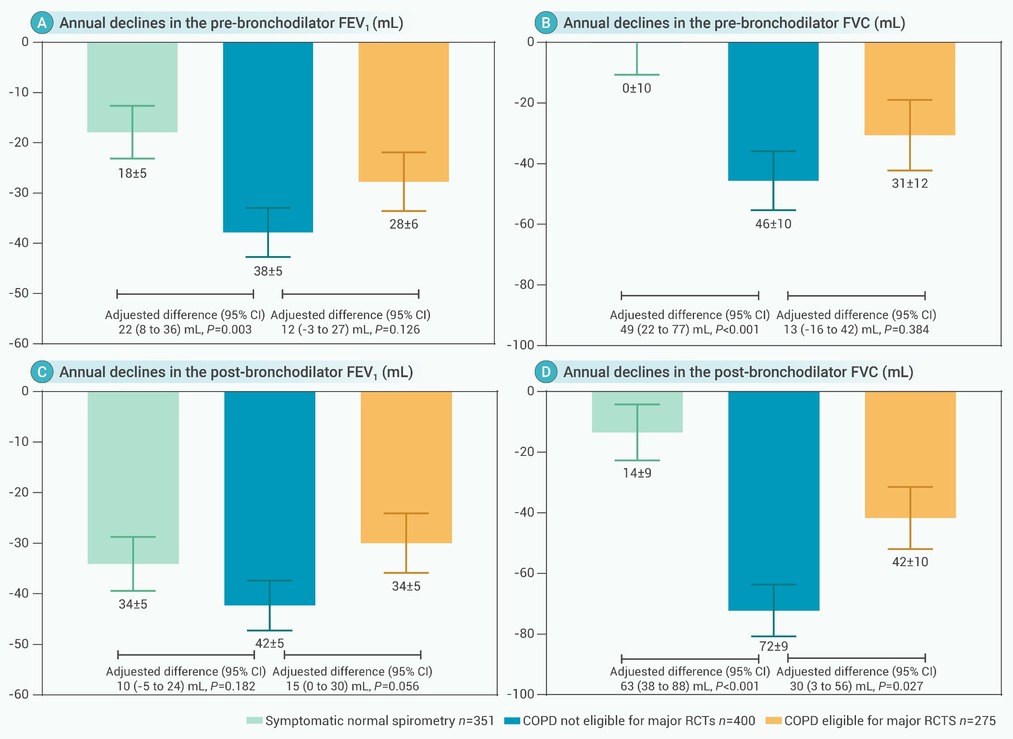
Figure 2.
Annual decline in lung function among patients in the ECOPD study
-
Figure 3.
Mean lung function and annual lung function decline among patients with mild-to-moderate COPD not eligible for major randomized clinical trial in the Tie-COPD study
-
Figure 4.
Acute exacerbations and CID among patients with mild-to-moderate COPD not eligible for major randomized clinical trial in the Tie-COPD study
