
Generative AI for brain-computer interfaces decoding: Advances, challenges and future
-
GRAPHICAL ABSTRACT

 DownLoad:
Full size image
DownLoad:
Full size image
-
PUBLIC SUMMARY
-
Generative BCI decoding reconstructs semantically rich content, including text and images, from brain signals.
Generative AI boosts BCI decoding through data augmentation and sensor optimization.
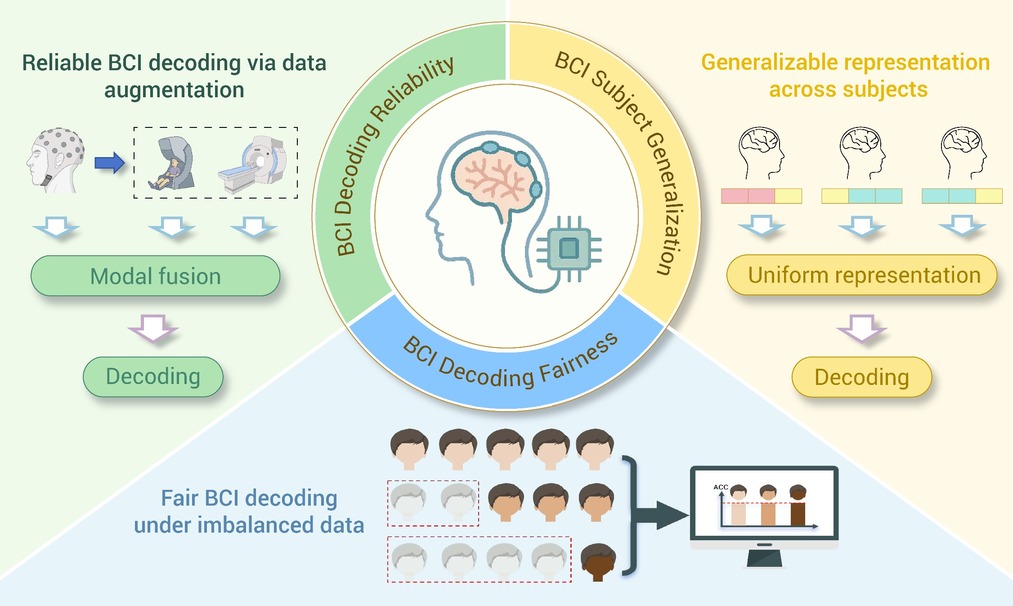
Key challenges include BCI decoding reliability, cross-subject generalizability, and fairness.
-
-
ABSTRACT
Brain-computer interfaces (BCIs) establish direct communication pathways between the human brain and external devices, enabling novel modes of human-machine interaction and providing essential technological foundations for innovative clinical therapies. BCI decoding can be divided into discriminative and generative approaches. Discriminative decoding models are primarily used for predefined tasks such as emotion recognition, limited performance in reconstructing high-dimensional semantic content such as natural language or visual images. Recent advances in generative artificial intelligence (AI), including diffusion models and autoregressive Transformers, have brought generative decoding to the forefront of BCI research by enabling the reconstruction of semantically rich content from neural activity. Current studies further demonstrate that decoding visually evoked neural activity into images can achieve structural similarity index measure (SSIM) scores ranging approximately from 0.26 to 0.43. Furthermore, generative AI enhances BCI decoding through data augmentation and sensor optimization, thereby improving both performance and generalizability. Here, we review recent progress in generative AI-enabled BCI decoding, focusing on methodological advances in language and visual decoding. We also summarize its roles in data augmentation and sensor optimization, outline key challenges in decoding accuracy, cross-subject generalization and fairness, and suggest future directions such as multimodal integration and fairness-aware frameworks. -

-
REFERENCES
[1] Xu S., Liu Y., Lee H., et al. (2024). Neural interfaces: Bridging the brain to the world beyond healthcare. Exploration 4:20230146. DOI:10.1002/exp.20230146 [2] Chaudhary U., Birbaumer N. and Ramos-Murguialday A. (2016). Brain-computer interfaces for communication and rehabilitation. Nat. Rev. Neurol. 12:513−525. DOI:10.1038/nrneurol.2016.113 [3] Schwemmer M.A., Skomrock N.D., Sederberg P.B., et al. (2018). Meeting brain-computer interface user performance expectations using a deep neural network decoding framework. Nat. Med. 24:1669−1676. DOI:10.1038/s41591-018-0171-y [4] Degenhart A.D., Bishop W.E., Oby E.R., et al. (2020). Stabilization of a brain-computer interface via the alignment of low-dimensional spaces of neural activity. Nat. Biomed. Eng. 4:672−685. DOI:10.1038/s41551-020-0542-9 [5] Ding Y., Udompanyawit C., Zhang Y., et al. (2025). EEG-based brain-computer interface enables real-time robotic hand control at individual finger level. Nat. Commun. 16:1−20. DOI:10.1038/s41467-025-61064-x [6] Kunz E.M., Krasa B.A., Kamdar F., et al. (2025). Inner speech in motor cortex and implications for speech neuroprostheses. Cell 188:4658−4673. DOI:10.1016/j.cell.2025.06.015 [7] Wei Q., Cui M., Liu Z., et al. (2025). Integrating statistical design and inference: A roadmap for robust and trustworthy medical AI. Innov. Med. 3:100145. DOI:10.59717/j.xinn-med.2025.100145 [8] Schalk G., McFarland D.J., Hinterberger T., et al. (2004). BCI2000: A general-purpose brain-computer interface (BCI) system. IEEE Trans. Biomed. Eng. 51:1034−1043. DOI:10.1109/tbme.2004.827072 [9] Littlejohn K.T., Cho C.J., Liu J.R., et al. (2025). A streaming brain-to-voice neuroprosthesis to restore naturalistic communication. Nat. Neurosci. 28:902−912. DOI:10.1038/s41593-025-01905-6 [10] Santhanam G., Ryu S.I., Yu B.M., et al. (2006). A high-performance brain-computer interface. Nature 442:195−198. DOI:10.1038/nature04968 [11] Wairagkar M., Card N.S., Singer-Clark T., et al. (2025). An instantaneous voice-synthesis neuroprosthesis. Nature 644:145−152. DOI:10.1038/s41586-025-09127-3 [12] Willsey M.S., Shah N.P., Avansino D.T., et al. (2025). A high-performance brain-computer interface for finger decoding and quadcopter game control in an individual with paralysis. Nat. Med. 31:96−104. DOI:10.1038/s41591-024-03341-8 [13] Del Pozo-Banos M., Alonso J.B., Ticay-Rivas J.R., et al. (2014). Electroencephalogram subject identification: A review. Expert Syst. Appl. 41:6537−6554. DOI:10.1016/j.eswa.2014.05.013 [14] Hu Y., Sun L., Mao X., et al. (2024). EEG data augmentation method for identity recognition based on spatial-temporal generating adversarial network. Electronics 13:4310. DOI:10.3390/electronics13214310 [15] Jolfaei A., Wu X.W. and Muthukkumarasamy V. (2013). On the feasibility and performance of pass-thought authentication systems. 2013 Fourth International Conference on Emerging Security Technologies pp:33–38. DOI:10.1109/est.2013.12 [16] Horikawa T. and Kamitani Y. (2017). Generic decoding of seen and imagined objects using hierarchical visual features. Nat. Commun. 8:15037. DOI:10.1038/ncomms15037 [17] Fares A., Zhong S.h. and Jiang J. (2019). EEG-based image classification via a regionlevel stacked bi-directional deep learning framework. BMC Med. Inform. Decis. Making 19:268. DOI:10.1186/s12911-019-0967-9 [18] Mukherjee P., Das A., Bhunia A.K. et al. (2019). Cogni-net: Cognitive feature learning through deep visual perception. 2019 IEEE International Conference on Image Processing pp:4539–4543. DOI:10.1109/icip.2019.8803717 [19] Song Y., Wang Y., He H., et al. (2025). Recognizing natural images from EEG with language-guided contrastive learning. IEEE Trans. Neural Netw. Learn. Syst. 36:15896−15910. DOI:10.1109/tnnls.2025.3562743 [20] Patel P., B S. and Annavarapu R.N. (2025). Application of supervised machine learning models in human emotion classification using Tsallis entropy as a feature. J. Big Data 12:126. DOI:10.1186/s40537-025-01177-8 [21] Fu K., Du C., Wang S., et al. (2022). Multi-view multi-label fine-grained emotion decoding from human brain activity. IEEE Trans. Neural Netw. Learn. Syst. 35:9026−9040. DOI:10.1109/tnnls.2022.3217767 [22] Huang Z., Du C., Li C., et al. (2025). Identifying the hierarchical emotional areas in the human brain through information fusion. Inf. Fusion 113:102613. DOI:10.1016/j.inffus.2024.102613 [23] Jin M., Du C., He H., et al. (2024). PGCN: Pyramidal graph convolutional network for EEG emotion recognition. IEEE Trans. Multimedia 26:9070−9082. DOI:10.1109/tmm.2024.3385676 [24] Silversmith D.B., Abiri R., Hardy N.F., et al. (2021). Plug-and-play control of a brain-computer interface through neural map stabilization. Nat. Biotechnol. 39:326−335. DOI:10.1038/s41587-020-0662-5 [25] Huang D., Qian K., Fei D.Y., et al. (2012). Electroencephalography (EEG)-based brain-computer interface (BCI): A 2-D virtual wheelchair control based on event-related desynchronization/synchronization and state control. IEEE Trans. Neural Syst. Rehabil. Eng. 20:379−388. DOI:10.1109/tnsre.2012.2190299 [26] Huang S., Wang Y. and Luo H. (2025). CCSUMSP: A cross-subject Chinese speech decoding framework with unified topology and multi-modal semantic pre-training. Inf. Fusion 119:103022. DOI:10.1016/j.inffus.2025.103022 [27] Zhao X., Sun J., Wang S. et al. (2024). Mapguide: A simple yet effective method to reconstruct continuous language from brain activities. Proceedings of the 2024 Conference of the North American Chapter of the Association for Computational Linguistics: Human Language Technologies pp:3822–3832. DOI:10.18653/v1/2024.naacl-long.211 [28] de la Torre-Ortiz C., Spapé M.M., Ravaja N., et al. (2024). Cross-subject EEG feedback for ′ implicit image generation. IEEE Trans. Cybern. 54:6105−6117. DOI:10.1109/tcyb.2024.3406159 [29] Meng L. and Yang C. (2023). Dual-guided brain diffusion model: Natural image reconstruction from human visual stimulus fMRI. Bioengineering 10:1117. DOI:10.3390/bioengineering10101117 [30] Deng C., Li X. and Dai J. (2023). Challenges for translating implantable brain-computer interface to medical device. Innov. Med. 1:100040. DOI:10.59717/j.xinn-med.2023.100040 [31] Tang J., LeBel A., Jain S., et al. (2023). Semantic reconstruction of continuous language from non-invasive brain recordings. Nat. Neurosci. 26:858−866. DOI:10.1038/s41593-023-01304-9 [32] Ozdenizci O., Wang Y., Koike-Akino T. et al. (2019). Transfer learning in brain-computer interfaces with adversarial variational autoencoders. 9th International IEEE EMBS Conference on Neural Engineering pp:207–210. DOI:10.1109/ner.2019.8716897 [33] Scotti P., Banerjee A., Goode J., et al. (2023). Reconstructing the mind’s eye: fMRI-toimage with contrastive learning and diffusion priors. Advances in Neural Information Processing Systems 36:24705−24728. DOI:10.48550/arXiv.2305.18274 [34] Jeong J.H., Cho J.H., Lee B.H., et al. (2022). Real-time deep neurolinguistic learning enhances noninvasive neural language decoding for brain-machine interaction. IEEE Trans. Cybern. 53:7469−7482. DOI:10.1109/tcyb.2022.3211694 [35] Antonello R., Vaidya A. and Huth A. (2023). Scaling laws for language encoding models in fMRI. Advances in Neural Information Processing Systems 36:21895−21907. DOI:10.48550/arXiv.2305.11863 [36] Ye Z., Ai Q., Liu Y., et al. (2025). Generative language reconstruction from brain recordings. Commun. Biol. 8:346. DOI:10.1038/s42003-025-07731-7 [37] Metzger S.L., Littlejohn K.T., Silva A.B., et al. (2023). A high-performance neuroprosthesis for speech decoding and avatar control. Nature 620:1037−1046. DOI:10.1038/s41586-023-06443-4 [38] Liu Y., Zhao Z., Xu M., et al. (2023). Decoding and synthesizing tonal language speech from brain activity. Sci. Adv. 9:eadh0478. DOI:10.1126/sciadv.adh0478 [39] Tian Z., Quan R., Ma F., et al. (2025). BRAINGUARD: Privacy-preserving multisubject image reconstructions from brain activities. Proceedings of the AAAI Conference on Artificial Intelligence 39:14414−14422. DOI:10.1609/aaai.v39i13.33579 [40] Song Y., Liu B., Li X. et al. (2024). Decoding natural images from EEG for object recognition. 12th International Conference on Learning Representations pp:15475–15492. DOI:10.48550/arXiv.2308.13234 [41] Xia W., De Charette R., Oztireli C. et al. (2024). Dream: Visual decoding from reversing human visual system. Proceedings of the IEEE/CVF Winter Conference on Applications of Computer Vision pp:8226–8235. DOI:10.1109/wacv57701.2024.00804 [42] Kumar S., Sumers T.R., Yamakoshi T., et al. (2024). Shared functional specialization in transformer-based language models and the human brain. Nat. Commun. 15:5523. DOI:10.1038/s41467-024-49173-5 [43] Ko W., Jeon E., Yoon J.S., et al. (2022). Semi-supervised generative and discriminative adversarial learning for motor imagery-based brain-computer interface. Sci. Rep. 12:4587. DOI:10.1038/s41598-022-08490-9 [44] Wang S., Zhou T., Shen Y., et al. (2025). Generative AI enables EEG super-resolution via spatio-temporal adaptive diffusion learning. IEEE Trans. Consum. Electron. 71:1034−1045. DOI:10.1109/tce.2025.3528438 [45] Vetter J., Macke J.H. and Gao R. (2024). Generating realistic neurophysiological time series with denoising diffusion probabilistic models. Patterns 5:101047. DOI:10.1016/j.patter.2024.101047 [46] Kwon J. and Im C.H. (2022). Novel signal-to-signal translation method based on StarGAN to generate artificial EEG for SSVEP-based brain-computer interfaces. Expert Syst. Appl. 203:117574. DOI:10.1016/j.eswa.2022.117574 [47] Yao W., Lyu Z., Mahmud M., et al. (2025). CATD: Unified representation learning for EEGto-fMRI cross-modal generation. IEEE Trans. Med. Imaging 44:2757−2767. DOI:10.1109/tmi.2025.3550206 [48] Li Y., Wang Y., Lei B., et al. (2025). SCDM: Unified representation learning for EEG-tofNIRS cross-modal generation in MI-BCIs. IEEE Trans. Med. Imaging 44:2384−2394. DOI:10.1109/tmi.2025.3532480 [49] Hu M., Chen J., Jiang S., et al. (2022). E2SGAN: EEG-to-SEEG translation with generative adversarial networks. Front. Neurosci. 16:971829. DOI:10.3389/fnins.2022.971829 [50] Antoniades A., Spyrou L., Martin-Lopez D., et al. (2018). Deep neural architectures for mapping scalp to intracranial EEG. Int. J. Neural Syst. 28:1850009. DOI:10.1142/s0129065718500090 [51] Zhang R., Zeng Y., Tong L., et al. (2022). ERP-WGAN: A data augmentation method for EEG single-trial detection. J. Neurosci. Meth. 376:109621. DOI:10.1016/j.jneumeth.2022.109621 [52] Fahimi F., Dosen S., Ang K.K., et al. (2020). Generative adversarial networks-based data augmentation for brain-computer interface. IEEE Trans. Neural Netw. Learn. Syst. 32:4039−4051. DOI:10.1109/tnnls.2020.3016666 [53] Tang Y., Chen D., Liu H., et al. (2022). Deep EEG superresolution via correlating brain structural and functional connectivities. IEEE Trans. Cybern. 53:4410−4422. DOI:10.1109/tcyb.2022.3178370 [54] Gayon-Lombardo A., Mosser L., Brandon N.P., et al. (2020). Pores for thought: generative adversarial networks for stochastic reconstruction of 3D multi-phase electrode microstructures with periodic boundaries. npj Comput. Mater. 6:82. DOI:10.1038/s41524-020-0340-7 [55] Sanchez-Lengeling B. and Aspuru-Guzik A. (2018). Inverse molecular design using machine learning: Generative models for matter engineering. Science 361:360−365. DOI:10.1126/science.aat2663 [56] Manica M., Born J., Cadow J., et al. (2023). Accelerating material design with the generative toolkit for scientific discovery. npj Comput. Mater. 9:69. DOI:10.1038/s41524-023-01028-1 [57] Dan Y., Zhao Y., Li X., et al. (2020). Generative adversarial networks (GAN) based efficient sampling of chemical composition space for inverse design of inorganic materials. npj Comput. Mater. 6:84. DOI:10.1038/s41524-020-00352-0 [58] Guenther F.H., Brumberg J.S., Wright E.J., et al. (2009). A wireless brain-machine interface for real-time speech synthesis. PloS one 4:e8218. DOI:10.1371/journal.pone.0008218 [59] Tang J. and Huth A.G. (2025). Semantic language decoding across participants and stimulus modalities. Curr. Biol. 35:1023−1032. DOI:10.1016/j.cub.2025.01.024 [60] Komeiji S., Mitsuhashi T., Iimura Y., et al. (2024). Feasibility of decoding covert speech in ECoG with a transformer trained on overt speech. Sci. Rep. 14:11491. DOI:10.1101/2024.02.05.578911 [61] Fan C., Hahn N., Kamdar F., et al. (2023). Plug-and-play stability for intracortical braincomputer interfaces: a one-year demonstration of seamless brain-to-text communication. Advances in Neural Information Processing Systems 36:42258−42270. DOI:10.48550/arXiv.2311.03611 [62] Metzger S.L., Liu J.R., Moses D.A., et al. (2022). Generalizable spelling using a speech neuroprosthesis in an individual with severe limb and vocal paralysis. Nat. Commun. 13:6510. DOI:10.1038/s41467-022-33611-3 [63] Proix T., Delgado Saa J., Christen A., et al. (2022). Imagined speech can be decoded from low-and cross-frequency intracranial EEG features. Nat. Commun. 13:48. DOI:10.1038/s41467-021-27725-3 [64] Qi Y., Zhu X., Xiong X., et al. (2025). Human motor cortex encodes complex handwriting through a sequence of stable neural states. Nat. Hum. Behav. 9:1260−1271. DOI:10.1038/s41562-025-02157-x [65] Miliotou E., Kyriakis P., Hinman J.D., et al. (2023). Generative decoding of visual stimuli. International Conference on Machine Learning 202:24775−24784. https://proceedings.mlr.press/v202/miliotou23a/miliotou23a.pdf. [66] Liu A., Jing H., Liu Y. et al. (2024). Hidden states in LLMs improve EEG representation learning and visual decoding. European Conference on Artificial Intelligence pp:2130–2137. DOI:10.3233/faia240732 [67] Huang S., Sun L., Yousefnezhad M., et al. (2023). Functional alignment-auxiliary generative adversarial network-based visual stimuli reconstruction via multi-subject fMRI. IEEE Trans. Neural Syst. Rehabil. Eng. 31:2715−2725. DOI:10.1109/tnsre.2023.3283405 [68] Shimizu S., Ota A. and Nakane A. (2025). Reviving intentional facial expressions: An interface for ALS patients using brain decoding and image-generative AI. Proceedings of the Extended Abstracts of the CHI Conference on Human Factors in Computing Systems pp:1–10. DOI:10.1145/3706599.3719775 [69] Mahajan G., Jeevan R., Divija L. et al. (2024). Deciphering EEG waves for the generation of images. 2024 12th International Winter Conference on Brain-Computer Interface pp:1–6. DOI:10.1109/bci60775.2024.10480501 [70] Yeung J., Luo A.F., Sarch G. et al. (2025). Reanimating images using neural representations of dynamic stimuli. Proceedings of the IEEE/CVF Conference on Computer Vision and Pattern Recognition pp:5331–5343. DOI:10.1109/cvpr52734.2025.00502 [71] Allen E.J., St-Yves G., Wu Y., et al. (2022). A massive 7t fmri dataset to bridge cognitive neuroscience and artificial intelligence. Nat. Neurosci. 25:116−126. DOI:10.1038/s41593-021-00962-x [72] Horikawa T., Tamaki M., Miyawaki Y., et al. (2013). Neural decoding of visual imagery during sleep. Science 340:639−642. DOI:10.1126/science.1234330 [73] Breedlove J.L., St-Yves G., Olman C.A., et al. (2020). Generative feedback explains distinct brain activity codes for seen and mental images. Curr. Biol. 30:2211−2224. DOI:10.1016/j.cub.2020.04.014 [74] Ritchie J.B., Kaplan D.M. and Klein C. (2019). Decoding the brain: Neural representation and the limits of multivariate pattern analysis in cognitive neuroscience. British J. Philos. Sci. 70:581−607. DOI:10.1093/bjps/axx023 [75] Wang S., Jiang C., Yu Y., et al. (2025). Tellurium nanowire retinal nanoprosthesis improves vision in models of blindness. Science 388:eadu2987. DOI:10.1126/science.adu2987 [76] Kravitz D.J., Saleem K.S., Baker C.I., et al. (2011). A new neural framework for visuospatial processing. Nat. Rev. Neurosci. 12:217−230. DOI:10.1038/nrn3008 [77] Kwon M., Han S., Kim K., et al. (2019). Super-resolution for improving EEG spatial resolution using deep convolutional neural network—feasibility study. Sensors 19:5317. DOI:10.3390/s19235317 [78] Bao G., Zhang Q., Gong Z., et al. (2025). Wills Aligner: Multi-subject collaborative brain visual decoding. Proceedings of the AAAI Conference on Artificial Intelligence 39:14194. DOI:10.1609/aaai.v39i13.33554 [79] Li D., Du C., Wang S., et al. (2021). Multi-subject data augmentation for target subject semantic decoding with deep multi-view adversarial learning. Inf. Sci. 547:1025−1044. DOI:10.1016/j.ins.2020.09.012 [80] Ozcelik F. and VanRullen R. (2023). Natural scene reconstruction from fMRI signals using generative latent diffusion. Sci. Rep. 13:15666. DOI:10.1038/s41598-023-42891-8 [81] Takagi Y. and Nishimoto S. (2023). High-resolution image reconstruction with latent diffusion models from human brain activity. Proceedings of the IEEE/CVF conference on computer vision and pattern recognition pp:14453–14463. DOI:10.1109/cvpr52729.2023.01389 [82] Du C., Fu K., Li J., et al. (2023). Decoding visual neural representations by multimodal learning of brain-visual-linguistic features. IEEE Trans. Pattern Anal. Mach. Intell. 45:10760−10777. DOI:10.1109/tpami.2023.3263181 [83] Shen G., Zhao D., He X., et al. (2024). Neuro-vision to language: Enhancing brain recording-based visual reconstruction and language interaction. Advances in Neural Information Processing Systems 37:98083−98110. DOI:10.52202/079017-3113 [84] Zhang A., Wang B., Wu X. et al. (2025). A novel multimodal method for decoding speech perception from brain activities. ICASSP 2025-2025 IEEE International Conference on Acoustics, Speech and Signal Processing pp:1–5. DOI:10.1109/icassp49660.2025.10889637 [85] Luo S., Angrick M., Coogan C., et al. (2023). Stable decoding from a speech BCI enables control for an individual with ALS without recalibration for 3 months. Adv. Sci. 10:2304853. DOI:10.1002/advs.202304853 [86] Xi N., Zhao S., Wang H. et al. (2023). Unicorn: Unified cognitive signal reconstruction bridging cognitive signals and human language. Proceedings of the Annual Meeting of the Association for Computational Linguistics pp:13277–13291. DOI:10.18653/v1/2023.acl-long.741 [87] Guo J., Yi C., Li F. et al. (2024). MindLDM: Reconstruct visual stimuli from fMRI using latent diffusion model. 2024 IEEE International Conference on Computational Intelligence and Virtual Environments for Measurement Systems and Applications pp:1–6. DOI:10.1109/civemsa58715.2024.10586647 [88] Wilson G.H., Stavisky S.D., Willett F.R., et al. (2020). Decoding spoken english from intracortical electrode arrays in dorsal precentral gyrus. J. Neural Eng. 17:066007. DOI:10.1088/1741-2552/abbfef [89] Ferrante M., Boccato T., Ozcelik F. et al. (2023). Multimodal decoding of human brain activity into images and text. Advances in Neural Information Processing Systems vol. 243 pp:87–101. https://proceedings.mlr.press/v243/ferrante24a. [90] Scotti P.S., Tripathy M., Villanueva C.K.T. et al. (2024). MindEye2: Shared-subject models enable fMRI-to-image with 1 hour of data. Proceedings of the 41st International Conference on Machine Learning pp:44038–44059. DOI:10.48550/arXiv.2403.11207 [91] Wang S., Liu S., Tan Z. et al. (2024). Mindbridge: A cross-subject brain decoding framework. Proceedings of the IEEE/CVF Conference on Computer Vision and Pattern Recognition pp:11333–11342. DOI:10.1109/cvpr52733.2024.01077 [92] Gong Z., Bao G., Zhang Q., et al. (2024). NeuroClips: Towards high-fidelity and smooth fMRI-to-video reconstruction. Advances in Neural Information Processing Systems 37:51655−51683. DOI:10.52202/079017-1636 [93] Vansteensel M.J., Pels E.G., Bleichner M.G., et al. (2016). Fully implanted brain-computer interface in a locked-in patient with ALS. N. Engl. J. Med. 375:2060−2066. DOI:10.1056/nejmoa1608085 [94] Willett F.R., Avansino D.T., Hochberg L.R., et al. (2021). High-performance brain-to-text communication via handwriting. Nature 593:249−254. DOI:10.1038/s41586-021-03506-2 [95] Martin S., Brunner P., Iturrate I., et al. (2016). Word pair classification during imagined speech using direct brain recordings. Sci. Rep. 6:25803. DOI:10.1038/srep25803 [96] Herff C., Heger D., De Pesters A., et al. (2015). Brain-to-text: decoding spoken phrases from phone representations in the brain. Front. Neurosci. 8:141498. DOI:10.3389/fnins.2015.00217 [97] Moses D.A., Leonard M.K., Makin J.G., et al. (2019). Real-time decoding of question-andanswer speech dialogue using human cortical activity. Nat. Commun. 10:3096. DOI:10.1038/s41467-019-10994-4 [98] Moses D.A., Metzger S.L., Liu J.R., et al. (2021). Neuroprosthesis for decoding speech in a paralyzed person with anarthria. N. Engl. J. Med. 385:217−227. DOI:10.1056/nejmoa2027540 [99] Duraivel S., Rahimpour S., Chiang C.H., et al. (2023). High-resolution neural recordings improve the accuracy of speech decoding. Nat. Commun. 14:6938. DOI:10.1038/s41467-023-42555-1 [100] Zhang D., Wang Z., Qian Y., et al. (2024). A brain-to-text framework for decoding natural tonal sentences. Cell Rep. 43:114924. DOI:10.1016/j.celrep.2024 [101] Makin J.G., Moses D.A. and Chang E.F. (2020). Machine translation of cortical activity to text with an encoder-decoder framework. Nat. Neurosci. 23:575−582. DOI:10.1038/s41593-020-0608-8 [102] Sun P., Anumanchipalli G.K. and Chang E.F. (2020). Brain2Char: a deep architecture for decoding text from brain recordings. J. Neural Eng. 17:066015. DOI:10.1088/1741-2552/abc742 [103] Simanova I., Hagoort P., Oostenveld R., et al. (2014). Modality-independent decoding of semantic information from the human brain. Cereb. Cortex 24:426−434. DOI:10.1093/cercor/bhs324 [104] Defossez A., Caucheteux C., Rapin J., et al. (2023). Decoding speech perception ′ from non-invasive brain recordings. Nat. Mach. Intell. 5:1097−1107. DOI:10.1038/s42256-023-00714-5 [105] Chen Q., Wang Y., Wang F., et al. (2025). Decoding text from electroencephalography signals: a novel hierarchical gated recurrent unit with masked residual attention mechanism. Eng. Appl. Artif. Intel. 139:109615. DOI:10.1016/j.engappai.2024.109615 [106] Wang Z. and Ji H. (2022). Open vocabulary electroencephalography-to-text decoding and zero-shot sentiment classification. Proceedings of the AAAI Conference on Artificial Intelligence 36:5350−5358. DOI:10.1609/aaai.v36i5.20472 [107] Duan Y., Zhou J., Wang Z., et al. (2023). Dewave: Discrete encoding of EEG waves for EEG to text translation. Advances in Neural Information Processing Systems 36:9907−9918. DOI:10.48550/arXiv.2309.14030 [108] Chen X., Du C., Liu C. et al. (2025). BP-GPT: Auditory neural decoding using fmriprompted llm. ICASSP 2025-2025 IEEE International Conference on Acoustics, Speech and Signal Processing pp:1–5. DOI:10.1109/icassp49660.2025.10890142 [109] Liu H., Hajialigol D., Antony B. et al. (2024). EEG2Text: Open vocabulary EEG-to-text translation with multi-view transformer. 2024 IEEE International Conference on Big Data pp:1824–1833. DOI:10.1109/bigdata62323.2024.10825980 [110] Zhou J., Duan Y., Chang Y.C., et al. (2024). BELT: bootstrapped EEG-to-language training by natural language supervision. IEEE Trans. Neural Syst. Rehabil. Eng. 32:3278−3288. DOI:10.1109/tnsre.2024.3450795 [111] Amrani H., Micucci D. and Napoletano P. (2024). Deep representation learning for open vocabulary electroencephalography-to-text decoding. IEEE J. Biomed. Health Inform. pp:1–12. DOI:10.1109/JBHI.2024.3416066 [112] Tao Y., Liang Y., Wang L. et al. (2025). See: Semantically aligned EEG-to-text translation. ICASSP 2025-2025 IEEE International Conference on Acoustics, Speech and Signal Processing pp:1–5. DOI:10.1109/icassp49660.2025.10889658 [113] Wang J., Song Z., Ma Z. et al. (2024). Enhancing EEG-to-text decoding through transferable representations from pre-trained contrastive EEG-text masked autoencoder. Proceedings of the Annual Meeting of the Association for Computational Linguistics pp:7278–7292. DOI:10.18653/v1/2024.acl-long.393 [114] Luo K. (2024). Real-time open-vocabulary sentence decoding from MEG signals using transformers. 2024 International Conference on Image Processing, Computer Vision and Machine Learning pp:460–463. DOI:10.1109/icicml63543.2024.10957766 [115] Boyko M., Druzhinina P., Kormakov G. et al. (2024). MEGFormer: enhancing speech decoding from brain activity through extended semantic representations. International Conference on Medical Image Computing and Computer-Assisted Intervention pp:281–290. DOI:10.1007/978-3-031-72069-7_27 [116] Wang B., Xu X., Zhang L. et al. (2024). Semantic reconstruction of continuous language from meg signals. ICASSP 2024-2024 IEEE International Conference on Acoustics, Speech and Signal Processing pp:2190–2194. DOI:10.1109/icassp48485.2024.10448281 [117] Guo Y., Dong Y., Ng M.K.P. et al. (2025). A pre-trained framework for multilingual brain decoding using non-invasive recordings. arXiv Preprint arXiv:2506.03214. DOI:10.48550/arXiv.2506.03214 [118] Silva A.B., Liu J.R., Metzger S.L., et al. (2024). A bilingual speech neuroprosthesis driven by cortical articulatory representations shared between languages. Nat. Biomed. Eng. 8:977−991. DOI:10.1038/s41551-024-01207-5 [119] Huang W., Yang P., Tang Y., et al. (2024). From sight to insight: A multi-task approach with the visual language decoding model. Inf. Fusion 112:102573. DOI:10.1016/j.inffus.2024.102573 [120] Han J., Gong K., Zhang Y. et al. (2024). Onellm: One framework to align all modalities with language. Proceedings of the IEEE/CVF Conference on Computer Vision and Pattern Recognition pp:26584–26595. DOI:10.1109/cvpr52733.2024.02510 [121] Chen J., Qi Y., Wang Y., et al. (2025). Mindgpt: Interpreting what you see with non-invasive brain recordings. IEEE Trans. Image Process. 34:3281−3293. DOI:10.1109/tip.2025.3572784 [122] Tang J., Yang Y., Zhao Q., et al. (2024). Visual guided dual-spatial interaction network for fine-grained brain semantic decoding. IEEE Trans. Instrum. Meas. 73:2534214. DOI:10.1109/tim.2024.3480232 [123] Ikegawa Y., Fukuma R., Sugano H., et al. (2024). Text and image generation from intracranial electroencephalography using an embedding space for text and images. J. Neural Eng. 21:036019. DOI:10.1088/1741-2552/ad417a [124] Willett F.R., Kunz E.M., Fan C., et al. (2023). A high-performance speech neuroprosthesis. Nature 620:1031−1036. DOI:10.1101/2023.01.21.524489 [125] Ramsey N.F., Salari E., Aarnoutse E.J., et al. (2018). Decoding spoken phonemes from sensorimotor cortex with high-density ECoG grids. Neuroimage 180:301−311. DOI:10.1016/j.neuroimage.2017.10.011 [126] Angrick M., Herff C., Mugler E., et al. (2019). Speech synthesis from ECoG using densely connected 3d convolutional neural networks. J. Neural Eng. 16:036019. DOI:10.1088/1741-2552/ab0c59 [127] Herff C., Diener L., Angrick M., et al. (2019). Generating natural, intelligible speech from brain activity in motor, premotor, and inferior frontal cortices. Front. Neurosci. 13:1267. DOI:10.3389/fnins.2019.01267 [128] Berezutskaya J., Freudenburg Z.V., Vansteensel M.J., et al. (2023). Direct speech reconstruction from sensorimotor brain activity with optimized deep learning models. J. Neural Eng. 20:056010. DOI:10.1088/1741-2552/ace8be [129] Anumanchipalli G.K., Chartier J. and Chang E.F. (2019). Speech synthesis from neural decoding of spoken sentences. Nature 568:493−498. DOI:10.1038/s41586-019-1119-1 [130] Shigemi K., Komeiji S., Mitsuhashi T. et al. (2023). Synthesizing speech from ECoG with a combination of transformer-based encoder and neural vocoder. ICASSP 2023-2023 IEEE International Conference on Acoustics, Speech and Signal Processing pp:1–5. DOI:10.1109/icassp49357.2023.10097004 [131] Ticha M.B.B., Ran X., Roussel P. et al. (2024). A vision transformer architecture for overt speech decoding from ECoG data. 2024 46th Annual International Conference of the IEEE Engineering in Medicine and Biology Society pp:1–4. DOI:10.1109/embc53108.2024.10781877 [132] Chen X., Wang R., Khalilian-Gourtani A., et al. (2024). A neural speech decoding framework leveraging deep learning and speech synthesis. Nat. Mach. Intell. 6:467−480. DOI:10.1038/s42256-024-00824-8 [133] Meng K., Goodarzy F., Kim E., et al. (2023). Continuous synthesis of artificial speech sounds from human cortical surface recordings during silent speech production. J. Neural Eng. 20:046019. DOI:10.1088/1741-2552/ace7f6 [134] Wu X., Wellington S., Fu Z., et al. (2024). Speech decoding from stereoelectroencephalography (sEEG) signals using advanced deep learning methods. J. Neural Eng. 21:036055. DOI:10.1088/1741-2552/ad593a [135] Angrick M., Ottenhoff M.C., Diener L., et al. (2021). Real-time synthesis of imagined speech processes from minimally invasive recordings of neural activity. Commun. Biol. 4:1055. DOI:10.1038/s42003-021-02578-0 [136] Angrick M., Luo S., Rabbani Q., et al. (2024). Online speech synthesis using a chronically implanted brain-computer interface in an individual with ALS. Sci. Rep. 14:9617. DOI:10.1038/s41598-024-60277-2 [137] Card N.S., Wairagkar M., Iacobacci C., et al. (2024). An accurate and rapidly calibrating speech neuroprosthesis. N. Engl. J. Med. 391:609−618. DOI:10.1056/nejmoa2314132 [138] Wu H., Cai C., Ming W., et al. (2024). Speech decoding using cortical and subcortical electrophysiological signals. Front. Neurosci. 18:1345308. DOI:10.3389/fnins.2024.1345308 [139] Feng C., Cao L., Wu D., et al. (2025). Acoustic inspired brain-to-sentence decoder for logosyllabic language. Cyborg Bionic Syst. 6:0257. DOI:10.34133/cbsystems.0257 [140] Accou B., Vanthornhout J., hamme H.V., et al. (2023). Decoding of the speech envelope from EEG using the VLAAI deep neural network. Sci. Rep. 13:812. DOI:10.1038/s41598-022-27332-2 [141] Van Dyck B., Yang L. and Van Hulle M.M. (2023). Decoding auditory EEG responses using an adapted wavenet. ICASSP 2023-2023 IEEE International Conference on Acoustics, Speech and Signal Processing pp:1–2. DOI:10.1109/icassp49357.2023.10095420 [142] Fan C., Zhang S., Zhang J. et al. (2025). SSM2Mel: State space model to reconstruct Mel spectrogram from the EEG. ICASSP 2025-2025 IEEE International Conference on Acoustics, Speech and Signal Processing pp:1–5. DOI:10.1109/icassp49660.2025.10888785 [143] Qi D., Kong L., Yang L. et al. (2023). Audiodiffusion: Generating high-quality audios from EEG signals: Reconstructing audio from EEG signals. 2023 4th International Symposium on Computer Engineering and Intelligent Communications pp:344–348. DOI:10.1109/isceic59030.2023.10271237 [144] Xiong W., Ma L. and Li H. (2025). Synthesizing intelligible utterances from EEG of imagined speech. Front. Neurosci. 19:1565848. DOI:10.3389/fnins.2025.1565848 [145] Lee J.W., Lee S.H., Lee Y.E. et al. (2023). Sentence reconstruction leveraging contextual meaning from speech-related brain signals. 2023 IEEE International Conference on Systems, Man, and Cybernetics pp:3721–3726. DOI:10.1109/smc53992.2023.10394348 [146] Park J.Y., Tsukamoto M., Tanaka M., et al. (2025). Natural sounds can be reconstructed from human neuroimaging data using deep neural network representation. PLoS Biol. 23:e3003293. DOI:10.1371/journal.pbio.3003293 [147] Craik A., Dial H. and Contreras-Vidal J.L. (2025). Continuous and discrete decoding of overt speech with scalp electroencephalography (EEG). J. Neural Eng. 22:026017. DOI:10.1088/1741-2552/ad8d0a [148] Dado T., Papale P., Lozano A., et al. (2024). Brain2GAN: Feature-disentangled neural encoding and decoding of visual perception in the primate brain. PLoS Comput. Biol. 20:e1012058. DOI:10.1371/journal.pcbi.1012058 [149] Doerig A., Kietzmann T.C., Allen E., et al. (2025). High-level visual representations in the human brain are aligned with large language models. Nat. Mach. Intell. 7:1220−1234. DOI:10.1038/s42256-025-01072-0 [150] Wang H., Zhang Q., Wang L. et al. (2025). Neurons: Emulating the human visual cortex improves fidelity and interpretability in fMRI-to-video reconstruction. Proceedings of the IEEE/CVF International Conference on Computer Vision pp:18367–18376. DOI:10.48550/arXiv.2503.11167 [151] Xia R., Yin C. and Li P. (2024). Decoding the echoes of vision from fmri: Memory disentangling for past semantic information. Proceedings of the 2024 Conference on Empirical Methods in Natural Language Processing pp:2040–2052. DOI:10.18653/v1/2024.emnlp-main.122 [152] Meng L. and Yang C. (2024). Semantics-guided hierarchical feature encoding generative adversarial network for visual image reconstruction from brain activity. IEEE Trans. Neural Syst. Rehabil. Eng. 32:1267−1283. DOI:10.1109/tnsre.2024.3377698 [153] Dado T., Guçlütürk Y., Ambrogioni L., et al. (2022). Hyperrealistic neural decoding for reconstructing faces from fMRI activations via the GAN latent space. Sci. Rep. 12:141. DOI:10.1038/s41598-021-03938-w [154] Quan R., Wang W., Tian Z. et al. (2025). Psychometry: An omnifit model for image reconstruction from human brain activity. Proceedings of the IEEE/CVF Conference on Computer Vision and Pattern Recognition pp:233–243. DOI:10.1109/cvpr52733.2024.00030 [155] Wu H., Li Q., Zhang C. et al. (2025). Bridging the vision-brain gap with an uncertainty aware blur prior. Proceedings of the IEEE/CVF Conference on Computer Vision and Pattern Recognition pp:2246–2257. DOI:10.1109/cvpr52734.2025.00215 [156] Miyawaki Y., Uchida H., Yamashita O., et al. (2008). Visual image reconstruction from human brain activity using a combination of multiscale local image decoders. Neuron 60:915−929. DOI:10.1016/j.neuron.2008.11.004 [157] Du C., Du C., Huang L., et al. (2018). Reconstructing perceived images from human brain activities with bayesian deep multiview learning. IEEE Trans. Neural Netw. Learn. Syst. 30:2310−2323. DOI:10.1109/tnnls.2018.2882456 [158] Güçlütürk Y., Güçlü U., Seeliger K., et al. (2017). Reconstructing perceived faces from brain activations with deep adversarial neural decoding. Advances in Neural Information Processing Systems 30:4249−4260. [159] VanRullen R. and Reddy L. (2019). Reconstructing faces from fMRI patterns using deep generative neural networks. Commun. Biol. 2:193. DOI:10.1038/s42003-019-0438-y [160] Du C., Du C., Huang L., et al. (2020). Conditional generative neural decoding with structured cnn feature prediction. Proceedings of the AAAI Conference on Artificial Intelligence 34:2629−2636. DOI:10.1609/aaai.v34i03.5647 [161] Naselaris T., Prenger R.J., Kay K.N., et al. (2009). Bayesian reconstruction of natural images from human brain activity. Neuron 63:902−915. DOI:10.1016/j.neuron.2009.09.006 [162] Beliy R., Gaziv G., Hoogi A., et al. (2019). From voxels to pixels and back: Self-supervision in natural-image reconstruction from fMRI. Advances in Neural Information Processing Systems 32:6517−6527. DOI:10.48550/arXiv.1907.02431 [163] Shen G., Horikawa T., Majima K., et al. (2019). Deep image reconstruction from human brain activity. PLOS Comput. Biol. 15:e1006633. DOI:10.1371/journal.pcbi.1006633 [164] Luo J., Cui W., Liu J., et al. (2022). Visual image decoding of brain activities using a dual attention hierarchical latent generative network with multiscale feature fusion. IEEE Trans. Cogn. Develop. Syst. 15:761−773. DOI:10.1109/tcds.2022.3181469 [165] Akamatsu Y., Harakawa R., Ogawa T., et al. (2020). Brain decoding of viewed image categories via semi-supervised multi-view bayesian generative model. IEEE Trans. Signal Process. 68:5769−5781. DOI:10.1109/tsp.2020.3028701 [166] Li D., Du C. and He H. (2020). Semi-supervised cross-modal image generation with generative adversarial networks. Pattern Recognit. 100:107085. DOI:10.1016/j.patcog.2019.107085 [167] Gaziv G., Beliy R., Granot N., et al. (2022). Self-supervised natural image reconstruction and large-scale semantic classification from brain activity. NeuroImage 254:119121. DOI:10.1016/j.neuroimage.2022.119121 [168] Zhou Q., Du C., Li D., et al. (2025). Interpretable visual neural decoding with unsupervised semantic disentanglement. Mach. Intell. Res. 22:553−570. DOI:10.1007/s11633-023-1484-y [169] Tirupattur P., Rawat Y.S., Spampinato C. et al. (2018). Thoughtviz: Visualizing human thoughts using generative adversarial network. Proceedings of the 26th ACM International Conference on Multimedia pp:950–958. DOI:10.1145/3240508.3240641 [170] Palazzo S., Spampinato C., Kavasidis I. et al. (2017). Generative adversarial networks conditioned by brain signals. Proceedings of the IEEE international conference on computer vision pp:3410–3418. DOI:10.1109/iccv.2017.369 [171] Kavasidis I., Palazzo S., Spampinato C. et al. (2017). Brain2image: Converting brain signals into images. Proceedings of the 25th ACM International Conference on Multimedia pp:1809–1817. DOI:10.1145/3123266.3127907 [172] Ahmadieh H., Gassemi F. and Moradi M.H. (2024). Visual image reconstruction based on EEG signals using a generative adversarial and deep fuzzy neural network. Biomed. Signal Proces. 87:105497. DOI:10.1016/j.bspc.2023.105497 [173] Fares A., Zhong S.h. and Jiang J. (2020). Brain-media: A dual conditioned and lateralization supported GAN (DCLS-GAN) towards visualization of image-evoked brain activities. Proceedings of the 28th ACM International Conference on Multimedia pp:1764–1772. DOI:10.1145/3394171.3413858 [174] Huang W., Yan H., Wang C., et al. (2020). Perception-to-image: Reconstructing natural images from the brain activity of visual perception. Ann. Biomed. Eng. 48:2323−2332. DOI:10.1007/s10439-020-02502-3 [175] Lu Y., Du C., Zhou Q. et al. (2023). Minddiffuser: Controlled image reconstruction from human brain activity with semantic and structural diffusion. Proceedings of the 31st ACM International Conference on Multimedia pp:5899–5908. DOI:10.1145/3581783.3613832 [176] Lu Y., Du C., Wang C. et al. (2025). Animate your thoughts: Reconstruction of dynamic natural vision from human brain activity. 13th International Conference on Learning Representations pp:23255–23293. DOI:10.48550/arXiv.2405.03280 [177] Li J., Li D., Xiong C. et al. (2022). Blip: Bootstrapping language-image pre-training for unified vision-language understanding and generation. International Conference on Machine Learning pp:12888–12900. DOI:10.48550/arXiv.2201.12086 [178] Luo A., Henderson M., Wehbe L., et al. (2023). Brain diffusion for visual exploration: Cortical discovery using large scale generative models. Advances in Neural Information Processing Systems 36:75740−75781. [179] Ferrante M., Boccato T., Passamonti L., et al. (2024). Retrieving and reconstructing conceptually similar images from fmri with latent diffusion models and a neuro-inspired brain decoding model. J. Neural Eng. 21:046001. DOI:10.1088/1741-2552/ad593c [180] Chen Z., Qing J., Xiang T. et al. (2023). Seeing beyond the brain: Conditional diffusion model with sparse masked modeling for vision decoding. Proceedings of the IEEE/CVF Conference on Computer Vision and Pattern Recognition pp:22710–22720. DOI:10.1109/cvpr52729.2023.02175 [181] Bai Y., Wang X., Cao Y.P. et al. (2024). Dreamdiffusion: High-quality EEG-to-image gener ation with temporal masked signal modeling and CLIP alignment. Computer Vision–ECCV 2024: 18th European Conference pp:472–488. DOI:10.1007/978-3-031-72751-1_27 [182] Liu Q., Zhu H., Chen N., et al. (2024). Mind-bridge: reconstructing visual images based on diffusion model from human brain activity. Signal Image Video Process. 18:953−963. DOI:10.1007/s11760-024-03207-z [183] Zhou Q., Du C., Wang S. et al. (2024). CLIP-MUSED: CLIP-guided multi-subject visual neural information semantic decoding. 12th International Conference on Learning Representations pp:43466–43482. DOI:10.48550/arXiv.2402.08994 [184] Ma Y., Liu Y., Chen L., et al. (2025). BrainCLIP: Brain representation via CLIP for generic natural visual stimulus decoding. IEEE Trans. Med. Imaging 44:3962−3972. DOI:10.1109/TMI.2025.3537287 [185] Bhalerao S.V. and Pachori R.B. (2024). Automated classification of cognitive visual objects using multivariate swarm sparse decomposition from multichannel EEG-MEG signals. IEEE Trans. Hum.-Mach. Syst. 54:455−464. DOI:10.1109/thms.2024.3395153 [186] Gong Z., Zhang Q., Bao G., et al. (2025). Mindtuner: Cross-subject visual decoding with visual fingerprint and semantic correction. Proceedings of the AAAI Conference on Artificial Intelligence 39:14247−14255. DOI:10.1609/aaai.v39i13.33560 [187] Luo A.F., Henderson M.M., Tarr M.J. et al. (2024). BrainSCUBA: Fine-grained natural language captions of visual cortex selectivity. 12th International Conference on Learning Representations pp:1744–1780. DOI:10.48550/arXiv.2310.0442 [188] Zhao Y., Dong G., Zhu L., et al. (2025). Memory recall: Retrieval-augmented mind reconstruction for brain decoding. Inf. Fusion 123:103280. DOI:10.1016/j.inffus.2025.103280 [189] Huo J., Wang Y., Wang Y. et al. (2024). Neuropictor: Refining fMRI-to-image reconstruction via multi-individual pretraining and multi-level modulation. European Conference on Computer Vision pp:56–73. DOI:10.1007/978-3-031-72983-6_4 [190] Liu M. and Kobayashi I. (2024). Do feature representations from different language models affect accuracy of brain encoding models’ predictions? 2024 IEEE International Conference on Systems, Man, and Cybernetics pp:2766–2771. DOI:10.1109/smc54092.2024.10831584 [191] Singh A.K., Wang Y.K., King J.T., et al. (2020). Extended interaction with a BCI video game changes resting-state brain activity. IEEE Trans. Cogn. Develop. Syst. 12:809−823. DOI:10.1109/tcds.2020.2985102 [192] Nishimoto S., Vu A.T., Naselaris T., et al. (2011). Reconstructing visual experiences from brain activity evoked by natural movies. Curr. Biol. 21:1641−1646. DOI:10.1016/j.cub.2011.08.031 [193] Hanke M., Baumgartner F.J., Ibe P., et al. (2014). A high-resolution 7-Tesla fMRI dataset from complex natural stimulation with an audio movie. Sci. Data 1:14003. DOI:10.1038/sdata.2014.3 [194] Sun J., Li M. and Moens M.F. (2025). Neuralflix: A simple while effective framework for semantic decoding of videos from non-invasive brain recordings. Proceedings of the AAAI Conference on Artificial Intelligence 39:7096−7104. DOI:10.1609/aaai.v39i7.32762 [195] Fosco C., Lahner B., Pan B. et al. (2024). Brain netflix: Scaling data to reconstruct videos from brain signals. European Conference on Computer Vision pp:457–474. DOI:10.1007/978-3-031-73347-5_26 [196] Simonyan K. and Zisserman A. (2014). Two-stream convolutional networks for action recognition in videos. Advances in Neural Information Processing Systems 27:568−576. DOI:10.48550/arXiv.1406.2199 [197] Carreira J. and Zisserman A. (2017). Quo vadis, action recognition? a new model and the kinetics dataset. Proceedings of the IEEE Conference on Computer Vision and Pattern Recognition pp:6299–6308. DOI:10.1109/cvpr.2017.502 [198] Chen Z., Qing J. and Zhou J.H. (2023). Cinematic mindscapes: High-quality video re construction from brain activity. Advances in Neural Information Processing Systems 36:24841−24858. DOI:10.48550/arXiv.2305.11675 [199] Liu X.H., Liu Y.K., Wang Y., et al. (2024). EEG2video: Towards decoding dynamic visual perception from EEG signals. Advances in Neural Information Processing Systems 37:72245−72273. DOI:10.52202/079017-2306 [200] Lin J., Chen H., Fan Y. et al. (2025). Multi-layer visual feature fusion in multimodal llms: 1167 Methods, analysis, and best practices. Proceedings of the IEEE/CVF Conference on 1168 Computer Vision and Pattern Recognition pp:4156−4166. DOI:10.1109/cvpr52734.2025.00393 [201] Zhang B., Fang Y., Ren T. et al. (2022). Multimodal analysis for deep video understanding with video language transformer. Proceedings of the 30th ACM International Conference on Multimedia pp:7165–7169. DOI:10.1145/3503161.3551600 [202] Holz F.G., Le Mer Y., Muqit M.M. et al. (2025). Subretinal photovoltaic implant to restore vision in geographic atrophy due to AMD. N. Engl. J. Med. 394:232-242. DOI:10.1056/nejmoa2501396 [203] Elnabawy R.H., Abdennadher S., Hellwich O., et al. (2022). PVGAN: a generative adversarial network for object simplification in prosthetic vision. J. Neural Eng. 19:056007. DOI:10.1088/1741-2552/ac8acf [204] Chen X., Wang F., Fernandez E., et al. (2020). Shape perception via a high-channelcount neuroprosthesis in monkey visual cortex. Science 370:1191−1196. DOI:10.1126/science.abd7435 [205] Luo T.j., Fan Y., Chen L., et al. (2020). EEG signal reconstruction using a generative adversarial network with wasserstein distance and temporal-spatial-frequency loss. Front. Neuroinf. 14:15. DOI:10.3389/fninf.2020.00015 [206] Aznan N.K.N., Atapour-Abarghouei A., Bonner S. et al. (2019). Simulating brain signals: Creating synthetic EEG data via neural-based generative models for improved SSVEP classification. 2019 International Joint Conference on Neural Networks pp:1–8. DOI:10.1109/ijcnn.2019.8852227 [207] Xie J., Chen S., Zhang Y., et al. (2021). Combining generative adversarial networks and multi-output CNN for motor imagery classification. J. Neural Eng. 18:046026. DOI:10.1088/1741-2552/abecc5 [208] Mao M., Komes D., Zhao S., et al. (2025). Non-invasive neuromodulation assisted by exogenous stimuli-responsive nanoplatforms for Alzheimer’s disease and Parkinson’s disease therapy. Innov. Med. 3:100121. DOI:10.59717/j.xinn-med.2025.100121 [209] Yuste R., Goering S., Arcas B.A.Y., et al. (2017). Four ethical priorities for neurotechnologies and AI. Nature 551:159−163. DOI:10.1038/551159a [210] Bahador N., Jokelainen J., Mustola S., et al. (2021). Reconstruction of missing channel in electroencephalogram using spatiotemporal correlation-based averaging. J. Neural Eng. 18:056045. DOI:10.1088/1741-2552/ac23e2 [211] An D., Guo Y., Lei N. et al. (2020). AE-OT: A new generative model based on extended semi-discrete optimal transport. 8th International Conference on Learning Representations pp: 8996–9014. https://openreview.net/pdf?id=HkldyTNYwH. [212] Anderson A.J., McDermott K., Rooks B., et al. (2020). Decoding individual identity from brain activity elicited in imagining common experiences. Nat. Commun. 11:5916. DOI:10.1038/s41467-020-19630-y [213] Li C., Qian X., Wang Y. et al. (2024). Enhancing cross-subject fMRI-to-video decoding with global-local functional alignment. European Conference on Computer Vision pp:353–369. DOI:10.1007/978-3-031-73010-8_21 [214] Wen S., Yin A., Furlanello T., et al. (2023). Rapid adaptation of brain-computer interfaces to new neuronal ensembles or participants via generative modelling. Nat. Biomed. Eng. 7:546−558. DOI:10.1038/s41551-021-00811-z [215] Karpowicz B.M., Ali Y.H., Wimalasena L.N., et al. (2025). Stabilizing brain-computer interfaces through alignment of latent dynamics. Nat. Commun. 16:4662. DOI:10.1038/s41467-025-59652-y [216] Ahuja C. and Sethia D. (2025). SS-EMERGE - self-supervised enhancement for multidimension emotion recognition using GNNs for EEG. Sci. Rep. 15:14254. DOI:10.1038/s41598-025-98623-7 [217] Chen R.J., Wang J.J., Williamson D.F., et al. (2023). Algorithmic fairness in artificial intelligence for medicine and healthcare. Nat. Biomed. Eng. 7:719−742. DOI:10.1038/s41551-023-01056-8 [218] Yang Y., Zhang H., Gichoya J.W., et al. (2024). The limits of fair medical imaging AI in real-world generalization. Nat. Med. 30:2838−2848. DOI:10.1038/s41591-024-03113-4 [219] Yao W., Chen X. and Wang S. (2025). Empowering functional neuroimaging: A pretrained generative framework for unified representation of neural signals. arXiv Preprint arXiv:2506.02433. DOI:10.48550/arXiv.2506.02433 [220] Liu R., Chen Y., Li A., et al. (2024). Aggregating intrinsic information to enhance BCI performance through federated learning. Neural Netw. 172:106100. DOI:10.1016/j.neunet.2024.106100 [221] Dai J., Xu H., Chen T., et al. (2025). Artificial intelligence for medicine 2025: Navigating the endless frontier. Innov. Med. 3:100120. DOI:10.59717/j.xinn-med.2025.100120 [222] Huang T., Xu H., Wang H., et al. (2023). Artificial intelligence for medicine: Progress, challenges, and perspectives. Innov. Med. 1:10030. DOI:10.59717/j.xinn-med.2023.100030 -
ABOUT THIS ARTICLE
Cite this article:
Guo Y., Ren G., Ma S., et al. (2026). Generative AI for brain-computer interfaces decoding: Advances, challenges and future. The Innovation Medicine 4:100193. https://doi.org/10.59717/j.xinn-med.2026.100193
Welcome!
To request copyright permission to republish or share portions of our works, please visit Copyright Clearance Center's (CCC) Marketplace website at marketplace.copyright.com.

Export File
Citation
Guo Y., Ren G., Ma S., et al. (2026). Generative AI for brain-computer interfaces decoding: Advances, challenges and future. The Innovation Medicine 4:100193. https://doi.org/10.59717/j.xinn-med.2026.100193

Format
Content
-
Figure 1.
Schematic illustration of discriminative and generative brain decoding
-
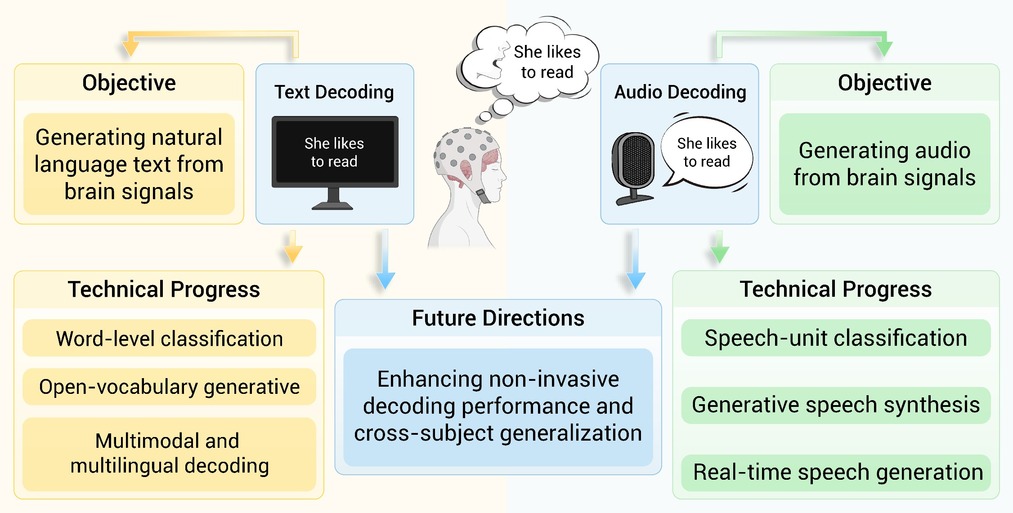
Figure 2.
Schematic of BCI language decoding
-
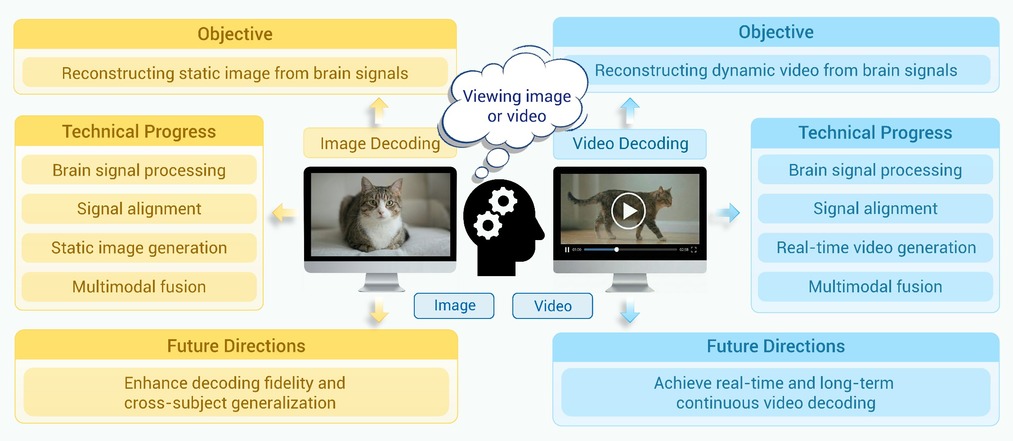
Figure 3.
Schematic of visual decoding from brain signals
-
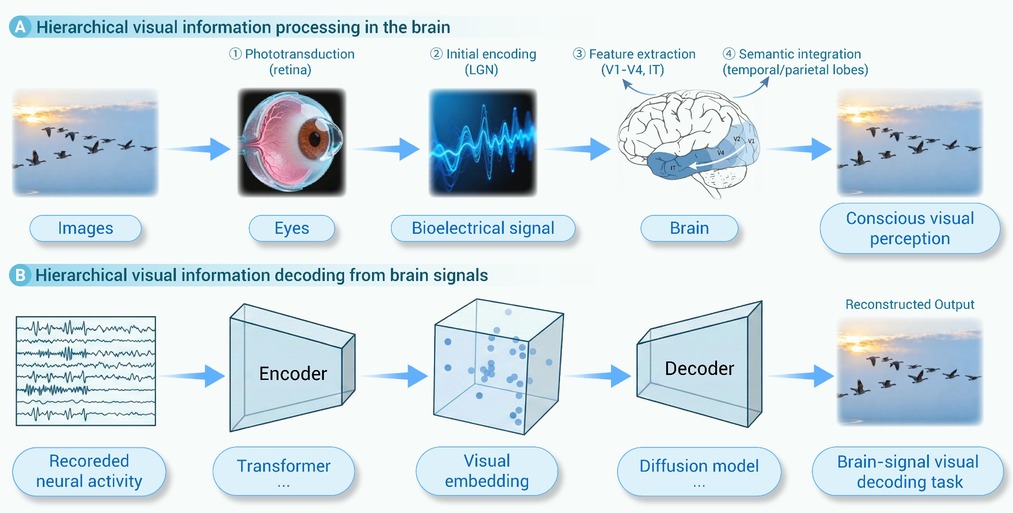
Figure 4.
Visual information flow and its correspondence to brain signal visual decoding
-
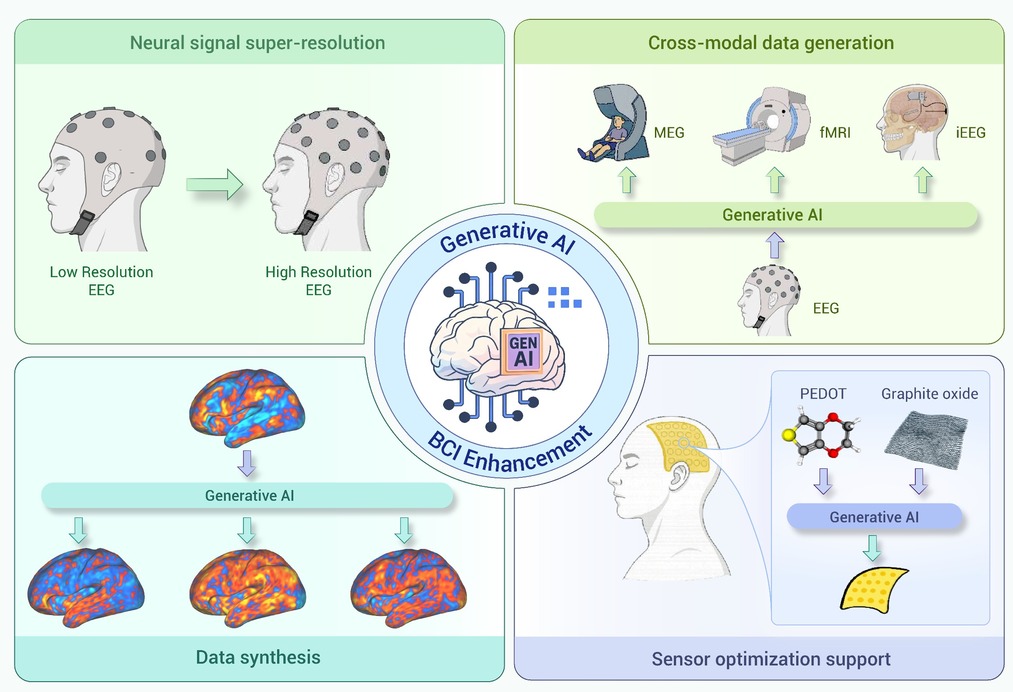
Figure 5.
Schematic of generative AI-enabled enhancements in BCI decoding
-
Figure 6.
Schematic of key limitations in BCI decoding, encompassing decoding reliability, cross-subject generalization, and BCI decoding fairness.
