
Controlling confounding in nutrition research: Methodological strategies, software implementation, and reporting guidelines
-
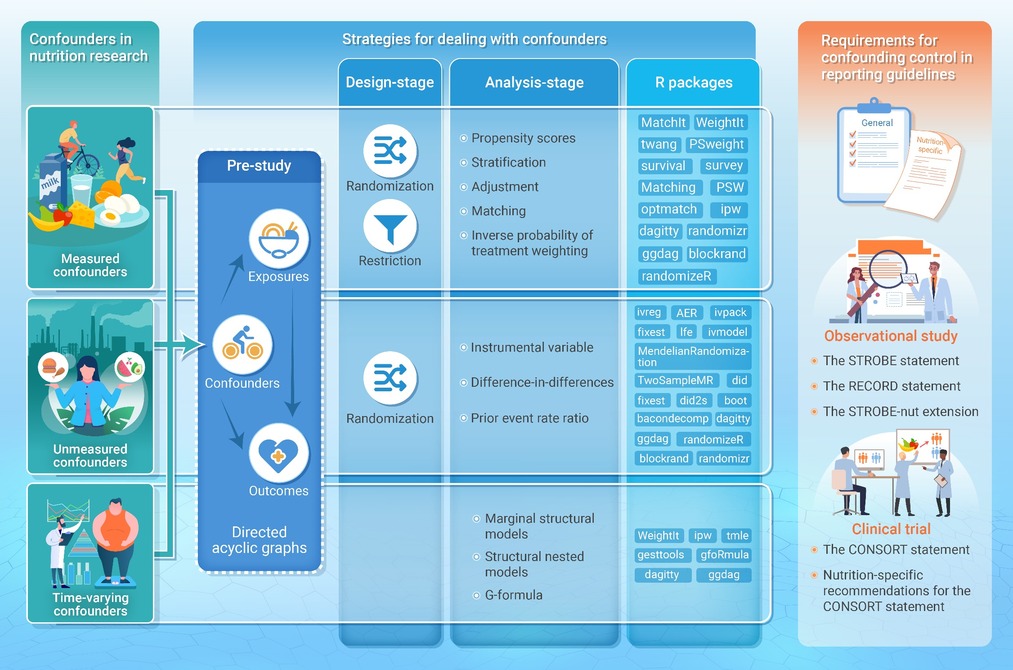
GRAPHICAL ABSTRACT
 DownLoad:
Full size image
DownLoad:
Full size image
-
PUBLIC SUMMARY
-
Confounding is an important challenge for causal inference in nutrition research.
Confounder management involves pre-study identification, design-stage control, and analysis-stage control.
This review summarizes methods to identify and address confounders across these stages.
Clear reporting guidelines are essential for enabling the correct interpretation of research findings.
-
-
ABSTRACT
In nutrition research, confounding is an important challenge. Owing to the complexities involved in dietary interventions, such research is often subject to three types of confounders: measured confounders, unmeasured confounders, and time-varying confounders. Inadequate control of these confounders can lead to distorted research conclusions and even undermine the credibility of dietary guidelines. This review systematically summarizes strategies for confounder control in nutrition research, including confounder identification at the pre-study stage, confounder control at the design and analysis stages, and relevant R packages for practical implementation. In addition, the review collates and compares the specific requirements for confounding control in general reporting guidelines and their nutrition-specific extensions, thereby providing reporting guidance for the identification and control of confounders in nutrition research. -

-
REFERENCES
[1] Rothman K. J., Greenland S. and Lash T. L. (2008). Modern epidemiology, 3rd edn. (Wolters Kluwer Health/Lippincott Williams & Wilkins). [2] Monsen E. R. and Horn L. V. (2007). Research: Successful approaches (American Dietetic Association). [3] Trepanowski J. F. and Ioannidis J. P. A. (2018). Perspective: Limiting dependence on nonrandomized studies and improving randomized trials in human nutrition research: Why and how. Adv. Nutr. 9:367−377. DOI:10.1093/advances/nmy014 [4] Ou G., Wu J., Wang S., et al. (2024). Dietary factors and risk of gout: A two-sample mendelian randomization study. Foods 13:1269. DOI:10.3390/foods13081269 [5] Brown A. W., Aslibekyan S., Bier D., et al. (2023). Toward more rigorous and informative nutritional epidemiology: The rational space between dismissal and defense of the status quo. Crit. Rev. Food Sci. Nutr. 63:3150-3167. DOI:10.1080/10408398.2021.1985427 [6] Ioannidis J. P. (2013). Implausible results in human nutrition research. BMJ 347:f6698. DOI:10.1136/bmj.f6698 [7] Maki K. C., Slavin J. L., Rains T. M., et al. (2014). Limitations of observational evidence: Implications for evidence-based dietary recommendations. Adv. Nutr. 5:7−15. DOI:10.3945/an.113.004929 [8] Choi A. L., Cordier S., Weihe P., et al. (2008). Negative confounding in the evaluation of toxicity: The case of methylmercury in fish and seafood. Crit. Rev. Toxicol. 38:877−893. DOI:10.1080/10408440802273164 [9] Keogh R. H. and White I. R. (2014). A toolkit for measurement error correction, with a focus on nutritional epidemiology. Stat. Med. 33:2137−2155. DOI:10.1002/sim.6095 [10] Boe L. A., Shaw P. A., Midthune D., et al. (2023). Issues in implementing regression calibration analyses. Am. J. Epidemiol. 192:1406−1414. DOI:10.1093/aje/kwad098 [11] Tang D., Hu Y., Zhang N., et al. (2024). Change analysis for intermediate disease markers in nutritional epidemiology: A causal inference perspective. BMC Med. Res. Methodol. 24:49. DOI:10.1186/s12874-024-02167-9 [12] Greenland S., Pearl J. and Robins J. M. (1999). Causal diagrams for epidemiologic research. Epidemiology 10:37−48. DOI:10.1093/acprof:oso/9780190243777.003.0003 [13] Tomova G. D., Arnold K. F., Gilthorpe M. S., et al. (2022). Adjustment for energy intake in nutritional research: A causal inference perspective. Am. J. Clin. Nutr. 115:189−198. DOI:10.1093/ajcn/nqab266 [14] Lichtenstein A. H., Petersen K., Barger K., et al. (2021). Perspective: Design and conduct of human nutrition randomized controlled trials. Adv. Nutr. 12:4−20. DOI:10.1093/advances/nmaa109 [15] Ebbeling C. B., Feldman H. A., Klein G. L., et al. (2018). Effects of a low carbohydrate diet on energy expenditure during weight loss maintenance: Randomized trial. BMJ 363:k4583. DOI:10.1136/bmj.k4583 [16] Weaver C. M. and Miller J. W. (2017). Challenges in conducting clinical nutrition research. Nutr. Rev. 75:491−499. DOI:10.1093/nutrit/nux026 [17] Kristensen M., Pelletier X., Ross A. B., et al. (2017). A high rate of non-compliance confounds the study of whole grains and weight maintenance in a randomised intervention trial-the case for greater use of dietary biomarkers in nutrition intervention studies. Nutrients 9. DOI:10.3390/nu9010055. [18] D'Agostino R. B., Jr. (1998). Propensity score methods for bias reduction in the comparison of a treatment to a non-randomized control group. Stat. Med. 17:2265−2281. DOI:3.0.co;2-b">10.1002/(sici)1097-0258(19981015)17:19<2265::aid-sim918>3.0.co;2-b [19] Rosenbaum P. R. and Rubin D. B. (1983). The central role of the propensity score in observational studies for causal effects. Biometrika 70:41−55. DOI:10.1017/cbo9780511810725.016 [20] Westreich D., Lessler J. and Funk M. J. (2010). Propensity score estimation: Neural networks, support vector machines, decision trees (cart), and meta-classifiers as alternatives to logistic regression. J. Clin. Epidemiol. 63:826−833. DOI:10.1016/j.jclinepi.2009.11.020 [21] Li X., Dai T., Rao Z., et al. (2022). Impact of oral nutrition supplementation on outcomes of esophageal cancer patients treated with chemotherapy: A retrospective cohort study with propensity score matching. Front. Nutr. 9:1004372. DOI:10.3389/fnut.2022.1004372 [22] Rosenbaum P. R. and Rubin D. B. (1984). Reducing bias in observational studies using subclassification on the propensity score. J. Am. Stat. Assoc. 79:516−524. DOI:10.1080/01621459.1984.10478078 [23] Touré A., Chambrier C., Vanhems P., et al. (2013). Propensity score analysis confirms the independent effect of parenteral nutrition on the risk of central venous catheter-related bloodstream infection in oncological patients. Clin. Nutr. 32:1050−1054. DOI:10.1016/j.clnu.2012.12.006 [24] Austin P. C. (2011). Optimal caliper widths for propensity-score matching when estimating differences in means and differences in proportions in observational studies. Pharm. Stat. 10:150−161. DOI:10.1002/pst.433 [25] Austin P. C. (2014). A comparison of 12 algorithms for matching on the propensity score. Stat. Med. 33:1057−1069. DOI:10.1002/sim.6004 [26] Rosenbaum P. R. and Rubin D. B. (1985). Constructing a control group using multivariate matched sampling methods that incorporate the propensity score. Am. Stat. 39:33−38. DOI:10.1080/00031305.1985.10479383 [27] Stuart E. A. (2010). Matching methods for causal inference: A review and a look forward. Stat. Sci. 25:1−21. DOI:10.1214/09-STS313 [28] Rosenbaum P. R. (2020). Modern algorithms for matching in observational studies. Annu. Rev. Stat. Appl. 7:143−176. DOI:10.1146/annurev-statistics-031219-041058 [29] Rosenbaum P. R. (1989). Optimal matching for observational studies. J. Am. Stat. Assoc. 84:1024−1032. DOI:10.1080/01621459.1989.10478868 [30] Rassen J. A., Shelat A. A., Myers J., et al. (2012). One-to-many propensity score matching in cohort studies. Pharmacoepidemiol. Drug Saf. 21 Suppl 2:69-80. DOI:10.1002/pds.3263 [31] Ming K. and Rosenbaum P. R. (2000). Substantial gains in bias reduction from matching with a variable number of controls. Biometrics 56:118−124. DOI:10.1111/j.0006-341X.2000.00118.x [32] Pimentel S. D., Yoon F. and Keele L. (2015). Variable-ratio matching with fine balance in a study of the peer health exchange. Stat. Med. 34:4070−4082. DOI:10.1002/sim.6593 [33] Hansen B. B. (2004). Full matching in an observational study of coaching for the sat. J. Am. Stat. Assoc. 99:609−618. DOI:10.1198/016214504000000647 [34] Stuart E. A. (2008). Developing practical recommendations for the use of propensity scores: Discussion of 'a critical appraisal of propensity score matching in the medical literature between 1996 and 2003' by peter austin, statistics in medicine. Stat. Med. 27:2062-2065; discussion 2066-2069. DOI:10.1002/sim.3207 [35] Austin P. C. and Stuart E. A. (2015). Optimal full matching for survival outcomes: A method that merits more widespread use. Stat. Med. 34:3949−3967. DOI:10.1002/sim.6602 [36] Takagi K., Murotani K., Kamoshita S., et al. (2022). Clinical impact of lipid injectable emulsion in internal medicine inpatients exclusively receiving parenteral nutrition: A propensity score matching analysis from a japanese medical claims database. BMC Med. 20:371. DOI:10.1186/s12916-022-02568-x [37] Robins J. M., Hernan M. A. and Brumback B. (2000). Marginal structural models and causal inference in epidemiology. Epidemiology 11:550−560. DOI:10.1097/00001648-200009000-00011 [38] Rosenbaum P. R. (1987). Model-based direct adjustment. J. Am. Stat. Assoc. 82:387−394. DOI:10.1080/01621459.1987.10478441 [39] Morgan S. L. and Todd J. J. (2008). 6. A diagnostic routine for the detection of consequential heterogeneity of causal effects. Sociol. Methodol. 38:231−282 [40] Tingsgard S., Bastrup Israelsen S., Jorgensen H. L., et al. (2024). Early switch from intravenous to oral antibiotics for patients with uncomplicated gram-negative bacteremia. JAMA Netw. Open 7:e2352314. DOI:10.1001/jamanetworkopen.2023.52314 [41] Austin P. C. and Stuart E. A. (2015). Moving towards best practice when using inverse probability of treatment weighting (iptw) using the propensity score to estimate causal treatment effects in observational studies. Stat. Med. 34:3661−3679. DOI:10.1002/sim.6607 [42] Cole S. R. and Hernan M. A. (2008). Constructing inverse probability weights for marginal structural models. Am. J. Epidemiol. 168:656−664. DOI:10.1093/aje/kwn164 [43] Buajitti E. and Rosella L. C. (2023). Neighbourhood socioeconomic improvement, residential mobility and premature death: A population-based cohort study and inverse probability of treatment weighting analysis. Int. J. Epidemiol. 52:489−500. DOI:10.1093/ije/dyac117 [44] Li F., Morgan K. L. and Zaslavsky A. M. (2018). Balancing covariates via propensity score weighting. J. Am. Stat. Assoc. 113:390−400. DOI:10.1080/01621459.2016.1260466 [45] Li F., Thomas L. E. and Li F. (2019). Addressing extreme propensity scores via the overlap weights. Am. J. Epidemiol. 188:250−257. DOI:10.1093/aje/kwy201 [46] Thomas L. E., Li F. and Pencina M. J. (2020). Overlap weighting: A propensity score method that mimics attributes of a randomized clinical trial. JAMA 323:2417−2418. DOI:10.1001/jama.2020.7819 [47] Mengist B., Lotfaliany M., Pasco J. A., et al. (2025). The risk associated with ultra-processed food intake on depressive symptoms and mental health in older adults: A target trial emulation. BMC Med. 23:172. DOI:10.1186/s12916-025-04002-4 [48] Greenland S. (2000). An introduction to instrumental variables for epidemiologists. Int. J. Epidemiol. 29:722−729. DOI:10.1093/ije/29.4.722 [49] Smith G. D. and Ebrahim S. (2003). 'Mendelian randomization': Can genetic epidemiology contribute to understanding environmental determinants of disease. Int. J. Epidemiol. 32:1−22. DOI:10.1093/ije/dyg070 [50] Berkowitz S. A., Terranova J., Randall L., et al. (2019). Association between receipt of a medically tailored meal program and health care use. JAMA Intern. Med. 179:786−793. DOI:10.1001/jamainternmed.2019.0198 [51] Zhou H., Taber C., Arcona S., et al. (2016). Difference-in-differences method in comparative effectiveness research: Utility with unbalanced groups. Appl. Health Econ. Health Policy 14:419−429. DOI:10.1007/s40258-016-0249-y [52] Saeed S., Moodie E. E. M., Strumpf E. C., et al. (2019). Evaluating the impact of health policies: Using a difference-in-differences approach. Int. J. Public Health 64:637−642. DOI:10.1007/s00038-018-1195-2 [53] Parnham J. C., Chang K., Millett C., et al. (2022). The impact of the universal infant free school meal policy on dietary quality in english and scottish primary school children: Evaluation of a natural experiment. Nutrients 14. DOI:10.3390/nu14081602. [54] Uddin M. J., Groenwold R. H., van Staa T. P., et al. (2015). Performance of prior event rate ratio adjustment method in pharmacoepidemiology: A simulation study. Pharmacoepidemiol. Drug Saf. 24:468−477. DOI:10.1002/pds.3724 [55] Yu M., Xie D., Wang X., et al. (2012). Prior event rate ratio adjustment: Numerical studies of a statistical method to address unrecognized confounding in observational studies. Pharmacoepidemiol. Drug Saf. 21 Suppl 2:60-68. DOI:10.1002/pds.3235. [56] Sturmer T., Schneeweiss S., Avorn J., et al. (2005). Adjusting effect estimates for unmeasured confounding with validation data using propensity score calibration. Am. J. Epidemiol. 162:279−289. DOI:10.1093/aje/kwi192 [57] Rodgers L. R., Dennis J. M., Shields B. M., et al. (2020). Prior event rate ratio adjustment produced estimates consistent with randomized trial: A diabetes case study. J. Clin. Epidemiol. 122:78−86. DOI:10.1016/j.jclinepi.2020.03.007 [58] Hern´an M. A. and Robins J. M. (2025). Causal inference: What if (CRC Press). DOI:10.1201/9781420076165 [59] Lee H. A., An H. and Lee E. (2020). Dietary patterns related to cardiovascular disease based on reduced rank regression analysis of healthy middle-aged koreans: Data from the community-based korean genome and epidemiology study (koges) cohort. Am. J. Clin. Nutr. 111:1159−1169. DOI:10.1093/ajcn/nqaa078 [60] Daniel R. M., Cousens S. N., De Stavola B. L., et al. (2013). Methods for dealing with time-dependent confounding. Stat. Med. 32:1584−1618. DOI:10.1002/sim.5686 [61] Veldscholte K., Veen M. A. N., Eveleens R. D., et al. (2022). Early hypophosphatemia in critically ill children and the effect of parenteral nutrition: A secondary analysis of the pepanic rct. Clin. Nutr. 41:2500−2508. DOI:10.1016/j.clnu.2022.09.001 [62] Chiu Y. H., Chavarro J. E., Dickerman B. A., et al. (2021). Estimating the effect of nutritional interventions using observational data: The american heart association's 2020 dietary goals and mortality. Am. J. Clin. Nutr. 114:690−703. DOI:10.1093/ajcn/nqab100 [63] VanderWeele T. J. and Ding P. (2017). Sensitivity analysis in observational research: Introducing the e-value. Ann. Intern. Med. 167:268−274. DOI:10.7326/M16-2607 [64] Lipsitch M., Tchetgen Tchetgen E. and Cohen T. (2010). Negative controls: A tool for detecting confounding and bias in observational studies. Epidemiology 21:383−388. DOI:10.1097/EDE.0b013e3181d61eeb [65] Schwingshackl L., Schwedhelm C., Hoffmann G., et al. (2017). Food groups and risk of all-cause mortality: A systematic review and meta-analysis of prospective studies. Am. J. Clin. Nutr. 105:1462−1473. DOI:10.3945/ajcn.117.153148 [66] Ioannidis J. P. A. (2018). The challenge of reforming nutritional epidemiologic research. JAMA 320:969−970. DOI:10.1001/jama.2018.11025 [67] von Elm E., Altman D. G., Egger M., et al. (2007). The strengthening the reporting of observational studies in epidemiology (STROBE) statement: Guidelines for reporting observational studies. Lancet 370:1453−1457. DOI:10.1016/s0140-6736(07)61602-x [68] Benchimol E. I., Smeeth L., Guttmann A., et al. (2015). The reporting of studies conducted using observational routinely-collected health data (RECORD) statement. PLoS Med. 12:e1001885. DOI:10.1371/journal.pmed.1001885 [69] Lachat C., Hawwash D., Ocké M. C., et al. (2016). Strengthening the reporting of observational studies in epidemiology-nutritional epidemiology (STROBE-nut): An extension of the strobe statement. PLoS Med. 13:e1002036. DOI:10.1371/journal.pmed.1002036 [70] Berger V. W., Bour L. J., Carter K., et al. (2021). A roadmap to using randomization in clinical trials. BMC Med. Res. Methodol. 21:168. DOI:10.1186/s12874-021-01303-z [71] Hopewell S., Chan A. W., Collins G. S., et al. (2025). CONSORT 2025 statement: Updated guideline for reporting randomised trials. Lancet. DOI:10.1016/s0140-6736(25)00672-5 [72] Rigutto-Farebrother J., Ahles S., Cade J., et al. (2023). Perspectives on the application of CONSORT guidelines to randomised controlled trials in nutrition. Eur. J. Nutr. 62:2319−2332. DOI:10.1007/s00394-023-03137-5 [73] Guo F., McGee E. E., Chiu Y. H., et al. (2025). Evaluating recommendation-based dietary and physical activity strategies for prostate cancer prevention: A target trial emulation in the health professionals follow-up study. Am. J. Epidemiol. 194:449−459. DOI:10.1093/aje/kwae184 [74] Morgenstern J. D., Rosella L. C., Costa A. P., et al. (2021). Perspective: Big data and machine learning could help advance nutritional epidemiology. Adv. Nutr. 12:621−631. DOI:10.1093/advances/nmaa183 [75] Kreif N., Tran L., Grieve R., et al. (2017). Estimating the comparative effectiveness of feeding interventions in the pediatric intensive care unit: A demonstration of longitudinal targeted maximum likelihood estimation. Am. J. Epidemiol. 186:1370−1379. DOI:10.1093/aje/kwx213 -
ABOUT THIS ARTICLE
Cite this article:
Shen M., Zhou J., You D., et al. (2026). Controlling confounding in nutrition research: Methodological strategies, software implementation, and reporting guidelines. The Innovation Nutrition 1:100010. https://doi.org/10.59717/j.xinn-nutri.2026.100010
Welcome!
To request copyright permission to republish or share portions of our works, please visit Copyright Clearance Center's (CCC) Marketplace website at marketplace.copyright.com.
Export File
Citation
Shen M., Zhou J., You D., et al. (2026). Controlling confounding in nutrition research: Methodological strategies, software implementation, and reporting guidelines. The Innovation Nutrition 1:100010. https://doi.org/10.59717/j.xinn-nutri.2026.100010

Format
Content
-
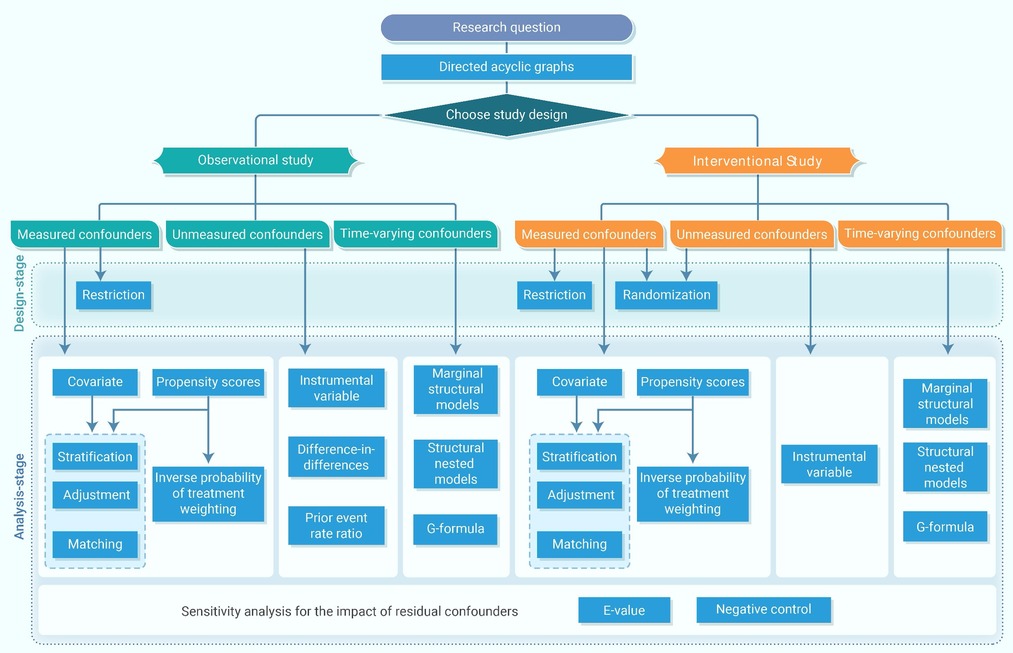
Figure 1.
Flowchart for selecting appropriate approaches for confounder identification and control according to study design, research stage, and confounder type
