
Reorienting Smart Window Innovation: From Material-Centric Metrics to Grid-Interactive Flexibility
-
ABSTRACT
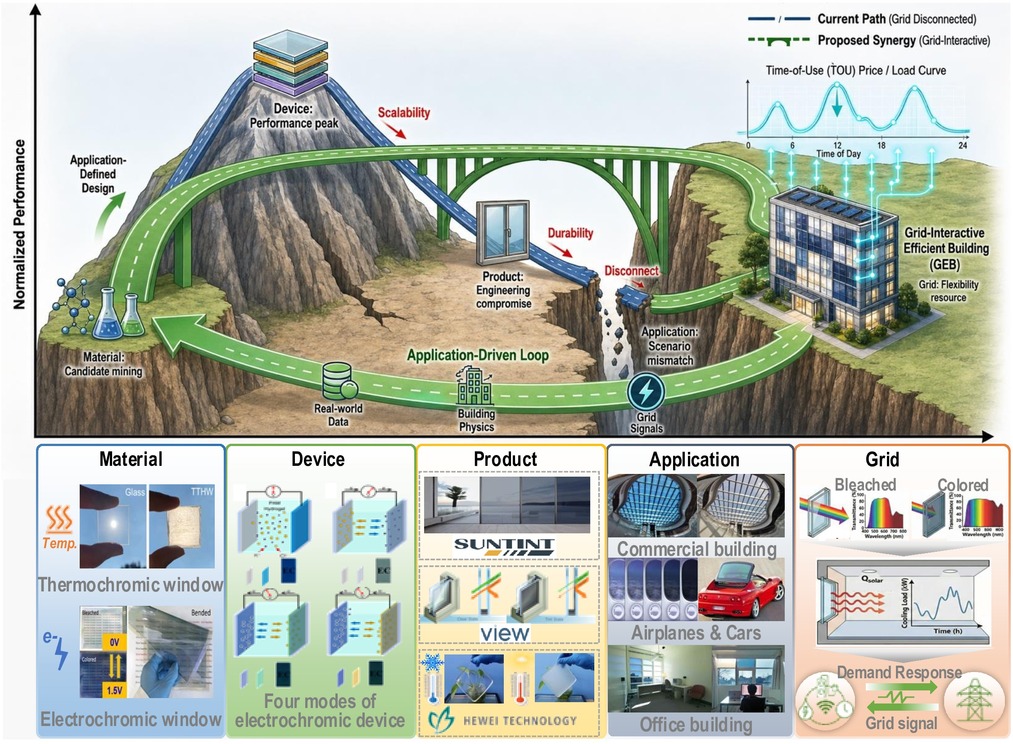
Smart windows are heralded as a pivotal technology for building energy efficiency and carbon neutrality. By dynamically regulating solar heat gain, they fundamentally alter building thermal loads. However, the field is currently constrained by a unidirectional loss system spanning the entire innovation chain. While academic breakthroughs propel laboratory devices to new performance peaks, the transition to commercial products is consistently plagued by severe performance degradation. This Perspective dissects the full technical chain to identify the critical bottlenecks responsible for this cascading degradation. We highlight that the most consequential gap lies not merely in the disconnect between laboratory metrics and real-world application scenarios, but more critically in the prevailing paradigm that treats smart windows solely as passive energy-saving barriers. This narrow focus entirely overlooks their potential as active, demand-side flexibility nodes interacting with the emerging new power system. To bridge these gaps, this paper proposes shifting from a linear, material-centric pipeline to a circular, application-driven ecosystem that redefines smart windows as grid-interactive flexible assets. -

-
REFERENCES
[1] Zhao F., Wang B., Huang B., et al. (2025). Inorganic electrochromic smart windows for advancing building energy efficiency. Nat. Rev. Clean Technol. 1:396−412. DOI:10.1038/s44359-025-00065-x [2] Tandon B., Lu H.-C. and Milliron D.J. (2022). Dual-Band Electrochromism: Plasmonic and Polaronic Mechanisms. J. Phys. Chem. C 126:9228−9238. DOI:10.1021/acs.jpcc.2c02155 [3] Sun J., Chen Z., Zhang R., et al. (2025). Electrochromic smart windows with co-intercalation of cations and anions for multi-band regulations. Nat. Commun. 16:6993. DOI:10.1038/s41467-025-61854-3 [4] Xiang Y., Chen L., Wuyun Q., et al. (2026). A Comprehensive Review of Building-to-Grid Interaction. Energy Use 2:100043. DOI:10.59717/ipj.energy-use.2025.100043 [5] Duan Z., Wu S., Sun H., et al. (2024). Improvements in energy saving and thermal comfort for electric vehicles in summer through coupled electrochromic and radiative cooling smart windows. Build. Simul. (Online published). DOI:10.1007/s12273-024-1137-2. [6] Gehbauer C., Lee E.S. and Wang T. (2023). An evaluation of the demand response potential of integrated dynamic window and HVAC systems. Energy Build. 298:113481. DOI:10.1016/j.enbuild.2023.113481 [7] Tan Y., Peng J., Luo Z., et al. (2025). Assessing the energy efficiency and grid friendliness of smart photovoltaic windows incorporating crystalline silicon cells and electrochromic film. Appl. Energy 377:124671. DOI:10.1016/j.apenergy.2024.124671 [8] Tang H., Lian X., Wang S., et al. (2025). Unlocking Building Energy Flexibility: Multi-Layered Pricing Framework Design from Distribution-Level to P2P Markets. Energy Use 1:100019. DOI:10.59717/ipj.energy-use.2025.100019 [9] Wu S., Sun J., Duan Z., et al. (2025). Building‐Tailored Hierarchical Electrochromism with Optimized Control Strategies. Adv. Sci. (Online published). DOI:10.1002/advs.202513530. [10] Wu S., Sun H., Song J., et al. (2024). Comprehensive analysis on building performance enhancement based on selective split-band modulated adaptive thermochromic windows. Appl. Energy 372:123754. DOI:10.1016/j.apenergy.2024.123754 -
ABOUT THIS ARTICLE
Cite this article:
Wu S., Peng Y. and Lin B. (2026). Reorienting Smart Window Innovation: From Material-Centric Metrics to Grid-Interactive Flexibility. Energy Use 2:100047. https://doi.org/10.59717/ipj.energy-use.2026.100047
Welcome!
To request copyright permission to republish or share portions of our works, please visit Copyright Clearance Center's (CCC) Marketplace website at marketplace.copyright.com.
Export File
Citation
Wu S., Peng Y. and Lin B. (2026). Reorienting Smart Window Innovation: From Material-Centric Metrics to Grid-Interactive Flexibility. Energy Use 2:100047. https://doi.org/10.59717/ipj.energy-use.2026.100047

Format
Content
 DownLoad:
-
Figure 1.
Reorienting Smart Window Innovation: From Unidirectional Loss to Grid-Interactive Circular Synergy.