
Three-Dimensional Boron Nitride Networks in Polymer Composites: Fabrication Strategies and Thermal-Management Applications
-
GRAPHICAL ABSTRACT
 DownLoad:
Full size image
-
PUBLIC SUMMARY
-
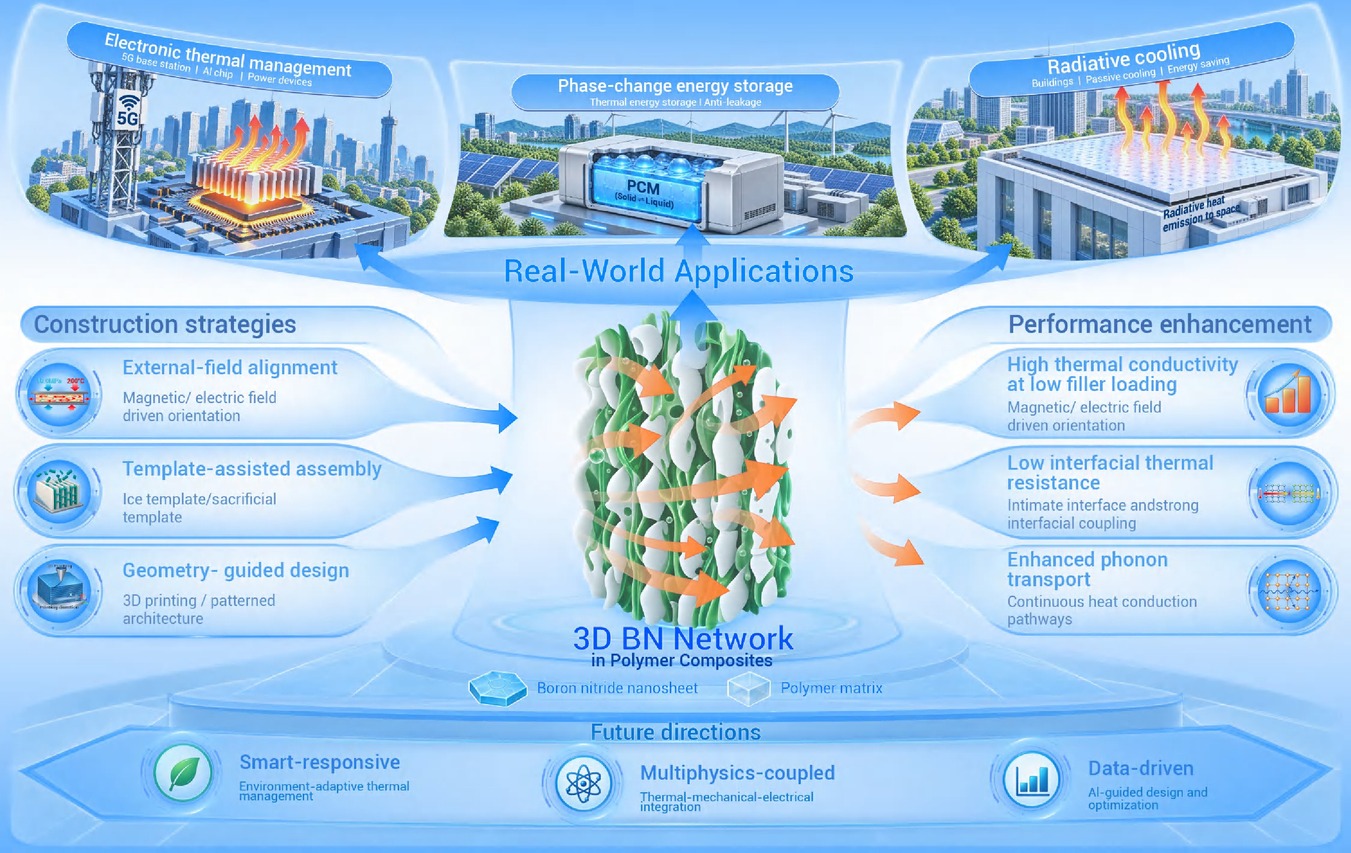
BNNSs are promising insulating fillers for thermal management, yet random dispersion in polymers hinders continuous thermal pathways and limits composite thermal conductivity.
Strategies to build 3D BN networks via external fields, templates and geometry design, clarifying structure–property relations for phonon transport and interfacial thermal resistance.
Applications of 3D BN networks in electronics, phase-change storage and radiative cooling, and identifies future directions including responsive materials and data-driven optimization.
-
-
ABSTRACT
Boron nitride nanosheets (BNNSs) combine high intrinsic thermal conductivity, electrical insulation, and chemical stability, making them attractive electrically insulating fillers for electronic thermal management applications. However, the random dispersion of BNNSs within polymer matrices severely restricts the effective construction of thermally conductive pathways, resulting in limited thermal conductivity of the resultant composites. A central challenge is to construct continuous thermally conductive networks at relatively low BN loadings while reducing interfacial thermal resistance. To address this issue, this review first introduces two mainstream solutions: multi-dimensional filler hybridization and the construction of three-dimensional (3D) boron nitride (BN) networks. This review focuses on representative strategies for engineering BN-based thermal architectures, including external-field-driven alignment, template-assisted assembly, and geometry-guided structural design, with particular emphasis on the transition from directional alignment to multidirectionally interconnected 3D networks. It elucidates the structure–property relationships governing interfacial thermal resistance modulation and phonon transport enhancement. Furthermore, this review summarizes the recent advances in applications of 3D BN networks in electronic thermal management, phase-change energy storage, and radiative cooling, while also discussing key challenges related to scalability, durability, multifunctional integration, and adaptability to complex operating conditions. Finally, future research directions are discussed, highlighting smart-responsive thermal management materials, multiphysics-coupled design, and data-driven structural optimization, aiming to provide a theoretical foundation and technical guidance for the design and engineering application of next-generation high-performance polymeric thermal management materials. -

-
REFERENCES
[1] Jin X., Pourjafari D., Chmielowski R., et al. (2026). High thermally conductive, flexible and tough cellulose nanopaper functionalised with multiscale hexagonal boron nitride. Comp. B Eng. 324:113888. DOI:10.1016/j.compositesb.2026.113888 [2] O'Neil M. L., Henderson T., Jankoski P., et al. (2026). Annealing-induced particle reorientation enhanced through-plane thermal conductivity in PPS/h-BN composites. Comp. B Eng. 324:113845. DOI:10.1016/j.compositesb.2026.113845 [3] Yang S., Zhang Y., Sha Z., et al. (2022). Deterministic Manipulation of Heat Flow via Three-Dimensional-Printed Thermal Meta-Materials for Multiple Protection of Critical Components. ACS Appl. Mate. Interf. 14:39354−39363. DOI:10.1021/acsami.2c09602 [4] Xiang J., Deng L., Zhou C., et al. (2022). Heat Transfer Performance and Structural Optimization of a Novel Micro-channel Heat Sink. Chin. J. Mech. Eng. 35:38. DOI:10.1186/s10033-022-00704-5 [5] Liu M.-X., Ma R.-Y., Wang Z.-X., et al. (2025). Scalable assembly of micron boron nitride into high-temperature-resistant insulating papers with superior thermal conductivity. Mater. Hor. 12:4349−4362. DOI:10.1039/d4mh01897d [6] Ma X., Zhang H., Guo Y., et al. (2025). Enhancing thermal conductivity in polysiloxane composites through synergistic design of liquid crystals and boron nitride nanosheets. J. Mater. Sci. Tech. 231:54−61. DOI:10.1016/j.jmst.2025.01.004 [7] Wang J., Liu X., Chu B., et al. (2025). Dual experimental-simulation study of ionic liquid-assisted polarized alignment of boron nitride: engineering thermal conductive pathways in polymer composites. Adv. Comp. Hybrid Mater. 8:368. DOI:10.1007/s42114-025-01310-4 [8] Xie Z., Tang Y., Zhang Y., et al. (2025). Fluorine-Mediated Carbon Doping in Boron Nitride: Atomic-Level Interface Engineering for Balancing Microwave Absorption and Thermal Management. Small 21:e06851. DOI:10.1002/smll.202506851 [9] Cui Y., Li M. and Hu Y. (2020). Emerging interface materials for electronics thermal management: experiments, modeling, and new opportunities. J. Mater. Chem. C 8:10568−10586. DOI:10.1039/c9tc05415d [10] Chen H., Ginzburg V. V., Yang J., et al. (2016). Thermal conductivity of polymer-based composites: Fundamentals and applications. Prog. Poly. Sci. 59:41−85. DOI:10.1016/j.progpolymsci.2016.03.001 [11] Guo Y., Ruan K., Shi X., et al. (2020). Factors affecting thermal conductivities of the polymers and polymer composites: A review. Comp. Sci. Tech. 193:108134. DOI:10.1016/j.compscitech.2020.108134 [12] Burger N., Laachachi A., Ferriol M., et al. (2016). Review of thermal conductivity in composites: Mechanisms, parameters and theory. Prog. Poly. Sci. 61:1−28. DOI:10.1016/j.progpolymsci.2016.05.001 [13] Kim G.-H., Lee D., Shanker A., et al. (2015). High thermal conductivity in amorphous polymer blends by engineered interchain interactions. Nat. Mater. 14:295−300. DOI:10.1038/nmat4141 [14] Huang C., Qian X. and Yang R. (2018). Thermal conductivity of polymers and polymer nanocomposites. Mater. Sci. Eng. R Rep. 132:1−22. DOI:10.1016/j.mser.2018.06.002 [15] Li M., Wang M., Hou X., et al. (2020). Highly thermal conductive and electrical insulating polymer composites with boron nitride. Comp. B Eng. 184:107746. DOI:10.1016/j.compositesb.2020.107746 [16] Li A., Zhang C. and Zhang Y.-F. (2017). Thermal Conductivity of Graphene-Polymer Composites: Mechanisms, Properties, and Applications. Polymers 9:435. DOI:10.3390/polym9090437 [17] Soga K., Saito T., Kawaguchi T., et al. (2017). Percolation effect on thermal conductivity of filler-dispersed polymer composites. J. Therm. Sci. Tech. 12:JTST0013. DOI:10.1299/jtst.2017jtst0013 [18] Zhu G.-L., Han D., Yuan Y., et al. (2018). Improving Damping Properties and Thermal Stability of Epoxy/Polyurethane Grafted Copolymer by Adding Glycidyl POSS. Chin. J. Poly. Sci. 36:1297−1302. DOI:10.1007/s10118-018-2145-4 [19] Nan C. W., Birringer R., Clarke D. R., et al. (1997). Effective thermal conductivity of particulate composites with interfacial thermal resistance. J. Appl. Phy. 81:6692−6699. DOI:10.1063/1.365209 [20] Wang X. J., Zhang L. Z. and Pei L. X. (2014). Thermal conductivity augmentation of composite polymer materials with artificially controlled filler shapes. J. Appl. Poly. Sci. 131. DOI:10.1002/app.39550. [21] Gu J., Liang C., Zhao X., et al. (2017). Highly thermally conductive flame-retardant epoxy nanocomposites with reduced ignitability and excellent electrical conductivities. Comp. Sci. Tech. 139:83−89. DOI:10.1016/j.compscitech.2016.12.015 [22] Chen X. and Elemans J. A. A. W. (2025). Artificial Processive Catalytic Systems: Bridging Synthetic Polymers and Biological Precision. Poly. Sci. Tech. 1:233−236. DOI:10.1021/polymscitech.5c00047 [23] Suh D., Moon C. M., Kim D., et al. (2016). Ultrahigh Thermal Conductivity of Interface Materials by Silver-Functionalized Carbon Nanotube Phonon Conduits. Adv. Mater. 28:7220−7227. DOI:10.1002/adma.201600642 [24] McNamara A. J., Joshi Y. and Zhang Z. M. (2012). Characterization of nanostructured thermal interface materials – A review. Int. J. Therm. Sci. 62:2−11. DOI:10.1016/j.ijthermalsci.2011.10.014 [25] Gharagozloo-Hubmann K., Boden A., Czempiel G. J. F., et al. (2013). Filler geometry and interface resistance of carbon nanofibres: Key parameters in thermally conductive polymer composites. Appl. Phys. Lett. 102:213103. DOI:10.1063/1.4807420 [26] Huang X., Zhi C., Jiang P., et al. (2013). Polyhedral Oligosilsesquioxane-Modified Boron Nitride Nanotube Based Epoxy Nanocomposites: An Ideal Dielectric Material with High Thermal Conductivity. Adv. Funct. Mater. 23:1824−1831. DOI:10.1002/adfm.201201824 [27] Shtein M., Nadiv R., Buzaglo M., et al. (2015). Thermally Conductive Graphene-Polymer Composites: Size, Percolation, and Synergy Effects. Chem. Mater. 27:2100−2106. DOI:10.1021/cm504550e [28] Chen L., Sun Y. Y., Lin J., et al. (2015). Modeling and analysis of synergistic effect in thermal conductivity enhancement of polymer composites with hybrid filler. Int. J. Heat Mass Trans. 81:457−464. DOI:10.1016/j.ijheatmasstransfer.2014.10.051 [29] Chen L. and Huang X. (2016). Preparation of an adsorbent based on polymeric ionic liquid for the simultaneous extraction of acidic, basic and neutral pollutants. J. Chrom. A 1466:42−49. DOI:10.1016/j.chroma.2016.09.011 [30] Sohn Y., Han T. and Han J. H. (2019). Effects of shape and alignment of reinforcing graphite phases on the thermal conductivity and the coefficient of thermal expansion of graphite/copper composites. Carbon 149:152−164. DOI:10.1016/j.carbon.2019.04.055 [31] Ouyang Y., Bai L., Tian H., et al. (2022). Recent progress of thermal conductive ploymer composites: Al2O3 fillers, properties and applications. Comp. A Appl. Sci. Manu. 152:106685. DOI:10.1016/j.compositesa.2021.106685 [32] He S., Hu J., Zhang C., et al. (2018). Performance improvement in nano-alumina filled silicone rubber composites by using vinyl tri-methoxysilane. Poly. Test. 67:295−301. DOI:10.1016/j.polymertesting.2018.03.023 [33] Zhu J., Si N., Wu M., et al. (2026). Soft alumina-based thermal interface materials with enhanced thermal properties enabled by the synergistic effect with hexagonal boron nitride and liquid metal. J. Mater. Sci. Tech. 244:60−69. DOI:10.1016/j.jmst.2025.05.019 [34] Huang T., Zhang X., Wang T., et al. (2022). Self-Modifying Nanointerface Driving Ultrahigh Bidirectional Thermal Conductivity Boron Nitride-Based Composite Flexible Films. Nano. Micro. Lett. 15:2. DOI:10.1007/s40820-022-00972-9 [35] Han C., Ma J., He H., et al. (2025). Fabrication of Curdlan connected honeycomb-like 3D BN-CNT network for enhancing the thermal conductivity of epoxy composites. Chem. Eng. J. 507:160443. DOI:10.1016/j.cej.2025.160443 [36] Fu L., Wu Z., Wu K., et al. (2024). A thermally induced flexible composite phase change material with boron nitride nanosheets/carbon nanotubes modified skeleton for battery thermal management. Appl. Energy 373:123899. DOI:10.1016/j.apenergy.2024.123899 [37] Chen J., Cheng Y., Scotland P., et al. (2025). Dimension Engineering of Boron Nitride Nanostructures through Catalytic Flash Joule Heating. ACS Nano 19:24904−24911. DOI:10.1021/acsnano.5c03593 [38] Shi N., Wu M., Li Z., et al. (2025). Gas convection and vertical temperature gradient-regulated aligned growth of boron nitride nanotubes for efficient thermal management. Comp. B Eng. 307:112926. DOI:10.1016/j.compositesb.2025.112926 [39] Mohanraman R., Steiner P., Kocabas C., et al. (2024). Synergistic Improvement in the Thermal Conductivity of Hybrid Boron Nitride Nanotube/Nanosheet Epoxy Composites. ACS Appl. Nano Mater. 7:13142−13146. DOI:10.1021/acsanm.4c01646 [40] Zhang S., Zhuo G., Wang R., et al. (2026). Polymer/MXene Composite-Based Flexible Pressure Sensors: From Mechanisms and Structural Designs to Emerging Applications. Poly. Sci. Tech. 2:519−555. DOI:10.1021/polymscitech.5c00143 [41] Jiao Z., Wei T., Lin G., et al. (2026). Promising microwave absorption and high thermal conductivity in silicone rubber composites filled by boron nitride and Ti3C2Tx hierarchical fillers. Carbon 252:121402. DOI:10.1016/j.carbon.2026.121402 [42] Ruminski A. M., Yang F., Cho E. S., et al. (2017). Geometric analysis of enhanced thermal conductivity in epoxy composites: A comparison of graphite and carbon nanofiber fillers. Phys. Stat. Sol. a 214:1600368. DOI:10.1002/pssa.201600368 [43] Fu Y.-X., He Z.-X., Mo D.-C., et al. (2014). Thermal conductivity enhancement with different fillers for epoxy resin adhesives. Appl. Therm. Eng. 66:493−498. DOI:10.1016/j.applthermaleng.2014.02.044 [44] Bard S., Tran T., Schönl F., et al. (2024). Relationship between the tensile modulus and the thermal conductivity perpendicular and in the fiber direction of PAN-based carbon fibers. Carbon Lett. 34:361−369. DOI:10.1007/s42823-023-00568-2 [45] Yu A., Ramesh P., Sun X., et al. (2008). Enhanced Thermal Conductivity in a Hybrid Graphite Nanoplatelet – Carbon Nanotube Filler for Epoxy Composites. Adv. Mater. 20:4740−4744. DOI:10.1002/adma.200800401 [46] Jiao T., Han B., Zhao L., et al. (2023). Pie-rolling-inspired construction of vertical carbon fiber high thermal conductivity hybrid networks. Appl. Surf. Sci. 618:156711. DOI:10.1016/j.apsusc.2023.156711 [47] Liao Q., Liu Z., Liu W., et al. (2015). Extremely High Thermal Conductivity of Aligned Carbon Nanotube-Polyethylene Composites. Sci. Rep. 5:16543. DOI:10.1038/srep16543 [48] Marconnet A. M., Yamamoto N., Panzer M. A., et al. (2011). Thermal Conduction in Aligned Carbon Nanotube–Polymer Nanocomposites with High Packing Density. ACS Nano 5:4818−4825. DOI:10.1021/nn200847u [49] Bao W., Wang X., Li L., et al. (2026). Core-Shell Structure Strategy to Prepare Super-tough Poly(lactic acid) Composites with Balanced Stiffness and Toughness. Poly. Sci. Tech. 2:505−514. DOI:10.1021/polymscitech.6c00012 [50] Jiong S., Kim J., Kim K., et al. (2025). Electrostatically engineered thermal interface materials with multiscale boron nitride-alumina-nanodiamond fillers in polyvinyl alcohol composites for tailored anisotropic thermal conductivities. Adv. Comp. Hybrid Mater. 8:321. DOI:10.1007/s42114-025-01409-8 [51] Li J., Tao Y., Rao S., et al. (2025). Core–Shell rGO-BN Heterostructures Endowing Polybutadiene Composites with High Thermal Conductivity and Efficient Microwave Absorption. Adv. Funct. Mater. 35:e08494. DOI:10.1002/adfm.202508494 [52] Huang C., Jia X., Tian R., et al. (2025). Recyclable thermally conductive nanocomposites based on interpenetrating network of boron nitride nanosheets and nanoribbons. Chem. Eng. J. 507:160697. DOI:10.1016/j.cej.2025.160697 [53] Zhao X.-L., Li L.-Y., Li Y.-D., et al. (2025). Biobased Thermoset Sandwiched Composites Enabled by Dynamic Covalent Chemistry for Electrical Insulation, EMI Shielding, and Thermal Management. Sus. Mat. 5:e70012. DOI:10.1002/sus2.70012 [54] Ji Y., Han S., Zhang Q., et al. (2023). Constructing a highly vertically aligned network of h-BN/CF in silicone rubber composites: Achieving superior through-plane thermal conductivity and electrical insulation. Comp. B Eng. 266:111024. DOI:10.1016/j.compositesb.2023.111024 [55] Yang K., Duan C., Ma R., et al. (2025). Ultrafast Thermal Conduction of Phase Change Fiber Enabled by Sheath Confinement-Induced Ordered Orientation of Hydroxylated BNNs. Small 21:2500255. DOI:10.1002/smll.202500255 [56] Jiang H., Xie Y., He M., et al. (2025). Highly Thermally Conductiveand Flame-Retardant Waterborne Polyurethane Composites with 3D BNNS Bridging Structures via MagneticField Assistance. Nano-Micro Lett. 17:138. DOI:10.1007/s40820-025-01651-1 [57] Miao S., Wang X., Dong Z., et al. (2025). Dopamine functionalized BNNS/PAN core-shell nanofiber membrane with high thermal conductivity and excellent dielectric properties. Comp. B Eng. 307:112909. DOI:10.1016/j.compositesb.2025.112909 [58] Chen B., Gong J., Huang W., et al. (2023). Constructing a parallel aligned shish kebab structure of HDPE/BN composites: Toward improved two-way thermal conductivity and tensile strength. Comp. B Eng. 259:110699. DOI:10.1016/j.compositesb.2023.110699 [59] Liu X., Zhou H., Wang Z., et al. (2022). Construction of 3D interconnected and aligned boron nitride nanosheets structures in phthalonitrile composites with high thermal conductivity. Comp. Sci. Tech. 220:109289. DOI:10.1016/j.compscitech.2022.109289 [60] Liu J., Feng H., Dai J., et al. (2023). A Full-component recyclable Epoxy/BN thermal interface material with anisotropy high thermal conductivity and interface adaptability. Chem. Eng. J. 469:143963. DOI:10.1016/j.cej.2023.143963 [61] He H., Peng W., Liu J., et al. (2022). Microstructured BN Composites with Internally Designed High Thermal Conductivity Paths for 3D Electronic Packaging. Adv. Mater. 34:2205120. DOI:10.1002/adma.202205120 [62] Jiang H., Li J., Xie Y., et al. (2025). Design of efficient microstructured path by magnetic orientation boron nitride nanosheets/MnFe2O4 enabling waterborne polyurethane with high thermal conductivity and flame retardancy. J. Mater. Sci. Tech. 209:207−218. DOI:10.1016/j.jmst.2024.05.013 [63] Yang J., Shen X., Yang W., et al. (2023). Templating strategies for 3D-structured thermally conductive composites: Recent advances and thermal energy applications. Prog. Mater. Sci. 133:101054. DOI:10.1016/j.pmatsci.2022.101054 [64] Han G., Cheng H., Feng Y., et al. (2025). Efficient thermal management of electronic devices by constructing interlayer phonon bridges. Nat. Commun. 16:10533. DOI:10.1038/s41467-025-65554-w [65] Zhao N., Li J., Wang W., et al. (2022). Isotropically Ultrahigh Thermal Conductive Polymer Composites by Assembling Anisotropic Boron Nitride Nanosheets into a Biaxially Oriented Network. ACS Nano 16:18959−18967. DOI:10.1021/acsnano.2c07862 [66] Cui Y., Xu F., Bao D., et al. (2023). Construction of 3D interconnected boron nitride/carbon nanofiber hybrid network within polymer composite for thermal conductivity improvement. J. Mater. Sci. Tech. 147:165−175. DOI:10.1016/j.jmst.2022.10.077 [67] Chen J., Wang D. and Fu J. (2025). Stiff yet Tough, Moisture-Tolerant, Room Temperature Self-Healing and Thermoconductive Biomimetic Nanocomposites. Adv. Mater. 37:e07548. DOI:10.1002/adma.202507548 [68] Luo Y., Hou Y., Zhang P., et al. (2026). Dual-Effect Integration of Thermal Management and Flame Retardancy for 3D Boron Nitride/Epoxy/Benzoxazine Composites. Adv. Funct. Mater. 36:e26998. DOI:10.1002/adfm.202526998 [69] Miao Z., Zhu G., Yang L., et al. (2026). Multiple crosslinking-Stretch-induced multi-level orientation structure BNNS/Ca-SA/D films with high thermal conductive performance. Comp. B Eng. 309:113032. DOI:10.1016/j.compositesb.2025.113032 [70] Kim Y. G., Jung I.-Y., Mun Y., et al. (2025). Bi-Directional Assembly of Boron Nitride µ-Platelets by Micro-Molding for Advanced Thermal Interface Materials. Adv. Funct. Mater. 35:2421607. DOI:10.1002/adfm.202421607 [71] Hong H., Jung Y. H., Lee J. S., et al. (2019). Anisotropic Thermal Conductive Composite by the Guided Assembly of Boron Nitride Nanosheets for Flexible and Stretchable Electronics. Adv. Funct. Mater. 29:1902575. DOI:10.1002/adfm.201902575 [72] Niu H., Guo H., Kang L., et al. (2024). Highly thermally conductive and soft thermal interface materials based on vertically oriented boron nitride film. Comp. B Eng. 272:111219. DOI:10.1016/j.compositesb.2024.111219 [73] Fan D., Zhao M., Yin S., et al. (2026). Covalently Interconnected BN/CNTs Hybrid Networks Enhance the Thermal Conductivity and Electrical Insulation of Phase Change Composites for Advanced Thermal Management. Adv. Funct. Mater. 36:e31090. DOI:10.1002/adfm.202531090 [74] Lee J. S., Choi J., Park G. Y., et al. (2023). Thermally Managed, Injectable Optoelectronic Probe with Heat Dissipation Guide for Photodynamic Therapy. Small 19:2300753. DOI:10.1002/smll.202300753 [75] Zhang Y., Xie K., Shi J., et al. (2024). Dressing Paraffin Wax/Boron Nitride Phase Change Composite with a Polyethylene “Underwear” for the Reliable Battery Safety Management. Small 20:2304886. DOI:10.1002/smll.202304886 [76] Sun S., Jiang D., Zheng H., et al. (2026). 3D-Printed Architected Anisotropic Channels for Ultrafast Solar-Driven Interfacial Evaporation via Localized Thermal Management and Water Layer Structuring. Adv. Sci. 13:e20694. DOI:10.1002/advs.202520694 [77] Ran X., Liu C. and Chen B. (2026). Synergistic radiative-evaporative cooling film for high-efficiency daytime passive cooling and photovoltaic thermal management. J. Mater. Sci. Tech. 249:189−195. DOI:10.1016/j.jmst.2025.05.057 [78] Zhang J., Xu J., Zhang C., et al. (2026). Wearable Cooling Textiles of Thermal Conduction and Sweat Transfer for Personal Thermal Management. Adv. Sci. 13:e23061. DOI:10.1002/advs.202523061 [79] Wu X., Liu M., Pan Y., et al. (2025). Integrating boron nitride and hydroxylated graphene in phase-change films for flexible electronics cooling. Carbon 244:120696. DOI:10.1016/j.carbon.2025.120696 [80] Hou P., Ma F., Li Y., et al. (2025). Investigation on topology optimization of cold plate for battery thermal management based on phase change slurry. Innov. Energy 2:100061. DOI:10.59717/j.xinn-energy.2024.100061 [81] Chen K., Ge C. and Chen X. (2024). Ultrahigh-enthalpy solid-solid phase change materials. The Innovation Energy 1:100036. DOI:10.59717/j.xinn-energy.2024.100061 [82] Tu C., Zhu C., Sun M., et al. (2026). Engineered thermal conduction pathways in high-performance flexible PEG phase-change composites enabling efficient thermal storage and thermoelectric conversion. Chem. Eng. J. 528:172574. DOI:10.1016/j.cej.2026.172574 [83] You T., Zhang Y., Sun Z., et al. (2025). High-speed Railway Thermal Management for Sustainable Future Transportation. Energy Use 1:100024. DOI:10.59717/ipj.energy-use.2025.100024 [84] Wu Z. and Wang Z. (2025). Cooling next-generation electronics: From emerging semiconductors to data centers. Innov. Energy 2:100125. DOI:10.59717/j.xinn-energy.2025.100125 [85] Nishad S., Elmoughni H. M., Shakoor R. A., et al. (2025). A novel design for battery cooling based on highly thermally conductive phase change composites encapsulated by 3D printed polyethylene/boron nitride layer. J. Energy Stor. 112:115490. DOI:10.1016/j.est.2025.115490 [86] Li Z.-Y., Zhang F., Zong Z., et al. (2026). Bifunctional Structural Regulation of Polymer Composites for High-Efficiency Electromagnetic Wave Absorption and Heat Dissipation. Small 22:e73337. DOI:10.1002/smll.73337 [87] Lin Y., Yu K., Zhong B., et al. (2025). Liquid metal modified hexagonal boron nitride flakes for efficient electromagnetic wave absorption and thermal management. J. Adv. Ceram. 14:9221208. DOI:10.26599/JAC.2025.9221208 [88] Li C., Wu Y., Li X., et al. (2024). Flame-retardant composite phase change material with silicone resin and melamine phosphate for battery thermal safety. Innov. Energy 1:100021. DOI:10.59717/j.xinn-energy.2024.100021 [89] Li X., Yang W., Li C., et al. (2024). Flexible solid-solid phase change material with zero leakage via in-situ preparation for battery thermal management. Innov. Energy 1:100034. DOI:10.59717/j.xinn-energy.2024.100034 [90] Liu H., Wang H., Wang R., et al. (2026). Thermal management of battery energy storage systems: Challenges and AI-assisted solutions. Innov. Energy 3:100141. DOI:10.59717/j.xinn-energy.2026.100141 [91] Cao D., Sun X., Li Q., et al. (2020). Lithium Dendrite in All-Solid-State Batteries: Growth Mechanisms, Suppression Strategies, and Characterizations. Matter 3:57−94. DOI:10.1016/j.matt.2020.03.015 [92] Shahid S. and Agelin-Chaab M. (2022). A review of thermal runaway prevention and mitigation strategies for lithium-ion batteries. Energy Conver. Manag. X 16:100310. DOI:10.1016/j.ecmx.2022.100310 [93] Wang T., Shi Z., Xu B., et al. (2026). A Thermally Conductive Separator for Safe Lithium Metal Batteries. ACS Energy Lett. 11:3880−3889. DOI:10.1021/acsenergylett.6c00276 [94] Zhu K., Li L., Xue P., et al. (2023). “Three-in-one” strategy: Heat regulation and conversion enhancement of a multifunctional separator for safer lithium–sulfur batteries. Carbon Energy 5:e352. DOI:10.1002/cey2.352 [95] Wang D. and Fan J. (2025). Large Scale Applications of Solar Thermal Energy. Energy Use 1:100010. DOI:10.59717/ipj.energy-use.2025.100010 [96] Che L., Li N., Wei W., et al. (2025). Day-Night energy harvesting: Photovoltaics-driven moisture evaporation and absorption for simultaneous 24-hour power and dehumidification. Innov. Energy 2:100078. DOI:10.59717/j.xinn-energy.2025.100078 [97] Chen H. and Wang C. (2025). Bridging radiative cooling materials and applications towards alleviating global energy issues. Innov. Energy 2:100090. DOI:10.59717/j.xinn-energy.2025.100090 [98] Zhao J. and Cao B. (2026). Thermal Environment Management of eVTOL Cabin for Future Urban Air Mobility: From Multi-dimensional Sensing to Intelligent Regulation. Energy Use 2:100034. DOI:10.59717/ipj.energy-use.2026.100034 [99] Afshari A. and Hultmark G. (2025). Toward Individual Thermal Comfort and Energy Saving in Open Plan Offices with Chilled Beams. Energy Use 1:100029. DOI:10.59717/ipj.energy-use.2025.100029 [100] Xue T., Tian J., Liu Y., et al. (2026). Colorless and Transparent Polyimide Aerogels via Molecular Engineering toward Energy-Efficient Windows. Poly. Sci. Tech. 2:103−110. DOI:10.1021/polymscitech.5c00114 [101] Dulal M., Afroj S., Ahn J., et al. (2022). Toward Sustainable Wearable Electronic Textiles. ACS Nano 16:19755−19788. DOI:10.1021/acsnano.2c07723 [102] Liu T., Peng Y., Liu H., et al. (2026). Janus POM/BN-phase-change composite fabric with dynamic radiative-thermal-moisture coupling for all-day cooling-heating balance. Chem. Eng. J. 535:175639. DOI:10.1016/j.cej.2026.175639 [103] Liu Y., Zheng W., Ai H., et al. (2024). Application of machine learning in predicting the thermal conductivity of single-filler polymer composites. Mater. Today Commun. 39:109116. DOI:10.1016/j.mtcomm.2024.109116 [104] Liu Y., Zheng W., Ai H., et al. (2024). Predicting the thermal conductivity of polymer composites with one-dimensional oriented fillers using the combination of deep learning and ensemble learning. Energy AI 18:100445. DOI:10.1016/j.egyai.2024.100445 [105] Lu X., Huang J., Cheng N., et al. (2023). Data-Driven Framework toward Accurate Prediction of Interfacial Thermal Resistance in Particulate-Filled Composites. ACS Appl. Mater. Interf. 15:43169−43182. DOI:10.1021/acsami.3c09174 [106] Na C., Shin S., Lee D., et al. (2025). Data-driven engineering and analysis of polymer composites with high thermal conductivity. Comp. Sci. Tech. 272:111400. DOI:10.1016/j.compscitech.2025.111400 -
ABOUT THIS ARTICLE
Cite this article:
Wang X., Lv Y., Yang T., et al. (2026). Three-Dimensional Boron Nitride Networks in Polymer Composites: Fabrication Strategies and Thermal-Management Applications. Energy Use 2:100065. https://doi.org/10.59717/ipj.energy-use.2026.100065
Welcome!
To request copyright permission to republish or share portions of our works, please visit Copyright Clearance Center's (CCC) Marketplace website at marketplace.copyright.com.
Export File
Citation
Wang X., Lv Y., Yang T., et al. (2026). Three-Dimensional Boron Nitride Networks in Polymer Composites: Fabrication Strategies and Thermal-Management Applications. Energy Use 2:100065. https://doi.org/10.59717/ipj.energy-use.2026.100065

Format
Content
-
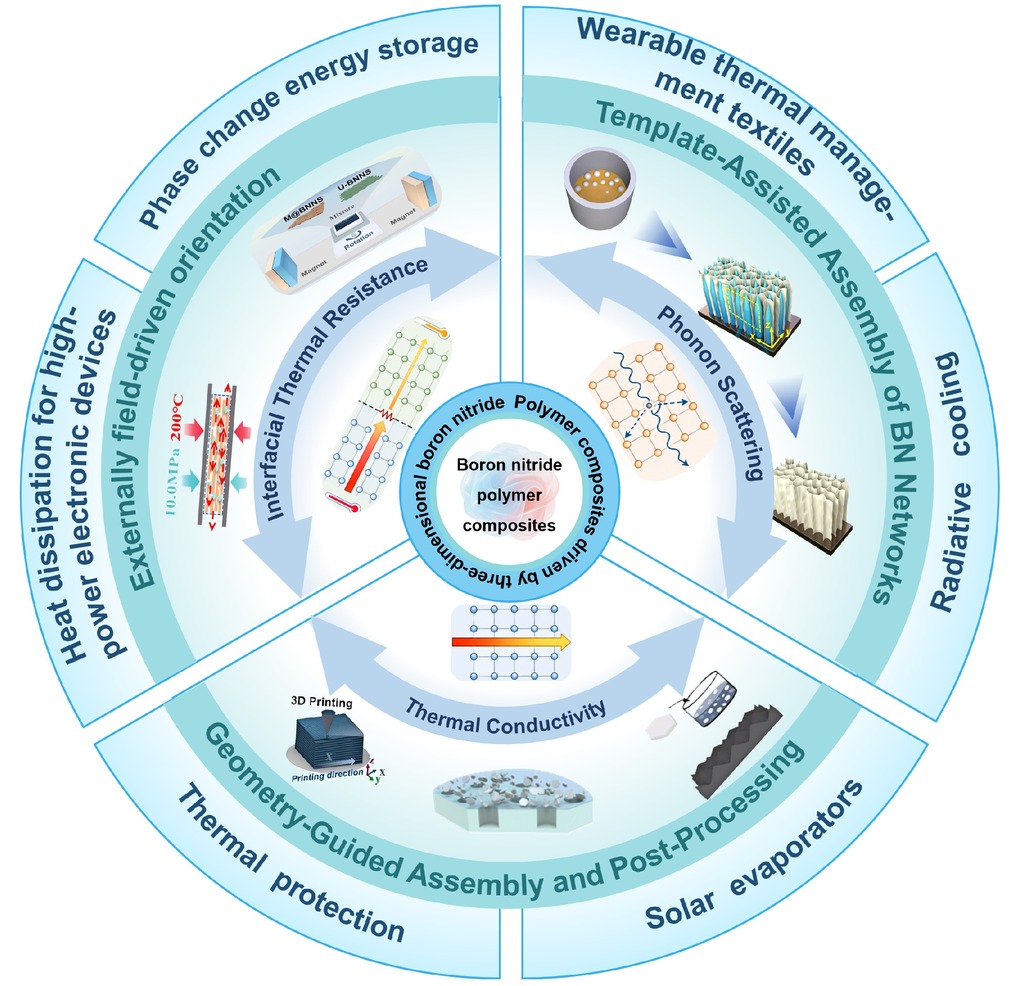
Figure 1.
Schematic illustration of thermal conduction mechanisms, fabrication strategies, and target applications.
-
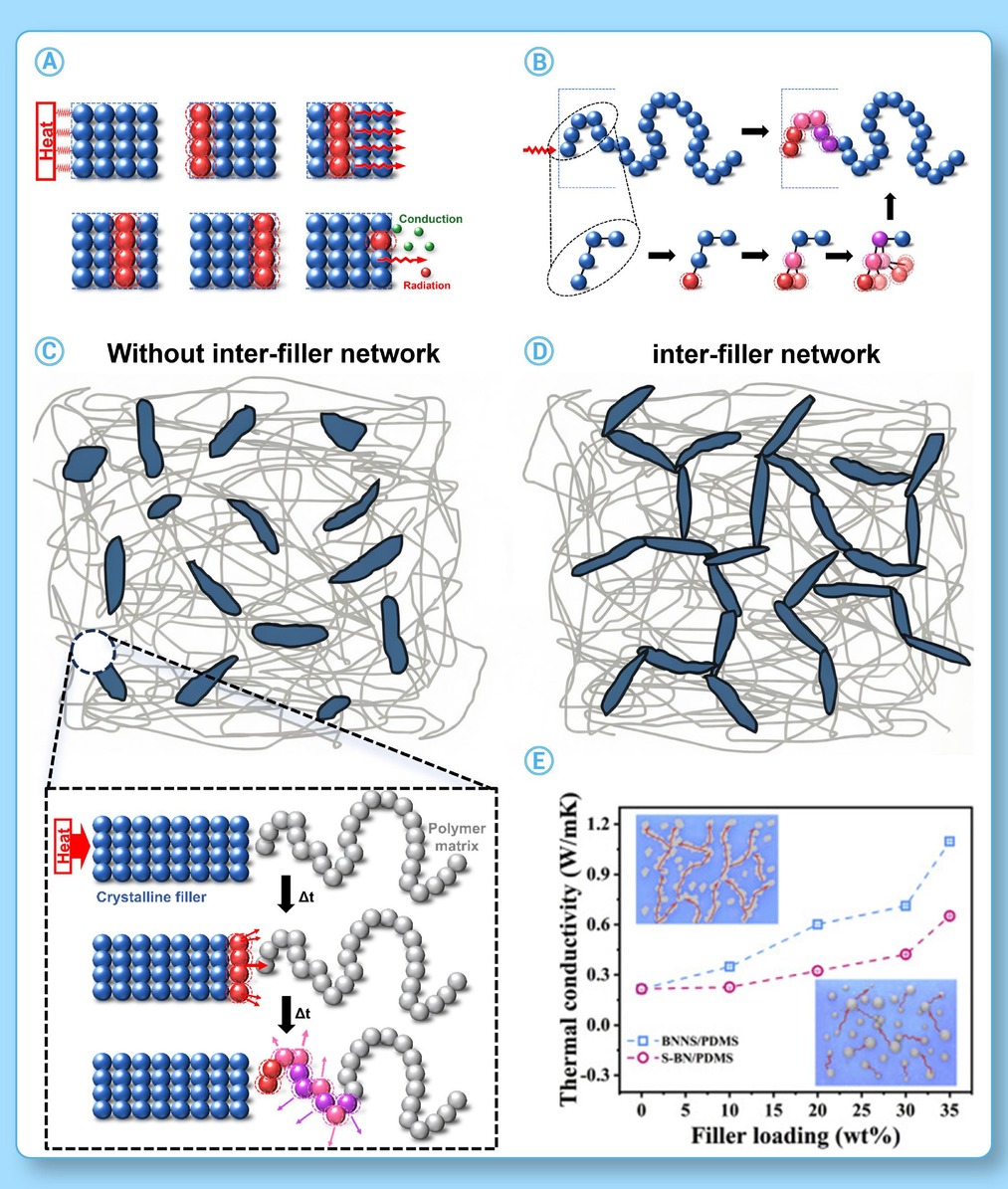
Figure 2.
(A) Thermal conduction mechanism in crystalline materials; (B) Thermal conduction mechanism in amorphous polymers; Reproduced with permission from Ref. 12. Copyright 2016, Elsevier. (C) At low filler loading, no thermal conduction pathway is formed. Phonon conduction transfers between the fillers and the polymer matrix with high interfacial impedance, resulting in severe interfacial heat dissipation; (D) At higher filler loading, a thermal pathway is formed, improving the phonon transport efficiency; Reproduced with permission from Ref. 14. Copyright 2018, Elsevier. (E) The thermal conductivity of BN/PDMS composites increases with the increase in BN loading. Reproduced with permission from Ref. 15. Copyright 2016, Elsevier.
-
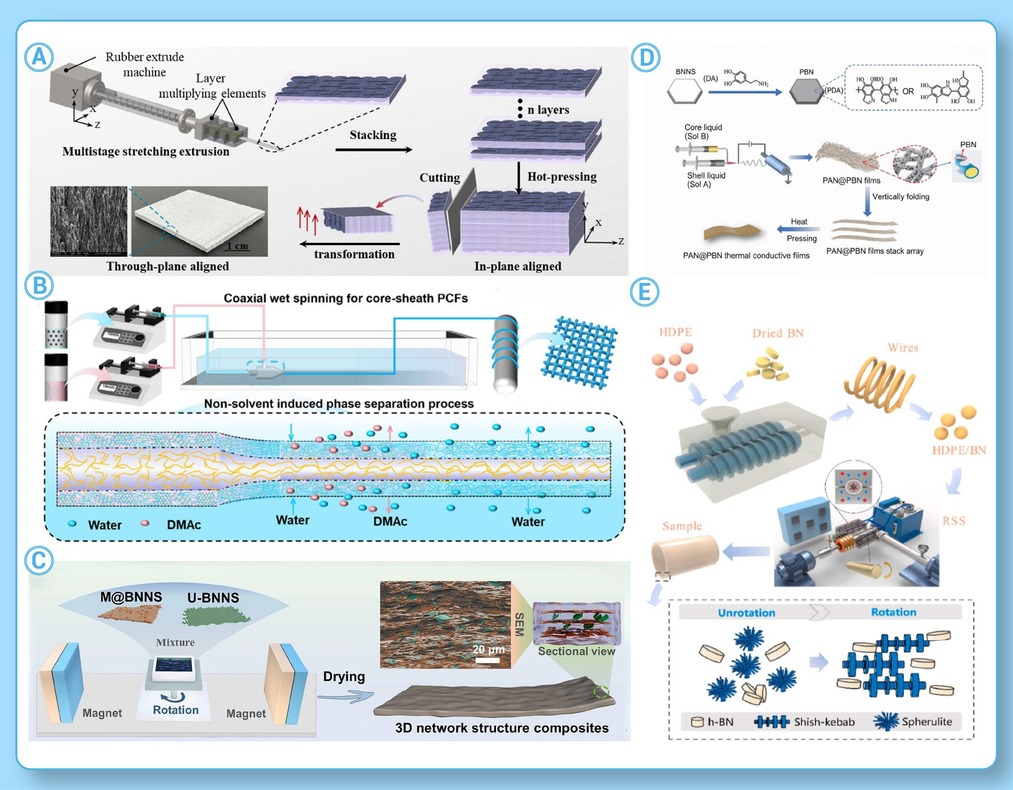
Figure 3.
(A) Schematic illustration of the fabrication of silicone rubber composites with highly vertically aligned hexagonal BNNSs/CF networks via multi-stage stretching extrusion, layer-by-layer stacking, and hot-pressing processes. Reproduced with permission from Ref. 54. Copyright 2023, Elsevier. (B) Schematic illustration of the core–sheath phase-change fibers containing axially aligned hydroxylated BNNSs with high thermal conductivity, superior heat conduction performance, and ultrafast heat transfer via a coaxial wet-spinning process based on non-solvent induced phase separation (NIPS). Reproduced with permission from Ref. 55. Copyright 2025, Wiley. (C) Schematic diagram of the preparation of composites with 3D-bridge architecture based on magnetic field orientation. Reproduced with permission from Ref. 56. Copyright 2025, Springer. (D) Schematic illustration of the fabrication of dopamine-functionalized BNNSs/polyacrylonitrile (PAN) core-shell nanofiber membranes via electrospinning combined with a hot-pressing process. Reproduced with permission from Ref. 57. Copyright 2025, Elsevier. (E) Schematic illustration of the fabrication of high density polyethylene (HDPE)/BN composites using a rotational shear system. Reproduced with permission from Ref. 58. Copyright 2023, Elsevier.
-
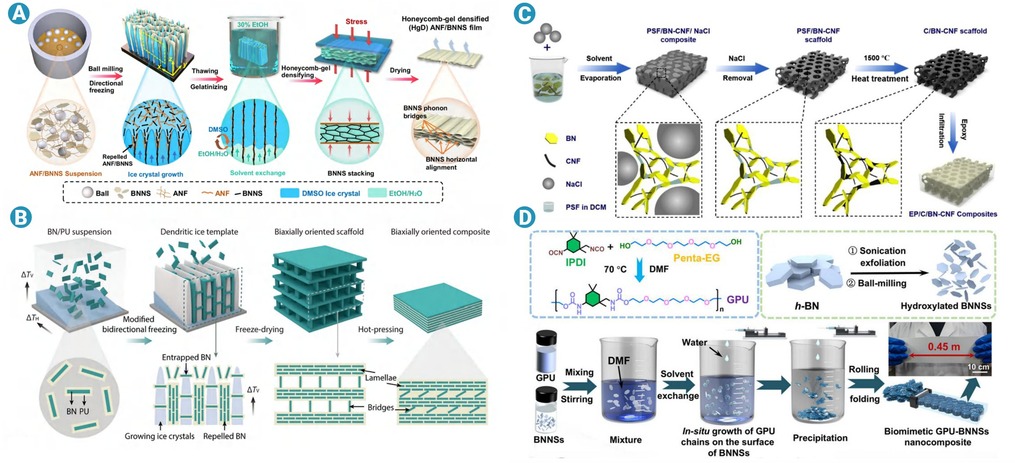
Figure 4.
(A) Schematic illustration of the formation of aramid nanofibers (ANF)/BNNSs films via a unidirectional freezing and thaw-gelation process. Reproduced with permission from Ref. 64. Copyright 2025, Springer Nature. (B) Schematic illustration of the fabrication of BN/polyurethane (PU) composites with a biaxially oriented network using a modified bidirectional freezing method. Reproduced with permission from Ref. 65. Copyright 2022, American Chemical Society. (C) Schematic illustration of the fabrication of epoxy resin (EP)/C/BNNSs/cellulose nanofibrils (CNFs) composites via a salt-templating method. Reproduced with permission from Ref. 66. Copyright 2023, Elsevier. (D) Schematic illustration of the fabrication of GPU-BNNSs nanocomposites via a solvent exchange-induced self-assembly strategy. Reproduced with permission from Ref. 67. Copyright 2025, Wiley.
-
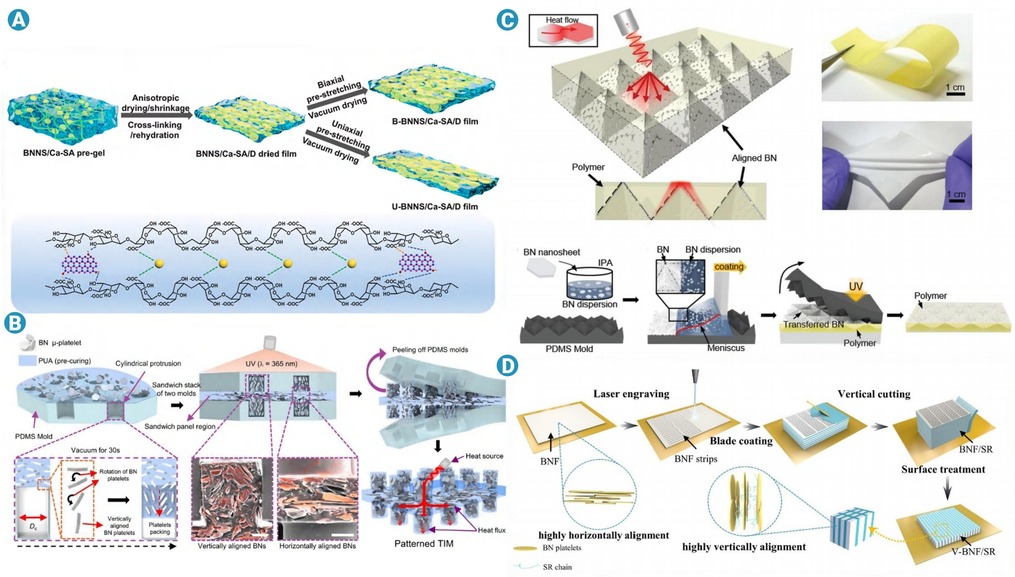
Figure 5.
(A) Schematic illustration of the fabrication of a multilayer crosslinked oriented BNNSs/Ca-SA/D film via stretch induction. Reproduced with permission from Ref. 69. Copyright 2026, Elsevier. (B) Assembly of BN flakes via micro-molding technology to further construct bi-directional thermally conductive composites. Reproduced with permission from Ref. 70. Copyright 2025, Wiley. (C) Assembly of continuous arrays of BNNSs on a tetrahedral structure to construct 3D thermal pathways and further fabricate anisotropic thermally conductive composites. Reproduced with permission from Ref. 71. Copyright 2019, Wiley. (D) Schematic illustration of the fabrication of V–BNF/SR composites with a vertically aligned structure via a stacking-cutting method. Reproduced with permission from Ref. 72. Copyright 2024, Elsevier.
-
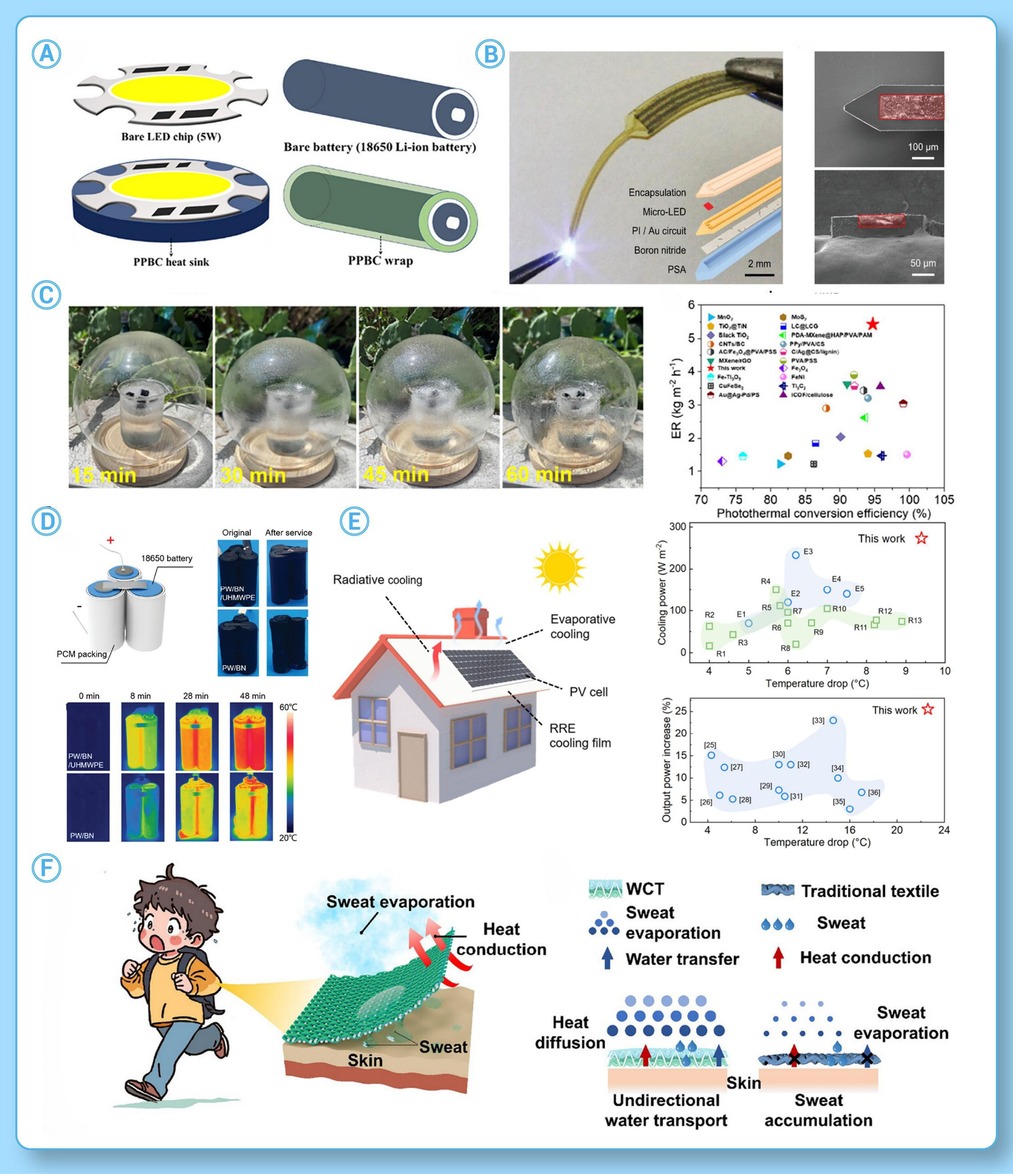
Figure 6.
(A) Thermal Management Performance of Phase Change Composites with Covalently Interconnected BN/Carbon Nanotube Hybrid Networks in Commercial
18650 Batteries. Reproduced with permission from Ref. 73. Copyright 2026, Wiley. (B) Assembled BNNSs-Based Heat Dissipation Directors for Neural Probes. Reproduced with permission from Ref. 74. Copyright 2023, Wiley. (C) Thermal Management and Mechanical Protection of Paraffin/BN Phase Change Composite Lithium-Ion Battery Systems Treated with a Polyethylene “Inner Layer”. Reproduced with permission from Ref. 75. Copyright 2024, Wiley. (D) 3D Printing-Assisted Orientation of BN for High-Performance Solar Evaporators. Reproduced with permission from Ref. 76. Copyright 2026, Wiley. (E) Schematic Diagram of the Cooling Principle of Regenerable Radiative-Evaporative Cooling Films. Reproduced with permission from Ref. 77. Copyright 2026, Elsevier. (F) Wearable Textiles for Personal Thermal Management. Reproduced with permission from Ref. 78. Copyright 2026, Wiley.