
Generative Residential Floor Plan Design Integrating Energy Performance Evaluation and Spatial-Functional Constraints
-
GRAPHICAL ABSTRACT
 DownLoad:
Full size image
-
PUBLIC SUMMARY
-
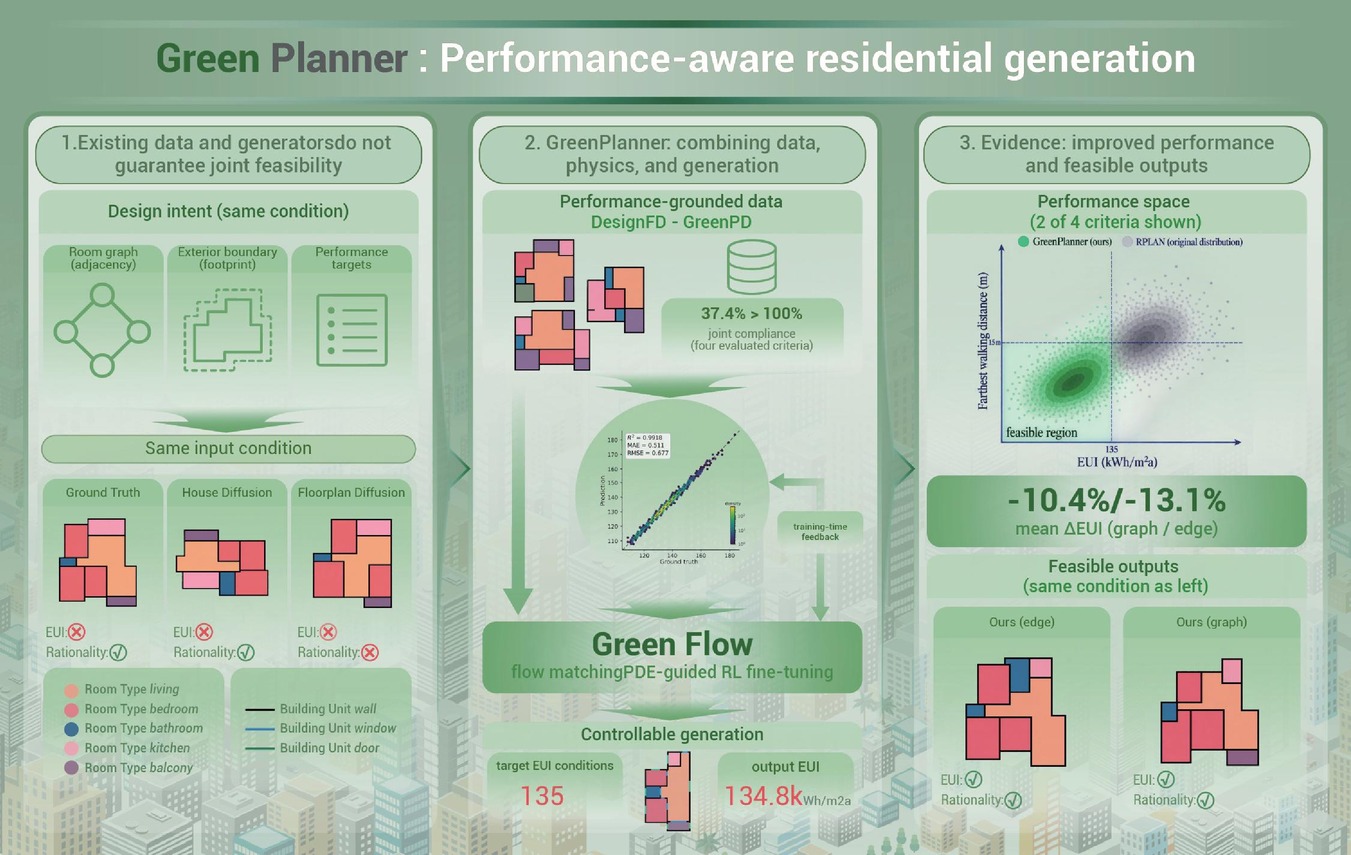
A performance-aware framework GreenPlanner is developed for early-stage residential floor-plan generation with built-in energy and spatial-function constraints.
Surrogate evaluator PDE delivers high-accuracy multi-metric assessment, accelerating evaluation by 1.7×10⁵.
GreenPD filters layouts to fully satisfy energy, evacuation and functional requirements.
GreenFlow cuts building EUI by up to 13.1% under constraints while retaining layout quality.
This workflow reduces expert design time by 87.0% for performance-driven early design exploration.
-
-
ABSTRACT
Early-stage residential floor-plan decisions influence both spatial functionality and operational energy use, yet existing generative approaches primarily focus on geometric plausibility and often lack efficient mechanisms for incorporating performance constraints during generation. Physics-based simulation can provide reliable energy assessment but is computationally expensive for repeated use in high-throughput generative design. To address this issue, we propose GreenPlanner, a performance-aware framework that integrates design evaluation, data refinement, and residential floor-plan generation. DesignFD augments residential layouts with automatically derived energy and spatial-functional feasibility labels. PDE learns these labels as a fast surrogate evaluator for energy performance, evacuation-related path length, floor area, and functional connectivity. GreenPD uses PDE-guided filtering and regeneration to construct demand–plan pairs satisfying the prescribed performance criteria. GreenFlow is then trained on GreenPD and further refined using PDE feedback, allowing energy and spatial-functional requirements to influence the generation process directly. Experiments show that PDE achieves an R2 of 0.99 and an MSE of 0.46 while evaluating 100 layouts in 7.3 ms, providing up to a 1.7×10⁵-fold speed-up over the reference EnergyPlus workflow. GreenPD achieves 100% compliance with the four evaluated criteria. Under performance-constrained generation, GreenFlow reduces mean EUI by 10.4% and 13.1% under graph- and edge-conditioned settings, respectively, while maintaining improved geometric and spatial-functional quality. A human expert study further shows an 87.0% reduction in design time relative to the tested manual workflow. These results demonstrate the feasibility of integrating rapid energy and functional evaluation into generative residential design for early-stage performance-aware exploration. -

-
REFERENCES
[1] Dales R., Liu L., Wheeler A.J., et al. (2008). Quality of indoor residential air and health. CMAJ 179:147−152. DOI:10.1503/cmaj.070359 [2] Liang Y., Li C., Liu Z., et al. (2023). Decarbonization potentials of the embodied energy use and operational process in buildings: A review from the life-cycle perspective. Heliyon 9:e20190. DOI:10.1016/j.heliyon.2023.e20190 [3] Zhang H. (2023). Leveraging policy instruments and financial incentives to reduce embodied carbon in energy retrofits. arXiv:2304.03403. [4] Zhang S., Ma M., Zhou N., et al. (2024). GLOBUS: Global building renovation potential by 2070. arXiv:2406.04133. [5] Zeng P., Yin J., Huang Y., et al. (2025). AI-based generation and optimization of energy-efficient residential layouts controlled by contour and room number. Build. Simul. 18:2777−2805. DOI:10.1007/s12273-025-1337-4 [6] Baduge S.K., Thilakarathna S., Perera J.S., et al. (2022). Artificial intelligence and smart vision for building and construction 4.0: Machine and deep learning methods and applications. Autom. Constr. 141:104440. DOI:10.1016/j.autcon.2022.104440. [7] Eberhardt L.C.M., Birkved M. and Birgisdottir H. (2022). Building design and construction strategies for a circular economy. Archit. Eng. Des. Manag. 18:93−113. DOI:10.1080/17452007.2020.1781588 [8] Himeur Y., Elnour M., Fadli F., et al. (2023). AI-big data analytics for building automation and management systems: A survey, actual challenges and future perspectives. Artif. Intell. Rev. 56:4929−5021. DOI:10.1007/s10462-022-10286-2 [9] Chen H., Xiang Q., Hu J., et al. (2025). Comprehensive exploration of diffusion models in image generation: A survey. Artif. Intell. Rev. 58:99. DOI:10.1007/s10462-025-11110-3 [10] Li J., Zhang C., Zhu W., et al. (2025). A comprehensive survey of image generation models based on deep learning. Ann. Data Sci. 12:141−170. DOI:10.1007/s40745-024-00544-1 [11] Wang B., Chen Q. and Wang Z. (2025). Diffusion-based visual art creation: A survey and new perspectives. ACM Comput. Surv. 57:268. DOI:10.1145/3728459 [12] Comanici G., Bieber E., Schaekermann M., et al. (2025). Gemini 2.5: Pushing the frontier with advanced reasoning, multimodality, long context, and next generation agentic capabilities. arXiv:2507.06261. [13] Hurst A., Lerer A., Goucher A.P., et al. (2024). GPT-4o system card. arXiv:2410.21276. [14] Xue H., Luo X., Hu Z., et al. (2025). Human motion video generation: A survey. IEEE Trans. Pattern Anal. Mach. Intell. 47:10709−10730. DOI:10.1109/TPAMI.2025.3594034 [15] Hu R., Huang Z., Tang Y., et al. (2020). Graph2Plan: Learning floorplan generation from layout graphs. ACM Trans. Graph. 39(4):118. DOI:10.1145/3386569.3392391 [16] Leng S., Zhou Y., Dupty M.H., et al. (2023). Tell2Design: A dataset for language-guided floor plan generation. Proceed. 61st Ann. Meet. Assoc. Comput. Ling. 1:14680–14697. DOI:10.18653/v1/2023.acl-long.820. [17] Nauata N., Chang K.-H., Cheng C.-Y., et al. (2020). House-GAN: Relational generative adversarial networks for graph-constrained house layout generation. Computer Vision ECCV 2020:162−177. DOI:10.1007/978-3-030-58452-8_10 [18] Nauata N., Hosseini S., Chang K.-H., et al. (2021). House-GAN++: Generative adversarial layout refinement network towards intelligent computational agent for professional architects. Proceed IEEE CVF CVPR:13632–13641. DOI:10.1109/CVPR46437.2021.01342. [19] Shabani M.A., Hosseini S. and Furukawa Y. (2023). HouseDiffusion: Vector floorplan generation via a diffusion model with discrete and continuous denoising. Proceed. IEEE CVF CVPR:5466–5475. DOI:10.1109/CVPR52729.2023.00529. [20] Wu W., Fu X.-M., Tang R., et al. (2019). Data-driven interior plan generation for residential buildings. ACM Trans. Graph. 38:234. DOI:10.1145/3355089.3356556 [21] Xu M., Lou Y., Gao X., et al. (2025). Floorplan-Diffusion: Automatic floor plan generation via pre-trained large latent diffusion model. Proceed. 2025 Int. Conf. Multi. Retr.:1617–1625. DOI:10.1145/3731715.3733343. [22] Zeng P., Gao W., Li J., et al. (2025). Automated residential layout generation and editing using natural language and images. Autom. Constr. 174:106133. DOI:10.1016/j.autcon.2025.106133 [23] Zeng P., Yin J., Gao Y., et al. (2025). Comprehensive and dedicated metrics for evaluating AI-generated residential floor plans. Buildings 15:1674. DOI:10.3390/buildings15101674 [24] Zeng P., Yin J., Zhang M., et al. (2025). CARD: Cross-modal agent framework for generative and editable residential design. Proceed. 2025 Conf. Emp. Meth. Nat. Lang. Process.:9304–9319. DOI:10.18653/v1/2025.emnlp-main.473. [25] Zeng P., Yin J., Zhang M., et al. (2025). Unified residential floor plan generation with multimodal inputs. Autom. Constr. 178:106408. DOI:10.1016/j.autcon.2025.106408 [26] Chen Y., Qin Z., Sun L., et al. (2025). GDT framework: Integrating generative design and design thinking for sustainable development in the AI era. Sustainability 17:372. DOI:10.3390/su17010372 [27] Lee J., Cho W., Kang D., et al. (2023). Simplified methods for generative design that combine evaluation techniques for automated conceptual building design. Appl. Sci. 13:12856. DOI:10.3390/app132312856 [28] Li T., Cheng C.-Y., Xie A., et al. (2024). Revision matters: Generative design guided by revision edits. arXiv:2406.18559. [29] Regenwetter L., Srivastava A., Gutfreund D., et al. (2023). Beyond statistical similarity: Rethinking metrics for deep generative models in engineering design. Comput. Aided Des. 165:103609. DOI:10.1016/j.cad.2023.103609 [30] Zeng P., Gao W., Yin J., et al. (2024). Residential floor plans: Multi-conditional automatic generation using diffusion models. Autom. Constr. 162:105374. DOI:10.1016/j.autcon.2024.105374 [31] Feng W., Zhu W., Fu T.-J., et al. (2023). LayoutGPT: Compositional visual planning and generation with large language models. Adv. Neural Inf. Process. Syst. 36:18225−18250. [32] Yin J., Zeng P., Sun H., et al. (2025). FloorPlan-LLaMa: Aligning architects’ feedback and domain knowledge in architectural floor plan generation. Proceed. 63rd Ann. Meet. Assoc. Comput. Ling. 1:6640–6662. DOI:10.18653/v1/2025.acl-long.331. [33] Eastman C., Lee J.-M., Jeong Y.-S., et al. (2009). Automatic rule-based checking of building designs. Autom. Constr. 18:1011−1033. DOI:10.1016/j.autcon.2009.07.002 [34] Liu M., Zhang L., Chen J., et al. (2025). Large language models for building energy applications: Opportunities and challenges. Build. Simul. 18:225−234. DOI:10.1007/s12273-025-1235-9 [35] Zeng P., Yin J., Sun H., et al. (2025). MRED-14: A benchmark for low-energy residential floor plan generation with 14 flexible inputs. Proceed. 33rd ACM Int. Conf. Multimedia:11298–11307. DOI:10.1145/3746027.3754949. [36] Lehmann M. (2024). The definitive guide to policy gradients in deep reinforcement learning: Theory, algorithms and implementations. arXiv:2401.13662. [37] Schulman J., Wolski F., Dhariwal P., et al. (2017). Proximal policy optimization algorithms. arXiv:1707.06347. [38] Hanson J. (2003). Decoding Homes and Houses. Cambridge University Press. [39] Architectural Society of China. (2017). Architectural Design Data Collection, 3rd ed., Vol. 2: Residential. China Architecture & Building Press, Beijing, China. ISBN 978-7-112-20940-8. [40] Vaswani A., Shazeer N., Parmar N., et al. (2017). Attention is all you need. Adv. Neural Inf. Process. Syst. 30:5998–6008. https://papers.neurips.cc/paper/7181-attention-is-all-you-need.pdf. [41] Touvron H., Cord M., Douze M., et al. (2021). Training data-efficient image transformers & distillation through attention. Proc. Mach. Learn. Res. 139:10347–10357. https://proceedings.mlr.press/v139/touvron21a.html. [42] Heusel M., Ramsauer H., Unterthiner T., et al. (2017). GANs trained by a two time-scale update rule converge to a local Nash equilibrium. Adv. Neural Inf. Process. Syst. 30:6626−6637. DOI:10.5555/3295222.3295408 [43] Everingham M., Van Gool L., Williams C.K.I., et al. (2010). The PASCAL visual object classes (VOC) challenge. Int. J. Comput. Vis. 88:303−338. DOI:10.1007/s11263-009-0275-4 [44] He K., Zhang X., Ren S., et al. (2016). Deep residual learning for image recognition. IEEE CVPR:770–778. DOI:10.1109/CVPR.2016.90. [45] Loshchilov I. and Hutter F. (2019). Decoupled weight decay regularization. ICLR. DOI:10.48550/arXiv.1711.05101. [46] Radford A., Kim J.W., Hallacy C., et al. (2021). Learning transferable visual models from natural language supervision. Proc. Mach. Learn. Res. 139:8748–8763. https://proceedings.mlr.press/v139/radford21a/radford21a.pdf. -
ABOUT THIS ARTICLE
Cite this article:
Zeng P., Zeng T., Yin J., et al. (2026). Generative Residential Floor Plan Design Integrating Energy Performance Evaluation and Spatial-Functional Constraints. Energy Use 2:100068. https://doi.org/10.59717/ipj.energy-use.2026.100068
Welcome!
To request copyright permission to republish or share portions of our works, please visit Copyright Clearance Center's (CCC) Marketplace website at marketplace.copyright.com.
Export File
Citation
Zeng P., Zeng T., Yin J., et al. (2026). Generative Residential Floor Plan Design Integrating Energy Performance Evaluation and Spatial-Functional Constraints. Energy Use 2:100068. https://doi.org/10.59717/ipj.energy-use.2026.100068

Format
Content
-
Figure 1.
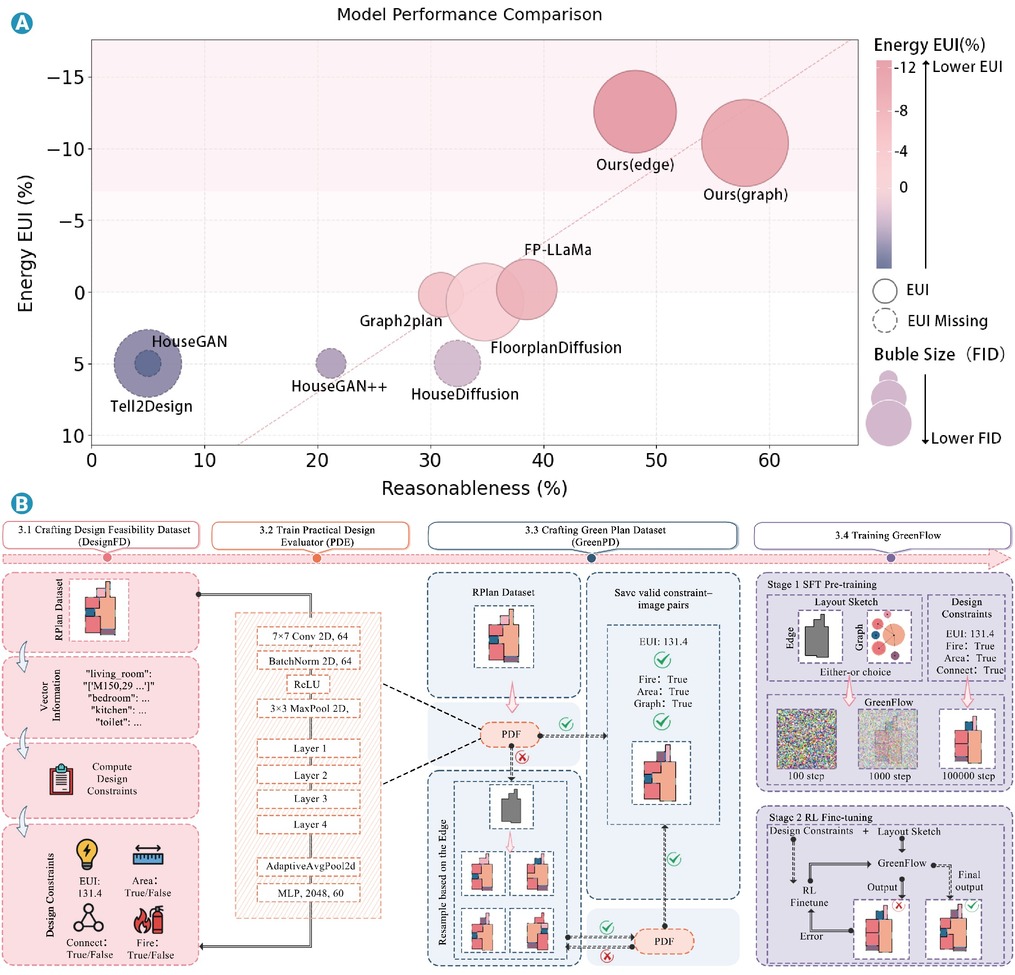
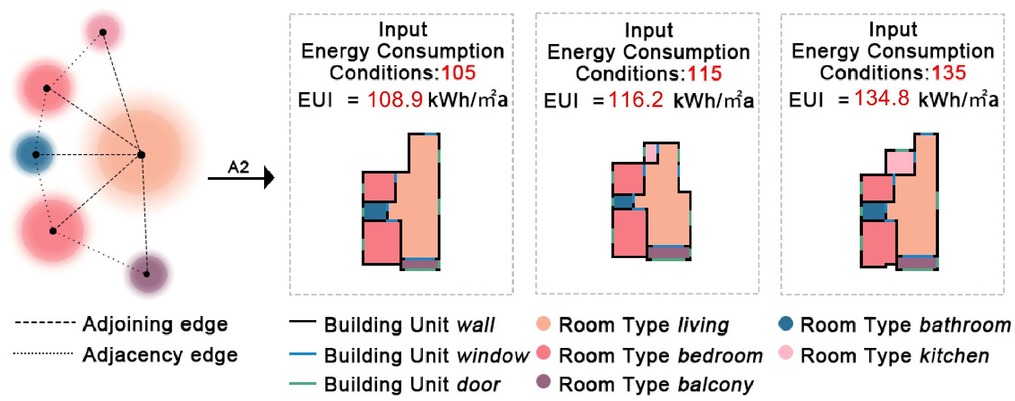
(A) Comparison of model performance in terms of reasonableness (higher is better), energy EUI (lower is better), and FID (bubble size, larger is better). Our method achieves higher spatial plausibility, significantly lower energy consumption, and better generation quality, surpassing existing approaches overall. (B) Overview of our GreenPlanner, an energy- and functional-aware generative framework for residential layout design. It consists of four key components: (1) Design Feasibility Dataset (DesignFD), a dataset derived from RPLAN through quantitative energy and functional evaluations; (2) the Practical Design Evaluator (PDE), a convolutional network trained on DesignFD to predict design metrics rapidly; (3) Green Plan Dataset (GreenPD), a demand–plan dataset satisfying all prescribed criteria refined via PDE-guided resampling; and (4) the GreenFlow generator, trained and fine-tuned under PDE feedback for controllable, constraint-aware floorplan generation. Together, these components form an end-to-end pipeline from data construction to constraint-driven generative design.
-
Figure 2.
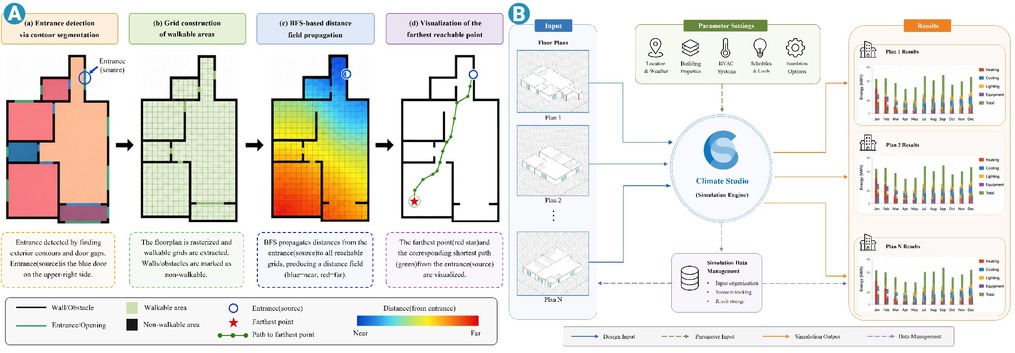
(A) Pipeline of the entrance-to-interior farthest distance calculation. The process includes (a) entrance detection via contour segmentation, (b) grid construction of walkable areas, (c) BFS-based distance field propagation, and (d) visualization of the farthest reachable point. Residential energy simulation pipeline. (B) Raster floor plans are vectorized (Python: svgwrite, opencv) to generate 2D vectors for 3D modeling (Rhinoceros + Grasshopper). We assign consistent orientation (top=north) and standard geometry presets, then run monthly EUI simulations in EnergyPlus via ClimateStudio. Each room is a thermal zone.
-
Figure 3.
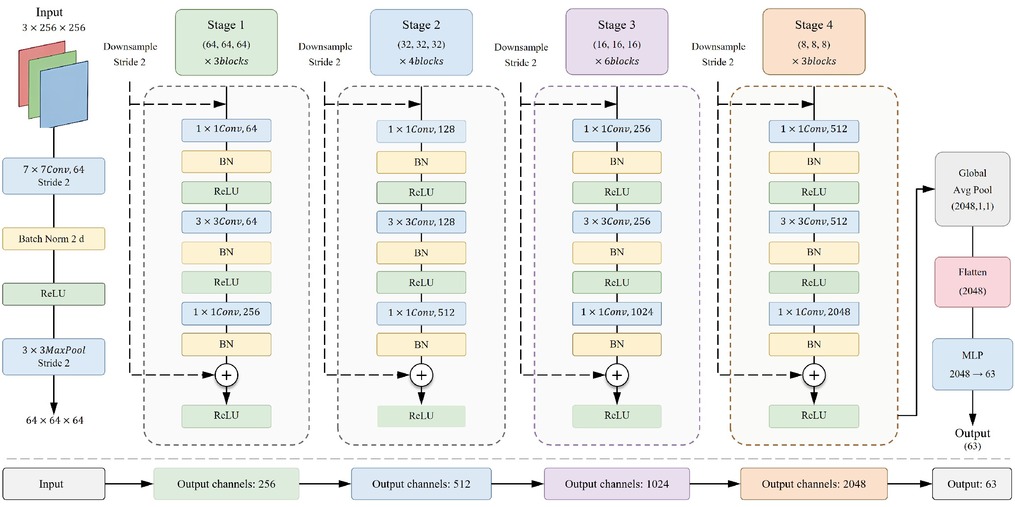
PDE architecture. A ResNet backbone encodes raster plans; a lightweight head outputs physical metrics (EUI, distance, area, topology compliance). Right: example predictions versus simulation labels.
-
Figure 4.
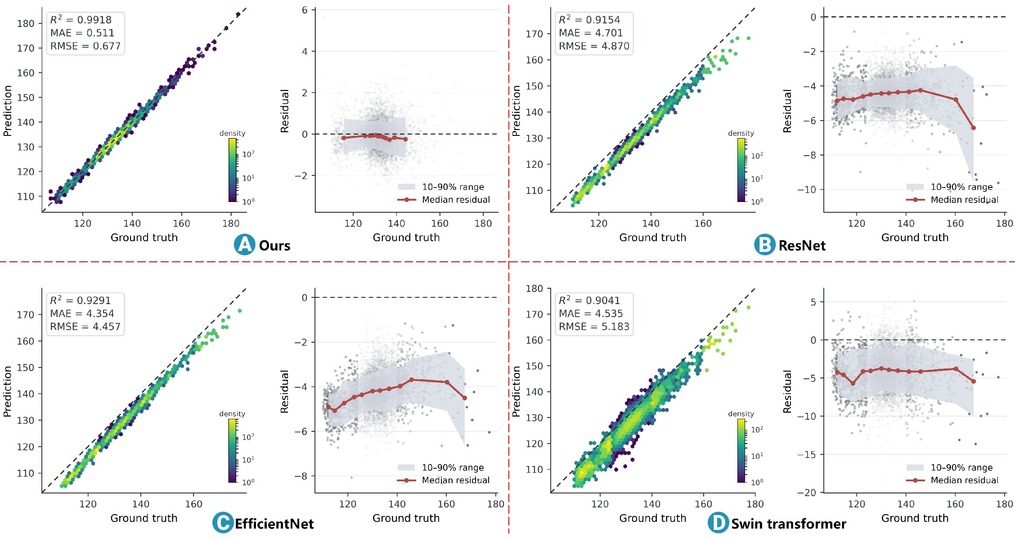
Quantitative comparison of energy predictions
-
Figure 5.
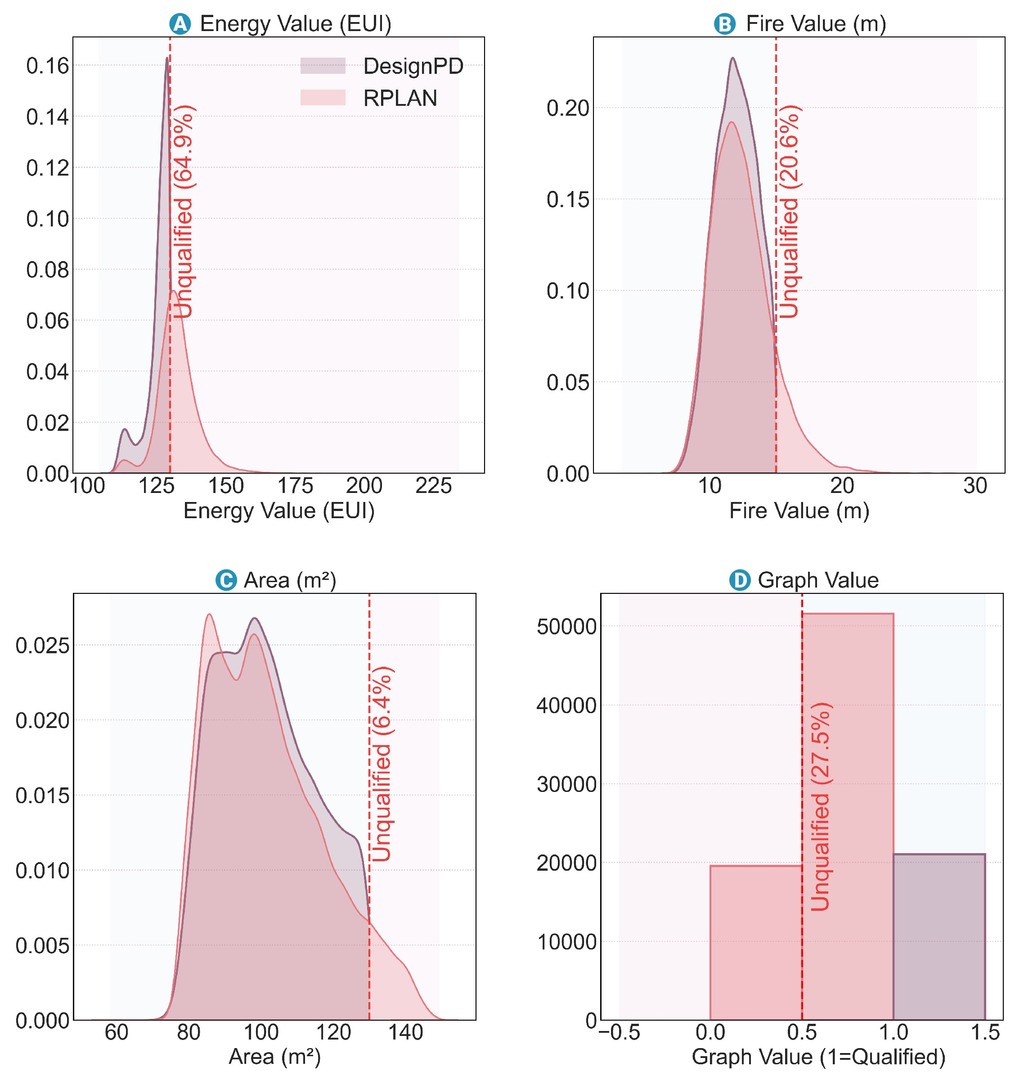
Comparison between the original RPLAN dataset and our proposed GreenPD
-
Figure 7.
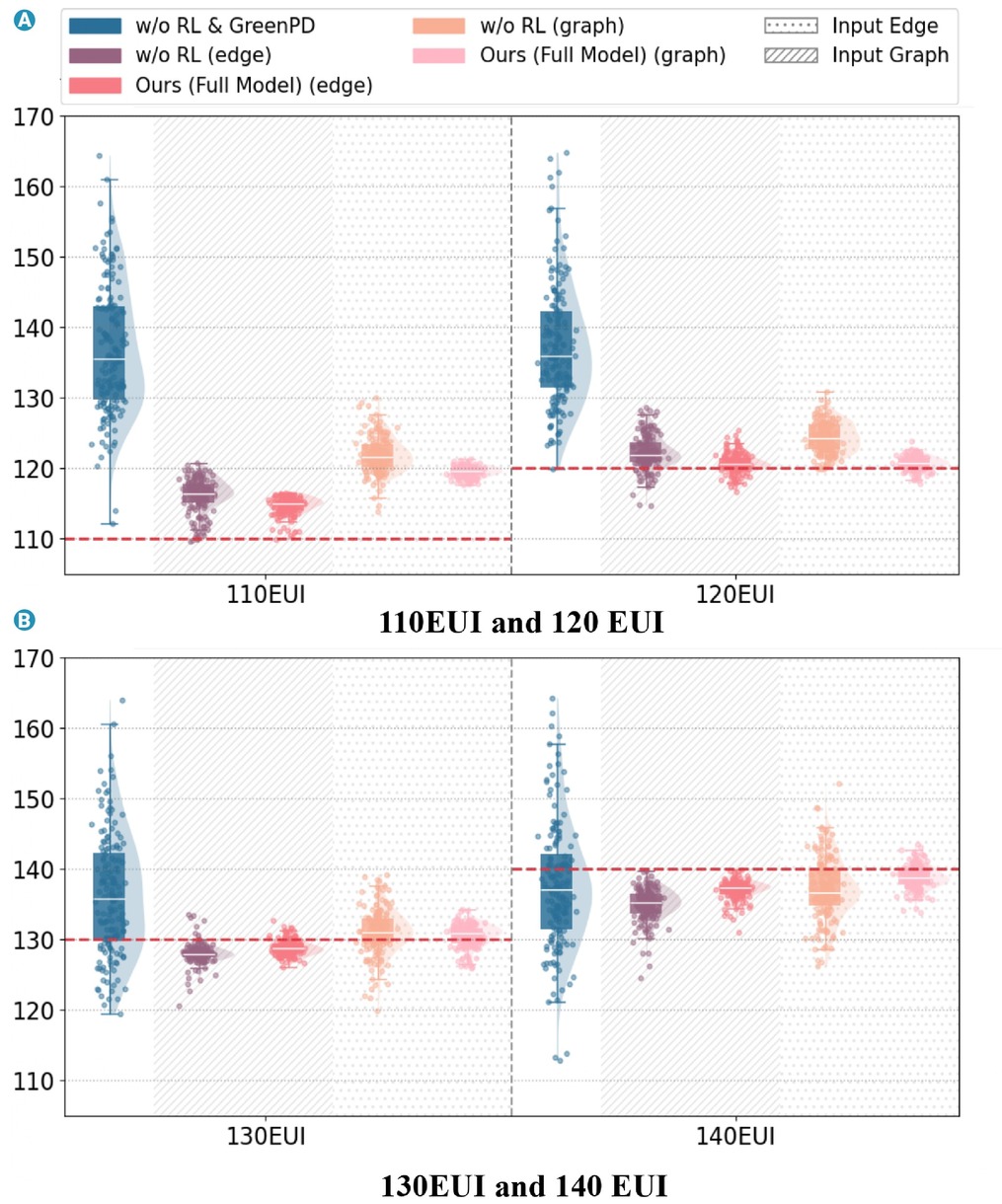
Energy controllability under different energy targets. Each model is evaluated at four target EUI levels (110, 120, 130, 140)
-
Figure 6.
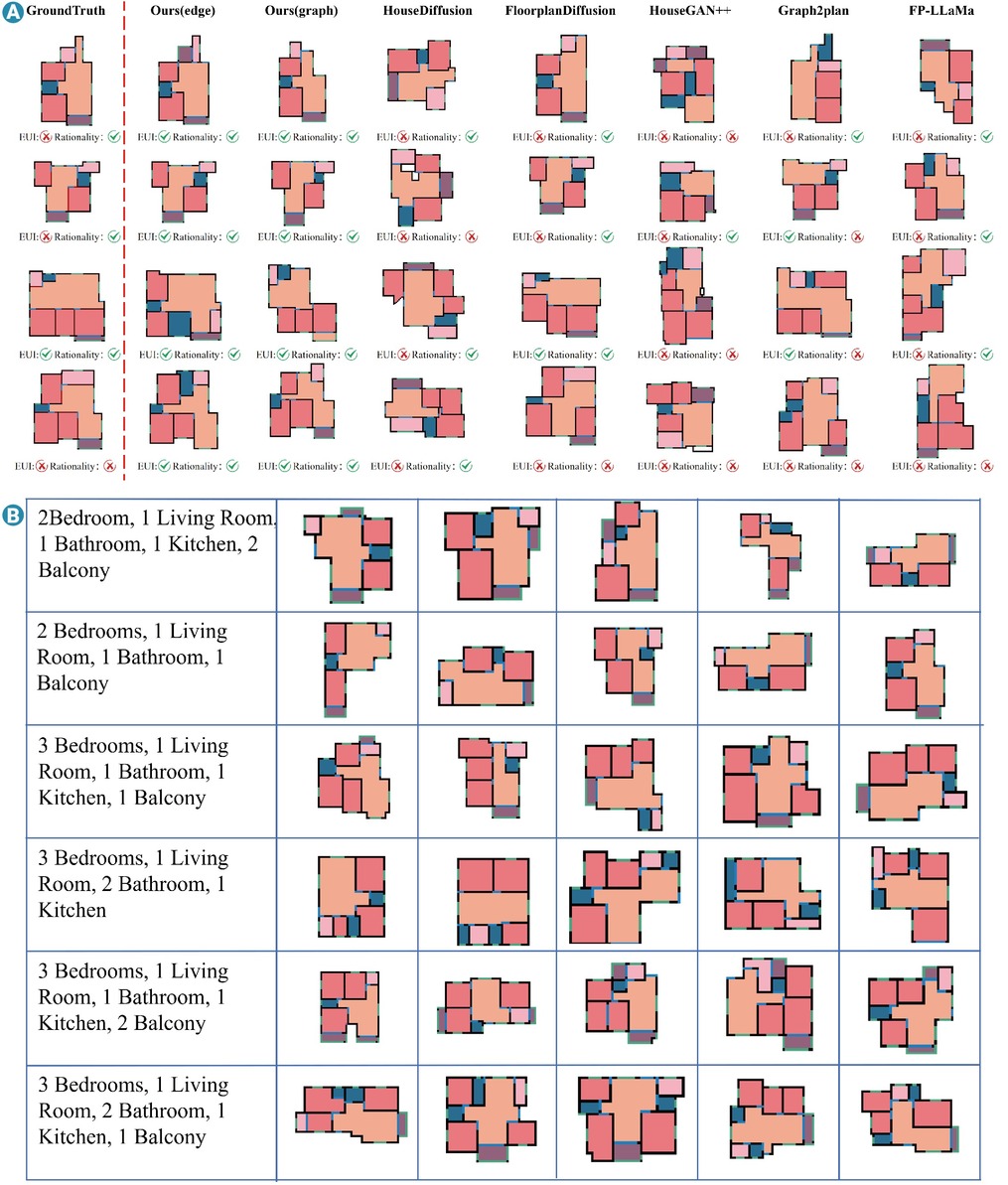
(A) Qualitative comparison of layout generation results. Baseline models (e.g., HouseDiffusion, HouseGAN++) often fail to produce necessary openings (doors and windows), resulting in functional incomplete layouts and unrealistic energy performance. For fair evaluation, a small number of openings were randomly inserted into their outputs to enable energy assessment. Our GreenFlow generates layouts with coherent spatial organization and complete openings. (B) More generated results by GreenPlanner.
-
Figure 8.
Controllability of green-performance attributes