
A Unified Value Signal Driven Strategy for Coordinated Multi-Energy Optimization in Building Clusters
-
GRAPHICAL ABSTRACT
 DownLoad:
Full size image
-
PUBLIC SUMMARY
-
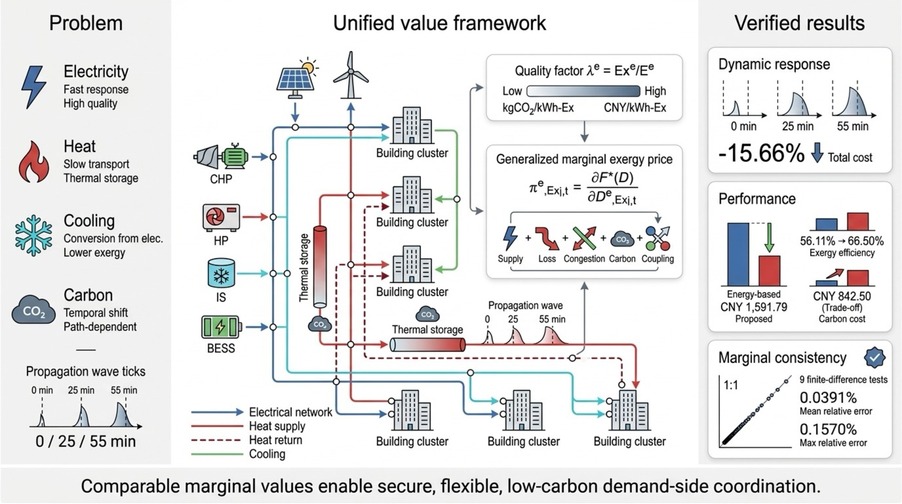
Electricity, heat, and cooling differ in transport dynamics, useful-work potential, and associated carbon responsibility; treating them as equivalent kilowatt-hours can therefore distort their system value.
This study integrates heating-network dynamics, energy quality, and carbon responsibility at the node–time level to derive a comparable value signal for heterogeneous energy carriers.
In a four-building-cluster case study, the proposed strategy reduces total system cost by 15.66% and raises average exergy efficiency to 66.50%.
-
-
ABSTRACT
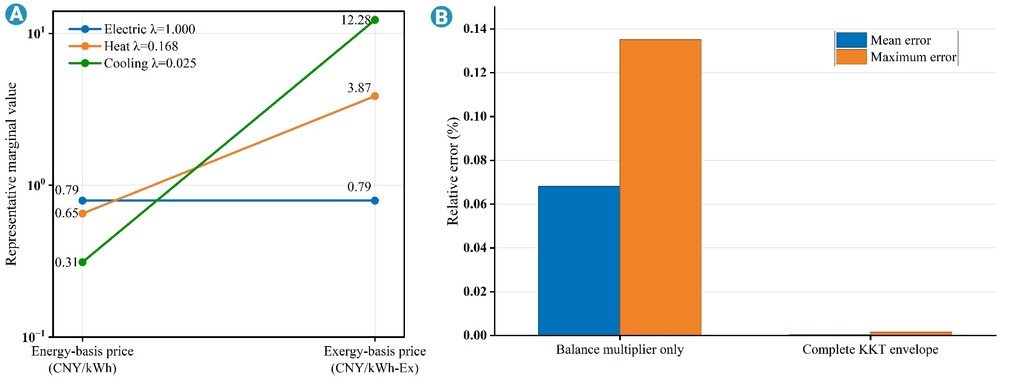
China’s transition toward an energy powerhouse requires not only a secure and low-carbon energy supply but also flexible and efficient coordination of distributed resources at the demand side. Building-cluster integrated energy systems couple electricity, heat, and cooling, whose transport dynamics, useful-work potential, and carbon responsibilities differ substantially. Conventional energy-based metrics therefore cannot fully capture how network states and energy quality affect nodal marginal values. This study proposes a unified value-signal-driven strategy for coordinated multi-energy optimization in building clusters. First, a coupled energy–carbon flow model represents the hydraulic–thermal dynamics, transport delays, and virtual thermal storage of the heating network, enabling the spatiotemporal tracing of heat and its associated carbon responsibility. Second, exergy is adopted as a common physical basis, while energy quality factors and exergy–carbon potentials quantify carrier-specific useful-work potential and carbon responsibility. An economic and low-carbon dispatch model is then formulated, and the generalized marginal exergy price is defined as the full KKT-based envelope derivative of the optimal value with respect to nodal exergy demand in a continuous convex pricing subproblem. In a four-cluster case study, the load-side response delays obtained from the steady-state, quasi-dynamic, and fully dynamic models are approximately 0, 25, and 55 min, respectively. Relative to unoptimized operation, the proposed strategy reduces daily total cost by 15.66%. Relative to energy-based optimization, it further reduces total cost by CNY 1,591.79 and increases average exergy efficiency from 56.11% to 66.50%, while carbon cost increases by CNY 842.50. Across nine finite-difference tests, the mean and maximum relative errors of the KKT-based marginal values are0.0391 % and0.1570 %, respectively. The framework provides a demand-side mechanism for coordinating local multi-energy resources and supports the development of a more secure, flexible, and low-carbon energy system. -

-
REFERENCES
[1] Chen X., Liu J., Lin B., et al. (2025). Promote the Revolution in Energy Use to Enhance the Impetus for Green Transformation and Development. Energy Use 1:100001. DOI:10.59717/ipj.energy-use.2025.100001 [2] Chen X. (2024). Green and low-carbon energy-use. Innov. Energy 1:100003. DOI:10.59717/j.xinn-energy.2024.100003 [3] Chen X. (2025). Urban Energy Use and Its Friendly Interaction with Power Grid. Energy Use 1:100011. DOI:10.59717/ipj.energy-use.2025.100011 [4] Xiang Y., Chen L., Wuyun Q., et al. (2025). A Comprehensive Review of Building-to-Grid Interaction. Energy Use 2:100043. DOI:10.59717/ipj.energy-use.2025.100043 [5] Ma L., Liu N., Wang L., et al. (2026). Multi-party energy management for smart building cluster with PV systems using automatic demand response. Energy Build. 121:11−21. DOI:10.1016/j.enbuild.2016.03.072 [6] Dawes G., Kirant-Mitić T., Jiang Z., et al. (2025). Energy flexibility at multi-building scales: A review of the dominant factors and their uncertainties. Energy Build. 346:116157. DOI:10.1016/j.enbuild.2025.116157 [7] Jing Z., Chen X., Bu L., et al. (2024). Intelligent optimization for building energy management considering indoor heat transfer. Innov. Energy 1:100058. DOI:10.59717/j.xinn-energy.2024.100058 [8] Li S., Chen X., Bu L., et al. (2024). Two-stage optimization for the air conditioning system in public buildings with flexible control of indoor load. Energy Build. 312:114162. DOI:10.1016/j.enbuild.2024.114162 [9] Zhu J., Han L., Yu J., et al. (2026). Planning High-PV Penetration Park: Enhancing Local PV Utilization and Economic Efficiency through Multi-Energy Storage. Energy Use 2:100042. DOI:10.59717/ipj.energy-use.2025.100042 [10] Zhu D., Korolija I., Dong Z.Y., et al. (2025). Coordinated Optimization of Carbon-Electricity-Gas Trading in Multi-Vector Energy Systems across Buildings. Energy Use 1:100003. DOI:10.59717/ipj.energy-use.2025.100003 [11] Ghilardi L.M.P., Castelli A.F., Moretti L., et al. (2021). Co-optimization of multi-energy system operation, district heating/cooling network and thermal comfort management for buildings. Appl. Energy 302:117480. DOI:10.1016/j.apenergy.2021.117480 [12] Qian C., He N., Cheng Z., et al. (2024). Optimal scheduling of building energy system with integrated virtual energy storage based on multi-task model predictive control. J. Build. Eng. 98:111185. DOI:10.1016/j.jobe.2024.111185 [13] Zhang H., Xiao F., Zhang C., et al. (2023). A multi-agent system based coordinated multi-objective optimal load scheduling strategy using marginal emission factors for building cluster demand response. Energy Build. 281:112765. DOI:10.1016/j.enbuild.2022.112765 [14] Hua H., Chen X., Gan L., et al. (2024). Demand-side joint electricity and carbon trading mechanism. IEEE Trans. Ind. Cyber-Phys. Syst. 2:14−25. DOI:10.1109/TICPS.2023.3335328 [15] Huang W., Zhang N., Cheng Y., et al. (2020). Multienergy networks analytics: Standardized modeling, optimization, and low carbon analysis. Proc. IEEE 108:1411−1436. DOI:10.1109/JPROC.2020.2993787 [16] Yao S., Gu W., Lu S., et al. (2021). Dynamic optimal energy flow in the heat and electricity integrated energy system. IEEE Trans. Sustain. Energy 12:179−190. DOI:10.1109/TSTE.2020.2988682 [17] Chen X., Bu L., Chen C., et al. (2024). An operational optimization method of regional multi-energy system considering thermal quasi-dynamic characteristics. CSEE J. Power Energy Syst. 10:2551−2563. DOI:10.17775/CSEEJPES.2020.03830 [18] Lu S., Gu W., Zhou S., et al. (2020). High-resolution modeling and decentralized dispatch of heat and electricity integrated energy system. IEEE Trans. Sustain. Energy 11:1451−1463. DOI:10.1109/TSTE.2019.2927637 [19] Yang J., Zhang N., Botterud A., et al. (2020). On an equivalent representation of the dynamics in district heating networks for combined electricity-heat operation. IEEE Trans. Power Syst. 35:560−570. DOI:10.1109/TPWRS.2019.2935748 [20] Chen B., Wu W., Guo Q., et al. (2022). An efficient optimal energy flow model for integrated energy systems based on energy circuit modeling in the frequency domain. Appl. Energy 326:119923. DOI:10.1016/j.apenergy.2022.119923 [21] Chen X., Hu Y., Zhao J., et al. (2025). Downscaling deconstruction, hybrid semi-mechanism state estimation and cascaded dynamic equivalent modelling of complex district heating networks. Energy 322:135678. DOI:10.1016/j.energy.2025.135678 [22] Wang X., Han L., Wang C., et al. (2023). A time-scale adaptive dispatching strategy considering the matching of time characteristics and dispatching periods of the integrated energy system. Energy 267:126584. DOI:10.1016/j.energy.2022.126584 [23] Qin Y., Liu P. and Li Z. (2022). Multi-timescale hierarchical scheduling of an integrated energy system considering system inertia. Renew. Sustain. Energy Rev. 169:112911. DOI:10.1016/j.rser.2022.112911 [24] Cheng Y., Zhang N., Wang Y., et al. (2019). Modeling carbon emission flow in multiple energy systems. IEEE Trans. Smart Grid 10:3562−3574. DOI:10.1109/TSG.2018.2830775 [25] Kang C., Zhou T., Chen Q., et al. (2015). Carbon emission flow from generation to demand: A network-based model. IEEE Trans. Smart Grid 6:2386−2394. DOI:10.1109/TSG.2015.2388695 [26] Huang J., Duan W., Zhou Q., et al. (2022). Methodology for carbon emission flow calculation of integrated energy systems. Energy Rep. 8:1090−1097. DOI:10.1016/j.egyr.2022.05.263 [27] Bu L., Chen X., Gan L., et al. (2023). Low-carbon operation method of the building based on dynamic carbon emission factor of power system. IET Smart Grid 6:67−85. DOI:10.1049/stg2.12085 [28] Tsatsaronis G. (2007). Definitions and nomenclature in exergy analysis and exergoeconomics. Energy 32:249−253. DOI:10.1016/j.energy.2006.07.002 [29] Rosen M.A., Dincer I. and Kanoglu M. (2008). Role of exergy in increasing efficiency and sustainability and reducing environmental impact. Energy Policy 36:128−137. DOI:10.1016/j.enpol.2007.09.006 [30] Tahir M.F., Chen H. and Han G. (2021). Exergy hub based modelling and performance evaluation of integrated energy system. J. Energy Storage 41:102912. DOI:10.1016/j.est.2021.102912 [31] Li J., Wang D., Jia H., et al. (2022). Mechanism analysis and unified calculation model of exergy flow distribution in regional integrated energy system. Appl. Energy 324:119725. DOI:10.1016/j.apenergy.2022.119725 [32] Yang W., Huang Y., Zhang T., et al. (2023). Mechanism and analytical methods for carbon emission-exergy flow distribution in heat-electricity integrated energy system. Appl. Energy 352:121980. DOI:10.1016/j.apenergy.2023.121980 [33] Chen J., Chen H., Liang Z., et al. (2024). A joint solution framework for the optimal operation and evaluation of integrated energy systems based on exergy. Energy Convers. Manag. 301:118071. DOI:10.1016/j.enconman.2024.118071 [34] Chen J., Chen H., Lin Z., et al. (2023). Multi-objective optimal dispatch of integrated heat and electricity energy systems considering heat load energy quality. Energy Rep. 9:1191−1200. DOI:10.1016/j.egyr.2023.05.081 [35] Liu S., Han S., Tian J., et al. (2024). A multi-objective optimization scheduling approach of integrated energy system considering the exergy efficiency using the variable step-size approximation method. Energy 311:133370. DOI:10.1016/j.energy.2024.133370 [36] Peng S., Liu S. and Wu X. (2025). Optimal scheduling of integrated energy system considering exergoeconomic performance. Energy 320:135171. DOI:10.1016/j.energy.2025.135171 [37] Chen L., Suzuki H., Wachi T., et al. (2002). Components of nodal prices for electric power systems. IEEE Trans. Power Syst. 17:41−49. DOI:10.1109/59.982191 [38] Deng L., Li Z., Sun H., et al. (2019). Generalized locational marginal pricing in a heat-and-electricity-integrated market. IEEE Trans. Smart Grid 10:6414−6425. DOI:10.1109/TSG.2019.2904522 [39] Li J., Xiang Y., Gu C., et al. (2023). Formulation of locational marginal electricity-carbon price in power systems. CSEE J. Power Energy Syst. 9:1968−1972. DOI:10.17775/CSEEJPES.2021.06400 [40] Jiang Y., Wan C., Botterud A., et al. (2021). Convex relaxation of combined heat and power dispatch. IEEE Trans. Power Syst. 36:1442−1458. DOI:10.1109/TPWRS.2020.3025070 -
ABOUT THIS ARTICLE
Cite this article:
Bu L., Chen X., Yu K., et al. (2026). A Unified Value Signal Driven Strategy for Coordinated Multi-Energy Optimization in Building Clusters. Energy Use 2:100066. https://doi.org/10.59717/ipj.energy-use.2026.100066
Welcome!
To request copyright permission to republish or share portions of our works, please visit Copyright Clearance Center's (CCC) Marketplace website at marketplace.copyright.com.
Export File
Citation
Bu L., Chen X., Yu K., et al. (2026). A Unified Value Signal Driven Strategy for Coordinated Multi-Energy Optimization in Building Clusters. Energy Use 2:100066. https://doi.org/10.59717/ipj.energy-use.2026.100066

Format
Content


-
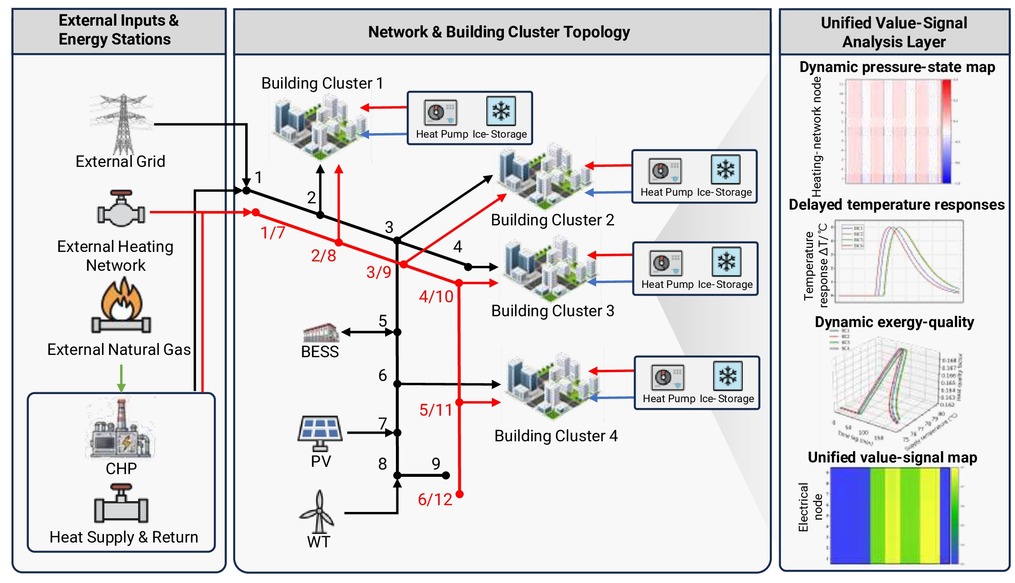
Figure 1.
Physical topology of the BCIES and the unified value-signal analysis framework
-
Figure 2.
Coupled dynamic-state and value-signal solution framework
-
Figure 3.
Dynamic response delays and spatial carbon-potential differentiation under different heating-network models
-
Figure 4.
Energy–exergy conversion, carrier structure, CHP product-responsibility allocation, and exergy-performance indicators
-
Figure 5.
Device-dispatch comparison between the energy-based and unified-value formulations
-
Figure 6.
Unified value-signal characteristics and marginal consistency