
Foundation models in Earth system science: Advances, challenges, and future paths
-
GRAPHICAL ABSTRACT
 DownLoad:
Full size image
-
PUBLIC SUMMARY
-
This review examines foundation models across six fields of Earth system science.
Limited access to usable data and difficulties in respecting physical laws remain major challenges.
Future models could connect information across Earth’s systems and incorporate physical knowledge.
These advances could improve planetary monitoring and simulations of future Earth system changes.
-
-
ABSTRACT
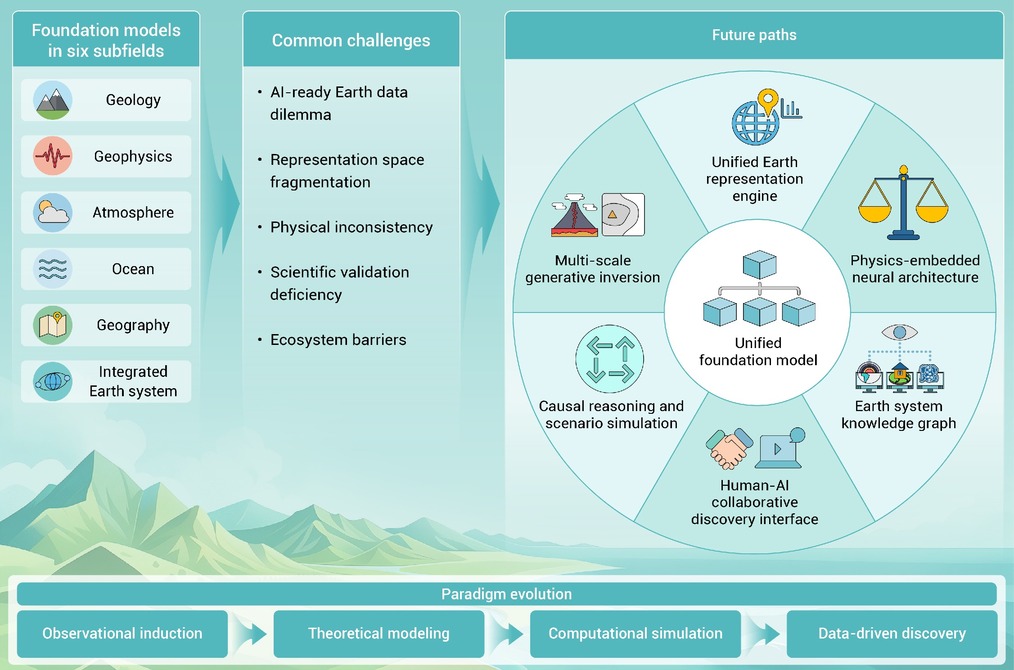
The convergence of massive Earth observation datasets and emerging foundation models offers an opportunity to address the complex challenges in Earth System Science (ESS). However, the direct application of foundation models to ESS is often hindered by domain gaps, characterized by the need for physical consistency, the complexity of Earth’s spherical geometries, and the non-stationarity of the multisphere coupled Earth systems. Building on prior reviews that prioritize model architecture or view geoscience as a monolithic entity, this study provides a domain-centric synthesis of foundation models across six distinct subfields, including Geology, Geophysics, Atmosphere, Ocean, Geography, and the Integrated Earth System. By analyzing the applications and limitations of Artificial Intelligence (AI) within these sub-fields, this work identifies unique domain barriers and cross-cutting challenges, including the AI-ready Earth data dilemma, representation space fragmentation, physical inconsistency, scientific validation deficiency, and ecosystem barriers. In this context, we provide future paths for the next generation of ESS foundation models, driven by unified Earth representation engine, a physics-embedded neural architecture, an Earth system knowledge graph, multi-scale generative inversion, causal reasoning, and human-AI collaborative discovery interface. In this way, foundation models can potentially complement traditional numerical models to monitor planetary status and simulate its future evolution, thereby equipping the scientific community with new tools for holistic planetary stewardship and complex decision-making. -

-
REFERENCES
[1] Steffen W., Richardson K., Rockström J., et al. (2020). The emergence and evolution of Earth system science. Nat. Rev. Earth Environ. 1:54−63. DOI:10.1038/s43017-019-0005-6 [2] Kumar A., Nagar S. and Anand S. (2021). Climate change and existential threats. Singh S., Singh P., Selvasembian R., et al (eds.). Global Climate Change (Elsevier), pp: 1–31. DOI: 10.1016/B978-0-12-822928-6.00005-8 [3] Raymond C., Horton R.M., Zscheischler J., et al. (2020). Understanding and managing connected extreme events. Nat. Clim. Change 10:611−621. DOI:10.1038/s41558-020-0790-4 [4] Cao Y., Wang H., Su F., et al. (2026). Satellite radar and AIS reveal a 97% decline in shipping traffic through the Strait of Hormuz. The Innovation 7:101367. DOI:10.1016/j.xinn.2026.101367 [5] Li X., Feng M., Ran Y., et al. (2023). Big data in Earth system science and progress towards a digital twin. Nat. Rev. Earth Environ. 4:319−332. DOI:10.1038/s43017-023-00409-w [6] Guo H., Wang L. and Liang D. (2016). Big earth data from space: a new engine for Earth science. Sci. Bull. 61:505−513. DOI:10.1007/s11434-016-1041-y [7] Gray J. (2009). Jim Gray on eScience: A transformed scientific method. Hey T., Tansley S., and Tolle K.M. (eds.). The Fourth Paradigm: Data-Intensive Scientific Discovery (Microsoft Research), pp: xvii–xxxi. [8] Radford A., Narasimhan K., Salimans T., et al. (2018). Improving language understanding by generative pre-training. https://cdn.openai.com/research-covers/language-unsupervised/language_understanding_paper.pdf [9] Guo D., Yang D., Zhang H., et al. (2025). DeepSeek-R1 incentivizes reasoning in LLMs through reinforcement learning. Nature 645:633−638. DOI:10.1038/s41586-025-09422-z [10] Liu Y., Zhang K., Li Y., et al. (2024). Sora: a review on background, technology, limitations, and opportunities of large vision models. arXiv. https://arxiv.org/abs/2402.17177 [11] Nguyen T., Brandstetter J., Kapoor A., et al. (2023). ClimaX: A foundation model for weather and climate. arXiv. https://arxiv.org/abs/2301.10343 [12] Bodnar C., Bruinsma W. P., Lucic A., et al. (2025). A foundation model for the Earth system. Nature 641:1180−1187. DOI:10.1038/s41586-025-09005-y [13] Irrgang C., Boers N., Sonnewald M., et al. (2021). Towards neural Earth system modelling by integrating artificial intelligence in Earth system science. Nat. Mach. Intell. 3:667−674. DOI:10.1038/s42256-021-00374-3 [14] Reichstein M., Camps-Valls G., Stevens B., et al. (2019). Deep learning and process understanding for data-driven Earth system science. Nature 566:195−204. DOI:10.1038/s41586-019-0912-1 [15] Schultz M. G., Betancourt C., Gong B., et al. (2021). Can deep learning beat numerical weather prediction. Philos. Trans. R. Soc. Math. Phys. Eng. Sci. 379:20200097. DOI:10.1098/rsta.2020.0097 [16] Dueben P. D. and Bauer P. (2018). Challenges and design choices for global weather and climate models based on machine learning. Geosci. Model Dev. 11:3999−4009. DOI:10.5194/gmd-11-3999-2018 [17] Zhang H., Xu J.J., Cui H.W., et al. (2024). When geoscience meets foundation models: Toward a general geoscience artificial intelligence system. IEEE Geosci. Remote Sens. Mag. 2-41. DOI:10.1109/MGRS.2024.3496478 [18] Karpatne A., Ebert-Uphoff I., Ravela S., et al. (2019). Machine learning for the geosciences: challenges and opportunities. IEEE Trans. Knowl. Data Eng. 31:1544−1554. DOI:10.1109/TKDE.2018.2861006 [19] Persello C., Wegner J. D., Hänsch R., et al. (2022). Deep learning and Earth observation to support the sustainable development goals: current approaches, open challenges, and future opportunities. IEEE Geosci. Remote Sens. Mag. 10:172−200. DOI:10.1109/MGRS.2021.3136100 [20] Zhao T., Wang S., Ouyang C., et al. (2024). Artificial intelligence for geoscience: progress, challenges, and perspectives. The Innovation 5:100691. DOI:10.1016/j.xinn.2024.100691 [21] Bergen K. J., Johnson P. A., de Hoop M. V., et al. (2019). Machine learning for data-driven discovery in solid Earth geoscience. Science 363:eaau0323. DOI:10.1126/science.aau0323 [22] Rhoads B.L. and Thorn C.E. (eds.) (1996). The scientific nature of geomorphology: Proceedings of the 27th Binghamton symposium in geomorphology (Wiley). [23] Burrough P. A. (1981). Fractal dimensions of landscapes and other environmental data. Nature 294:240−242. DOI:10.1038/294240a0 [24] Chamberlin T. C. (1890). The method of multiple working hypotheses. Science ns- 15:92−96. DOI:10.1126/science.ns-15.366.92 [25] Byers C. W. (1982). Stratigraphy–The fall of continuity. J. Geol. Educ. 30:215−221. DOI:10.5408/0022-1368-30.4.215 [26] Harris E. C. (1979). The laws of archaeological stratigraphy. World Archaeol. 11:111−117. DOI:10.1080/00438243.1979.9979753 [27] Short N.M. and Blair R.W. Jr. (eds.) (1986). Geomorphology from space: A global overview of regional landforms. Washington DC: Scientific and Technical Information Branch, National Aeronautics and Space Administration, pp: 717. [28] Kondolf G.M., Piégay H., Schmitt L., et al. (2016). Geomorphic classification of rivers and streams. Kondolf G.M. and Piégay H. (eds.). Tools in Fluvial Geomorphology (John Wiley & Sons, Ltd), pp: 133–158. DOI: 10.1002/9781118648551.ch7 [29] Greene M.T. (2017). Geology in the Nineteenth century: Changing views of a changing world. Cornell University Press. DOI: 10.7591/9781501704741 [30] Bokulich A. and Oreskes N. (2017). Models in geosciences. Magnani L. and Bertolotti T. (eds). Springer Handbook of Model-Based Science (Springer International Publishing), pp: 891–911. DOI: 10.1007/978-3-319-30526-4_41 [31] Bauer P., Thorpe A. and Brunet G. (2015). The quiet revolution of numerical weather prediction. Nature 525:47−55. DOI:10.1038/nature14956 [32] Turner A.K. and Gable C.W. (2007). A review of geological modeling. Thorleifson L.H., Berg R.C. and Russell H.A.J. (eds). Three-Dimensional Geologic Mapping for Groundwater Applications (Minnesota Geological Survey), pp: 75–79. [33] Johannessen O.M. (1986). Brief overview of the physical oceanography. Hurdle B.G. (ed). The Nordic Seas (Springer), pp: 103–128. DOI: 10.1007/978-1-4615-8035-5_4 [34] Pierce D. W., Barnett T. P., Santer B. D., et al. (2009). Selecting global climate models for regional climate change studies. Proc. Natl. Acad. Sci. 106:8441−8446. DOI:10.1073/pnas.0900094106 [35] Schneider T., Lan S., Stuart A., et al. (2017). Earth system modeling 2.0: a blueprint for models that learn from observations and targeted high-resolution simulations. Geophys. Res. Lett. 44. DOI:10.1002/2017GL076101 [36] Li X., Chen Y., Liu X., et al. (2011). Concepts, methodologies, and tools of an integrated geographical simulation and optimization system. Int. J. Geogr. Inf. Sci. 25:633−655. DOI:10.1080/13658816.2010.496370 [37] Fox-Kemper B., Adcroft A., Böning C. W., et al. (2019). Challenges and prospects in ocean circulation models. Front. Mar. Sci. 6. DOI:10.3389/fmars.2019.00065 [38] Jakob C. (2010). Accelerating progress in global atmospheric model development through improved parameterizations: Challenges, opportunities, and strategies. Bull. Am. Meteorol. Soc. 91:869−876. DOI:10.1175/2009BAMS2898.1 [39] Xu Y., Liu X., Cao X., et al. (2021). Artificial intelligence: a powerful paradigm for scientific research. The Innovation 2:100179. DOI:10.1016/j.xinn.2021.100179 [40] Guo X., Lao J., Dang B., et al. (2024). SkySense: A multi-modal remote sensing foundation model towards universal interpretation for Earth observation imagery. arXiv. https://arxiv.org/abs/2312.10115 [41] Jakubik J., Yang F., Blumenstiel B., et al. (2025). TerraMind: Large-scale generative multimodality for Earth observation. arXiv. https://arxiv.org/abs/2504.11171 [42] Brown C. F., Kazmierski M. R., Pasquarella V. J., et al. (2025). AlphaEarth foundations: An embedding field model for accurate and efficient global mapping from sparse label data. arXiv. https://arxiv.org/abs/2507.22291 [43] Xiang Y., Jin W., Dong H., et al. (2025). ADAF: an artificial intelligence data assimilation framework for weather forecasting. J. Adv. Model. Earth Syst. 17:e2024MS004839. DOI:10.1029/2024MS004839 [44] Liu Q., Chen Z. and Ma J. (2025). Foundation models for exploration geophysics. Geophysics 90:H29−H52. DOI:10.1190/geo2024-0916.1 [45] Bommasani R., Hudson D. A., Adeli E., et al. (2021). On the opportunities and risks of foundation models. arXiv. https://arxiv.org/abs/2108.07258 [46] Plésiat É., Dunn R. J. H., Donat M. G., et al. (2024). Artificial intelligence reveals past climate extremes by reconstructing historical records. Nat. Commun. 15:9191. DOI:10.1038/s41467-024-53464-2 [47] Karniadakis G. E., Kevrekidis I. G., Lu L., et al. (2021). Physics-informed machine learning. Nat. Rev. Phys. 3:422−440. DOI:10.1038/s42254-021-00314-5 [48] Zhang R., Zhou L., Gao C., et al. (2024). A transformer-based coupled ocean-atmosphere model for ENSO studies. Sci. Bull. 69. DOI:10.1016/j.scib.2024.04.048 [49] Zhang P., Zhou L., Li Y., et al. (2025). Self-supervised learning of invariant causal representation in heterogeneous information network. Inf. Fusion 123:103246. DOI:10.1016/j.inffus.2025.103246 [50] Li X. and Guo Y. (2025). Paradigm shifts from data-intensive science to robot scientists. Sci. Bull. 70:14−18. DOI:10.1016/j.scib.2024.09.029 [51] Lam R., Sanchez-Gonzalez A., Willson M., et al. (2023). Learning skillful medium-range global weather forecasting. Science 382:1416−1421. DOI:10.1126/science.adi2336 [52] Bi K., Xie L., Zhang H., et al. (2023). Accurate medium-range global weather forecasting with 3D neural networks. Nature 619:533−538. DOI:10.1038/s41586-023-06185-3 [53] Pathak J., Subramanian S., Harrington P., et al. (2022). FourCastNet: A global data-driven high-resolution weather model using adaptive fourier neural operators. arXiv. https://arxiv.org/abs/2202.11214 [54] Gao Y., Xiong Y., Wang S., et al. (2022). GeoBERT: Pre-training geospatial representation learning on point-of-interest. Appl. Sci. 12:12942. DOI:10.3390/app122412942 [55] Lin Z., Deng C., Zhou L., et al. (2024). GeoGalactica: a scientific large language model in geoscience. arXiv. https://arxiv.org/abs/2401.00434 [56] Wu G., Wang H., Zhang K., et al. (2025). GeoProspect: A domain-specific geological large language model with enhanced continual learning. Neurocomputing 650:130801. DOI:10.1016/j.neucom.2025.130801 [57] Chen X., Liu Y., Han W., et al. (2025). A vision-language foundation model-based multi-modal retrieval-augmented generation framework for remote sensing lithological recognition. ISPRS J. Photogramm. Remote Sens. 225:328−340. DOI:10.1016/j.isprsjprs.2025.04.015 [58] Zhao M., Xiao Z., Zhang M., et al. (2023). DiTingMotion: a deep-learning first-motion-polarity classifier and its application to focal mechanism inversion. Front. Earth Sci. 11:1103914. DOI:10.3389/feart.2023.1103914 [59] Si X., Wu X., Sheng H., et al. (2024). SeisCLIP: a seismology foundation model pre-trained by multimodal data for multipurpose seismic feature extraction. IEEE Trans. Geosci. Remote Sens. 62:1−13. DOI:10.1109/TGRS.2024.3354456 [60] Li S., Yang X., Cao A., et al. (2024). SeisT: a foundational deep-learning model for earthquake monitoring tasks. IEEE Trans. Geosci. Remote Sens. 62:1−15. DOI:10.1109/TGRS.2024.3371503 [61] Sheng H., Wu X., Si X., et al. (2025). Seismic foundation model: a next generation deep-learning model in geophysics. Geophysics 90:IM59−IM79. DOI:10.1190/geo2024-0262.1 [62] Price I., Sanchez-Gonzalez A., Alet F., et al. (2025). Probabilistic weather forecasting with machine learning. Nature 637:84−90. DOI:10.1038/s41586-024-08252-9 [63] Sun X., Zhong X., Xu X., et al. (2025). A data-to-forecast machine learning system for global weather. Nat. Commun. 16:6658. DOI:10.1038/s41467-025-62024-1 [64] Mardani M., Brenowitz N., Cohen Y., et al. (2025). Residual corrective diffusion modeling for km-scale atmospheric downscaling. Commun. Earth Environ. 6:124. DOI:10.1038/s43247-025-02042-5 [65] Xiong W., Xiang Y., Wu H., et al. (2023). AI-GOMS: Large AI-driven global ocean modeling system. arXiv. https://arxiv.org/abs/2308.03152 [66] Guo Z., Lyu P., Ling F., et al. (2025). Data-driven global ocean modeling for seasonal to decadal prediction. Sci. Adv. 11:eadu2488. DOI:10.1126/sciadv.adu2488 [67] Huang Q., Niu Y., Zhong X., et al. (2026). A deep learning global ocean forecasting model with sub-daily and eddy-resolving resolution. npj Climate and Atmospheric Science. DOI: 10.1038/s41612-026-01444-2 [68] Yang N., Wang C., Zhao Z., et al. (2026). LangYa: a large AI model for global ocean forecasting. Sci. Bull. DOI:10.1016/j.scib.2026.08.001 [69] Li X., Zhang X., Ren Y., et al. (2026). Artificial intelligence for ocean phenomena forecasting. Sci. Bull. 71:2632−2652. DOI:10.1016/j.scib.2026.04.002 [70] Wu K., Zhang Y., Ru L., et al. (2025). A semantic-enhanced multi-modal remote sensing foundation model for Earth observation. Nat. Mach. Intell. 7:1235−1249. DOI:10.1038/s42256-025-01078-8 [71] Szwarcman D., Roy S., Fraccaro P., et al. (2026). Prithvi-EO-2.0: A versatile multitemporal foundation model for Earth observation applications. IEEE Trans. Geosci. Remote Sens. 64:1-20. DOI:10.1109/TGRS.2025.3642610 [72] Ozdemir F., Cheng Y., Mohebi S., et al. (2026). Earth system foundation model (ESFM): a unified framework for heterogeneous data integration and forecasting. arXiv. https://arxiv.org/abs/2605.00850 [73] Pal A., Sweeney A., Heyblom K., et al. (2026). NIVA: a multimodal foundation model for actionable earth system intelligence. arXiv. https://arxiv.org/abs/2606.28546v1 [74] Wang C., Wei X., Pan H., et al. (2024). Well logging stratigraphic correlation algorithm based on Semantic Segmentation. Appl. Geophys. 21:650−666. DOI:10.1007/s11770-024-1085-8 [75] Sun Y., Pang S., Zhao Z., et al. (2024). Interpretable SHAP model combining Meta-learning and vision transformer for lithology classification using limited and unbalanced drilling data in well logging. Nat. Resour. Res. 33:2545−2565. DOI:10.1007/s11053-024-10396-4 [76] Jiang C. and Lei Q. (2025). FracLab: A robust 3D DFN generator for coupled stress-flow-transport modeling of complex fractured media. Comput. Geotech. 186:107444. DOI:10.1016/j.compgeo.2025.107444 [77] Yang F., Zuo R. and Kreuzer O. P. (2024). Artificial intelligence for mineral exploration: A review and perspectives on future directions from data science. Earth-Sci. Rev. 258:104941. DOI:10.1016/j.earscirev.2024.104941 [78] Dagdelen J., Dunn A., Lee S., et al. (2024). Structured information extraction from scientific text with large language models. Nat. Commun. 15:1418. DOI:10.1038/s41467-024-45563-x [79] Chen Y., Tian M., Wu Q., et al. (2024). A deep learning-based method for deep information extraction from multimodal data for geological reports to support geological knowledge graph construction. Earth Sci. Inform. 17:1867−1887. DOI:10.1007/s12145-023-01207-0 [80] Luo X., Sun J., Zhang R., et al. (2024). A multi-condition denoising diffusion probabilistic model controls the reconstruction of 3D digital rocks. Comput. Geosci. 184:105541. DOI:10.1016/j.cageo.2024.105541 [81] McGovern A., Lagerquist R., Gagne D. J., et al. (2019). Making the black box more transparent: Understanding the physical implications of machine learning. Bull. Am. Meteorol. Soc. 100:2175−2199. DOI:10.1175/BAMS-D-18-0195.1 [82] Hu Y., Zhang Q., Zhao W., et al. (2021). TransQuake: A transformer-based deep learning approach for seismic P-wave detection. Earthq. Res. Adv. 1:100004. DOI:10.1016/j.eqrea.2021.100004 [83] Sun M., Yu M., Lv P., et al. (2021). Man-made threat event recognition based on distributed optical fiber vibration sensing and SE-WaveNet. IEEE Trans. Instrum. Meas. 70:1−11. DOI:10.1109/TIM.2021.3081178 [84] Zhao M., Xiao Z., Chen S., et al. (2023). DiTing: a large-scale chinese seismic benchmark dataset for artificial intelligence in seismology. Earthq. Sci. 36:84−94. DOI:10.1016/j.eqs.2022.01.022 [85] Ongie G., Jalal A., Metzler C. A., et al. (2020). Deep learning techniques for inverse problems in imaging. IEEE J. Sel. Areas Inf. Theory 1:39−56. DOI:10.1109/JSAIT.2020.2991563 [86] Wu X., Ma J., Si X., et al. (2023). Sensing prior constraints in deep neural networks for solving exploration geophysical problems. Proc. Natl. Acad. Sci. 120:e2219573120. DOI:10.1073/pnas.2219573120 [87] Hersbach H., Bell B., Berrisford P., et al. (2020). The ERA5 global reanalysis. Q. J. R. Meteorol. Soc. 146:1999−2049. DOI:10.1002/qj.3803 [88] Eyring V., Bony S., Meehl G. A., et al. (2016). Overview of the coupled model intercomparison project phase 6 (CMIP6) experimental design and organization. Geosci. Model Dev. 9:1937−1958. DOI:10.5194/gmd-9-1937-2016 [89] Camps-Valls G., Fernández-Torres M.Á., Cohrs K.H., et al. (2025). Artificial intelligence for modeling and understanding extreme weather and climate events. Nat. Commun. 16:1919. DOI:10.1038/s41467-025-56573-8 [90] Rasp S., Hoyer S., Merose A., et al. (2024). WeatherBench 2: A Benchmark for the Next Generation of Data‐Driven Global Weather Models. J. Adv. Model. Earth Syst. 16:e2023MS004019. DOI:10.1029/2023MS004019 [91] Weyn J. A., Durran D. R. and Caruana R. (2020). Improving data‐driven global weather prediction using deep convolutional neural networks on a cubed sphere. J. Adv. Model. Earth Syst. 12:e2020MS002109. DOI:10.1029/2020MS002109 [92] Kochkov D., Yuval J., Langmore I., et al. (2024). Neural general circulation models for weather and climate. Nature 632:1060−1066. DOI:10.1038/s41586-024-07744-y [93] Sheng Z., He Y., Wang S., et al. (2025). Dynamics, chemistry, and modeling studies in the aviation and aerospace transition zone. The Innovation 6:101012. DOI:10.1016/j.xinn.2025.101012 [94] Chattopadhyay A., Gray M., Wu T., et al. (2024). OceanNet: a principled neural operator-based digital twin for regional oceans. Sci. Rep. 14:21181. DOI:10.1038/s41598-024-72145-0 [95] Beauchamp M., Febvre Q., Georgenthum H., et al. (2023). 4DVarNet-SSH: end-to-end learning of variational interpolation schemes for nadir and wide-swath satellite altimetry. Geosci. Model Dev. 16:2119−2147. DOI:10.5194/gmd-16-2119-2023 [96] Nowak K., Koldunov N., Jung T., et al. (2025). OceanRep: A foundation model for ocean dynamics. Vienna: EGU General Assembly 2025. DOI: 10.5194/egusphere-egu25-15061 [97] Bi Z., Zhang N., Xue Y., et al. (2024). OceanGPT: A large language model for ocean science tasks. Ku L.W., Martins A. and Srikumar V. (eds). Proceedings of the 62nd Annual Meeting of the Association for Computational Linguistics (Association for Computational Linguistics), pp: 3357–3372. DOI: 10.18653/v1/2024.acl-long.184 [98] Brajard J., Carrassi A., Bocquet M., et al. (2021). Combining data assimilation and machine learning to infer unresolved scale parametrization. Philos. Trans. R. Soc. Math. Phys. Eng. Sci. 379:20200086. DOI:10.1098/rsta.2020.0086 [99] Zilberman N. V., Thierry V., King B., et al. (2023). Observing the full ocean volume using Deep Argo floats. Front. Mar. Sci. 10:1287867. DOI:10.3389/fmars.2023.1287867 [100] Wan L., Garcia Sotillo M., Bell M., et al. (2025). An introduction to operational chains in ocean forecasting. State Planet 5-opsr: 15. DOI: 10.5194/sp-5-opsr-15-2025 [101] Jakubik J., Roy S., Phillips C. E., et al. (2023). Foundation Models for Generalist Geospatial Artificial Intelligence. arXiv. https://arxiv.org/abs/2310.18660 [102] Feng Z., Atzberger C., Jaffer S., et al. (2025). TESSERA: Temporal embeddings of surface spectra for Earth representation and analysis. arXiv. https://arxiv.org/abs/2506.20380 [103] Herzog H., Bastani F., Zhang Y., et al. (2026). OlmoEarth: Stable latent image modeling for multimodal Earth observation. Proceedings of the IEEE/CVF Conference on Computer Vision and Pattern Recognition (CVPR), pp: 34806–34817. [104] Chen S., Wang J., Yuan S., et al. (2026). Democratizing planetary-scale analysis: an ultra-lightweight Earth embedding database for accurate and flexible global land monitoring. Earth Syst. Sci. Data 18:5375−5398. DOI:10.5194/essd-18-5375-2026 [105] Lessig C., Luise I., Gong B., et al. (2023). AtmoRep: A stochastic model of atmosphere dynamics using large scale representation learning. arXiv. https://arxiv.org/abs/2308.13280 [106] Schmude J., Roy S., Trojak W., et al. (2024). Prithvi WxC: Foundation model for weather and climate. arXiv. https://arxiv.org/abs/2409.13598 [107] Zhao X., Zhou Z., Zhang W., et al. (2025). WeatherGFM: learning a weather generalist foundation model via In-context learning. Int. Conf. Learn. Represent. 2025:80665−80685. [108] Klocke D., Frauen C., Engels J. F., et al. (2025). Computing the full earth system at 1 km resolution. arXiv. https://arxiv.org/abs/2511.02021 [109] Wu H., Gao Y., Gou R., et al. (2025). Advanced long-term earth system forecasting by learning the small-scale nature. arXiv. https://arxiv.org/abs/2505.19432 [110] Valcke S., Balaji V., Craig A., et al. (2012). Coupling technologies for Earth System Modelling. Geosci. Model Dev. 5:1589−1596. DOI:10.5194/gmd-5-1589-2012 [111] Wilkinson M. D., Dumontier M., Aalbersberg Ij. J., et al. (2016). The FAIR guiding principles for scientific data management and stewardship. Sci. Data 3:160018. DOI:10.1038/sdata.2016.18 [112] Liu Z. and Yao T. (2024). Strategizing Earth science data development. Sci. Data 11:693. DOI:10.1038/s41597-024-03531-6 [113] Rödder S., Heymann M. and Stevens B. (2020). Historical, philosophical, and sociological perspectives on Earth system modeling. J. Adv. Model. Earth Syst. 12:e2020MS002139. DOI:10.1029/2020MS002139 [114] Beucler T. (2021). Enforcing analytic constraints in neural networks emulating physical systems. Phys. Rev. Lett. 126:098302. DOI:10.1103/PhysRevLett.126.098302 [115] Pegion K., Kirtman B. P., Becker E., et al. (2019). The subseasonal experiment (SubX): A multimodel subseasonal prediction experiment. B. Am. Meteorol. Soc. 100:2043−2060. DOI:10.1175/BAMS-D-18-0270.1 [116] Raissi M., Perdikaris P. and Karniadakis G. E. (2019). Physics-informed neural networks: a deep learning framework for solving forward and inverse problems involving nonlinear partial differential equations. J. Comput. Phys. 378:686−707. DOI:10.1016/j.jcp.2018.10.045 [117] Hansen D., Maddix D.C., Alizadeh S., et al. (2024). Learning physical models that can respect conservation laws. Physica D 457:133952. DOI:10.1016/j.physd.2023.133952 [118] Lee J., Gleckler P.J., Ahn M.S., et al. (2024). Systematic and objective evaluation of Earth system models. Geosci. Model Dev. 17:3919−3948. DOI:10.5194/gmd-17-3919-2024 [119] Eyring V., Gleckler P. J., Heinze C., et al. (2016). Towards improved and more routine Earth system model evaluation in CMIP. Earth Syst. Dyn. 7:813−830. DOI:10.5194/esd-7-813-2016 [120] Runge J., Gerhardus A., Varando G., et al. (2023). Causal inference for time series. Nat. Rev. Earth Environ. 4:487−505. DOI:10.1038/s43017-023-00431-y [121] Runge J., Bathiany S., Bollt E., et al. (2019). Inferring causation from time series in Earth system sciences. Nat. Commun. 10:2553. DOI:10.1038/s41467-019-10105-3 [122] Govett M., Bah B., Bauer, P., et al. (2024). Exascale computing and data handling: Challenges and opportunities for weather and climate prediction. Bull. Am. Meteorol. Soc. 105:E2385−E2404. DOI:10.1175/BAMS-D-23-0220.1 [123] Luccioni A. S., Viguier S. and Ligozat A.L. (2023). Estimating the carbon footprint of BLOOM, a 176B parameter language model. J. Mach. Learn. Res. 24:1−15. [124] Rozet F. and Louppe G. (2023). Score-based data assimilation. Oh A., Naumann T., Globerson A., et al. (eds). Advances in Neural Information Processing Systems 36 (Curran Associates), pp: 40521–40541. DOI: 10.52202/075280-1763 [125] Tom G., Schmid S. P., Baird S. G., et al. (2024). Self-driving laboratories for chemistry and materials science. Chem. Rev. 124:9633−9732. DOI:10.1021/acs.chemrev.4c00055 [126] Rußwurm M., Wang S., Kellenberger B., et al. (2024). Meta-learning to address diverse earth observation problems across resolutions. Commun. Earth Environ. 5:37. DOI:10.1038/s43247-023-01146-0 [127] Batzner S., Musaelian A., Sun L., et al. (2022). E(3)-equivariant graph neural networks for data-efficient and accurate interatomic potentials. Nat. Commun. 13:2453. DOI:10.1038/s41467-022-29939-5 [128] Shan S., Wang P., Chen S., et al. (2024). PiRD: Physics-informed residual diffusion for flow field reconstruction. arXiv. https://arxiv.org/abs/2404.08412v2 [129] Raskin R. G. and Pan M. J. (2005). Knowledge representation in the semantic web for Earth and environmental terminology (SWEET). Comput. Geosci. 31:1119−1125. DOI:10.1016/j.cageo.2004.12.004 [130] Richard S.M. and CGI Interoperability Working Group (2007). GeoSciML – A GML application for geoscience information interchange. Soller D.R. (ed). Digital Mapping Techniques’06—Workshop Proceedings (U.S. Geological Survey), pp: 47–59. https://pubs.usgs.gov/of/2007/1285/pdf/Richard.pdf [131] Wang C., Ma X., Chen J., et al. (2018). Information extraction and knowledge graph construction from geoscience literature. Comput. Geosci. 112:112−120. DOI:10.1016/j.cageo.2017.12.007 [132] Zhang X., Huang Y., Zhang C., et al. (2022). Geoscience knowledge graph (GeoKG): development, construction and challenges. Trans. GIS 26:2480−2494. DOI:10.1111/tgis.12985 [133] Zhou C., Wang H., Wang C., et al. (2021). Geoscience knowledge graph in the big data era. Sci. China Earth Sci. 64:1105−1114. DOI:10.1007/s11430-020-9750-4 [134] Zhu Y., Sun K., Wang S., et al. (2023). An adaptive representation model for geoscience knowledge graphs considering complex spatiotemporal features and relationships. Sci. China Earth Sci. 66:2563−2578. DOI:10.1007/s11430-022-1169-9 [135] Ho J., Jain A. and Abbeel P. (2020). Denoising diffusion probabilistic models. arXiv. https://arxiv.org/abs/2006.11239v2 [136] Schölkopf B., Locatello F., Bauer S., et al. (2021). Towards causal representation learning. arXiv. https://arxiv.org/abs/2102.11107 [137] Runge J., Nowack P., Kretschmer M., et al. (2019). Detecting and quantifying causal associations in large nonlinear time series datasets. Sci. Adv. 5:eaau4996. DOI:10.1126/sciadv.aau4996 [138] Bareinboim E. and Pearl J. (2016). Causal inference and the data-fusion problem. Proc. Natl. Acad. Sci. 113:7345−7352. DOI:10.1073/pnas.1510507113 [139] Wei J., Yang Y., Zhang X., et al. (2025). From AI for science to agentic science: a survey on autonomous scientific discovery. arXiv. https://arxiv.org/abs/2508.14111 [140] Bell A., Aides A., Helmy A., et al. (2026). Earth AI: Unlocking geospatial insights with foundation models and cross-modal reasoning. arXiv. https://arxiv.org/abs/2510.18318 [141] Feng P., Lv Z., Ye J., et al. (2026). Earth-agent: unlocking the full landscape of Earth observation with agents. Int. Conf. Learn. Represent. 2026:55701−55764. [142] Zhao S., Liu F., Zhang X., et al. (2026). OpenEarth-agent: from tool calling to tool creation for open-environment earth observation. arXiv. https://arxiv.org/abs/2603.22148 [143] Coley C. W., Thomas D. A., Lummiss J. A. M., et al. (2019). A robotic platform for flow synthesis of organic compounds informed by AI planning. Science 365:eaax1566. DOI:10.1126/science.aax1566 [144] Shields B. J., Stevens J., Li J., et al. (2021). Bayesian reaction optimization as a tool for chemical synthesis. Nature 590:89−96. DOI:10.1038/s41586-021-03213-y [145] King R. D., Rowland J., Oliver S. G., et al. (2009). The automation of science. Science 324:85−89. DOI:10.1126/science.1165620 -
ABOUT THIS ARTICLE
Cite this article:
Su F., Cao Y., Li X., et al. (2026). Foundation models in Earth system science: Advances, challenges, and future paths. The Innovation Reviews 1:100014. https://doi.org/10.59717/j.tirv.2026.100014
Welcome!
To request copyright permission to republish or share portions of our works, please visit Copyright Clearance Center's (CCC) Marketplace website at marketplace.copyright.com.
Export File
Citation
Su F., Cao Y., Li X., et al. (2026). Foundation models in Earth system science: Advances, challenges, and future paths. The Innovation Reviews 1:100014. https://doi.org/10.59717/j.tirv.2026.100014

Format
Content
-
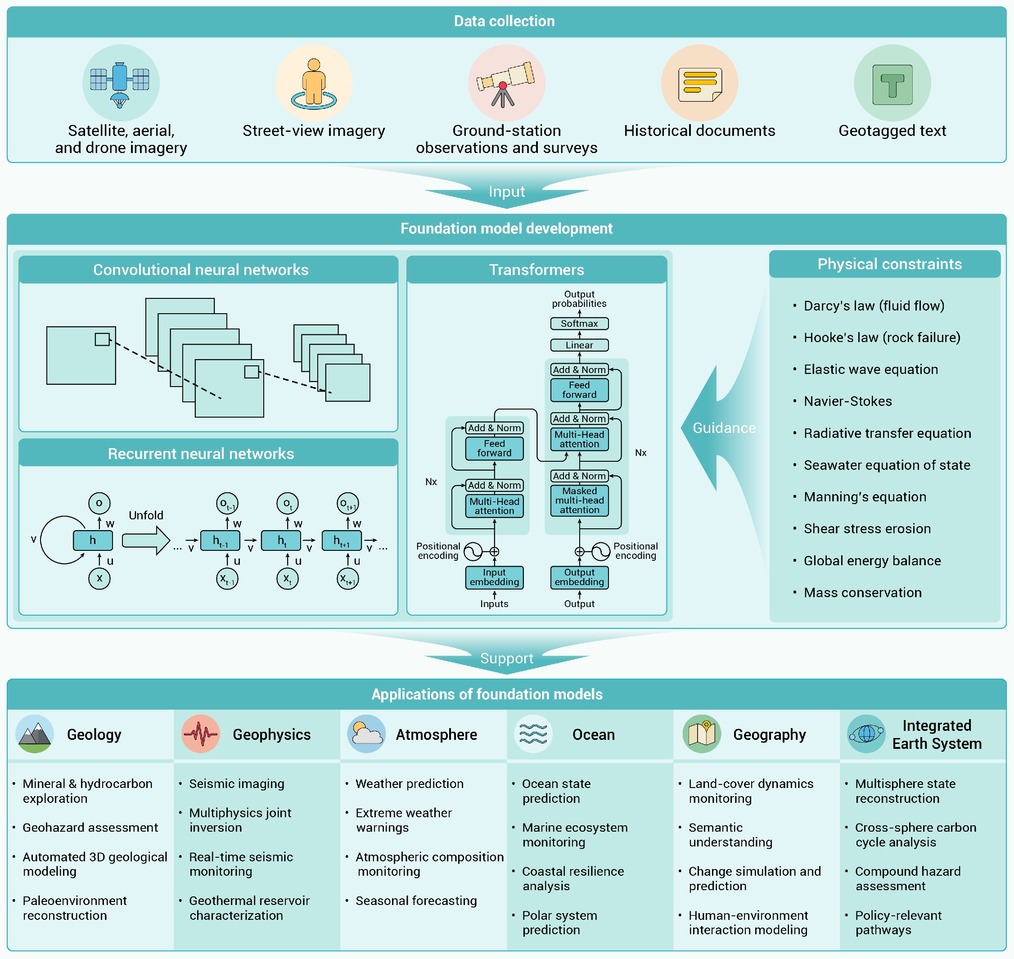
Figure 1.
Applications of foundation models in ESS
