
Functionalized flash graphene membrane with turbostratic stacking enables ultrafast water purification
-
GRAPHICAL ABSTRACT
 DownLoad:
Full size image
-
PUBLIC SUMMARY
-
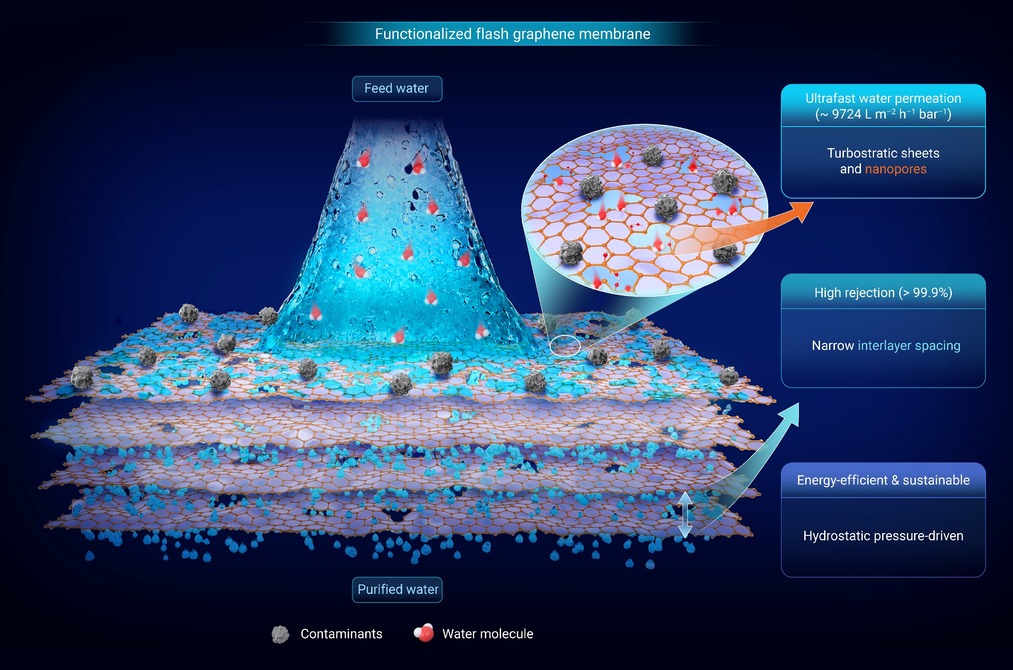
Functionalized flash graphene membrane with turbostratic sheets and nanopores enables fast water transport.
Narrow interlayer spacing of the membrane ensures the efficient rejection (> 99.9%) of various contaminants.
Scalable, energy-efficient fabrication suitable for household and on-site water purification.
-
-
ABSTRACT
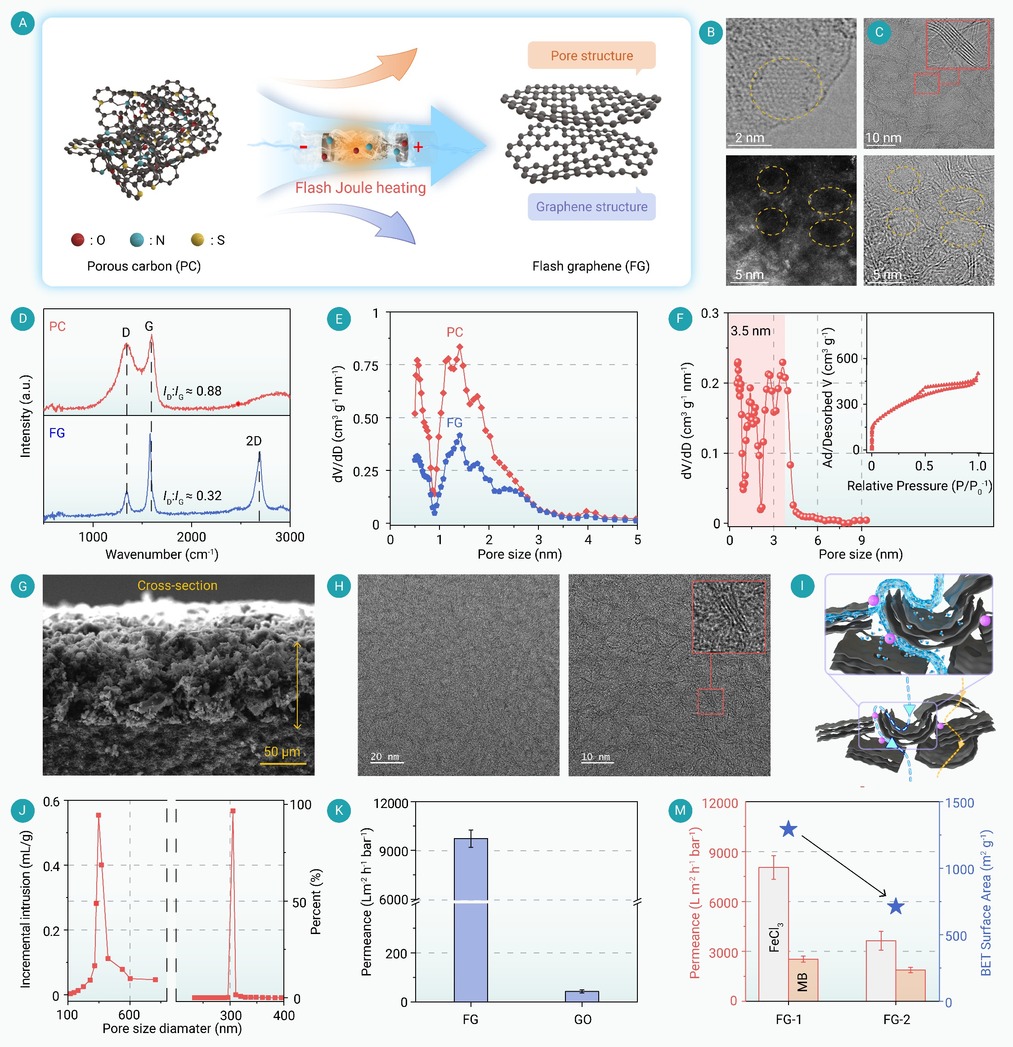
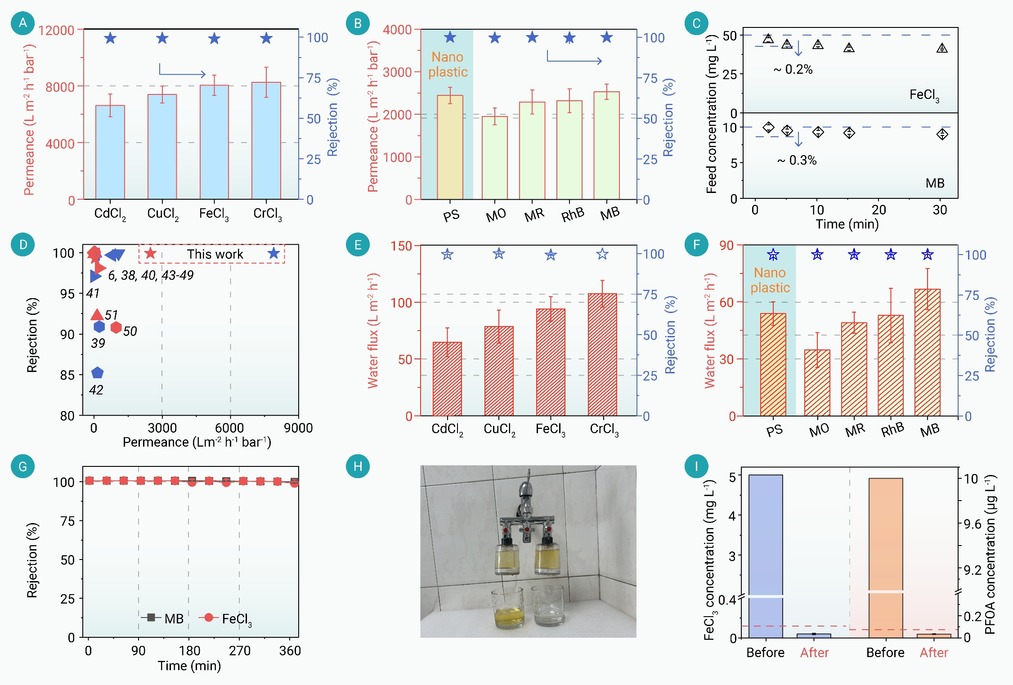
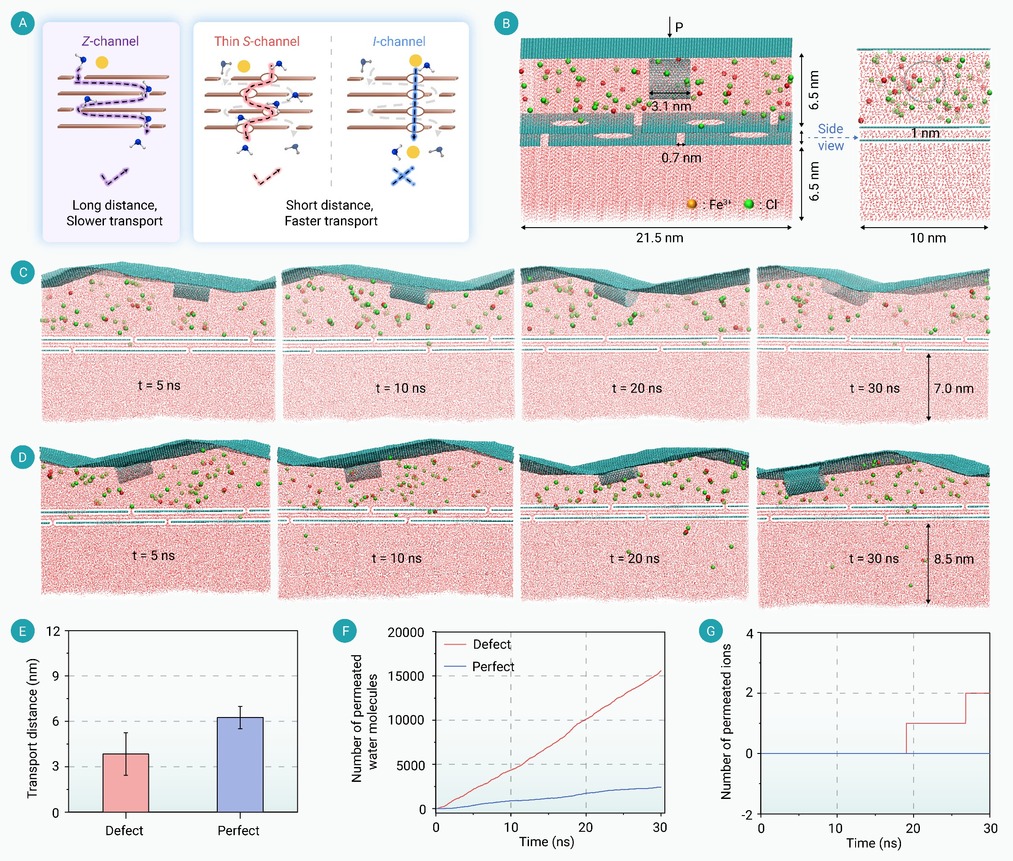
Currently, the potentially high permeability of graphene oxide (GO) membranes is fundamentally limited by their long and tortuous diffusion channels (Z-channels). To address this dilemma, we introduced a continuous flash Joule heating method to synthesize functionalized flash graphene (FFG) membranes with turbostratically stacked sheets that formed interconnected water transport channels. Meanwhile, the combination of misaligned nanopores within the sheets and the narrow interlayer spacing generated numerous thin S-channels, which also accelerated water transport. Thus, the FFG membrane can easily achieve a water permeance (~9724 L m–2 h–1 bar–1) that was two orders of magnitude higher than that of conventional GO membranes. The trajectories of water molecules were tracked by molecular dynamics, confirming that the formed misaligned nanopores significantly shorten the transport distance of water molecules. Importantly, this membrane exhibited efficient rejection (> 99.9%) of various heavy metal ions, organic molecules, and nano-plastics due to its narrow interlayer spacing. Overall, this work facilitates the scalability and economy of FFG membrane fabrication, expanding the demand for on-site and household water purification in the entire membrane field. -

-
REFERENCES
[1] Chen C., Chen J., Peng Y., et al. (2024). Multifunctional coatings of graphene oxide: New membranes for proton permeation and salt rejection. Matter 7:1259−1274. DOI:10.1016/j.matt.2024.01.014 [2] Chen L., Shi G., Shen J., et al. (2017). Ion sieving in graphene oxide membranes via cationic control of interlayer spacing. Nature 550:380−383. DOI:10.1038/nature24044 [3] Kang J., Ko Y., Kim J. P., et al. (2023). Microwave-assisted design of nanoporous graphene membrane for ultrafast and switchable organic solvent nanofiltration. Nat. Commun. 14:901. DOI:10.1038/s41467-023-36524-x [4] Surwade S. P., Smirnov S. N., Vlassiouk I. V., et al. (2015). Water desalination using nanoporous single-layer graphene. Nat. Nanotechnol. 10:459−464. DOI:10.1038/nnano.2015.37 [5] Yang Y., Yang X., Liang L., et al. (2019). Large-area graphene-nanomesh/carbon-nanotube hybrid membranes for ionic and molecular nanofiltration. Science 364:1057−1062. DOI:10.1126/science.aau5321 [6] Zhang W. H., Yin M. J., Zhao Q., et al. (2021). Graphene oxide membranes with stable porous structure for ultrafast water transport. Nat. Nanotechnol. 16:337−343. DOI:10.1038/s41565-020-00833-9 [7] Liu H., Wang H. and Zhang X. (2015). Facile fabrication of freestanding ultrathin reduced graphene oxide membranes for water purification. Adv. Mater. 27:249−254. DOI:10.1002/adma.201404054 [8] Joshi R. K., Carbone P., Wang F. C., et al. (2014). Precise and ultrafast molecular sieving through graphene oxide membranes. Science 343:752−754. DOI:10.1126/science.1245711 [9] Zhu Z., Song M., Qu F., et al. (2024). Engineering multinanochannel polymer-intercalated graphene oxide membrane for strict volatile sieving in membrane distillation. Environ. Sci. Technol. 58:1399−1409. DOI:10.1021/acs.est.3c08452 [10] Dong Y., Lyu Q., Lin L. C., et al. (2024). Ultrastable ceramic-based metal–organic framework membranes with missing linkers for robust desalination. Nat. Water 2:464−474. DOI:10.1038/s44221-024-00218-5 [11] Ren Y., Chong B., Xu W., et al. (2022). Coordination-driven structure reconstruction in polymer of intrinsic microporosity membranes for efficient propylene/propane separation. The Innovation 3. DOI:10.1016/j.xinn.2022.100334. [12] Mi B. (2019). Scaling up nanoporous graphene membranes. Science 364:1033−1034. DOI:10.1126/science.aax3103 [13] Huang H., Shi H., Das P., et al. (2020). The chemistry and promising applications of graphene and porous graphene materials. Adv. Funct. Mater. 30:1909035. DOI:10.1002/adfm.201909035 [14] Zhang Z., Simon A., Abetz C., et al. (2021). Hybrid organic–inorganic–organic isoporous membranes with tunable pore sizes and functionalities for molecular separation. Adv. Mater. 33:2105251. DOI:10.1002/adma.202105251 [15] Warkiani M. E., Bhagat A. A. S., Khoo B. L., et al. (2013). Isoporous micro/nanoengineered membranes. ACS Nano 7:1882−1904. DOI:10.1021/nn305616k [16] Fane A. G., Wang R. and Hu M. X. (2015). Synthetic membranes for water purification: Status and future. Angew. Chem. Int. Ed. 54:3368−3386. DOI:10.1002/anie.201409783 [17] Lin Y., Liao Y., Chen Z., et al. (2017). Holey graphene: A unique structural derivative of graphene. Mater. Res. Lett. 5:209−234. DOI:10.1080/21663831.2016.1271047 [18] Kang J., Choi Y., Kim J. H., et al. (2021). Functionalized nanoporous graphene membrane with ultrafast and stable nanofiltration. J. Membr. Sci. 618:118635. DOI:10.1016/j.memsci.2020.118635 [19] Yuan B., Wang M., Wang B., et al. (2020). Cross-linked graphene oxide framework membranes with robust nano-channels for enhanced sieving ability. Environ. Sci. Technol. 54:15442−15453. DOI:10.1021/acs.est.0c05387 [20] Seo D. H., Pineda S., Woo Y. C., et al. (2018). Anti-fouling graphene-based membranes for effective water desalination. Nat. Commun. 9:683. DOI:10.1038/s41467-018-02871-3 [21] Sun M. and Li J. (2018). Graphene oxide membranes: Functional structures, preparation and environmental applications. Nano Today 20:121−137. DOI:10.1016/j.nantod.2018.04.007 [22] Cheng C., Jiang G., Garvey C. J., et al. (2016). Ion transport in complex layered graphene-based membranes with tuneable interlayer spacing. Sci. Adv. 2:e1501272. DOI:10.1126/sciadv.1501272 [23] Gao F., Chen W., Eatman J. G., et al. (2024). Pushing the limits of size selectivity in nanoscale solute separations. Nat. Water 2:521−530. DOI:10.1038/s44221-024-00252-3 [24] Liu G., Jin W. and Xu N. (2015). Graphene-based membranes. Chem. Soc. Rev. 44:5016−5030. DOI:10.1039/C4CS00423J [25] Yang L., Xiao X., Shen S., et al. (2022). Recent advances in graphene oxide membranes for nanofiltration. ACS Appl. Nano Mater. 5:3121−3145. DOI:10.1021/acsanm.1c04469 [26] Huang J., Zhang Y., Guo J., et al. (2024). Polymeric membranes with highly homogenized nanopores for ultrafast water purification. Nat. Sustain. 7:901−909. DOI:10.1038/s41893-024-01371-1 [27] Luong D. X., Bets K. V., Algozeeb W. A., et al. (2020). Gram-scale bottom-up flash graphene synthesis. Nature 577:647−651. DOI:10.1038/s41586-020-1938-0 [28] Jia C., Pang M., Lu Y., et al. (2022). Graphene environmental footprint greatly reduced when derived from biomass waste via flash Joule heating. One Earth 5:1394−1403. DOI:10.1016/j.oneear.2022.11.006 [29] Zhu X., Lin L., Pang M., et al. (2024). Continuous and low-carbon production of biomass flash graphene. Nat. Commun. 15:3218. DOI:10.1038/s41467-024-47603-y [30] Phillips J. C., Braun R., Wang W., et al. (2005). Scalable molecular dynamics with NAMD. J. Comput. Chem. 26:1781−1802. DOI:10.1002/jcc.20289 [31] Geng H., Liu X., Shi G., et al. (2017). Graphene oxide restricts growth and recrystallization of ice crystals. Angew. Chem. Int. Ed. 56:997−1001. DOI:10.1002/anie.201609230 [32] Liu X., Geng H., Sheng N., et al. (2020). Suppressing ice growth by integrating the dual characteristics of antifreeze proteins into biomimetic two-dimensional graphene derivatives. J. Mater. Chem. A 8:23555−23562. DOI:10.1039/D0TA06421A [33] Tu Y., Lv M., Xiu P., et al. (2013). Destructive extraction of phospholipids from Escherichia coli membranes by graphene nanosheets. Nat. Nanotechnol. 8:594−601. DOI:10.1038/nnano.2013.125 [34] Jorgensen W. L., Chandrasekhar J., Madura J. D., et al. (1983). Comparison of simple potential functions for simulating liquid water. J. Chem. Phys. 79:926−935. DOI:10.1063/1.445869 [35] MacKerell A. D., Jr., Bashford D., Bellott M., et al. (1998). All-atom empirical potential for molecular modeling and dynamics studies of proteins. J. Phys. Chem. B 102:3586−3616. DOI:10.1021/jp973084f [36] Essmann U., Perera L., Berkowitz M. L., et al. (1995). A smooth particle mesh Ewald method. J. Chem. Phys. 103:8577−8593. DOI:10.1063/1.470117 [37] Yan L., Chen J., Zhang Z., et al. (2025). Reduced graphene oxide membrane with small nanosheets for efficient and ultrafast removal of both microplastics and small molecules. J. Hazard. Mater. 487:137078. DOI:10.1016/j.jhazmat.2024.137078 [38] Aba N. D., Chong J. Y., Wang B., et al. (2015). Graphene oxide membranes on ceramic hollow fibers – microstructural stability and nanofiltration performance. J. Membr. Sci. 484:87−94. DOI:10.1016/j.memsci.2015.03.001 [39] Kang Y., Hu T., Wang Y., et al. (2023). Nanoconfinement enabled non-covalently decorated MXene membranes for ion-sieving. Nat. Commun. 14:4075. DOI:10.1038/s41467-023-39533-y [40] Wu T., Wang Z., Lu Y., et al. (2021). Graphene oxide membranes for tunable ion sieving in acidic radioactive waste. Adv. Sci. 8:2002717. DOI:10.1002/advs.202002717 [41] Mahmoud K. A., Mansoor B., Mansour A., et al. (2015). Functional graphene nanosheets: The next generation membranes for water desalination. Desalination 356:208−225. DOI:10.1016/j.desal.2014.10.022 [42] Mi B. (2014). Graphene oxide membranes for ionic and molecular sieving. Science 343:740−742. DOI:10.1126/science.1250247 [43] Jian L., Qiu Y., Zhang Z., et al. (2025). Reduced graphene oxide membrane with wrinkled surfaces for ultrafast and stable microplastics removal. J. Environ. Chem. Eng. 13:120454. DOI:10.1016/j.jece.2025.120454 [44] Sun J., Xiong Y., Jia H., et al. (2024). Superb microplastics separation performance of graphene oxide tuned by laser bombardment. J. Hazard. Mater. 461:132599. DOI:10.1016/j.jhazmat.2023.132599 [45] Cohen-Tanugi D. and Grossman J. C. (2015). Nanoporous graphene as a reverse osmosis membrane: Recent insights from theory and simulation. Desalination 366:59−70. DOI:10.1016/j.desal.2014.12.046 [46] Zhang M., Guan K., Ji Y., et al. (2019). Controllable ion transport by surface-charged graphene oxide membrane. Nat. Commun. 10:1253. DOI:10.1038/s41467-019-09286-8 [47] Yang T., Lin H., Loh K. P., et al. (2019). Fundamental transport mechanisms and advancements of graphene oxide membranes for molecular separation. Chem. Mater. 31:1829−1846. DOI:10.1021/acs.chemmater.8b03820 [48] Yang R., Fan Y., Yu R., et al. (2021). Robust reduced graphene oxide membranes with high water permeance enhanced by K+ modification. J. Membr. Sci. 635:119437. DOI:10.1016/j.memsci.2021.119437 [49] Liu J., Wang S., Yang R., et al. (2022). Bio-inspired graphene oxide-amino acid cross-linked framework membrane trigger high water permeance and high metal ions rejection. J. Membr. Sci. 659:120745. DOI:10.1016/j.memsci.2022.120745 [50] Dai F., Zhou F., Chen J., et al. (2021). Ultrahigh water permeation with a high multivalent metal ion rejection rate through graphene oxide membranes. J. Mater. Chem. A 9:10672−10677. DOI:10.1039/D1TA00647A [51] Wang Z., Wei Y. M., Xu Z. L., et al. (2016). Preparation, characterization and solvent resistance of γ-Al2O3/α-Al2O3 inorganic hollow fiber nanofiltration membrane. J. Membr. Sci. 503:69−80. DOI:10.1016/j.memsci.2015.12.039 [52] Yi R., Xia X., Yang R., et al. (2021). Selective reduction of epoxy groups in graphene oxide membrane for ultrahigh water permeation. Carbon 172:228−235. DOI:10.1016/j.carbon.2020.09.076 [53] Yang Q., Su Y., Chi C., et al. (2017). Ultrathin graphene-based membrane with precise molecular sieving and ultrafast solvent permeation. Nat. Mater. 16:1198−1202. DOI:10.1038/nmat5025 [54] Liu T., Zhang Y., Shan Z., et al. (2023). Covalent organic framework membrane for efficient removal of emerging trace organic contaminants from water. Nat. Water 1:1059−1067. DOI:10.1038/s44221-023-00162-w [55] Zhang W., Xu H., Xie F., et al. (2022). General synthesis of ultrafine metal oxide/reduced graphene oxide nanocomposites for ultrahigh-flux nanofiltration membrane. Nat. Commun. 13:471. DOI:10.1038/s41467-022-28180-4 [56] Akbari A., Sheath P., Martin S. T., et al. (2016). Large-area graphene-based nanofiltration membranes by shear alignment of discotic nematic liquid crystals of graphene oxide. Nat. Commun. 7:10891. DOI:10.1038/ncomms10891 [57] Liu W., Li Y., Xu L., et al. (2022). Biomimic heterostructured graphene oxide membranes via supramolecular-mediated intercalation assembly for efficient water transport. Small 18:2200461. DOI:10.1002/smll.202200461 [58] Han C., Jiang J., Mu L., et al. (2025). Quasi-vertically asymmetric channels of graphene oxide membrane for ultrafast ion sieving. Nat. Commun. 16:1020. DOI:10.1038/s41467-025-56358-z [59] Dai F., Gu Z., Hu S., et al. (2024). Unexpected self-assembly of nanographene oxide membranes upon electron beam irradiation for ultrafast ion sieving. Adv. Sci. 11:2404001. DOI:10.1002/advs.202404001 [60] Liu H., Mu M., Graham N. J. D., et al. (2024). Alkaline-oxidized MXene composite membrane of ultra high flux and advanced rejection performance for water purification. J. Membr. Sci. 698:122604. DOI:10.1016/j.memsci.2024.122604 [61] Li Y., Luo H., Ji W., et al. (2023). Visible-light-driven photocatalytic ZnO@Ti3C2Tx MXene nanofiltration membranes for enhanced organic dyes removal. Sep. Purif. Technol. 323:124420. DOI:10.1016/j.seppur.2023.124420 -
ABOUT THIS ARTICLE
Cite this article:
Jia C., Chen J., Liu X., et al. (2026). Functionalized flash graphene membrane with turbostratic stacking enables ultrafast water purification. The Innovation Materials 4:100244. https://doi.org/10.59717/j.xinn-mater.2026.100244
Welcome!
To request copyright permission to republish or share portions of our works, please visit Copyright Clearance Center's (CCC) Marketplace website at marketplace.copyright.com.
Export File
Citation
Jia C., Chen J., Liu X., et al. (2026). Functionalized flash graphene membrane with turbostratic stacking enables ultrafast water purification. The Innovation Materials 4:100244. https://doi.org/10.59717/j.xinn-mater.2026.100244

Format
Content
-
Figure 1.
Thin S-channels constructed from nanopores in a functionalized flash graphene (FFG) membrane
-
Figure 2.
Separation performance of PC-1 sample-derived FFG membranes
-
Figure 3.
Theoretical guidance for the synthesis of FFG membranes with S-channels
-
Figure 4.
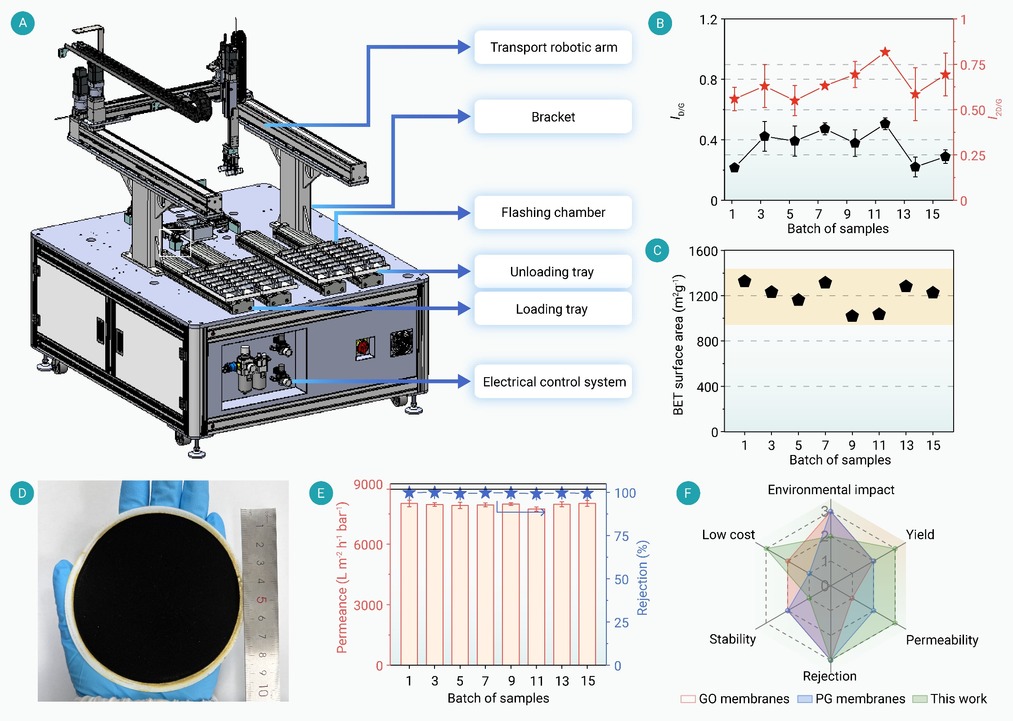
Continuous large-scale synthesis of FFG membranes for water purification
