
Synergistic Yb/Mg dual-doping strategy for tabilizing the structure of high-voltage LiCoO2
-
GRAPHICAL ABSTRACT
 DownLoad:
Full size image
-
PUBLIC SUMMARY
-
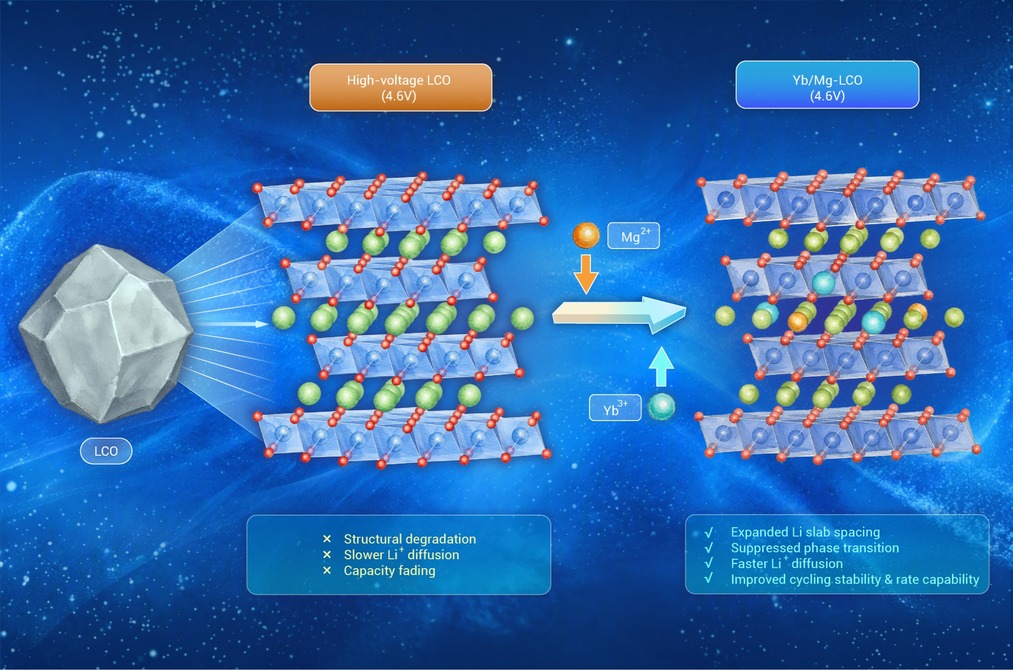
High-voltage lithium cobalt oxide (LCO) suffers from structural degradation and rapid capacity fading.
Ytterbium (Yb) and magnesium (Mg) co-doping improves the structural stability and lithium-ion transport of LCO.
The co-doped LCO exhibits improved cycling stability and rate capability under high-voltage operation.
-
-
ABSTRACT
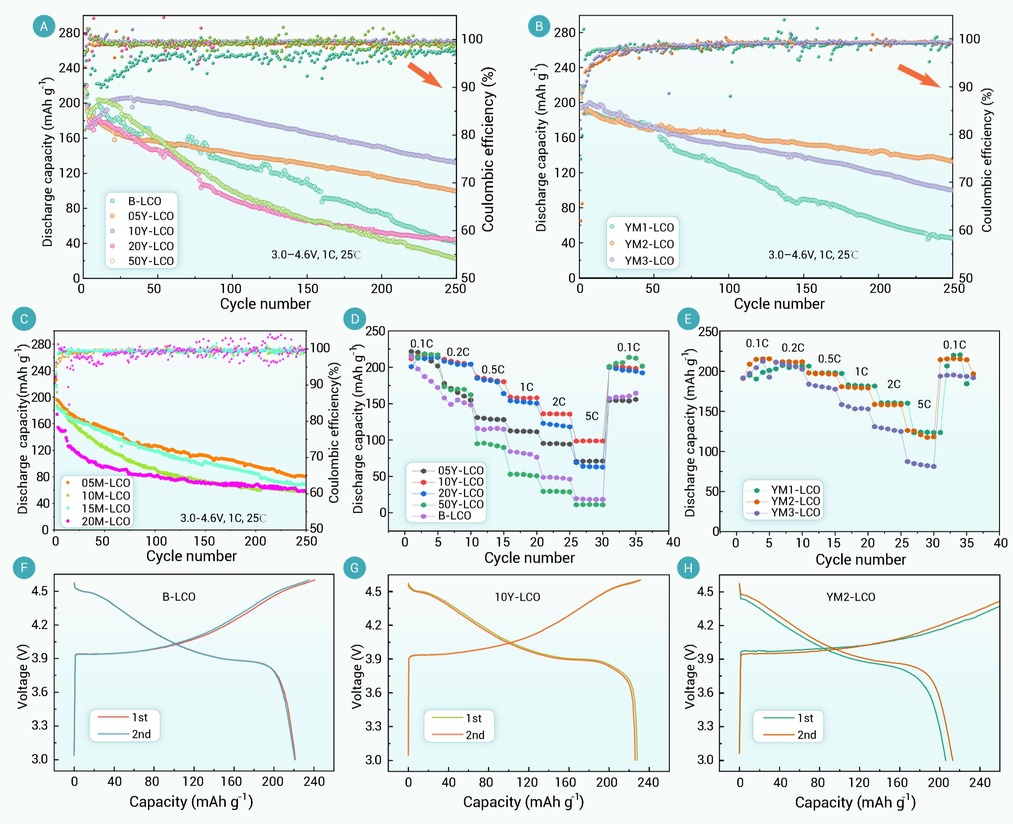
Elevating the charging cutoff voltage of lithium cobalt oxide (LiCoO2, LCO) beyond 4.5 V is the most direct approach to unlock its high theoretical capacity, yet it triggers detrimental phase transitions and rapid capacity degradation. To address this challenge, a synergistic doping strategy via ytterbium (Yb) and magnesium (Mg) is proposed to enhance the structural stability of LCO under high-voltage operation. A series of Yb doping and Yb/Mg doping LCO materials are synthesized via a conventional solid-state method. Comprehensive characterizations confirm that the larger-radius Yb3+ ions are successfully incorporated into the lattice, effectively expanding the Li slab spacing and enhancing thermal stability. Electrochemical evaluations reveal that an optimal Yb doping sample (10Y-LCO) delivers an improved capacity retention of 132 mAh g−1 after 250 cycles at 1 C, compared to 44.6 mAh g−1 for pristine LCO. Remarkably, the Yb/Mg doping sample (YM2-LCO) exhibits superior comprehensive performance, achieving a high reversible capacity, enhanced cycling stability, and excellent rate capability (126.1 mAh g−1 at 5 C). Mechanism studies through dQ/dV analysis and electrochemical impedance spectroscopy demonstrate that the doping effectively suppresses polarization growth and phase transition, while galvanostatic intermittent titration technique (GITT) results indicate a significantly enhanced lithium-ion diffusion coefficient. This work presents an effective doping protocol for developing high-voltage LCO cathodes with balanced stability and kinetics, offering valuable insights for the design of advanced layered oxide cathode materials.-
Keywords:
- LiCoO2 /
- High-voltage cathode /
- Structural stabilization /
- Ion doping
-

-
REFERENCES
[1] Zheng M., You Y. and Lu J. (2025). Understanding materials failure mechanisms for the optimization of lithium-ion battery recycling. Nat. Rev. Mater. 10:355−368. DOI:10.1038/s41578-025-00783-5 [2] Wu B., Chang Z., Chen Z., et al. (2025). Understanding degradation and enhancing cycling stability for high-voltage LiCoO2-based Li-metal batteries. Adv. Energy Mater. 15:2404028. DOI:10.1002/aenm.202404028 [3] Fu A., Zhang Z., Lin J., et al. (2022). Highly stable operation of LiCoO2 at cut-off >= 4.6 V enabled by synergistic structural and interfacial manipulation. Energy Storage Mater. 46:406-416. DOI:10.1016/j.ensm.2022.01.033 [4] Wang X., Wu Q., Li S., et al. (2021). Lithium-aluminum-phosphate coating enables stable 4.6 V cycling performance of LiCoO2 at room temperature and beyond. Energy Storage Mater. 37:67-76. DOI:10.1016/j.ensm.2021.01.031 [5] Zhu Y., Wu D., Yang X., et al. (2023). Microscopic investigation of crack and strain of LiCoO2 cathode cycled under high voltage. Energy Storage Mater. 60:102828. DOI:10.1016/j.ensm.2023.102828 [6] Konar R., Maiti S., Shpigel N., et al. (2023). Reviewing failure mechanisms and modification strategies in stabilizing high-voltage LiCoO2 cathodes beyond 4.55 V. Energy Storage Mater. 63:103001. DOI:10.1016/j.ensm.2023.103001 [7] Zhang J., Wong D., Zhang Q., et al. (2023). Reducing Co/O band overlap through spin state modulation for stabilized high capability of 4.6 V LiCoO2. J. Am. Chem. Soc. 145:10208-10219. DOI:10.1021/jacs.3c01128 [8] Harika V., Penki T., Fan T., et al. (2025). Stable LCO cathodes charged at 4.6 V for high energy secondary Li-ion batteries by one-pot dual metal fluorides coating. Adv. Energy Mater. 15:2402794. DOI:10.1002/aenm.202402794 [9] Li J., Lin C., Weng M., et al. (2021). Structural origin of the high-voltage instability of lithium cobalt oxide. Nat. Nanotechnol. 16:599−605. DOI:10.1038/s41565-021-00855-x [10] Wang L., Chen B., Ma J., et al. (2018). Reviving lithium cobalt oxide-based lithium secondary batteries-toward a higher energy density. Chem. Soc. Rev. 47:6505−6602. DOI:10.1039/c8cs00322j [11] Jiao S., Li Y., Lin T., et al. (2025). Achieving high-performance defect-free LiCoO2 cathode via a dopant-free approach. J. Am. Chem. Soc. 147:22839−22850. DOI:10.1021/jacs.5c05162 [12] Zhang Z., Du P., Liu J., et al. (2025). Mechanisms of enhanced electrochemical performance by chemical short-range disorder in lithium oxide cathodes. ACS Nano 19:6554−6562. DOI:10.1021/acsnano.4c17907 [13] Zhang W., Zhang X., Cheng F., et al. (2023). Enabling stable 4.6 V LiCoO2 cathode through oxygen charge regulation strategy. J. Energy Chem. 76:557-565. DOI:10.1016/j.jechem.2022.09.034 [14] Wang Q., Yao Z., Wang J., et al. (2024). Chemical short-range disorder in lithium oxide cathodes. Nature 629:341−347. DOI:10.1038/s41586-024-07362-8 [15] Sun C., Liao X., Xia F., et al. (2020). High-voltage cycling induced thermal vulnerability in LiCoO2 cathode: Cation loss and oxygen release driven by oxygen vacancy migration. ACS Nano 14:6181−6190. DOI:10.1021/acsnano.0c02237 [16] Wu Z., Zeng G., Yin J., et al. (2023). Unveiling the evolution of LiCoO2 beyond 4.6 V. ACS Energy Lett. 8:4806-4817. DOI:10.1021/acsenergylett.3c01954 [17] Yu X. and Manthiram A. (2018). Electrode-electrolyte interfaces in lithium-based batteries. Energy Environ. Sci. 11:527−543. DOI:10.1039/C7EE02555F [18] Lin C., Li J., Yin Z., et al. (2024). Structural understanding for high-voltage stabilization of lithium cobalt oxide. Adv. Mater. 36:2307404. DOI:10.1002/adma.202307404 [19] Chen J., Chen H., Zhang S., et al. (2022). Structure/interface coupling effect for high-voltage LiCoO2 cathodes. Adv. Mater. 34:2204845. DOI:10.1002/adma.202204845 [20] Kong W., Zhou D., Zhang Q., et al. (2023). Adjusting the redox coupling effect via Li/Co anti-site defect for stable high-voltage LiCoO2 cathode. Adv. Funct. Mater. 33:2211033. DOI:10.1002/adfm.202211033 [21] Park S., Seok J., Lee W. et al., (2025). Structural stabilization of 4.6 V LiCoO2 through tri-site Co-doping with Al-Mg-F. Small 21:2409892. DOI:10.1002/smll.202409892 [22] Qu J., Wang B., Li J., et al. (2025). Separating Li-ion and electron conduction pathways to realize robust cathode interfaces. J. Mater. Chem. A 13:28508−28520. DOI:10.1039/d5ta04002g [23] Luo D., Cui J., Zhang B., et al. (2021). Ti-based surface integrated layer and bulk doping for stable voltage and long life of Li-rich layered cathodes. Adv. Funct. Mater. 31:2009310. DOI:10.1002/adfm.202009310 [24] Hong Y., Huang X., Wei C., et al. (2020). Hierarchical defect engineering for LiCoO2 through low-solubility trace element doping. Chem 6:2759−2769. DOI:10.1016/j.chempr.2020.07.017 [25] Liu T., Yan Z., Xin W., et al. (2025). Short-time and high-performance recovery of critical metal elements from spent ternary lithium-ion batteries by selective synergic coordination effect. Adv. Funct. Mater. 35:2417883. DOI:10.1002/adfm.202417883 [26] Zhou J., Liu Y., Peng Z., et al. (2024). Unveiling the tailorable electrochemical properties of zeolitic imidazolate framework-derived Ni-doped LiCoO2 for lithium-ion batteries in half/full cells. J. Energy Chem. 93:229−242. DOI:10.1016/j.jechem.2024.02.005 [27] Wang Z., Li L., Sun Z., et al. (2024). Advances and perspectives in understanding the structure-redox relationship of layered Li-Co-Ni-Mn oxide cathode materials. Prog. Mater. Sci. 143:101247. DOI:10.1016/j.pmatsci.2024.101247 [28] Zhang Z., Wang J., Sun X., et al. (2024). Improved stability of single-crystal LiCoO2 cathodes at 4.8 V through solvation structure regulation. Adv. Funct. Mater. 34:2411409. DOI:10.1002/adfm.202411409 [29] Huang Y., Zhu Y., Fu H., et al. (2021). Mg-pillared LiCoO2: towards stable cycling at 4.6 V. Angew. Chem. Int. Ed. 60:4682-4688. DOI:10.1002/anie.202014226 [30] Wan J., Zhu J., Xiang Y., et al. (2021). Revealing the correlation between structure evolution and electrochemical performance of high-voltage lithium cobalt oxide. J. Energy Chem. 54:786−794. DOI:10.1016/j.jechem.2020.06.027 [31] Tang Y., Zhao J., Zhu H., et al. (2023). Towards extreme fast charging of 4.6 V LiCoO2 via mitigating high-voltage kinetic hindrance. J. Energy Chem. 78:13-20. DOI:10.1016/j.jechem.2022.11.044 [32] Xia J., Zhang N., Yang Y., et al. (2023). Lanthanide contraction builds better high-voltage LiCoO2 batteries. Adv. Funct. Mater. 33:2212869. DOI:10.1002/adfm.202212869 [33] Xia J., Zhang N., Yi D., et al. (2024). Stabilizing 4.6 V LiCoO2 via Er and Mg trace doping at Li-site and Co-site respectively. Small 20:2311578. DOI:10.1002/smll.202311578 [34] Sun W., Yang J., Shi W., et al. (2024). A dual-Functional synergetic strategy enhances the interfacial and structural stability of LiCoO2 at high voltage. ACS Appl. Energy Mater. 7:6585−6597. DOI:10.1021/acsaem.4c01228 [35] Ding X., Shi Y., Xu K., et al. (2025). A modification strategy for 4.6V LiCoO2: Uniform nano-coating and multi-level structure via high-temperature calcination. J. Power Sources 660:238477. DOI:10.1016/j.jpowsour.2025.238477. [36] Xia Y., Feng J., Li J., et al. (2024). Selective core-shell doping enabling high performance 4.6 V-LiCoO2. J. Energy Chem. 95:684-693. DOI:10.1016/j.jechem.2024.04.004 [37] Li X., Zhu X., Zhang Y., et al. (2025). Ternary inert element Co-doping: A new approach to stable 4.7 V LiCoO2. Adv. Mater. 37:2506228. DOI:10.1002/adma.202506228 [38] Kresse G. and Furthmüller J. (1996). Efficient iterative schemes for ab initio total-energy calculations using a plane-wave basis set. Phys. Rev. B 54:11169−11186. DOI:10.1103/PhysRevB.54.11169 [39] Kresse G. and Furthmüller J. (1996). Efficiency of ab-initio total energy calculations for metals and semiconductors using a plane-wave basis set. Comput. Mater. Sci. 6:15−50. DOI:10.1016/0927-0256(96)00008-0 [40] Blöchl P. E. (1994). Projector augmented-wave method. Phys. Rev. B 50:17953−17979. DOI:10.1103/PhysRevB.50.17953 [41] Kresse G. and Joubert D. (1999). From ultrasoft pseudopotentials to the projector augmented-wave method. Phys. Rev. B 59:1758−1775. DOI:10.1103/PhysRevB.59.1758 [42] Perdew J. P., Burke K. and Ernzerhof M. (1996). Generalized gradient approximation made simple. Phys. Rev. Lett. 77:3865−3868. DOI:10.1103/PhysRevLett.77.3865 [43] Chase M. W. Jr. (1998). NIST-JANAF Thermochemical Tables. 4th ed. J. Phys. Chem. Ref. Data Monograph 9:1-1951. DOI:10.1063/1.555974. [44] Reuter K. and Scheffler M. (2001). Composition, structure, and stability of RuO2(110) as a function of oxygen pressure. Phys. Rev. B 65:035406. DOI:10.1103/PhysRevB.65.035406 [45] Shi W., Dong H., Yin J., et al. (2023). Synergetic effect of Ti-Mg-Sb tri-doping on enhanced electrochemical performance of LiCoO2 at 4.6 V. J. Alloys Compd. 966:171530. DOI:10.1016/j.jallcom.2023.171530 [46] Xu S., Tan X., Ding W., et al. (2023). Promoting surface electric conductivity for high-rate LiCoO2. Angew. Chem. Int. Ed. 62:e202218595. DOI:10.1002/anie.202218595 -
ABOUT THIS ARTICLE
Cite this article:
Wang J., Shi P., Zhou T., et al. (2026). Synergistic Yb/Mg dual-doping strategy for tabilizing the structure of high-voltage LiCoO2. The Innovation Materials 4:100253. https://doi.org/10.59717/j.xinn-mater.2026.100253
Welcome!
To request copyright permission to republish or share portions of our works, please visit Copyright Clearance Center's (CCC) Marketplace website at marketplace.copyright.com.
Export File
Citation
Wang J., Shi P., Zhou T., et al. (2026). Synergistic Yb/Mg dual-doping strategy for tabilizing the structure of high-voltage LiCoO2. The Innovation Materials 4:100253. https://doi.org/10.59717/j.xinn-mater.2026.100253

Format
Content
-
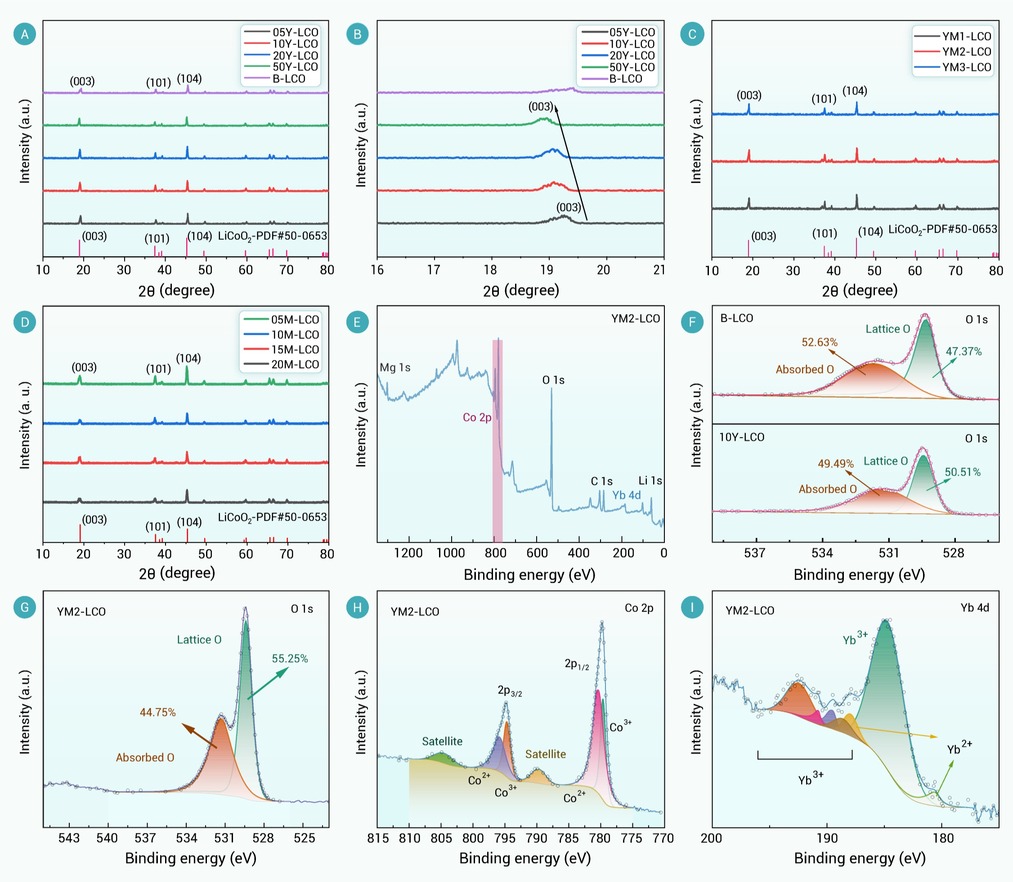
Figure 1.
Structural and chemical state analysis of the synthesized LCO samples
-
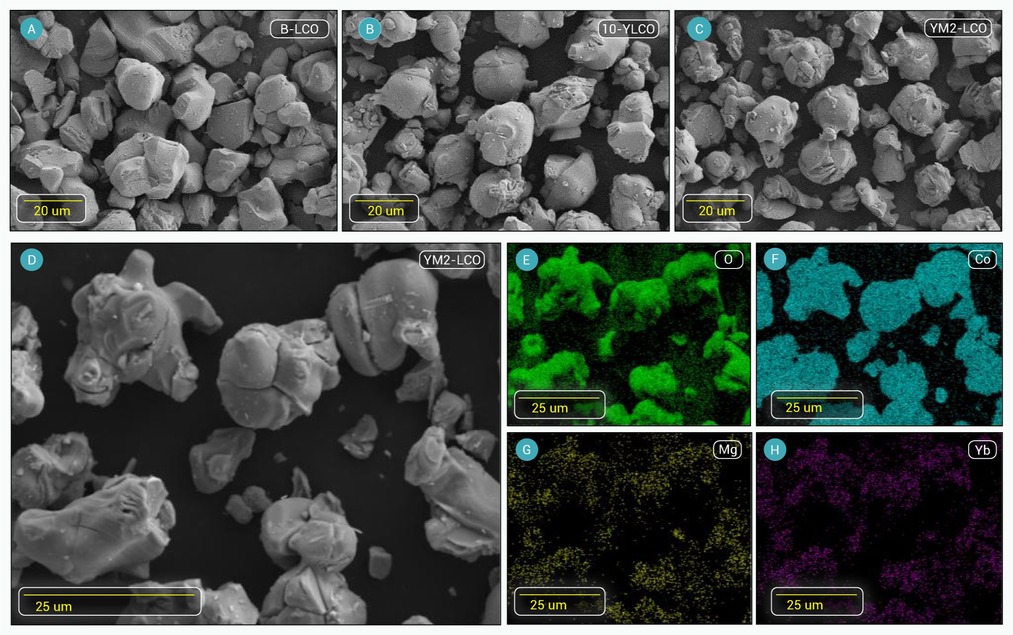
Figure 2.
Morphological and elemental distribution analysis
-
Figure 3.
Electrochemical performance comparison in a voltage window of 3.0–4.6 V (vs. Li+/Li)
-
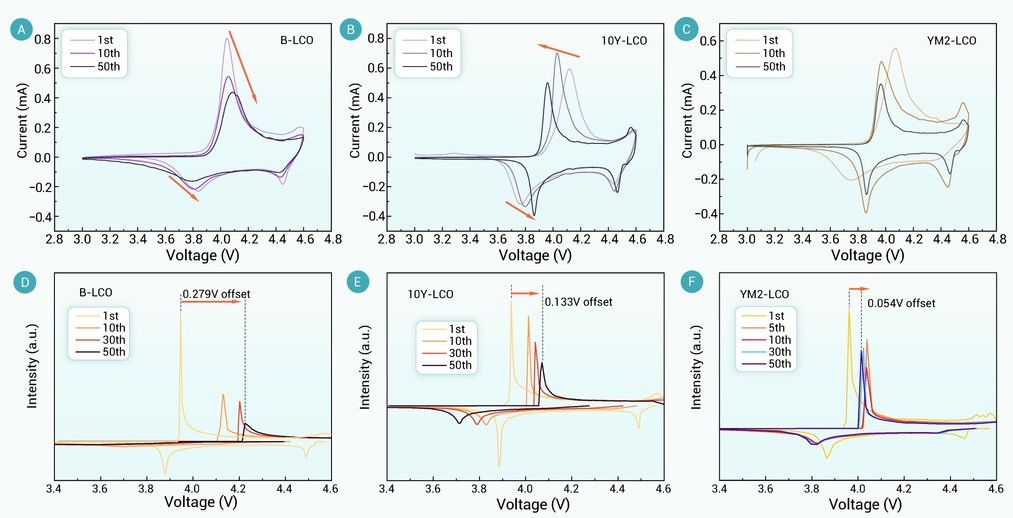
Figure 4.
Cyclic voltammetry and differential capacity analysis
-
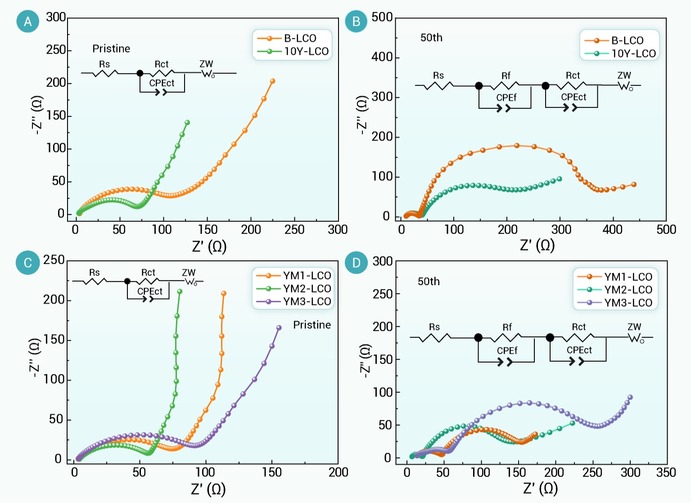
Figure 5.
Electrochemical impedance analysis
-
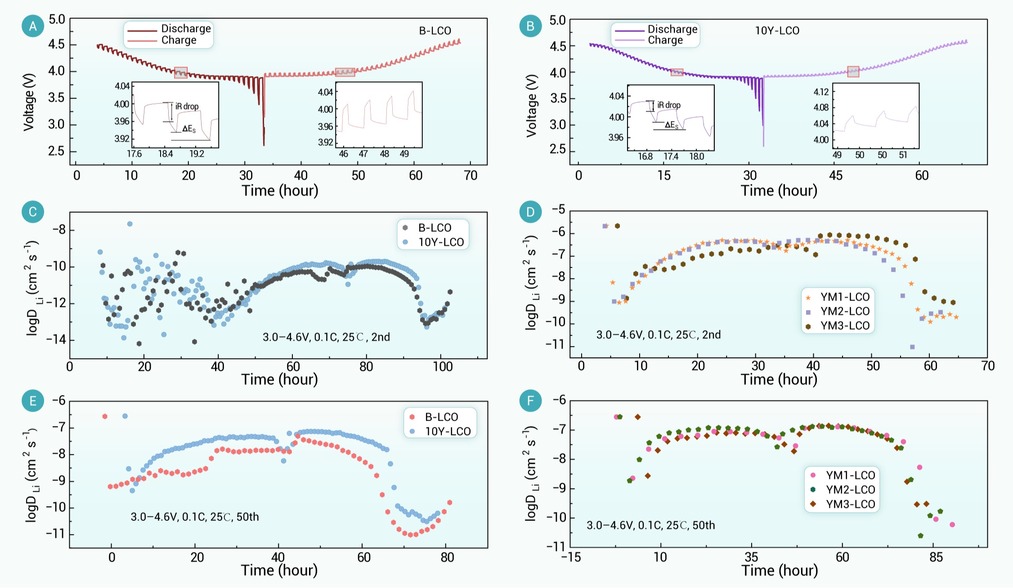
Figure 6.
Electrochemical kinetics analysis based on GITT
-
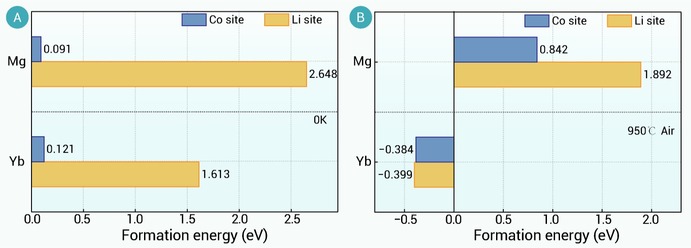
Figure 7.
Calculated formation energies of Yb and Mg substitution defects at Li and Co sites in LiCoO2 under different chemical potential conditions
