
Cold exposure and acute chest pain-related life-threatening cardiovascular diseases: A scientific statement
-
GRAPHICAL ABSTRACT
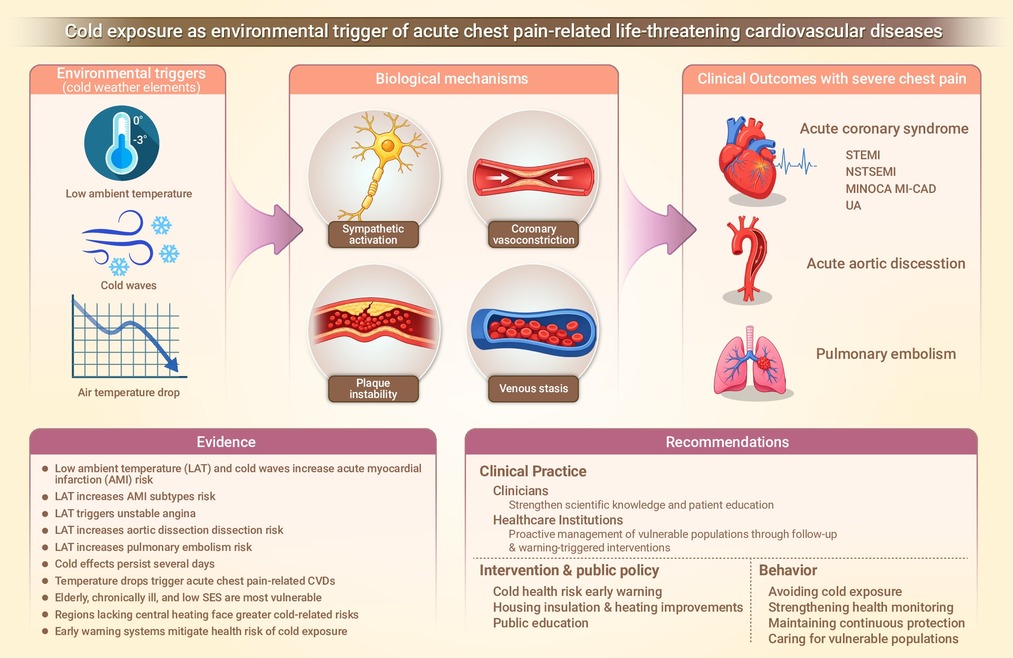
 DownLoad:
Full size image
DownLoad:
Full size image
-
PUBLIC SUMMARY
-
Cold exposure is a major but preventable trigger of acute life-threatening cardiovascular events.
Multidisciplinary evidence links cold exposure to coronary events, aortic dissection, and pulmonary embolism.
Older adults, chronically ill patients, and low-SES communities are especially vulnerable to cold exposure.
Integrated clinical, policy, and behavioral measures can reduce cold-related cardiovascular risks.
-
-
ABSTRACT
Climate change has amplified the variability and intensity of cold weather, contributing to a growing health burden. Cold exposure serves as a significant, yet preventable, environmental trigger for acute chest pain–related life-threatening cardiovascular diseases (CVDs), such as acute coronary syndrome, acute aortic dissection, and pulmonary embolism. This scientific statement synthesizes multidisciplinary evidence from meteorology, environmental epidemiology, basic science, and clinical research to offer an updated evaluation of the impact of cold exposure on these acute chest pain-related life-threatening CVDs. The evidence consistently demonstrates that cold weather significantly increases the incidence of such events, often with delayed effects lasting several days to weeks. Vulnerable groups, including the elderly, individuals with chronic conditions, and those of lower socioeconomic status, are particularly at risk. Data also suggest that interventions, including central heating, integrated health warning systems, and appropriate personal protective measures, can effectively mitigate the associated risks. Based on this evidence, the statement provides expert consensus recommendations across clinical, policy, and behavioral domains. Strengthening prevention and response to cold-related cardiovascular risks is essential for building climate-resilient health systems and mitigating the health impacts of climate change. -

-
REFERENCES
[1] Institute for Health Metrics and Evaluation (IHME) (2023). Global Burden of Disease Study 2021 (GBD 2021). [2] Gulati M., Levy P. D., Mukherjee D., et al. (2021). 2021 AHA/ACC/ASE/CHEST/SAEM/SCCT/SCMR guideline for the evaluation and diagnosis of chest pain: A report of the American college of cardiology/American heart association joint committee on clinical practice guidelines. J. Am. College Cardiol. 78:e187−e285. DOI:10.1016/j.jacc.2021.07.053 [3] Harskamp R. E., Laeven S. C., Himmelreich J. C. L., et al. (2019). Chest pain in general practice: A systematic review of prediction rules. BMJ Open 9:e027081. DOI:10.1136/bmjopen-2018-027081 [4] Eisen A., Giugliano R. P. and Braunwald E. (2016). Updates on acute coronary syndrome: A review. JAMA Cardiol. 1:718−730. DOI:10.1001/jamacardio.2016.2049 [5] Timmis A., Kazakiewicz D., Townsend N., et al. (2023). Global epidemiology of acute coronary syndromes. Nat. Rev. Cardiol. 20:778−788. DOI:10.1038/s41569-023-00884-0 [6] Liu K. and Qian D. (2024). Trends in mortality from acute myocardial infarction among urban and rural residents aged 15 – 79 years in China from 2006 to 2020: An age-period-cohort analysis (In Chinese). Chinese Journal of Public Health 40:681−685. DOI:10.11847/zgggws1143413 [7] Zhang Z., Lei J., Shao X., et al. (2019). Trends in hospitalization and in-hospital mortality from VTE, 2007 to 2016, in China. Chest 155:342−353. DOI:10.1016/j.chest.2018.10.040 [8] Cohen J., Agel L., Barlow M., et al. (2021). Linking Arctic variability and change with extreme winter weather in the United States. Science 373:1116−1121. DOI:10.1126/science.abi9167 [9] Zhang R., Screen J. A. and Zhang R. (2022). Arctic and Pacific Ocean conditions were favorable for cold extremes over Eurasia and North America during winter 2020/21. Bull. Amer. Meteor. Soc. 103:E2285−E2301. DOI:10.1175/BAMS-D-21-0264.1 [10] Gasparrini A., Guo Y., Hashizume M., et al. (2015). Mortality risk attributable to high and low ambient temperature: A multicountry observational study. Lancet 386:369−375. DOI:10.1016/S0140-6736(14)62114-0 [11] World Meteorological Organization. (2023). Guidelines on the Definition and Characterization of Extreme Weather and Climate Events. https://library.wmo.int/viewer/58396/download?file=1310_Guidelines_on_DEWCE_en.pdf&type=pdf&navigator=1 [12] Jiang Y., Yi S., Gao C., et al. (2023). Cold spells and the onset of acute myocardial infarction: A nationwide case-crossover study in 323 Chinese cities. Environ. Health Perspect. 131:087016. DOI:10.1289/EHP11841 [13] Ryti Niilo R. I., Guo Y. and Jaakkola Jouni J. K. (2016). Global association of cold spells and adverse health effects: A systematic review and meta-analysis. Environ. Health Perspect. 124:12−22. DOI:10.1289/ehp.1408104 [14] Ni W., Areal A. T., Lechner K., et al. (2025). Low and high air temperature and cardiovascular risk. Atherosclerosis 406:119238. DOI:10.1016/j.atherosclerosis.2025.119238 [15] Lei J., Chen R., Yin P., et al. (2022). Association between cold spells and mortality risk and burden: a nationwide study in China. Environ. Health Perspect. 130:027006. DOI:10.1289/EHP9284 [16] Liu Q., Fu C., Xu Z., et al. (2025). Global warming intensifies extreme day-to-day temperature changes in mid–low latitudes. Nat. Clim. Chang. 16:69-76. DOI:10.1038/s41558-025-02486-9 [17] Zhang Q., Peng L., Hu J., et al. (2022). Low temperature and temperature decline increase acute aortic dissection risk and burden: A nationwide case crossover analysis at hourly level among 40,270 patients. Lancet Reg. Health West. Pac. 28:100562. DOI:10.1016/j.lanwpc.2022.100562 [18] Greaney J. L., Kenney W. L. and Alexander L. M. (2017). Neurovascular mechanisms underlying augmented cold-induced reflex cutaneous vasoconstriction in human hypertension. J. Physiol. 595:1687−1698. DOI:10.1113/jp273487 [19] Greaney J. L., Kenney W. L. and Alexander L. M. (2017). Sympathetic function during whole body cooling is altered in hypertensive adults. J. Appl. Physiol. (1985) 123:1617-1624. DOI:10.1152/japplphysiol.00613.2017 [20] Williams R. P., Asrress K. N., Lumley M., et al. (2018). Deleterious effects of cold air inhalation on coronary physiological indices in patients with obstructive coronary artery disease. J. Am. Heart Assoc. 7:e008837. DOI:10.1161/JAHA.118.008837 [21] Huynh N., Thordsen S., Thomas T., et al. (2019). Clinical and pathologic findings of aortic dissection at autopsy: Review of 336 cases over nearly 6 decades. Am. Heart J. 209:108−115. DOI:10.1016/j.ahj.2018.11.006 [22] Edwards D. G., Gauthier A. L., Hayman M. A., et al. (2006). Acute effects of cold exposure on central aortic wave reflection. J. Appl. Physiol. 100:1210−1214. DOI:10.1152/japplphysiol.01154.2005 [23] Manfredini R., Boari B., Gallerani M., et al. (2004). Chronobiology of rupture and dissection of aortic aneurysms. J. Vasc. Surg. 40:382−388. DOI:10.1016/j.jvs.2004.04.019 [24] Da Costa A., Isaaz K., Faure E., et al. (2001). Clinical characteristics, aetiological factors and long-term prognosis of myocardial infarction with an absolutely normal coronary angiogram; a 3-year follow-up study of 91 patients. Eur. Heart J. 22:1459−1465. DOI:10.1053/euhj.2000.2553 [25] Carder M., McNamee R., Beverland I., et al. (2005). The lagged effect of cold temperature and wind chill on cardiorespiratory mortality in Scotland. Occup. Environ. Med. 62:702−710. DOI:10.1136/oem.2004.016394 [26] Neill W. A., Duncan D. A., Kloster F., et al. (1974). Response of coronary circulation to cutaneous cold. Am. J. Med. 56:471−476. DOI:10.1016/0002-9343(74)90478-1 [27] Hattenhaur M. and Neill W. A. (1975). The effect of cold air inhalation on again pectoris and myocardial oxygen supply. Circulation 51:1053−1058. DOI:10.1161/01.CIR.51.6.1053 [28] Dong M., Yang X., Lim S., et al. (2013). Cold exposure promotes atherosclerotic plaque growth and instability via UCP1-dependent lipolysis. Cell Metab. 18:118−129. DOI:10.1016/j.cmet.2013.06.003 [29] Shea D. J., Ockene I. S. and Greene H. L. (1981). Acute myocardial infarction provoked by a cold pressor test. Chest 80:649−651. DOI:10.1378/chest.80.5.649 [30] Campisi R., Czernin J., Schöder H., et al. (1998). Effects of long-term smoking on myocardial blood flow, coronary vasomotion, and vasodilator capacity. Circulation 98:119−125. DOI:10.1161/01.cir.98.2.119 [31] Zeiher A. M., Drexler H., Wollschlaeger H., et al. (1989). Coronary vasomotion in response to sympathetic stimulation in humans: Importance of the functional integrity of the endothelium. J. Am. Coll. Cardiol. 14:1181−1190. DOI:10.1016/0735-1097(89)90414-2 [32] Fairbairn T. A., Motwani M., Mather A. N., et al. (2014). Cardiac MR imaging to measure myocardial blood flow response to the cold pressor test in healthy smokers and nonsmokers. Radiology 270:82−90. DOI:10.1148/radiol.13122345 [33] Muller M. D., Gao Z., Drew R. C., et al. (2011). Effect of cold air inhalation and isometric exercise on coronary blood flow and myocardial function in humans. J. Appl. Physiol. 111:1694−1702. DOI:10.1152/japplphysiol.00909.2011 [34] Saeki K., Obayashi K., Iwamoto J., et al. (2014). The relationship between indoor, outdoor and ambient temperatures and morning BP surges from inter-seasonally repeated measurements. J. Hum. Hypertens. 28:482−488. DOI:10.1038/jhh.2014.4 [35] Keatinge W. R., Coleshaw S. R., Cotter F., et al. (1984). Increases in platelet and red cell counts, blood viscosity, and arterial pressure during mild surface cooling: Factors in mortality from coronary and cerebral thrombosis in winter. BMJ 289:1405−1408. DOI:10.1136/bmj.289.6456.1405 [36] Zucker M. B. and Borrelli J. (1954). Reversible alterations in platelet morphology produced by anticoagulants and by cold. Blood 9:602−608. DOI:10.1182/blood.V9.6.602.602 [37] Saw J., Humphries K., Aymong E., et al. (2017). Spontaneous coronary artery dissection: Clinical outcomes and risk of recurrence. J. Am. Coll. Cardiol. 70:1148−1158. DOI:10.1016/j.jacc.2017.06.053 [38] Woodhouse P. R., Khaw K., Plummer M., et al. (1994). Seasonal variations of plasma fibrinogen and factor VII activity in the elderly: Winter infections and death from cardiovascular disease. Lancet 343:435−439. DOI:10.1016/S0140-6736(94)92689-1 [39] Kattlove H. E. and Alexander B. (1971). The effect of cold on platelets. I. Cold-induced platelet aggregation. Blood 38:39−48. DOI:10.1182/blood.V38.1.39.39 [40] Gallerani M., Boari B., Smolensky M. H., et al. (2007). Seasonal variation in occurrence of pulmonary embolism: Analysis of the database of the Emilia-Romagna region, Italy. Chronobiol. Int. 24:143−160. DOI:10.1080/07420520601139755 [41] Grade Working Group. (2004). Grading quality of evidence and strength of recommendations. BMJ 328:1490. DOI:10.1136/bmj.328.7454.1490 [42] Bean W. B. and Mills C. A. (1938). Coronary occlusion, heart failure, and environmental temperatures. Am. Heart J. 16:701−713. DOI:10.1016/S0002-8703(38)90952-4 [43] Petersen W. F. (1947). Organic variability in heart disease. Postgrad. Med. 1:36−43. DOI:10.1080/00325481.1947.11691627 [44] Anderson T. W. and Le Riche W. H. (1970). Cold weather and myocardial infarction. Lancet 1:291−296. DOI:10.1016/s0140-6736(70)90651-3 [45] Mannino J. A. and Washburn R. A. (1989). Environmental temperature and mortality from acute myocardial infarction. Int. J. Biometeorol. 33:32−35. DOI:10.1007/BF01045895 [46] Danet S., Richard F., Montaye M. l., et al. (1999). Unhealthy effects of atmospheric temperature and pressure on the occurrence of myocardial infarction and coronary deaths: A 10-year survey: The Lille-World Health Organization MONICA project (Monitoring trends and determinants in cardiovascular disease). Circulation 100:e1−e7. DOI:10.1161/01.CIR.100.1.e [47] Wolf K., Schneider A., Breitner S., et al. (2009). Air temperature and the occurrence of myocardial infarction in Augsburg, Germany. Circulation 120:735−742. DOI:10.1161/CIRCULATIONAHA.108.815860 [48] Bhaskaran K., Hajat S., Haines A., et al. (2010). Short term effects of temperature on risk of myocardial infarction in England and Wales: Time series regression analysis of the Myocardial Ischaemia National Audit Project (MINAP) registry. BMJ 341:c3823. DOI:10.1136/bmj.c3823 [49] Mohammad M. A., Koul S., Rylance R., et al. (2018). Association of weather with day-to-day incidence of myocardial infarction: A SWEDEHEART nationwide observational study. JAMA Cardiol. 3:1081−1089. DOI:10.1001/jamacardio.2018.3466 [50] Jiang Y., Hu J., Peng L., et al. (2022). Non-optimum temperature increases risk and burden of acute myocardial infarction onset: A nationwide case-crossover study at hourly level in 324 Chinese cities. EClinicalMedicine 50. DOI:10.1016/j.eclinm.2022.101501 [51] Chen K., Breitner S., Wolf K., et al. (2019). Temporal variations in the triggering of myocardial infarction by air temperature in Augsburg, Germany, 1987-2014. Eur. Heart J. 40:1600−1608. DOI:10.1093/eurheartj/ehz116 [52] Huang J., He Q., Jiang Y., et al. (2024). Low ambient temperature and incident myocardial infarction with or without obstructive coronary arteries: a Chinese nationwide study. Eur. Heart J. 46 :ehae711. DOI:10.1093/eurheartj/ehae711 [53] Khan R. C. and Halder D. (2014). Effect of seasonal variation on hospital admission due to cardiovascular disease - findings from an observational study in a divisional hospital in Bangladesh. BMC Cardiovasc. Disord. 14:76. DOI:10.1186/1471-2261-14-76 [54] Hodzic E., Perla S., Iglica A., et al. (2018). Seasonal incidence of acute coronary syndrome and its features. Mater. Sociomed. 30:10. DOI:10.5455/msm.2018.30.10-14 [55] Bunker A., Wildenhain J., Vandenbergh A., et al. (2016). Effects of air temperature on climate-sensitive mortality and morbidity outcomes in the elderly; a systematic review and meta-analysis of epidemiological evidence. EBioMedicine 6:258−268. DOI:10.1016/j.ebiom.2016.02.034 [56] Chen J., Gao Y., Jiang Y., et al. (2022). Low ambient temperature and temperature drop between neighbouring days and acute aortic dissection: A case-crossover study. Eur. Heart J. 43:228−235. DOI:10.1093/eurheartj/ehab803 [57] Kato K., Nishino T., Otsuka T., et al. (2024). Nationwide analysis of the relationship between low ambient temperature and acute aortic dissection-related hospitalizations. Eur. J. Prev. Cardiol. 32:zwae278. DOI:10.1093/eurjpc/zwae278 [58] Xue X., Hu J., Peng L., et al. (2022). Low ambient temperature might trigger the symptom onset of pulmonary embolism: A nationwide case-crossover study at hourly level in China. Sci. Total Environ. 853:158524. DOI:10.1016/j.scitotenv.2022.158524 [59] Di Blasi C., Renzi M., Michelozzi P., et al. (2022). Association between air temperature, air pollution and hospital admissions for pulmonary embolism and venous thrombosis in Italy. Eur. J. Int. Med. 96:74−80. DOI:10.1016/j.ejim.2021.09.019 [60] Teng H. C. and Heyer H. E. (1955). The relationship between sudden changes in weather and the occurrence of acute myocardial infarction. Am. Heart J. 49:9−20. DOI:10.1016/0002-8703(55)90049-1 [61] Zhang N., Cao P., Zhao L., et al. (2023). Effect of temperature fluctuations in cold seasons on acute myocardial infarction hospitalisations in northeast China: A retrospective observational cohort study. BMJ Open 13:e073528. DOI:10.1136/bmjopen-2023-073528 [62] Cheng J., Su H., Xu Z., et al. (2021). Extreme temperature exposure and acute myocardial infarction: Elevated risk within hours. Environ. Res. 202:111691. DOI:10.1016/j.envres.2021.111691 [63] Lam H. C. Y., Chan J. C. N., Luk A. O. Y., et al. (2018). Short-term association between ambient temperature and acute myocardial infarction hospitalizations for diabetes mellitus patients: A time series study. PLOS Med. 15:e1002612. DOI:10.1371/journal.pmed.1002612 [64] Vassalle C., Grifoni D., Gozzini B., et al. (2024). Environmental temperature, other climatic variables, and cardiometabolic profile in acute myocardial infarction. J. Clin. Med. 13:2098. DOI:10.3390/jcm13072098 [65] Tseng C., Chen D., Chang S., et al. (2023). Ambient temperature effect on acute myocardial infarction by risk factors: daily data from 2000 to 2017, Taiwan. JACC: Asia 3:228−238. DOI:10.1016/j.jacasi.2022.12.002 [66] Dawson L. P., Andrew E., Nehme Z., et al. (2022). Temperature-related chest pain presentations and future projections with climate change. Sci. Total Environ. 848:157716. DOI:10.1016/j.scitotenv.2022.157716 [67] Cheng J., Bambrick H., Tong S., et al. (2020). Winter temperature and myocardial infarction in Brisbane, Australia: Spatial and temporal analyses. Sci. Total Environ. 715:136860. DOI:10.1016/j.scitotenv.2020.136860 [68] Yang M., He Q., Wu K., et al. (2025). Urban–rural disparities in the short-term effects of cold and heat on myocardial infarction mortality in Anhui Province, China. Am. J. Epidemiol. 194:1933−1940. DOI:10.1093/aje/kwae108 [69] The Eurowinter Group. (1997). Cold exposure and winter mortality from ischaemic heart disease, cerebrovascular disease, respiratory disease, and all causes in warm and cold regions of Europe. Lancet 349:1341-1346. [70] Barnett A. G., Dobson A. J., McElduff P., et al. (2005). Cold periods and coronary events: an analysis of populations worldwide. J. Epidemiol. Community Health 59:551−557. DOI:10.1136/jech.2004.028514 [71] Chiu C. H., Vagi S. J., Wolkin A. F., et al. (2014). Evaluation of the National Weather Service extreme cold warning experiment in North Dakota. Weather Clim. Soc. 6:22−31. DOI:10.1175/WCAS-D-13-00023.1 [72] Chalabi Z., Hajat S., Wilkinson P., et al. (2016). Evaluation of the cold weather plan for England: Modelling of cost-effectiveness. Public Health 137:13−19. DOI:10.1016/j.puhe.2015.11.001 [73] Saeki K., Obayashi K., Iwamoto J., et al. (2013). Influence of room heating on ambulatory blood pressure in winter: A randomised controlled study. J. Epidemiol. Community Health 67:484−490. DOI:10.1136/jech-2012-201883 [74] Milner J. and Wilkinson P. (2017). Commentary: Effects of home energy efficiency and heating interventions on cold-related health. Epidemiology 28:86−89. DOI:10.1097/EDE.0000000000000570 [75] Yan B., Chebana F., Masselot P., et al. (2020). A cold-health watch and warning system, applied to the province of Quebec (Canada). Sci. Total Environ. 741:140188. DOI:10.1016/j.scitotenv.2020.140188 [76] Quijal-Zamorano M., Petrova D., Martínez-Solanas È., et al. (2024). Forecast skill assessment of an operational continental heat-cold-health forecasting system: New avenues for health early warning systems. Sci. Adv. 10:eado5286. DOI:10.1126/sciadv.ado5286 [77] Masato G., Bone A., Charlton-Perez A., et al. (2015). Improving the health forecasting alert system for cold weather and heat-waves in England: A proof-of-concept using temperature-mortality relationships. PLoS One 10:e0137804. DOI:10.1371/journal.pone.0137804 [78] Murage P., Hajat S. and Bone A. (2018). Variation in cold-related mortality in England since the introduction of the cold weather plan: Which areas have the greatest unmet needs. Int. J. Environ. Res. Public Health 15:2588. DOI:10.3390/ijerph15112588 [79] Ryan E. C., Dubrow R. and Sherman J. D. (2020). Medical, nursing, and physician assistant student knowledge and attitudes toward climate change, pollution, and resource conservation in health care. BMC Med. Educ. 20:200. DOI:10.1186/s12909-020-02099-0 [80] Hampshire K., Ndovu A., Bhambhvani H., et al. (2021). Perspectives on climate change in medical school curricula—A survey of U. S. medical students. J. Clim. Chang. Health 4:100033. DOI:10.1016/j.joclim.2021.100033 [81] Barnett A. G., Lucas M., Platts D., et al. (2013). The benefits of thermal clothing during winter in patients with heart failure: A pilot randomised controlled trial. BMJ Open 3:e002799. DOI:10.1136/bmjopen-2013-002799 [82] Ryti N. R. I., Korpelainen A., Seppänen O., et al. (2020). Paradoxical home temperatures during cold weather: A proof-of-concept study. Int. J. Biometeorol. 64:2065−2076. DOI:10.1007/s00484-020-01998-7 [83] Vohra A. S., Chua R. F. M., Besser S. A., et al. (2020). Community health workers reduce rehospitalizations and emergency department visits for low-socioeconomic urban patients with heart failure. Crit. Pathw. Cardiol. 19:139−145. DOI:10.1097/hpc.0000000000000220 [84] Shi W., Wu L., Li X., et al. (2024). Community-embedded follow-up management intervention for geriatric primary care: A mixed-methods study of an integrated health services model. BMC Health Serv. Res. 24:298. DOI:10.1186/s12913-024-10804-8 [85] Haines A., Kimani-Murage E. W. and Gopfert A. (2024). Strengthening primary health care in a changing climate. Lancet 404:1620−1622. DOI:10.1016/S0140-6736(24)02193-7 [86] Reis da Silva T. H. (2024). The impact of cold weather on older people and the vital role of community nurses. Br. J. Community Nurs. 30:28−34. DOI:10.12968/bjcn.2024.0003 [87] Freijser L., Annear P., Tenneti N., et al. (2023). The role of hospitals in strengthening primary health care in the Western Pacific. Lancet Reg. Health West. Pac. 33:100698. DOI:10.1016/j.lanwpc.2023.100698 [88] Wang Y., Deng R. and Geng X. (2025). Exploring the integration of medical and preventive chronic disease health management in the context of big data. Front. Public Health 13:1547392. DOI:10.3389/fpubh.2025.1547392 [89] Benmarhnia T., Zhao X., Wang J., et al. (2019). Evaluating the potential public health impacts of the Toronto cold weather program. Environ. Int. 127:381−386. DOI:10.1016/j.envint.2019.03.042 [90] Toloo G., FitzGerald G., Aitken P., et al. (2013). Evaluating the effectiveness of heat warning systems: Systematic review of epidemiological evidence. Int. J. Public Health 58:667−681. DOI:10.1007/s00038-013-0465-2 [91] Bowen K. J. and Ebi K. L. (2015). Governing the health risks of climate change: Towards multi-sector responses. Curr. Opin. Environ. Sustain. 12:80−85. DOI:10.1016/j.cosust.2014.12.001 [92] Yang Z., Huang W., Xu R., et al. (2026). More than warming: Climate change as an emerging health crisis. Innov. Med. 4:100206. DOI:10.59717/j.xinn-med.2026.100206 [93] Heidenreich A. and Thieken A. H. (2024). Individual heat adaptation: Analyzing risk communication, warnings, heat risk perception, and protective behavior in three German cities. Risk Anal. 44:1788−1808. DOI:10.1111/risa.14278 [94] Lazo Green K., Tan M. M. C., Johnson E. E., et al. (2024). Interventions for cold homes: A rapid review of the health impacts. Eur. J. Public Health 34:682−695. DOI:10.1093/eurpub/ckae058 [95] Fan J., Xiao Y., Feng Y., et al. (2023). A systematic review and meta-analysis of cold exposure and cardiovascular disease outcomes. Front. Cardiovasc. Med. 10:1084611. DOI:10.3389/fcvm.2023.1084611 [96] Nitschke M., Krackowizer A., Hansen A. L., et al. (2017). Heat health messages: A randomized controlled trial of a preventative messages tool in the older population of South Australia. Int. J. Environ. Res. Public Health 14:992. DOI:10.3390/ijerph14090992 [97] Renn O. (2020). Risk communication: Insights and requirements for designing successful communication programs on health and environmental hazards. In Handbook of Risk and Crisis Communication, (Routledge), pp. 80-98. [98] Maibach E. W., Nisbet M., Baldwin P., et al. (2010). Reframing climate change as a public health issue: An exploratory study of public reactions. BMC Public Health 10:299. DOI:10.1186/1471-2458-10-299 [99] Zhang B., Luo W., Cai Y., et al. (2024). Global burden of adolescent and young adult cardiovascular diseases and risk factors: Results from Global Burden of Disease Study 2019. Innov. Med. 2:100063. DOI:10.59717/j.xinn-med.2024.100063 [100] Cappuccio F. P., Kerry S. M., Forbes L., et al. (2004). Blood pressure control by home monitoring: Meta-analysis of randomised trials. BMJ 329:145. DOI:10.1136/bmj.38121.684410.AE [101] Koehler F., Koehler K., Prescher S., et al. (2020). Mortality and morbidity 1 year after stopping a remote patient management intervention: Extended follow-up results from the telemedical interventional management in patients with heart failure II (TIM-HF2) randomised trial. Lancet Digital Health 2:e16−e24. DOI:10.1016/S2589-7500(19)30195-5 [102] Ban J., Lan L., Yang C., et al. (2017). Public perception of extreme cold weather-related health risk in a cold area of Northeast China. Disaster Med. Public Health Prep. 11:417−421. DOI:10.1017/dmp.2016.176 [103] Luo Z., Li K., Chen A., et al. (2024). The influence of family health on self-efficacy in patients with chronic diseases: The mediating role of perceived social support and the moderating role of health literacy. BMC Public Health 24:3398. DOI:10.1186/s12889-024-20906-x [104] Siegler E. L., Lama S. D., Knight M. G., et al. (2015). Community-based supports and services for older adults: A primer for clinicians. J. Geriatr. 2015:678625. DOI:10.1155/2015/678625 -
ABOUT THIS ARTICLE
Cite this article:
Yan M., Sun Q., Yang J., et al. (2026). Cold exposure and acute chest pain-related life-threatening cardiovascular diseases: A scientific statement. The Innovation Medicine 4:100232. https://doi.org/10.59717/j.xinn-med.2026.100232
Welcome!
To request copyright permission to republish or share portions of our works, please visit Copyright Clearance Center's (CCC) Marketplace website at marketplace.copyright.com.
Export File
Citation
Yan M., Sun Q., Yang J., et al. (2026). Cold exposure and acute chest pain-related life-threatening cardiovascular diseases: A scientific statement. The Innovation Medicine 4:100232. https://doi.org/10.59717/j.xinn-med.2026.100232

