
-
GRAPHICAL ABSTRACT
 DownLoad:
Full size image
DownLoad:
Full size image
-
PUBLIC SUMMARY
-
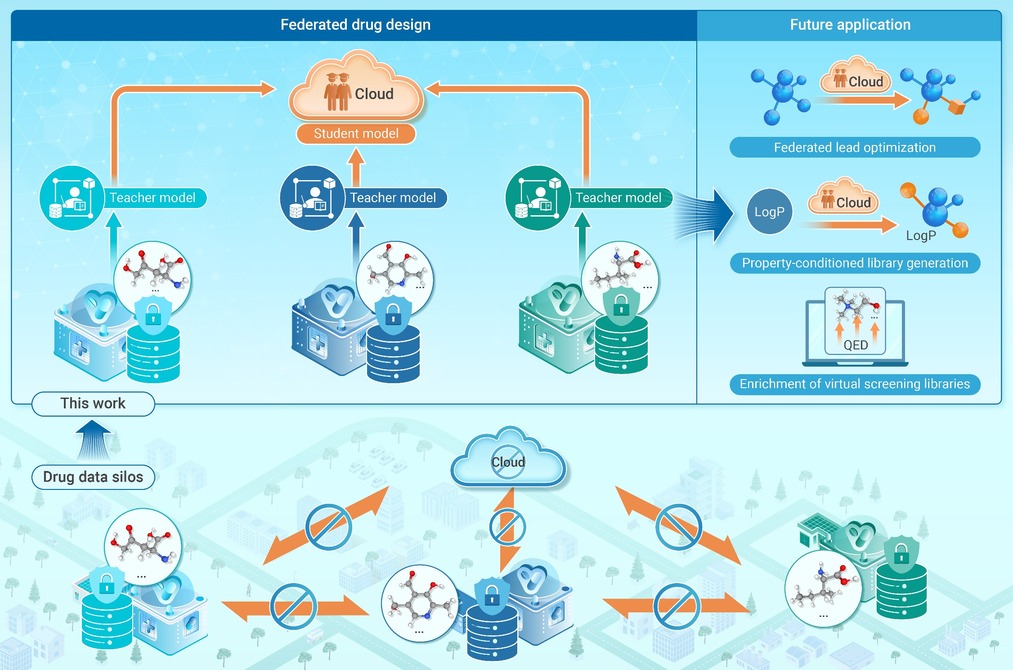
A federated framework for collaborative training of molecular generative models.
Combining low rank adaptation (LoRA) with knowledge distillation (KD).
FedMol achieves superior performance under high data heterogeneity, maintaining better distribution matching.
-
-
ABSTRACT
Generating molecules with properties of interest is a fundamental challenge in computational molecular design. However, a significant portion of valuable chemical data resides within proprietary corporate data silos, limiting the potential of data-driven approaches for molecular design. Federated learning provides a framework for collaborative model training without sharing raw data, but existing methods face challenges in communication efficiency and robustness to heterogeneous data distributions. Here we introduce FedMol, a federated learning framework that combines pre-trained molecular language models with parameter-efficient fine-tuning (using low-rank adaptation) and knowledge distillation to enable privacy-preserving molecular generation. We evaluate FedMol on the GuacaMol distribution-learning benchmarks under varying degrees of data heterogeneity simulated via Dirichlet partitioning. Our results show that FedMol achieves competitive performance with state-of-the-art centralized models by updating only 2.4% of parameters through low-rank adaptation. Under high heterogeneity, knowledge distillation outperforms standard federated averaging in preserving chemical diversity. This work demonstrates a practical approach to collaborative molecular design that respects data privacy, with potential applications in drug discovery where proprietary data and multi-institutional collaboration are both critical.-
Keywords:
- molecular generation /
- federated learning /
- knowledge distillation
-

-
REFERENCES
[1] Kang, N.Y., Ha, H.H., Yun, S.W. et al. (2011). Diversity-driven chemical probe development for biomolecules: beyond hypothesis-driven approach. Chem. Soc. Rev. 40:3613−3626. DOI:10.1039/C0CS00172D [2] Honarparvar, B., Govender, T., Maguire, G.E. et al. (2014). Integrated approach to structure-based enzymatic drug design: molecular modeling, spectroscopy, and experimental bioactivity. Chem. Rev. 114:493−537. DOI:10.1021/cr300314q [3] Bagal, V., Aggarwal, R., Vinod, P. et al. (2021). MolGPT: molecular generation using a transformer-decoder model. J. Chem. Inf. Model. 62:2064−2076. DOI:10.1021/acs.jcim.1c00600 [4] Gómez-Bombarelli, R., Wei, J.N., Duvenaud, D. et al. (2018). Automatic chemical design using a data-driven continuous representation of molecules. ACS Cent. Sci. 4:268−276. DOI:10.1021/acscentsci.7b00572 [5] Li, C. (2025). Breaking data silos in drug discovery with federated learning. Nat. Chem. Eng. 2:288−289. DOI:10.1038/s44286-025-00213-x [6] Durant, G., Boyles, F., Birchall, K. et al. (2024). The future of machine learning for small-molecule drug discovery will be driven by data. Nat. Comput. Sci. 4:735−743. DOI:10.1038/s43588-024-00699-0 [7] Hanser, T., Ahlberg, E., Amberg, A. et al. (2025). Data-driven federated learning in drug discovery with knowledge distillation. Nat. Mach. Intell. 1−14. DOI:10.1038/s42256-025-00991-2 [8] Chen, S., Xue, D., Chuai, G. et al. (2020). FL-QSAR: a federated learning-based QSAR prototype for collaborative drug discovery. Bioinformatics 36:5492−5498. DOI:10.1093/bioinformatics/btaa1006 [9] Li, L., Fan, Y., Tse, M. et al. (2020). A review of applications in federated learning. Comput. Ind. Eng. 149:106854. DOI:10.1016/j.cie.2020.106854 [10] Huang, T., Xu, H., Wang, H. et al. (2023). Artificial intelligence for medicine: Progress, challenges, and perspectives. Innov. Med. 1:100030. DOI:10.59717/j.xinn-med.2023.100030 [11] Zhu, W., Luo, J., and White, A.D. (2022). Federated learning of molecular properties with graph neural networks in a heterogeneous setting. Patterns 3. DOI:10.1016/j.patter.2022.100521. DOI:10.1016/j.patter.2022.100521 [12] Cozac, R., Hasic, H., Choong, J.J. et al. (2025). kMoL: an open-source machine and federated learning library for drug discovery. J. Cheminform. 17:22. DOI:10.1186/s13321-025-00967-9 [13] Bassani, D., Brigo, A., and Andrews-Morger, A. (2023). Federated learning in computational toxicology: an industrial perspective on the effiris hackathon. Chem. Res. Toxicol. 36:1503−1517. DOI:10.1021/acs.chemrestox.3c00137 [14] Luo, B., Li, X., Wang, S. et al. (2021). Cost-effective federated learning design. In IEEE INFOCOM 2021. pp. 1–10. DOI: 10.1109/INFOCOM42981.2021.9488679. [15] Zhu, Z., Hong, J., and Zhou, J. (2021). Data-free knowledge distillation for heterogeneous federated learning. In ICML. pp. 12878–12889. DOI: 10.48550/arXiv.2105.10056. [16] Lu, Z., Pan, H., Dai, Y. et al. (2024). Federated learning with non-IID data: A survey. IEEE Internet Things J. 11:19188−19209. DOI:10.1109/JIOT.2024.3376548 [17] Hu, E.J., Shen, Y., Wallis, P. et al. (2022). LoRA: Low-rank adaptation of large language models. In ICLR. pp. 3. DOI: 10.48550/arXiv.2106.09685. [18] Gou, J., Yu, B., Maybank, S.J. et al. (2021). Knowledge distillation: A survey. Int. J. Comput. Vis. 129:1789−1819. DOI:10.1007/s11263-021-01453-z [19] Brown, N., Fiscato, M., Segler, M.H. et al. (2019). GuacaMol: benchmarking models for de novo molecular design. J. Chem. Inf. Model. 59:1096−1108. DOI:10.1021/acs.jcim.8b00839 [20] Yang, A., Yang, B., Hui, B. et al. (2024). Qwen2 technical report. ArXiv. DOI: 10.48550/arXiv.2407.10671. [21] Ainslie, J., Lee-Thorp, J., De Jong, M. et al. (2023). GQA: Training generalized multi-query transformer models from multi-head checkpoints. In Proc. EMNLP 2023. pp. 4895–4901. DOI: 10.18653/v1/2023.emnlp-main.298. [22] Su, J., Ahmed, M., Lu, Y. et al. (2024). Roformer: Enhanced transformer with rotary position embedding. Neurocomputing 568:127063. DOI:10.1016/j.neucom.2023.127063 [23] Li, T., Sahu, A.K., Zaheer, M. et al. (2020). Federated optimization in heterogeneous networks. In Proc. Mach. Learn. Syst. pp. 429–450. DOI: 10.48550/arXiv.1812.06127. [24] Kim, S., Chen, J., Cheng, T. et al. (2023). PubChem 2023 update. Nucleic Acids Res. 51:D1373−D1380. DOI:10.1093/nar/gkac956 [25] Gaulton, A., Bellis, L.J., Bento, A.P. et al. (2012). ChEMBL: a large-scale bioactivity database for drug discovery. Nucleic Acids Res. 40:D1100−D1107. DOI:10.1093/nar/gkr777 [26] Shokri, R., Stronati, M., Song, C. et al. (2017). Membership inference attacks against machine learning models. In Proc. IEEE Symp. Secur. Priv. pp. 3–18. DOI: 10.1109/SP.2017.41. [27] He, Y., Li, B., Liu, L. et al. (2025). Towards Label-Only membership inference attack against pre-trained large language models. In Proc. 34th USENIX Secur. Symp. pp. 1609–1628. DOI: 10.48550/arXiv.2502.18943. [28] Preuer, K., Renz, P., Unterthiner, T. et al. (2018). Fréchet chemnet distance: a metric for generative models for molecules in drug discovery. J. Chem. Inf. Model. 58:1736−1741. DOI:10.1021/acs.jcim.8b00234 [29] Cavanagh, J.M., Sun, K., Gritsevskiy, A. et al. (2024). Smileyllama: Modifying large language models for directed chemical space exploration. arXiv. DOI: 10.48550/arXiv.2409.02231. [30] Izdebski, A., Olszewski, J., Gawade, P. et al. (2025). Synergistic benefits of joint molecule generation and property prediction. arXiv. DOI: 10.48550/arXiv.2504.16559. [31] Chen, X., Wang, Y., He, J. et al. (2025). Graph generative pre-trained transformer. arXiv. DOI: 10.48550/arXiv.2501.01073. [32] Kwon, Y., Yoo, J., Choi, Y. et al. (2019). Efficient learning of non-autoregressive graph variational autoencoders for molecular graph generation. J. Cheminform. 11:70. DOI:10.1186/s13321-019-0396-x [33] Iwata, H., Nakai, T., Koyama, T. et al. (2023). VGAE-MCTS: A new molecular generative model combining the variational graph auto-encoder and monte carlo tree search. J. Chem. Inf. Model. 63:7392−7400. DOI:10.1021/acs.jcim.3c01220 [34] Wu, J.N., Wang, T., Chen, Y. et al. (2024). t-SMILES: a fragment-based molecular representation framework for de novo ligand design. Nat. Commun. 15:4993. DOI:10.1038/s41467-024-49388-6 [35] Mahmood, O., Mansimov, E., Bonneau, R. et al. (2021). Masked graph modeling for molecule generation. Nat. Commun. 12:3156. DOI:10.1038/s41467-021-23415-2 [36] Geng, Z., Xie, S., Xia, Y. et al. (2023). De novo molecular generation via connection-aware motif mining. arXiv. DOI: https://doi.org/10.48550/arXiv.2302.01129. [37] Huang, Y., Zeng, Y., Dwivedi, V.P. et al. (2026). Higher-order grammar representations for molecular generation and learning. In ICLR. [38] Ueda, R., Nakai, T., Yoshida, K. et al. (2025). Mitigation of membership inference attack by knowledge distillation on federated learning. IEICE Trans. Fundam. Electron. Commun. Comput. Sci. 108:267−279. DOI:10.1587/transfun.2024CIP0004 [39] Karimireddy, S.P., Kale, S., Mohri, M. et al. (2020). Scaffold: Stochastic controlled averaging for federated learning. In ICML. pp. 5132–5143. DOI: 10.48550/arXiv.1910.06378. [40] You, J., Ying, R., Ren, X. et al. (2018). Graphrnn: Generating realistic graphs with deep auto-regressive models. In ICML. pp. 5708–5717. DOI: 10.48550/arXiv.1802.08773. [41] Schütt, K., Kindermans, P.J., Sauceda Felix, H.E. et al. (2017). Schnet: A continuous-filter convolutional neural network for modeling quantum interactions. vol. 30. DOI: 10.48550/arXiv.1706.08566. [42] Satorras, V.G., Hoogeboom, E., and Welling, M. (2021). E(n) equivariant graph neural networks. In ICML. pp. 9323–9332. DOI: 10.48550/arXiv.2102.09844. [43] Stärk, H., Beaini, D., Corso, G. et al. (2022). 3d infomax improves gnns for molecular property prediction. In ICML. pp. 20479–20502. DOI: 10.48550/arXiv.2110.04126. [44] Carlini, N., Chien, S., Nasr, M. et al. (2022). Membership inference attacks from first principles. In Proc. IEEE Symp. Secur. Priv. pp. 1897–1914. DOI: 10.1109/SP46214.2022.9833649. [45] Shi, S., Zhang, J., Jiang, S. et al. (2025). DP-GENG: Differentially private dataset distillation guided by dp-generated data. DOI: 10.1609/aaai.v40i11.37854. [46] Abadi, M., Chu, A., Goodfellow, I. et al. (2016). Deep learning with differential privacy. In ACM CCS. pp. 308–318. DOI: 10.1145/2976749.2978318. [47] Bonawitz, K., Ivanov, V., Kreuter, B. et al. (2017). Practical secure aggregation for privacy-preserving machine learning. In ACM CCS. pp. 1175–1191. DOI: 10.1145/3133956.3133982. -
ABOUT THIS ARTICLE
Cite this article:
Dong T., You L. and Chen C. (2026). Cost-effective federated molecular design with FedMol. The Innovation Drug Discovery 1:100022. https://doi.org/10.59717/j.xinn-drugdisc.2026.100022
Welcome!
To request copyright permission to republish or share portions of our works, please visit Copyright Clearance Center's (CCC) Marketplace website at marketplace.copyright.com.
Export File
Citation
Dong T., You L. and Chen C. (2026). Cost-effective federated molecular design with FedMol. The Innovation Drug Discovery 1:100022. https://doi.org/10.59717/j.xinn-drugdisc.2026.100022

Format
Content
-
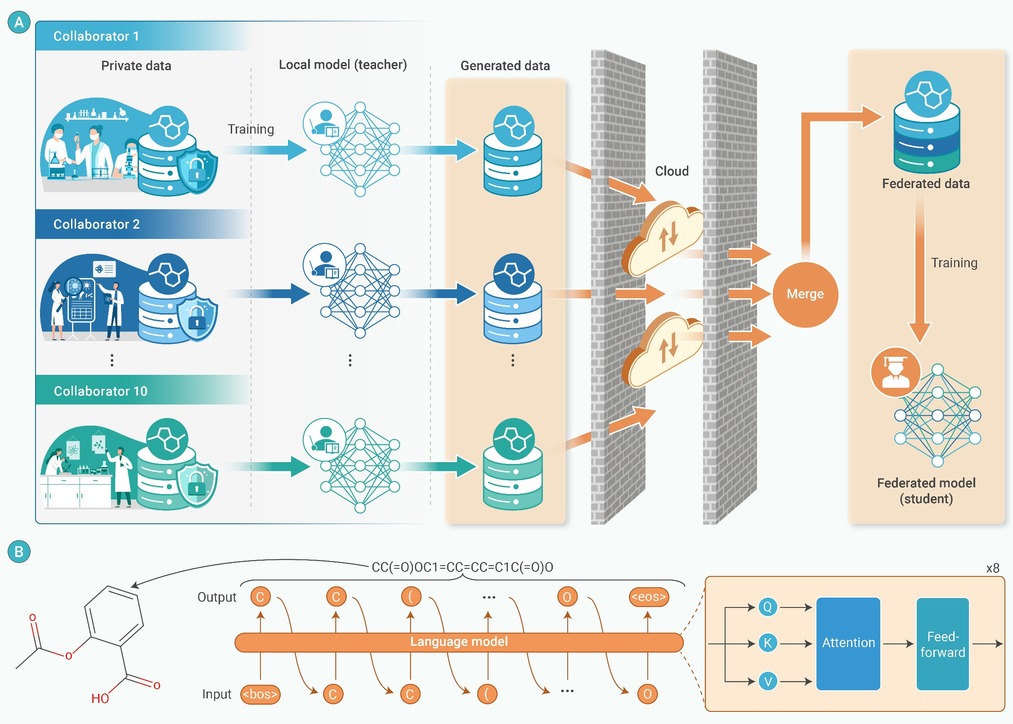
Figure 1.
Overview of the FedMol framework
-
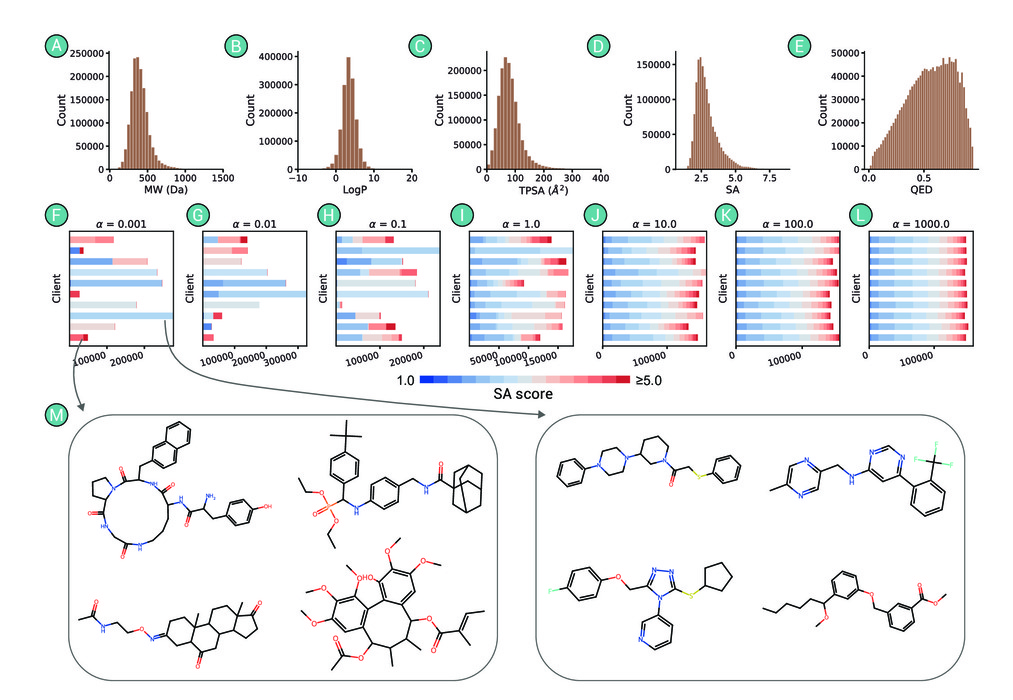
Figure 2.
Data distribution and simulation of client heterogeneity
-
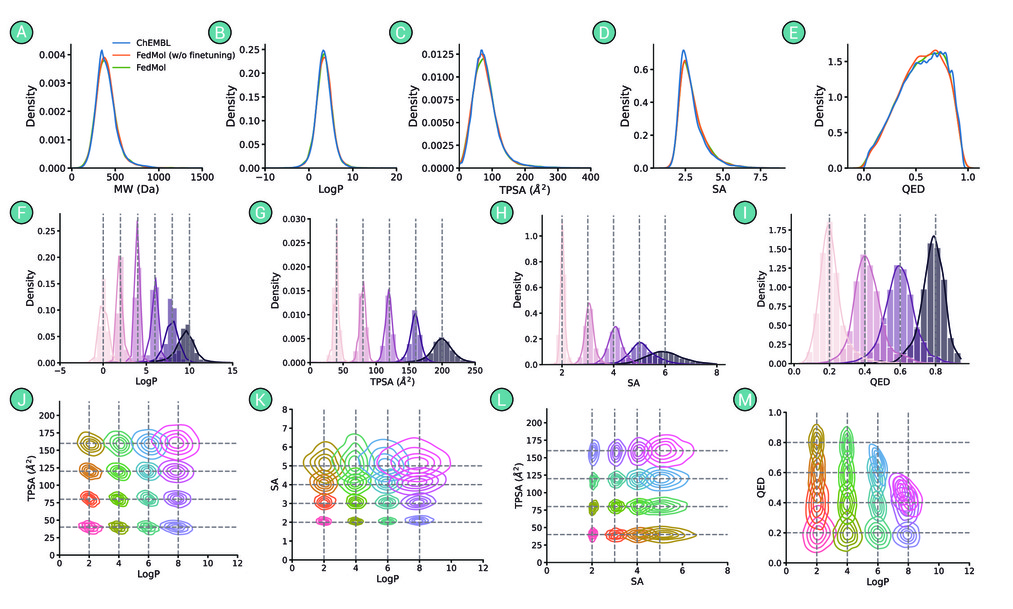
Figure 3.
Molecuar generation with FedMol trained under near-IID condition
-
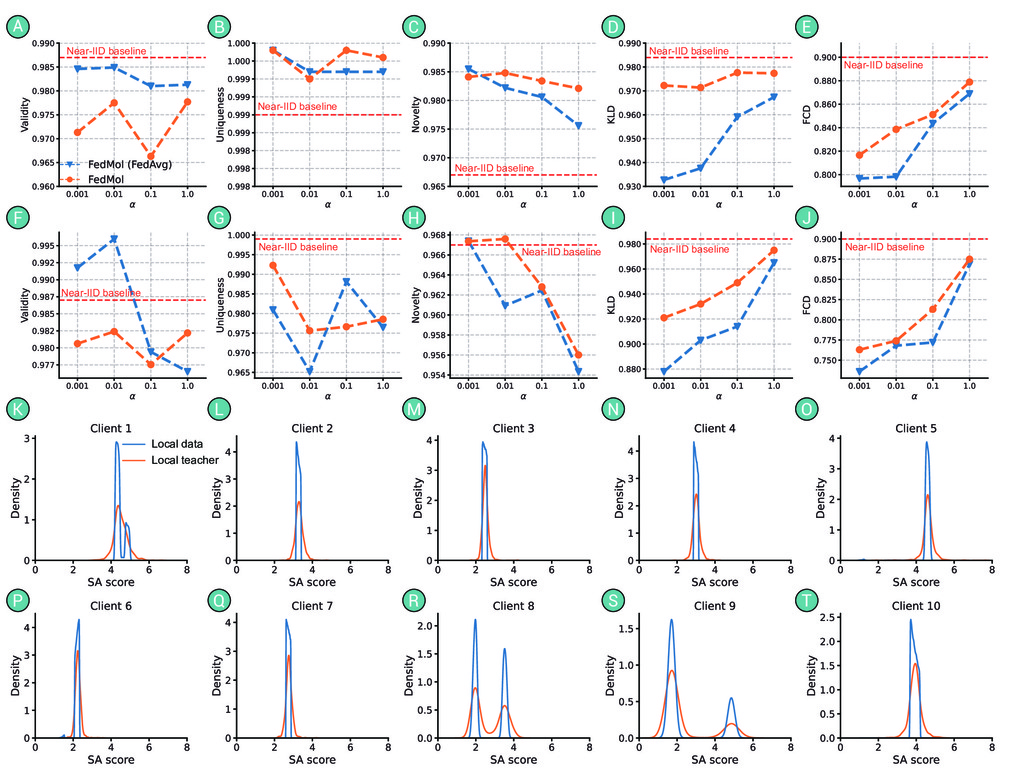
Figure 4.
Performance of FedMol under varying degrees of data heterogeneity
