
-
ABSTRACT
Classic biogeography provides the context for understanding why large-scale patterns of biodiversity occur where they do. However, over the past half century, human activities have greatly changed biogeographic patterns and caused accelerating loss of biodiversity on the earth. In spite of the Launch of Conservation Biogeography a couple of decades ago, there has been no concerted effort to implement conservation practices for regional biodiversity by integrating ecology and evolution over geographical space and time. This paper presents lessons and experiences from biodiversity protection of the Yangtze River, demonstrating an urgent need for biogeography-based solutions that cannot be easily deduced from current conservation biogeography. We aim to open a new window for conservation biogeography by providing a new cross-level paradigm and a new definition, seeking for biogeographic strategies for the long-lasting preservation of regional biodiversity. We believe that this paper makes a concise conceptual advance in conservation biogeography. -

-
REFERENCES
[1] Whittaker, R.J., Araújo, M.B., Jepson, P., et al. (2005). Conservation biogeography: assessment and prospect. Divers. Distrib. 11: 3−23. DOI: 10.1111/j.1366-9516.2005.00143.x. [2] Lomolino, M.V. (2023). The ecological and geographic dynamics of extinction: Niche modeling and ecological marginalization. Proc. Natl. Acad. Sci. 120: e2220467120. DOI: 10.1073/pnas.2220467120. [3] Chang, M. M., and Zhou, J. (1993). A brief survey of the Chinese Eocene ichthyofauna. Kaupia. 2: 157−162. http://www.irgrid.ac.cn/handle/1471x/246803?mode=full. [4] Chen, F., Wang, Y., He, J., et al. (2022). Molecular mechanisms of spawning habits for the adaptive radiation of endemic East Asian cyprinid fishes. Research. 2022: 9827986. DOI: 10.34133/2022/9827986. [5] Chen, F., Xue, G., Wang, Y., et al. (2023). Evolution of the Yangtze River and its biodiversity. The Innovation. 4: 100417. DOI: 10.1016/j.xinn.2023.100417. [6] Peng, Z. G., Ludwig, A., Wang, D., et al. (2007). Age and biogeography of major clades in sturgeons and paddlefishes (Pisces: Acipenseriformes). Mol. Phylogenet. Evol. 42: 854−862. DOI: 10.1016/j.ympev.2006.09.008. [7] Wang, H. J., Wang, P., Xu C, et al. (2022). Can the “10-year fishing ban” rescue biodiversity of the Yangtze River. The Innovation. 3: 100235. DOI: 10.1016/j.xinn.2022.100235. [8] Xie, P. (2003). Three-Gorges Dam: risk to ancient fish. Science. 302: 1149. DOI: 10.1126/science.302.5648.1149b. [9] Rodrigues, A.S.L., Andelman, S.J., Bakarr, M.I., et al. (2004). Effectiveness of the global protected area network in representing species diversity. Nature, 428: 640−643. DOI: 10.1038/nature02422. [10] Zhang, L., Wang, H., Gessner, J., et al. (2023). To save sturgeons, we need river channels around hydropower dams[J]. Proc. Natl. Acad. Sci. 120: e2217386120. DOI: 10.1073/pnas.2217386120. -
ABOUT THIS ARTICLE
Cite this article:
Chen J., Wang H., Zhang L., et al., (2024). A new window for conservation biogeography. The Innovation Geoscience 2(1): 100052. https://doi.org/10.59717/j.xinn-geo.2024.100052
Welcome!
To request copyright permission to republish or share portions of our works, please visit Copyright Clearance Center's (CCC) Marketplace website at marketplace.copyright.com.
Export File
Citation
Chen J., Wang H., Zhang L., et al., (2024). A new window for conservation biogeography. The Innovation Geoscience 2(1): 100052. https://doi.org/10.59717/j.xinn-geo.2024.100052

Format
Content
 DownLoad:
-
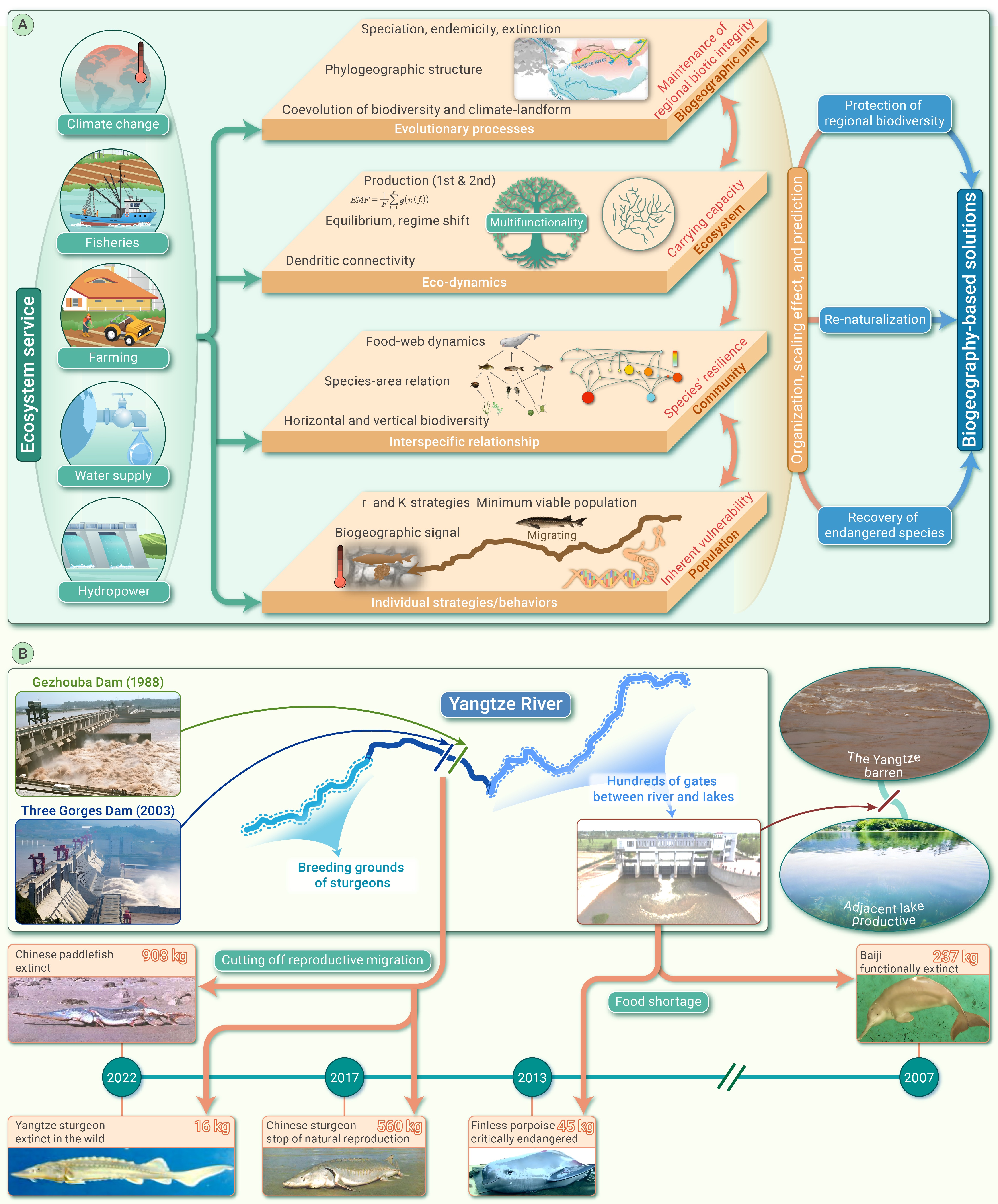
Figure 1.
A sketch of new paradigm for conservation biogeography, inspired by unsuccessful rescue of biodiversity in the Yangtze River during the past decades
