
How does canopy height regulate autumn photosynthetic phenology in the Northern Hemisphere?
-
GRAPHICAL ABSTRACT

 DownLoad:
Full size image
DownLoad:
Full size image
-
PUBLIC SUMMARY
-
We investigated the regulatory effect of forest canopy height on photosynthetic phenology in autumn.
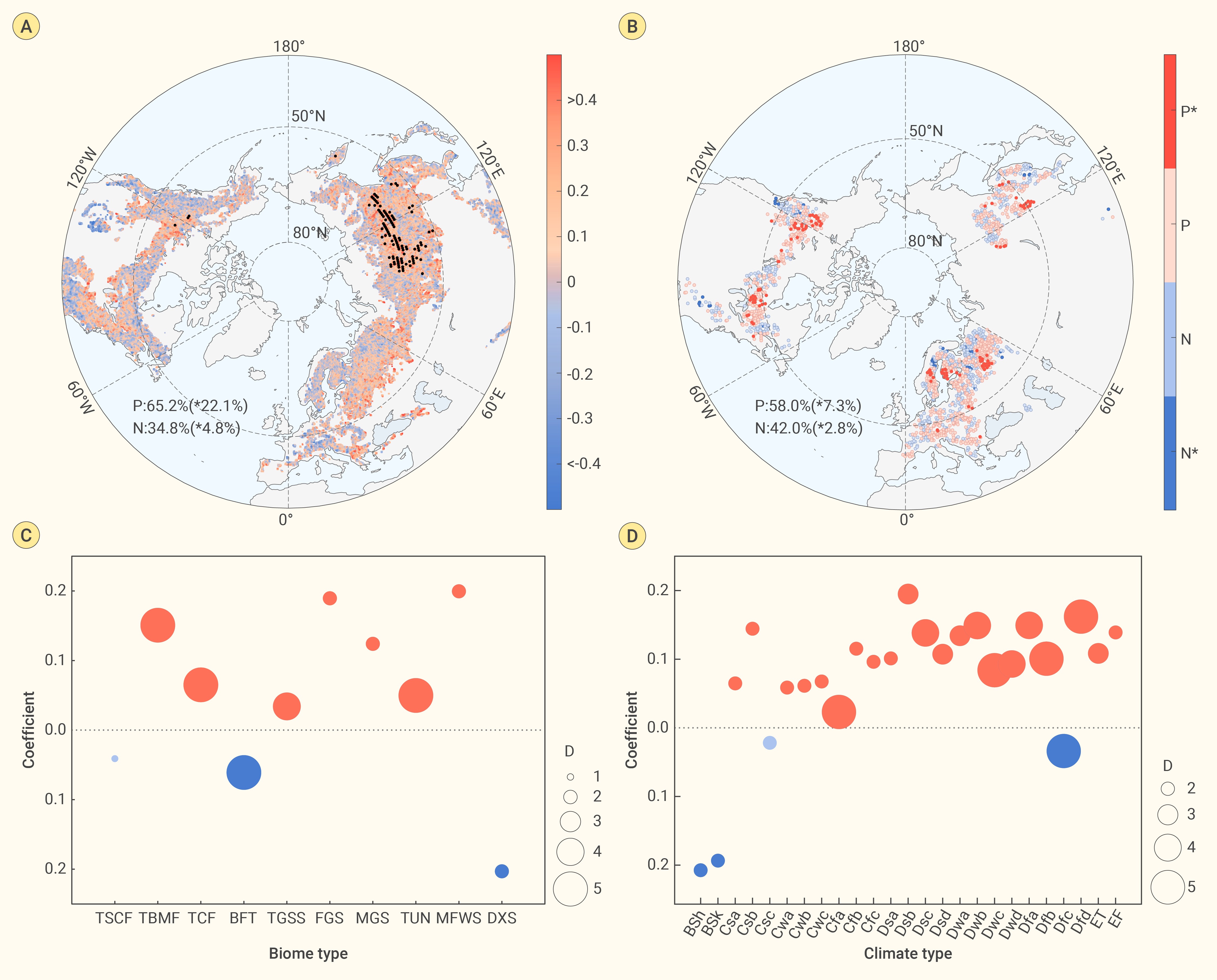
Widespread (65.2%) positive regulatory of canopy height on the end of growing season in northern forest.
Canopy height regulates photosynthetic phenology in autumn mainly through radiation and water.
Considering canopy height may help to improve phenological models.
-
-
ABSTRACT
Autumn photosynthetic phenology strongly regulates the length of growing season and terrestrial carbon cycle, providing feedbacks to climate change. While the climatic drivers of autumn photosynthetic phenology have received considerable attention, the regulation by forest structural features is frequently overlooked. Here, we used spaceborne LiDAR observations of canopy height, two sets of canopy height products, and satellite solar-induced chlorophyll, to characterize the role of canopy height in autumn photosynthetic phenology from 2001 to 2020. We found strong dependencies of autumn photosynthetic phenology on canopy height in 65.2% of the northern forest. Taller trees tend to end the growing season later, likely due to the enhanced acquisition of solar radiation associated with increased canopy height. Additionally, taller trees have deeper root system to maintain strong hydraulic transport capacity and higher resistance to water stress. This study highlights the importance of forest structure in regulating vegetation phenology and contributes to enhancement of phenological models and carbon cycle simulations. -

-
REFERENCES
[1] Piao, S., Ciais, P., Friedlingstein, P., et al. (2008). Net carbon dioxide losses of northern ecosystems in response to autumn warming. Nature 451: 49−52. DOI: 10.1038/nature06444. [2] Piao, S., Liu, Q., Chen, A., et al. (2019). Plant phenology and global climate change: Current progresses and challenges. Glob. Chang. Biol. 25 : 1922-1940. DOI: 10.1111/gcb.14619. [3] Li, S., Wang, Y., Ciais, P., et al. (2022). Deficiencies of phenology models in simulating spatial and temporal variations in temperate spring leaf phenology. J. Geophys. Res.: Biogeosciences 127 : e2021JG006421. DOI: 10.1029/2021JG006421. [4] Jeong, S.-J., Ho, C.-H., Gim, H.-J., et al. (2011). Phenology shifts at start vs. end of growing season in temperate vegetation over the Northern Hemisphere for the period 1982-2008. Glob. Chang. Biol. 17 : 2385-2399. DOI: 10.1111/j.1365-2486.2011.02397.x. [5] Liu, Q., Fu, Y.H., Zeng, Z., et al. (2016). Temperature, precipitation, and insolation effects on autumn vegetation phenology in temperate China. Glob. Chang. Biol. 22: 644−655. DOI: 10.1111/gcb.13081. [6] Wang, M., Li, P., Peng, C., et al. (2022). Divergent responses of autumn vegetation phenology to climate extremes over northern middle and high latitudes. Glob. Ecol. Biogeogr. 31 : 2281-2296. DOI: 10.1111/geb.13583. [7] Garonna, I., de Jong, R., de Wit, A.J.W., et al. (2014). Strong contribution of autumn phenology to changes in satellite-derived growing season length estimates across Europe (1982–2011). Glob. Chang. Biol. 20 : 3457-3470. DOI: 10.1111/gcb.12625. [8] Wu, C., Chen, J.M., Black, T.A., et al. (2013). Interannual variability of net ecosystem productivity in forests is explained by carbon flux phenology in autumn. Glob. Ecol. Biogeogr. 22: 994−1006. DOI: 10.1111/geb.12044. [9] Lim, P.O., Kim, H.J., and Nam, H.G. (2007). Leaf senescence. Annu. Rev. Plant Biol. 58: 115−136. DOI: 10.1146/annurev.arplant.57.032905.105316. [10] Wu, C., Wang, J., Ciais, P., et al. (2021). Widespread decline in winds delayed autumn foliar senescence over high latitudes. Proc. Natl. Acad. Sci. USA 118 : e2015821118. DOI: 10.1073/pnas.2015821118. [11] Zhang, Y., Commane, R., Zhou, S., et al. (2020). Light limitation regulates the response of autumn terrestrial carbon uptake to warming. Nat. Clim. Change. 10: 739−743. DOI: 10.1038/s41558-020-0806-0. [12] Liu, Q., Piao, S., Janssens, I.A., et al. (2018). Extension of the growing season increases vegetation exposure to frost. Nat. Commun. 9: 426. DOI: 10.1038/s41467-017-02690-y. [13] Wu, C., Peng, J., Ciais, P., et al. (2022). Increased drought effects on the phenology of autumn leaf senescence. Nat. Clim. Change. 12: 943−949. DOI: 10.1038/s41558-022-01464-9. [14] Wang, X., Wu, C., Liu, Y., et al. (2023). Earlier leaf senescence dates are constrained by soil moisture. Glob. Change Biol. 29 : 1557-1573. DOI: 10.1111/gcb.16569. [15] Buitenwerf, R., Rose, L., and Higgins, S.I. (2015). Three decades of multi-dimensional change in global leaf phenology. Nat. Clim. Change. 5: 364−368. DOI: 10.1038/nclimate2533. [16] Deslauriers, A. and Rossi, S. (2019). Metabolic memory in the phenological events of plants: Looking beyond climatic factors. Tree Physiol. 39: 1272−1276. DOI: 10.1093/treephys/tpz082. [17] Potapov, P., Li, X., Hernandez-Serna, A., et al. (2021). Mapping global forest canopy height through integration of GEDI and Landsat data. Remote Sens. Environ. 253 : 112165. DOI: 10.1016/j.rse.2020.112165. [18] Kumkar, Y., Astrup, R., Stordal, F., et al. (2020). Quantifying regional surface energy responses to forest structural change in Nordic Fennoscandia. J. Geophys. Res. Atmos. 125 : e2019JD032092. DOI: 10.1029/2019JD032092. [19] Kuusinen, N., Tomppo, E., Shuai, Y., et al. (2014). Effects of forest age on albedo in boreal forests estimated from MODIS and Landsat albedo retrievals. Remote Sens. Environ. 145 : 145-153. DOI: 10.1016/j.rse.2014.02.005. [20] Xu, P., Zhou, T., Zhao, X., et al. (2018). Diverse responses of different structured forest to drought in Southwest China through remotely sensed data. Int. J. Appl. Earth Obs. Geoinf. 69 : 217-225. DOI: 10.1016/j.jag.2018.03.009. [21] Moon, M., Li, D., Liao, W., et al. (2020). Modification of surface energy balance during springtime: The relative importance of biophysical and meteorological changes. Agric. For. Meteorol. 284 : 107905. DOI: 10.1016/j.agrformet.2020.107905. [22] Lindroth, A. and Cienciala, E. (1996). Water use efficiency of short-rotation Salix viminalis at leaf, tree and stand scales. Tree Physiol. 16: 257−262. DOI: 10.1093/treephys/16.1-2.257%JTreePhysiology. [23] Binkley, D., Campoe, O.C., Gspaltl, M., et al. (2013). Light absorption and use efficiency in forests: Why patterns differ for trees and stands. For. Ecol. Manag. 288 : 5-13. DOI: 10.1016/j.foreco.2011.11.002. [24] Zhang, Y., Joiner, J., Alemohammad, S.H., et al. (2018). A global spatially contiguous solar-induced fluorescence (CSIF) dataset using neural networks. Biogeosciences 15: 5779−5800. DOI: 10.5194/bg-15-5779-2018. [25] Guanter, L., Zhang, Y., Jung, M., et al. (2014). Global and time-resolved monitoring of crop photosynthesis with chlorophyll fluorescence. Proc. Natl Acad. Sci. USA 111: E1327−1333. DOI: 10.1073/pnas.1320008111. [26] Sun, Y., Frankenberg, C., Wood, J.D., et al. (2017). OCO-2 advances photosynthesis observation from space via solar-induced chlorophyll fluorescence. Science 358: eaam5747. DOI: 10.1126/science.aam5747. [27] Healey, S.P., Hernandez, M.W., Edwards, D.P., et al. (2015). CMS: GLAS LiDAR-derived global estimates of forest canopy height, 2004-2008. ORNL Distributed Active Archive Center. http://dx.doi.org/10.3334/ORNLDAAC/1271 [28] Lefsky, M.A., Keller, M., Pang, Y., et al. (2007). Revised method for forest canopy height estimation from Geoscience Laser Altimeter System waveforms. J. Appl. Remote Sens. 1: 013537-013518. DOI: 10.1117/1.2795724. [29] Simard, M., Pinto, N., Fisher, J.B., et al. (2011). Mapping forest canopy height globally with spaceborne lidar. J. Geophys. Res. 116 : G04021. DOI: 10.1029/2011jg001708. [30] Martens, B., Miralles, D.G., Lievens, H., et al. (2017). GLEAM v3: Satellite-based land evaporation and root-zone soil moisture. Geosci. Model Dev. 10: 1903−1925. DOI: 10.5194/gmd-10-1903-2017. [31] Li, Y., Zhao, M., Motesharrei, S., et al. (2015). Local cooling and warming effects of forests based on satellite observations. Nat. Commun. 6: 6603. DOI: 10.1038/ncomms7603. [32] Fan, Y., Miguez-Macho, G., Jobbagy, E.G., et al. (2017). Hydrologic regulation of plant rooting depth. Proc. Natl. Acad. Sci. USA 114: 10572−10577. DOI: 10.1073/pnas.1712381114. [33] Dinerstein, E., Olson, D., Joshi, A., et al. (2017). An ecoregion-based approach to protecting half the terrestrial realm. Bioscience 67: 534−545. DOI: 10.1093/biosci/bix014. [34] Beck, H.E., Zimmermann, N.E., McVicar, T.R., et al. (2018). Present and future Köppen-Geiger climate classification maps at 1-km resolution. Sci. Data 5: 180214. DOI: 10.1038/sdata.2018.214. [35] Poyatos, R., Granda, V., Molowny-Horas, R., et al. (2016). SAPFLUXNET: Towards a global database of sap flow measurements. Tree Physiol. 36: 1449−1455. DOI: 10.1093/treephys/tpw110. [36] Shen, M., Tang, Y., Chen, J., et al. (2011). Influences of temperature and precipitation before the growing season on spring phenology in grasslands of the central and eastern Qinghai-Tibetan Plateau. Agric. For. Meteorol. 151: 1711−1722. DOI: 10.1016/j.agrformet.2011.07.003. [37] Meng, F., Felton, A.J., Mao, J., et al. (2024). Consistent time allocation fraction to vegetation green-up versus senescence across northern ecosystems despite recent climate change. Sci. Adv. 10 : eadn2487. DOI:10.1126/sciadv.adn2487. [38] Allen, R.G., Pereira, L.S., Raes, D., et al. (1998). Crop evapotranspiration - Guidelines for computing crop water requirements - FAO Irrigation and drainage paper 56. [39] Liu, Q., Fu, Y.H., Zhu, Z., et al. (2016). Delayed autumn phenology in the Northern Hemisphere is related to change in both climate and spring phenology. Glob. Chang. Biol. 22: 3702−3711. DOI: 10.1111/gcb.13311. [40] Kempes, C.P., West, G.B., Crowell, K., and Girvan, M. (2011). Predicting maximum tree heights and other traits from allometric scaling and resource limitations. PLoS One 6: e20551. DOI: 10.1371/journal.pone.0020551. [41] Halim, M.A., Chen, H.Y.H., and Thomas, S.C. (2019). Stand age and species composition effects on surface albedo in a mixedwood boreal forest. Biogeosciences 16: 4357−4375. DOI: 10.5194/bg-16-4357-2019. [42] Schenk, H.J. and Jackson, R.B. (2002). Rooting depths, lateral root spreads and below-ground/above-ground allometries of plants in water-limited ecosystems. J. Ecol. 90 : 480-494. DOI: 10.1046/j.1365-2745.2002.00682.x. [43] Chunxia, H., Jiyue, L., Ming, G., et al. (2008). Changes in leaf photosynthetic characteristics and water use efficiency along with tree height of 4 tree species. Acta Ecol. Sin. 28 : 3008-3016. DOI: 10.1016/S1872-2032(08)60064-5. [44] Zhu, Z., Piao, S., Myneni, R.B., et al. (2016). Greening of the Earth and its drivers. Nat. Clim. Change. 6: 791−795. DOI: 10.1038/nclimate3004. [45] Richardson, A.D., Keenan, T.F., Migliavacca, M., et al. (2013). Climate change, phenology, and phenological control of vegetation feedbacks to the climate system. Agric. For. Meteorol. 169: 156−173. DOI: 10.1016/j.agrformet.2012.09.012. [46] Zhu, W., Tian, H., Xu, X., et al. (2012). Extension of the growing season due to delayed autumn over mid and high latitudes in North America during 1982–2006. Glob. Ecol. Biogeogr. 21 : 260-271. DOI: 10.1111/j.1466-8238.2011.00675.x. [47] Martínez-Vilalta, J. and Garcia-Forner, N. (2017). Water potential regulation, stomatal behaviour and hydraulic transport under drought: deconstructing the iso/anisohydric concept. Plant Cell Environ. 40 : 962-976. DOI: 10.1111/pce.12846. [48] Rowland, L., da Costa, A.C.L., Galbraith, D.R., et al. (2015). Death from drought in tropical forests is triggered by hydraulics not carbon starvation. Nature 528: 119−122. DOI: 10.1038/nature15539. [49] Rijkers, T., Pons, T.L., and Bongers, F. (2000). The effect of tree height and light availability on photosynthetic leaf traits of four neotropical species differing in shade tolerance. Funct. Ecol. 14 : 77-86. DOI: 10.1046/j.1365-2435.2000.00395.x. [50] Yang, B., Lee, D.K., Heo, H.K., et al. (2019). The effects of tree characteristics on rainfall interception in urban areas. Landsc. Ecol. Eng. 15: 289−296. DOI: 10.1007/s11355-019-00383-w. [51] Bonan, G. (2015). Ecological climatology: concepts and applications, 3 Edition (Cambridge University Press). DOI: 10.1017/CBO9781107339200. https://www.cambridge.org/core/books/ecological-climatology/D146443B007985BC366B2512345692C0. [52] Curtis, P.G., Slay, C.M., Harris, N.L., et al. (2018). Classifying drivers of global forest loss. Science 361: 1108−1111. DOI: 10.1126/science.aau3445. -
ABOUT THIS ARTICLE
Cite this article:
Tang R., He B., Shen M., et al., (2024). How does canopy height regulate autumn photosynthetic phenology in the Northern Hemisphere? The Innovation Geoscience 2(4): 100095. https://doi.org/10.59717/j.xinn-geo.2024.100095
Welcome!
To request copyright permission to republish or share portions of our works, please visit Copyright Clearance Center's (CCC) Marketplace website at marketplace.copyright.com.
Article Metrics
Relative Articles
Cited by
Export File
Citation
Tang R., He B., Shen M., et al., (2024). How does canopy height regulate autumn photosynthetic phenology in the Northern Hemisphere? The Innovation Geoscience 2(4): 100095. https://doi.org/10.59717/j.xinn-geo.2024.100095

Format
Content


-
Figure 1.
Associations between canopy height and the end of growing season (EOS) north of 30°N
-
Figure 2.
Relationship between the difference of acquired radiation and EOS at different canopy heights
-
Figure 3.
Relationship between canopy height and water transport variables affecting EOS
-
Figure 4.
Conceptual illustrations of the effect with different canopy heights on EOS.
