
Filling the global biomass burning emissions puzzle: A China-Laos partnership toward a new monitoring paradigm in Southeast Asia
-

-
REFERENCES
[1] Liu Y., Chen J., Shi Y., et al. (2024). Global emissions inventory from open biomass burning (GEIOBB): Utilizing Fengyun-3D global fire spot monitoring data. Earth Syst. Sci. Data 16:3495−3515. DOI:10.5194/essd-16-3495-2024 [2] Schill G. P., Froyd K. D., Bian H., et al. (2020). Widespread biomass burning smoke throughout the remote troposphere. Nat. Geosci. 13:422−427. DOI:10.1038/s41561-020-0586-1 [3] Zhu C. S., Qu Y., Zhang Z. S., et al. (2022). High spatial variability of biomass burning emissions observed at three Tibetan Plateau sites. Earths Future 10:e2021EF002214. DOI:10.1029/2021EF002214 [4] Brown H., Liu X., Pokhrel R., et al. (2021). Biomass burning aerosols in most climate models are too absorbing. Nat. Commun. 12:277. DOI:10.1038/s41467-020-20482-9 -
ABOUT THIS ARTICLE
Cite this article:
Yang T., Li X. and Wang Z. (2026). Filling the global biomass burning emissions puzzle: A China-Laos partnership toward a new monitoring paradigm in Southeast Asia. The Innovation Geoscience 4:100206. https://doi.org/10.59717/j.xinn-geo.2026.100206
Welcome!
To request copyright permission to republish or share portions of our works, please visit Copyright Clearance Center's (CCC) Marketplace website at marketplace.copyright.com.
Export File
Citation
Yang T., Li X. and Wang Z. (2026). Filling the global biomass burning emissions puzzle: A China-Laos partnership toward a new monitoring paradigm in Southeast Asia. The Innovation Geoscience 4:100206. https://doi.org/10.59717/j.xinn-geo.2026.100206

Format
Content
 DownLoad:
-
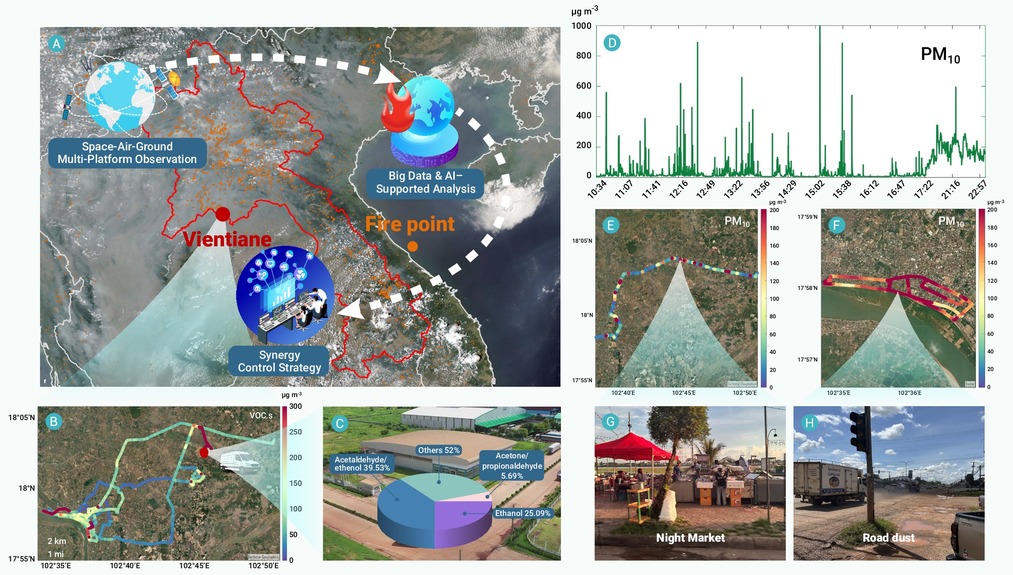
Figure 1.
Conceptual diagram of the China-Laos air quality initiative and preliminary observational findings
