
3D-bioprinted anisotropic bicellular living hydrogels boost osteochondral regeneration via reconstruction of cartilage–bone interface
-
GRAPHICAL ABSTRACT

 DownLoad:
Full size image
DownLoad:
Full size image
-
PUBLIC SUMMARY
- ■ Anisotropic bicellular living hydrogels (ABLHs) were bioprinted at room temperature with high cell viability.
- ■ ABLHs promoted osteochondral regeneration by fulfilling osteogenesis and chondrogenesis.
- ■ Cartilage-bone-vessel crosstalk was confirmed to lead to the reconstruction of the osteochondral interface.
-
ABSTRACT
Reconstruction of osteochondral (OC) defects represents an immense challenge due to the need for synchronous regeneration of special stratified tissues. The revolutionary innovation of bioprinting provides a robust method for precise fabrication of tissue-engineered OCs with hierarchical structure; however, their spatial living cues for simultaneous fulfilment of osteogenesis and chondrogenesis to reconstruct the cartilage-bone interface of OC are underappreciated. Here, inspired by natural OC bilayer features, anisotropic bicellular living hydrogels (ABLHs) simultaneously embedding articular cartilage progenitor cells (ACPCs) and bone mesenchymal stem cells (BMSCs) in stratified layers were precisely fabricated via two-channel extrusion bioprinting. The optimum formulation of the 7% GelMA/3% AlgMA hydrogel bioink was demonstrated, with excellent printability at room temperature and maintained high cell viability. Moreover, the chondrogenic ability of ACPCs and the osteogenic ability of BMSCs were demonstrated in vitro, confirming the inherent differential spatial regulation of ABLHs. In addition, ABLHs exhibited satisfactory synchronous regeneration of cartilage and subchondral bone in vivo. Compared with homogeneous hydrogels, the neo-cartilage and neo-bone in ABLHs were augmented by 23.5% and 20.8%, respectively, and more important, a more harmonious cartilage–bone interface was achieved by ABLHs due to their well-tuned cartilage-bone-vessel crosstalk. We anticipate that such a strategy of tissue-mimetic ABLH by means of bioprinting is capable of spatiotemporal cell-driven regeneration, offering insights into the fabrication of anisotropic living materials for the reconstruction of complex organ defects -

-
REFERENCES
[1] Lesage, C., Lafont, M., Guihard, P., Weiss, P., Guicheux, J., and Delplace, V. (2022). Material-Assisted Strategies for Osteochondral Defect Repair. Adv. Sci. 9, e2200050. [2] Li, W., Lai, J., Zu, Y., et al. (2022). Cartilage-inspired hydrogel lubrication strategy. Innovation 3, 100275. [3] Hu, X., Wang, Y., Tan, Y., Wang, J., Liu, H., Wang, Y., Yang, S., Shi, M., Zhao, S., Zhang, Y., and Yuan, Q. (2017). A Difunctional Regeneration Scaffold for Knee Repair based on Aptamer-Directed Cell Recruitment. Adv. Mater. 29, 1605235. [4] Ma, Z., Song, W., He, D., Zhang, X., He, Y., and Li, H. (2022). Smart μ-Fiber Hydrogels with Macro-Porous Structure for Sequentially Promoting Multiple Phases of Articular Cartilage Regeneration. Adv. Funct. Mater. 32, 2113380. [5] Gao, F., Xu, Z., Liang, Q., Liu, B., Li, H., Wu, Y., Zhang, Y., Lin, Z., Wu, M., Ruan, C., and Liu, W. (2018). Direct 3D Printing of High Strength Biohybrid Gradient Hydrogel Scaffolds for Efficient Repair of Osteochondral Defect. Adv. Funct. Mater. 28, 1706644. [6] Sun, Y., You, Y., Jiang, W., Wang, B., Wu, Q., and Dai, K. (2020). 3D bioprinting dual-factor releasing and gradient-structured constructs ready to implant for anisotropic cartilage regeneration. Sci. Adv. 6, eaay1422. [7] Kang, Y., Zhang, H., Chen, L., Dong, J., Yao, B., Yuan, X., Qin, D., Yaremenko, A.V., Liu, C., Feng, C., Ji, X., and Tao, W. (2022). The marriage of Xenes and hydrogels: Fundamentals, applications, and outlook. Innovation 3, 100327. [8] Qiao, Z., Lian, M., Han, Y., Sun, B., Zhang, X., Jiang, W., Li, H., Hao, Y., and Dai, K. (2021). Bioinspired stratified electrowritten fiber-reinforced hydrogel constructs with layer-specific induction capacity for functional osteochondral regeneration. Biomaterials 266, 120385. [9] Liu, Y., Peng, L., Li, L., Huang, C., Shi, K., Meng, X., Wang, P., Wu, M., Li, L., Cao, H., Wu, K., Zeng, Q., Pan, H., Lu, W.W., Qin, L., Ruan, C., and Wang, X. (2021). 3D-bioprinted BMSC-laden biomimetic multiphasic scaffolds for efficient repair of osteochondral defects in an osteoarthritic rat model. Biomaterials 279, 121216. [10] Shaw, S., and White, J.D. (2019). Asymmetric Catalysis Using Chiral Salen-Metal Complexes: Recent Advances. Chem. Rev. 119, 9381–9426. [11] He, H., Li, D., Lin, Z., Peng, L., Yang, J., Wu, M., Cheng, D., Pan, H., and Ruan, C. (2020). Temperature-programmable and enzymatically solidifiable gelatin-based bioinks enable facile extrusion bioprinting. Biofabrication 12, 045003. [12] Keller, L., Pijnenburg, L., Idoux-Gillet, Y., Bornert, F., Benameur, L., Tabrizian, M., Auvray, P., Rosset, P., María Gonzalo-Daganzo, R., Gómez Barrena, E., Gentile, L., and Benkirane-Jessel, N. (2019). Preclinical safety study of a combined therapeutic bone wound dressing for osteoarticular regeneration. Nat. Commun. 10, 2156. [13] Liu, X., Chen, Y., Mao, A.S., Xuan, C., Wang, Z., Gao, H., An, G., Zhu, Y., Shi, X., and Mao, C. (2020). Molecular recognition-directed site-specific release of stem cell differentiation inducers for enhanced joint repair. Biomaterials 232, 119644. [14] Blaeser, A., Duarte Campos, D.F., Puster, U., Richtering, W., Stevens, M.M., and Fischer, H. (2016). Controlling Shear Stress in 3D Bioprinting is a Key Factor to Balance Printing Resolution and Stem Cell Integrity. Adv. Healthc. Mater. 5, 326–333. [15] Hallett, S.A., Matsushita, Y., Ono, W., Sakagami, N., Mizuhashi, K., Tokavanich, N., Nagata, M., Zhou, A., Hirai, T., Kronenberg, H.M., and Ono, N. (2021). Chondrocytes in the resting zone of the growth plate are maintained in a Wnt-inhibitory environment. Elife 10, e64513. [16] Liu, H., Lan, Y., Xu, J., Chang, C.F., Brugmann, S.A., and Jiang, R. (2013). Odd-skipped related-1 controls neural crest chondrogenesis during tongue development. Proc. Natl. Acad. Sci. USA 110, 18555–18560. [17] Otsuki, S., Hanson, S.R., Miyaki, S., Grogan, S.P., Kinoshita, M., Asahara, H., Wong, C.H., and Lotz, M.K. (2010). Extracellular sulfatases support cartilage homeostasis by regulating BMP and FGF signaling pathways. Proc. Natl. Acad. Sci. USA 107, 10202–10207. [18] Tsumaki, N., Nakase, T., Miyaji, T., Kakiuchi, M., Kimura, T., Ochi, T., and Yoshikawa, H. (2002). Bone morphogenetic protein signals are required for cartilage formation and differently regulate joint development during skeletogenesis. J. Bone Miner. Res. 17, 898–906. [19] van den Bosch, M.H., Blom, A.B., Kram, V., Maeda, A., Sikka, S., Gabet, Y., Kilts, T.M., van den Berg, W.B., van Lent, P.L., van der Kraan, P.M., and Young, M.F. (2017). WISP1/CCN4 aggravates cartilage degeneration in experimental osteoarthritis. Osteoarthritis Cartilage 25, 1900–1911. [20] Tillgren, V., Ho, J.C.S., Önnerfjord, P., et al. (2015). The novel small leucine-rich protein chondroadherin-like (CHADL) is expressed in cartilage and modulates chondrocyte differentiation. J. Biol. Chem. 290, 918–925. [21] Zhu, S., Donovan, E.L., Makosa, D., Mehta-D'souza, P., Jopkiewicz, A., Batushansky, A., Cortassa, D., Simmons, A.D., Lopes, E.B.P., Kinter, M., and Griffin, T.M. (2022). Sirt3 Promotes Chondrogenesis, Chondrocyte Mitochondrial Respiration and the Development of High-Fat Diet-Induced Osteoarthritis in Mice. J. Bone Miner. Res. 37, 2531–2547. [22] Zhang, Y., Liu, Y., Hou, M., Xia, X., Liu, J., Xu, Y., Shi, Q., Zhang, Z., Wang, L., Shen, Y., Yang, H., He, F., and Zhu, X. (2023). Reprogramming of Mitochondrial Respiratory Chain Complex by Targeting SIRT3-COX4I2 Axis Attenuates Osteoarthritis Progression. Adv. Sci. 10, e2206144. [23] Chen, P., Liu, X., Gu, C., Zhong, P., Song, N., Li, M., Dai, Z., Fang, X., Liu, Z., Zhang, J., Tang, R., Fan, S., and Lin, X. (2022). A plant-derived natural photosynthetic system for improving cell anabolism. Nature 612, 546–554. [24] Litingtung, Y., Dahn, R.D., Li, Y., Fallon, J.F., and Chiang, C. (2002). Shh and Gli3 are dispensable for limb skeleton formation but regulate digit number and identity. Nature 418, 979–983. [25] Mohamed, F.F., Ge, C., Cowling, R.T., Lucas, D., Hallett, S.A., Ono, N., Binrayes, A.A., Greenberg, B., and Franceschi, R.T. (2022). The collagen receptor, discoidin domain receptor 2, functions in Gli1-positive skeletal progenitors and chondrocytes to control bone development. Bone Res. 10, 11. [26] Salazar, V.S., Gamer, L.W., and Rosen, V. (2016). BMP signalling in skeletal development, disease and repair. Nat. Rev. Endocrinol. 12, 203–221. [27] Neunaber, C., Catala-Lehnen, P., Beil, F.T., Marshall, R.P., Kanbach, V., Baranowsky, A., Lehmann, W., Streichert, T., Ignatius, A., Muramatsu, T., Schinke, T., and Amling, M. (2010). Increased trabecular bone formation in mice lacking the growth factor midkine. J. Bone Miner. Res. 25, 1724–1735. [28] Jensen, E.D., Schroeder, T.M., Bailey, J., Gopalakrishnan, R., and Westendorf, J.J. (2008). Histone deacetylase 7 associates with Runx2 and represses its activity during osteoblast maturation in a deacetylation-independent manner. J. Bone Miner. Res. 23, 361–372. [29] Nolan, K., Kattamuri, C., Rankin, S.A., Read, R.J., Zorn, A.M., and Thompson, T.B. (2016). Structure of Gremlin-2 in Complex with GDF5 Gives Insight into DAN-Family-Mediated BMP Antagonism. Cell Rep. 16, 2077–2086. [30] Munmun, F., and Witt-Enderby, P.A. (2021). Melatonin effects on bone: Implications for use as a therapy for managing bone loss. J. Pineal Res. 71, e12749. [31] Chen, W., Chen, H., Zheng, D., Zhang, H., Deng, L., Cui, W., Zhang, Y., Santos, H.A., and Shen, H. (2020). Gene-Hydrogel Microenvironment Regulates Extracellular Matrix Metabolism Balance in Nucleus Pulposus. Adv. Sci. 7, 1902099. [32] Qin, T., Zhang, G., Zheng, Y., Li, S., Yuan, Y., Li, Q., Hu, M., Si, H., Wei, G., Gao, X., Cui, X., Xia, B., Ren, J., Wang, K., Ba, H., Liu, Z., Heller, R., Li, Z., Wang, W., Huang, J., Li, C., and Qiu, Q. (2023). A population of stem cells with strong regenerative potential discovered in deer antlers. Science 379, 840–847. [33] Qin, T., Fan, C.M., Wang, T.Z., Sun, H., Zhao, Y.Y., Yan, R.J., Yang, L., Shen, W.L., Lin, J.X., Bunpetch, V., Cucchiarini, M., Clement, N.D., Mason, C.E., Nakamura, N., Bhonde, R., Yin, Z., and Chen, X. (2021). Single-cell RNA-seq reveals novel mitochondria-related musculoskeletal cell populations during adult axolotl limb regeneration process. Cell Death Differ. 28, 1110–1125. [34] Klotz, B.J., Gawlitta, D., Rosenberg, A.J.W.P., Malda, J., and Melchels, F.P.W. (2016). Gelatin-Methacryloyl Hydrogels: Towards Biofabrication-Based Tissue Repair. Trends Biotechno 34, 394–407. [35] Jiang, Y., and Tuan, R.S. (2015). Origin and function of cartilage stem/progenitor cells in osteoarthritis. Nat. Rev. Rheumatol. 11, 206–212. [36] Zhen, G., Wen, C., Jia, X., Li, Y., Crane, J.L., Mears, S.C., Askin, F.B., Frassica, F.J., Chang, W., Yao, J., Carrino, J.A., Cosgarea, A., Artemov, D., Chen, Q., Zhao, Z., Zhou, X., Riley, L., Sponseller, P., Wan, M., Lu, W.W., and Cao, X. (2013). Inhibition of TGF-β signaling in mesenchymal stem cells of subchondral bone attenuates osteoarthritis. Nat. Med. 19, 704–712. [37] Lam, J., Lu, S., Kasper, F.K., et al. (2015). Strategies for controlled delivery of biologics for cartilage repair. Adv. Drug Deliv. Rev. 84, 123–134. [38] Yang, R., Li, G., Zhuang, C., Yu, P., Ye, T., Zhang, Y., Shang, P., Huang, J., Cai, M., Wang, L., Cui, W., and Deng, L. (2021). Gradient bimetallic ion-based hydrogels for tissue microstructure reconstruction of tendon-to-bone insertion. Sci. Adv. 7, eabg3816. [39] Xie, L., Wang, G., Wu, Y., Liao, Q., Mo, S., Ren, X., Tong, L., Zhang, W., Guan, M., Pan, H., Chu, P.K., and Wang, H. (2021). Programmed surface on poly(aryl-ether-ether-ketone) initiating immune mediation and fulfilling bone regeneration sequentially. Innovation 2, 100148. [40] Xie, C., Liang, R., Ye, J., Peng, Z., Sun, H., Zhu, Q., Shen, X., Hong, Y., Wu, H., Sun, W., Yao, X., Li, J., Zhang, S., Zhang, X., and Ouyang, H. (2022). High-efficient engineering of osteo-callus organoids for rapid bone regeneration within one month. Biomaterials 288, 121741. [41] Levingstone, T.J., Ramesh, A., Brady, R.T., Brama, P.A.J., Kearney, C., Gleeson, J.P., and O'Brien, F.J. (2016). Cell-free multi-layered collagen-based scaffolds demonstrate layer specific regeneration of functional osteochondral tissue in caprine joints. Biomaterials 87, 69–81. [42] Wang, X., Lin, J., Li, Z., Ma, Y., Zhang, X., He, Q., Wu, Q., Yan, Y., Wei, W., Yao, X., Li, C., Li, W., Xie, S., Hu, Y., Zhang, S., Hong, Y., Li, X., Chen, W., Duan, W., and Ouyang, H. (2022). Identification of an Ultrathin Osteochondral Interface Tissue with Specific Nanostructure at the Human Knee Joint. Nano Lett. 22, 2309–2319. [43] Gerald, D., Adini, I., Shechter, S., Perruzzi, C., Varnau, J., Hopkins, B., Kazerounian, S., Kurschat, P., Blachon, S., Khedkar, S., Bagchi, M., Sherris, D., Prendergast, G.C., Klagsbrun, M., Stuhlmann, H., Rigby, A.C., Nagy, J.A., and Benjamin, L.E. (2013). RhoB controls coordination of adult angiogenesis and lymphangiogenesis following injury by regulating VEZF1-mediated transcription. Nat Commu 4, 2824. [44] Bentz, G.L., and Yurochko, A.D. (2008). Human CMV infection of endothelial cells induces an angiogenic response through viral binding to EGF receptor and beta1 and beta3 integrins. Proc. Natl. Acad. Sci. USA 105, 5531–5536. [45] Xu, R., Yallowitz, A., Qin, A., Wu, Z., Shin, D.Y., Kim, J.M., Debnath, S., Ji, G., Bostrom, M.P., Yang, X., Zhang, C., Dong, H., Kermani, P., Lalani, S., Li, N., Liu, Y., Poulos, M.G., Wach, A., Zhang, Y., Inoue, K., Di Lorenzo, A., Zhao, B., Butler, J.M., Shim, J.H., Glimcher, L.H., and Greenblatt, M.B. (2018). Targeting skeletal endothelium to ameliorate bone loss. Nat. Med. 24, 823–833. [46] Usui-Ouchi, A., and Friedlander, M. (2019). Anti-VEGF therapy: higher potency and long-lasting antagonism are not necessarily better. J. Clin. Invest. 129, 3032–3034. [47] Liu, X., Chai, Y., Liu, G., Su, W., Guo, Q., Lv, X., Gao, P., Yu, B., Ferbeyre, G., Cao, X., and Wan, M. (2021). Osteoclasts protect bone blood vessels against senescence through the angiogenin/plexin-B2 axis. Nat. Commun. 12, 1832. [48] Hu, W., Chen, Y., Dou, C., et al. (2021). Microenvironment in subchondral bone: predominant regulator for the treatment of osteoarthritis. Ann. Rheum. Dis. 80, 413–422. [49] Lu, J., Zhang, H., Cai, D., Zeng, C., Lai, P., Shao, Y., Fang, H., Li, D., Ouyang, J., Zhao, C., Xie, D., Huang, B., Yang, J., Jiang, Y., and Bai, X. (2018). Positive-Feedback Regulation of Subchondral H-Type Vessel Formation by Chondrocyte Promotes Osteoarthritis Development in Mice. J. Bone Miner. Res. 33, 909–920. [50] Cui, Z., Crane, J., Xie, H., Jin, X., Zhen, G., Li, C., Xie, L., Wang, L., Bian, Q., Qiu, T., Wan, M., Xie, M., Ding, S., Yu, B., and Cao, X. (2016). Halofuginone attenuates osteoarthritis by inhibition of TGF-β activity and H-type vessel formation in subchondral bone. Ann. Rheum. Dis. 75, 1714–1721. [51] Cui, Z., Wu, H., Xiao, Y., Xu, T., Jia, J., Lin, H., Lin, R., Chen, K., Lin, Y., Li, K., Wu, X., Li, C., and Yu, B. (2022). Endothelial PDGF-BB/PDGFR-β signaling promotes osteoarthritis by enhancing angiogenesis-dependent abnormal subchondral bone formation. Bone Res. 10, 58. [52] Wang, X., Wu, Q., Zhang, R., Fan, Z., Li, W., Mao, R., Du, Z., Yao, X., Ma, Y., Yan, Y., Sun, W., Wu, H., Wei, W., Hu, Y., Hong, Y., Hu, H., Koh, Y.W., Duan, W., Chen, X., and Ouyang, H. (2023). Stage-specific and location-specific cartilage calcification in osteoarthritis development. Ann. Rheum. Dis. 82, 393–402. [53] Aghajanian, P., and Mohan, S. (2018). The art of building bone: emerging role of chondrocyte-to-osteoblast transdifferentiation in endochondral ossification. Bone Res. 6, 19. -
ABOUT THIS ARTICLE
Cite this article:
Yijian Zhang, Duo Li, Yang Liu, Liuqi Peng, Dongdong Lu, Pinpin Wang, Dongxu Ke, Huilin Yang, Xuesong Zhu, Changshun Ruan. 3D-bioprinted anisotropic bicellular living hydrogels boost osteochondral regeneration via reconstruction of cartilage–bone interface[J]. The Innovation, 2024, 5(1). https://doi.org/10.1016/j.xinn.2023.100542
Welcome!
To request copyright permission to republish or share portions of our works, please visit Copyright Clearance Center's (CCC) Marketplace website at marketplace.copyright.com.

Export File
Citation
Yijian Zhang, Duo Li, Yang Liu, Liuqi Peng, Dongdong Lu, Pinpin Wang, Dongxu Ke, Huilin Yang, Xuesong Zhu, Changshun Ruan. 3D-bioprinted anisotropic bicellular living hydrogels boost osteochondral regeneration via reconstruction of cartilage–bone interface[J]. The Innovation, 2024, 5(1). https://doi.org/10.1016/j.xinn.2023.100542

Format
Content


-
Figure 1.
Preparation and printability of 7G3A compounded bioinks
-
Figure 2.
The 7G3A composite bioprinted hydrogels supported the survival and proliferation of embedded cells
-
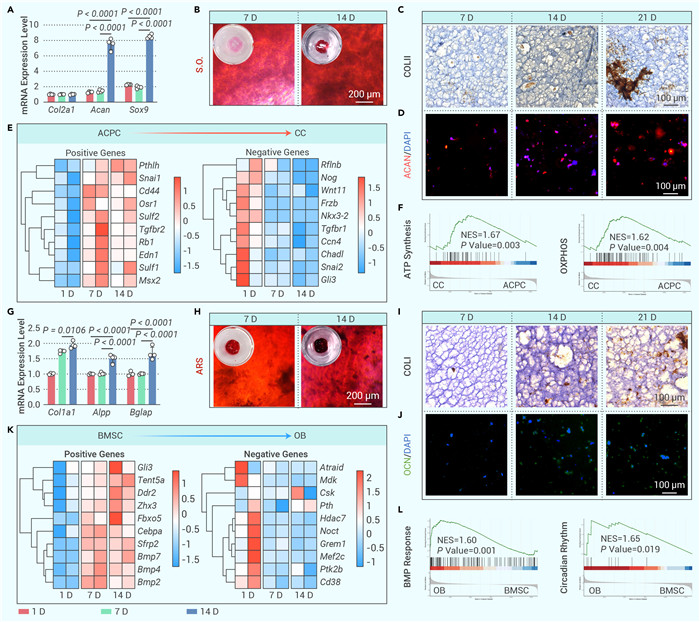
Figure 3.
Distinct lineage commitment toward chondrogenesis or osteogenesis in ACPC- or BMSC-laden bioprinted constructs
-
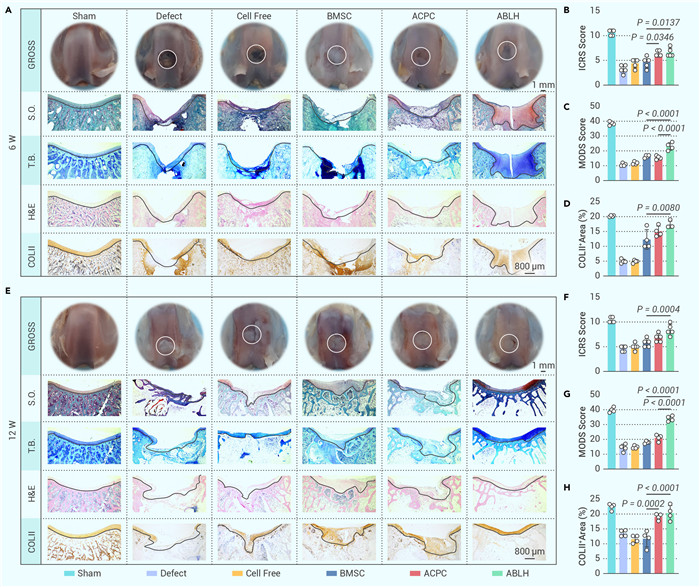
Figure 4.
ABLHs promoted cartilage regeneration in vivo
-
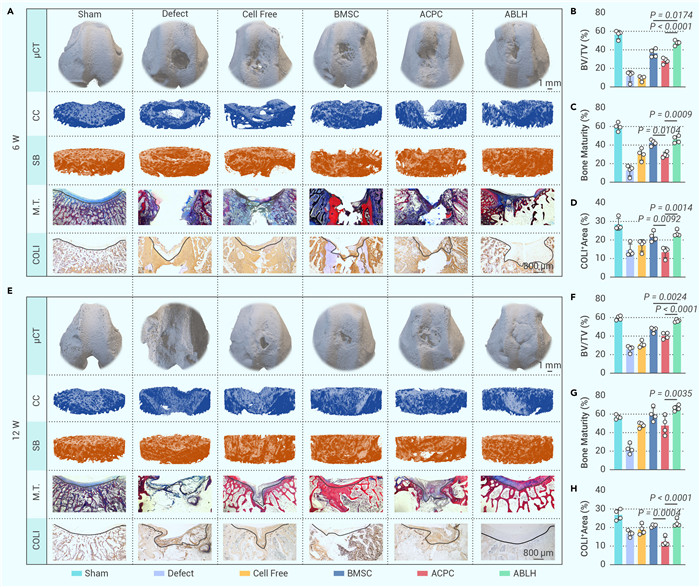
Figure 5.
ABLHs accelerated subchondral bone formation and remodeling in vivo
-
Figure 6.
ABLHs coordinated cartilage-bone-vessel crosstalk to reconstruct the OC unit
