
Fueling the fight: β-hydroxybutyrate as a metabolic modulator of CAR T cell therapy
-

-
REFERENCES
[1] Hou A. J., Chen L. C. and Chen Y. Y. (2021). Navigating CAR-T cells through the solid-tumour microenvironment. Nat. Rev. Drug. Discov. 20:531−550. DOI:10.1038/s41573-021-00189-2 [2] Scharping N. E., Rivadeneira D. B., Menk A. V., et al. (2021). Mitochondrial stress induced by continuous stimulation under hypoxia rapidly drives T cell exhaustion. Nat. Immunol. 22:205−215. DOI:10.1038/s41590-020-00834-9 [3] Liu S., Guruprasad P., Ramasubramanian R., et al. (2026). β-hydroxybutyrate enhances the metabolic fitness of CAR T cells in cancer. Cell 189:1701−1716.e1724. DOI:10.1016/j.cell.2026.02.004 [4] Luda K. M., Longo J., Kitchen-Goosen S. M., et al. (2023). Ketolysis drives CD8(+) T cell effector function through effects on histone acetylation. Immunity 56:2021−2035.e2028. DOI:10.1016/j.immuni.2023.07.002 [5] Kumar A., Rivadeneira D. B., Mehta I., et al. (2026). Postprandial lipid metabolism durably enhances T cell immunity. Nature. DOI:10.1038/s41586-026-10432-8 -
ABOUT THIS ARTICLE
Cite this article:
Zhou X., Liu J., Chen C., et al. (2026). Fueling the fight: β-hydroxybutyrate as a metabolic modulator of CAR T cell therapy. The Innovation Nutrition 1:100017. https://doi.org/10.59717/j.xinn-nutri.2026.100017
Welcome!
To request copyright permission to republish or share portions of our works, please visit Copyright Clearance Center's (CCC) Marketplace website at marketplace.copyright.com.
Export File
Citation
Zhou X., Liu J., Chen C., et al. (2026). Fueling the fight: β-hydroxybutyrate as a metabolic modulator of CAR T cell therapy. The Innovation Nutrition 1:100017. https://doi.org/10.59717/j.xinn-nutri.2026.100017

Format
Content
 DownLoad:
-
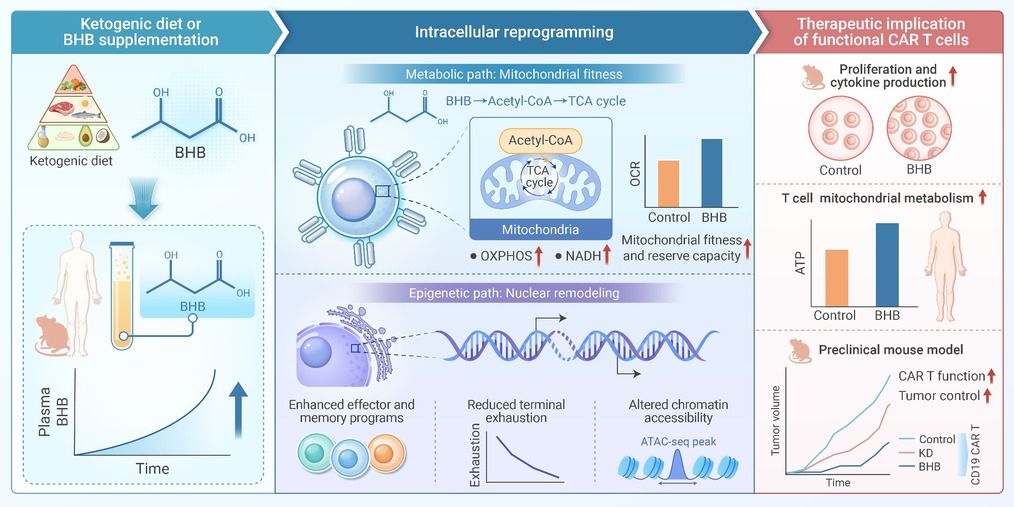
Figure 1.
Ketogenic input enhances CAR T cell function via BHB-driven reprogramming.
