
Robust mussel-inspired adhesives sourced from sustainable lignin
-
GRAPHICAL ABSTRACT

 DownLoad:
Full size image
DownLoad:
Full size image
-
PUBLIC SUMMARY
-
Mussel-inspired adhesives fabricated via a top-down approach from plant lignin.
Robust adhesion under extreme conditions: water, solvents, and liquid N2.
Lignin-specific moieties critically enhance adhesion performance.
-
-
ABSTRACT
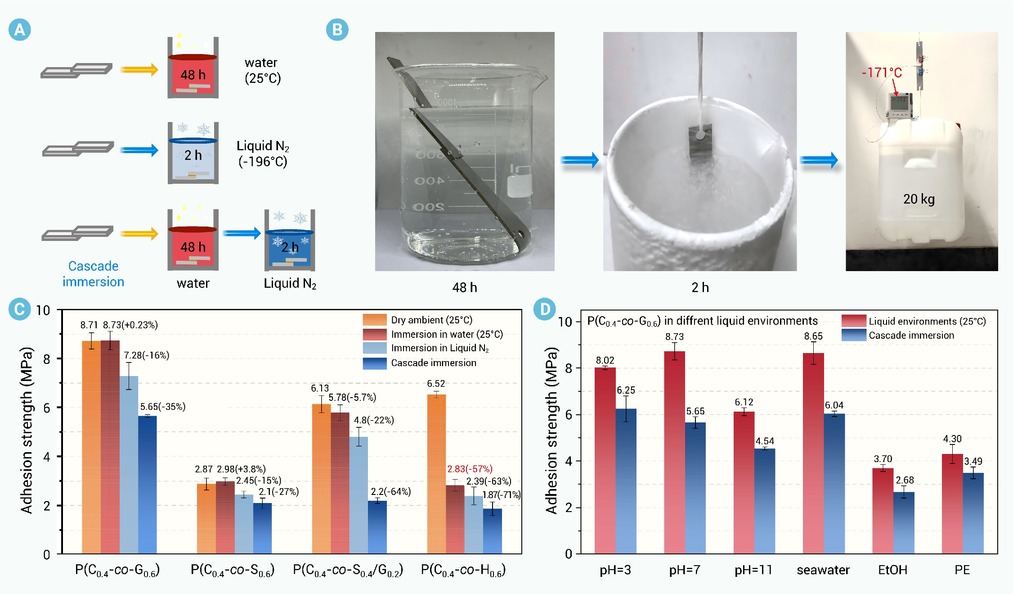
Adhesive materials resistant to manifold extreme conditions, such as water, organic solvents, and ultra-low temperatures, are highly sought after but remain rare. Here we present a top-down approach for making mussel-inspired, catechol-based copolymers from two types of natural plant lignins involving depolymerization, derivatization, and copolymerization. The lignin-sourced polymers exhibit robust adhesion and high resistance to water (8.73 MPa) and cryogenic temperature (7.28 MPa), and even retain 6.04 MPa after consecutive immersion in water and liquid N2, a testing condition rarely examined. Through a combination of monomer permutation screening and molecular dynamics simulations, we demonstrate that lignin-specific moieties, such as catechol, methoxy, and alkyl groups, significantly enhance the adhesive performance of the resulting polymers. Thus, this work pioneers a sustainable pathway for making robust biomimetic materials from bio-based feedstocks. -

-
REFERENCES
[1] Ganewatta M. S., Wang Z. and Tang C. (2021). Chemical syntheses of bioinspired and biomimetic polymers toward biobased materials. Nat. Rev. Chem. 5:753−772. DOI:10.1038/s41570-021-00325-x [2] Chen L., Yu X., Gao M., et al. (2024). Renewable biomass-based aerogels: From structural design to functional regulation. Chem. Soc. Rev. 53:7489−7530. DOI:10.1039/d3cs01014g [3] Zhang C., Wu B., Zhou Y., et al. (2020). Mussel-inspired hydrogels: From design principles to promising applications. Chem. Soc. Rev. 49:3605−3637. DOI:10.1039/c9cs00849g [4] Li M., Mao A., Guan Q., et al. (2024). Nature-inspired adhesive systems. Chem. Soc. Rev. 53:8240−8305. DOI:10.1039/d3cs00764b [5] Liu F., Liu X., Chen F., et al. (2021). Mussel-inspired chemistry: A promising strategy for natural polysaccharides in biomedical applications. Prog. Polym. Sci. 123:101472. DOI:10.1016/j.progpolymsci.2021.101472 [6] Franck H. G. and Stadelhofer J. W. (1988). Production and uses of benzene derivatives. Industrial aromatic chemistry (Springer Berlin, Heidelberg), pp: 132-235, DOI: 10.1007/978-3-642-73432-8. [7] Gan D., Xing W., Jiang L., et al. (2019). Plant-inspired adhesive and tough hydrogel based on Ag-lignin nanoparticles-triggered dynamic redox catechol chemistry. Nat. Commun. 10:1487. DOI:10.1038/s41467-019-09351-2 [8] Zhao Q., Zhang M., Gao S., et al. (2022). A mussel-inspired high bio-content thermosetting polyimine polymer with excellent adhesion, flame retardancy, room-temperature self-healing and diverse recyclability. J. Mater. Chem. A 10:11363−11374. DOI:10.1039/d2ta01062c [9] Liu X., Shi L., Wan X., et al. (2021). A spider‐silk‐inspired wet adhesive with supercold tolerance. Adv. Mater. 33:2007301. DOI:10.1002/adma.202007301 [10] Zhao K., Liu Y., Ren Y., et al. (2022). Molecular engineered crown‐ether‐protein with strong adhesion over a wide temperature range from −196 to 200°C. Angew. Chem. Int. Ed. 61:e202207425. DOI:10.1002/anie.202207425 [11] Guan W., Jiang W., Deng X., et al. (2023). Supramolecular adhesives with extended tolerance to extreme conditions via water‐modulated noncovalent interactions. Angew. Chem. Int. Ed. 62:e202303506. DOI:10.1002/anie.202303506 [12] Li X., Lai J., Deng Y., et al. (2020). Supramolecular adhesion at extremely low temperatures: A combined experimental and theoretical investigation. J. Am. Chem. Soc. 142:21522−21529. DOI:10.1021/jacs.0c10786 [13] Cheng B., Yu J., Arisawa T., et al. (2022). Ultrastrong underwater adhesion on diverse substrates using non-canonical phenolic groups. Nat. Commun. 13:1892. DOI:10.1038/s41467-022-29427-w [14] Sun P., Mei S., Xu J. F., et al. (2022). A bio‐based supramolecular adhesive: Ultra‐high adhesion strengths at both ambient and cryogenic temperatures and excellent multi‐reusability. Adv. Sci. 9:2105016. DOI:10.1002/advs.202203182 [15] Ragauskas A. J., Beckham G. T., Biddy M. J., et al. (2014). Lignin Valorization: Improving lignin processing in the biorefinery. Science 344:1246843. DOI:10.1126/science.1246843 [16] Wang S. Z., Li X. C., Ma R. M., et al. (2025). Catalytic hydrogenolysis of lignin into serviceable products. Acc. Chem. Res. 58:529−542. DOI:10.1021/acs.accounts.4c00644 [17] Schutyser W., Renders T., Van den Bosch S., et al. (2018). Chemicals from lignin: An interplay of lignocellulose fractionation, depolymerisation, and upgrading. Chem. Soc. Rev. 47:852−908. DOI:10.1039/c7cs00566k [18] Zhang B., Qiang G., Barta K., et al. (2024). Bio–based polymers from lignin. Innov. Mater. 2:100062. DOI: 10.59717/j.xinn-mater.2024.100062 [19] O’Dea R. M., Pranda P. A., Luo Y., et al. (2022). Ambient-pressure lignin valorization to high-performance polymers by intensified reductive catalytic deconstruction. Sci. Adv. 8:eabj7523. DOI:10.1126/sciadv.abj7523 [20] Wang S., Shuai L., Saha B., et al. (2018). From tree to tape: Direct synthesis of pressure sensitive adhesives from depolymerized raw lignocellulosic biomass. ACS Cent. Sci. 4:701−708. DOI:10.1021/acscentsci.8b00140 [21] Trullemans L., Koelewijn S.-F., Boonen I., et al. (2023). Renewable and safer bisphenol A substitutes enabled by selective zeolite alkylation. Nat. Sustain. 6:1693−1704. DOI:10.1038/s41893-023-01201-w [22] Li N., Yan K., Rukkijakan T., et al. (2024). Selective lignin arylation for biomass fractionation and benign bisphenols. Nature 630:381−386. DOI:10.1038/s41586-024-07446-5 [23] Wu X., Galkin M. V., Stern T., et al. (2022). Fully lignocellulose-based PET analogues for the circular economy. Nat. Commun. 13:3376. DOI:10.1038/s41467-022-30735-4 [24] Shi J., Hu B., Li H., et al. (2025). Fabricating robust pressure-sensitive adhesives from Lignin Depolymerization-Derived 4-Propanol-Tethered Guaiacol. ChemSusChem. 8:11. DOI:10.1002/cssc.202402757 [25] Du Q., Hu B., Shen Q., et al. (2024). Creating tough mussel-inspired underwater adhesives from plant catechyl lignin. Chem. Eng. J. 482:148758. DOI:10.1016/j.cej.2024.148828 [26] Song S., Zhang J., Gözaydın G., et al. (2019). Production of terephthalic acid from corn stover lignin. Angew. Chem. Int. Ed. 58:4934−4937. DOI:10.1002/anie.201814284 [27] Su S., Shen Q., Wang S., et al. (2023). Discovery, disassembly, depolymerization and derivatization of catechyl lignin in Chinese tallow seed coats. Int. J. Biol. Macromol. 239:124848. DOI:10.1016/j.ijbiomac.2023.124256 [28] Li X., Ma R., Gao X., et al. (2024). Harnessing Atomically Dispersed Cobalt for the Reductive Catalytic Fractionation of Lignocellulose. Adv. Sci. 11:2470126. DOI:10.1002/advs.202310202 [29] Liu Z., Li H., Gao X., et al. (2022). Rational highly dispersed ruthenium for reductive catalytic fractionation of lignocellulose. Nat. Commun. 13:4716. DOI:10.1038/s41467-022-32451-5 [30] Zhao Y., Wu Y., Wang L., et al. (2017). Bio-inspired reversible underwater adhesive. Nat Commun 8:2218. DOI:10.1038/s41467-017-02387-2 [31] Sun Z., Fridrich B., de Santi A., et al. (2018). Bright side of lignin depolymerization: Toward new platform chemicals. Chem. Rev. 118:614−678. DOI:10.1021/acs.chemrev.7b00588 [32] Wang S., Shen Q., Su S., et al. (2022). The temptation from homogeneous linear catechyl lignin. Trends Chem. 4:948−961. DOI:10.1016/j.trechm.2022.07.008 [33] Chen F., Tobimatsu Y., Havkin-Frenkel D., et al. (2012). A polymer of caffeyl alcohol in plant seeds. Proc. Natl. Acad. Sci. USA 109:1772−1777. DOI:10.1073/pnas.1120992109 [34] Li Y., Shuai L., Kim H., et al. (2018). An “ideal lignin” facilitates full biomass utilization. Sci. Adv. 4:eaau2968. DOI:10.1126/sciadv.aau2968 [35] Wang S., Zhang K., Li H., et al. (2021). Selective hydrogenolysis of catechyl lignin into propenylcatechol over an atomically dispersed ruthenium catalyst. Nat. Commun. 12:416. DOI:10.1038/s41467-020-20684-1 [36] Ralph J., Lapierre C. and Boerjan W. (2019). Lignin structure and its engineering. Curr. Opin. Biotechnol. 56:240−249. DOI:10.1016/j.copbio.2019.02.019 [37] Ren T., Zhang Z., You S., et al. (2022). Isolation and purification of 4-propylguaiacol and 4-propylsyringol by extraction and crystallization from the products of reductive catalytic fractionation processes. Green Chem. 24:7355−7361. DOI:10.1039/d2gc01863b [38] Sun Z., Liu J., Chen H., et al. (2024). Ultralow-temperature-tolerance adhesive with excellent toughness and record-high strength. ACS Mater. Lett. 6:1012−1019. DOI:10.1021/acsmaterialslett.4c00200 [39] Wang H., Yang Y., Nishiura M., et al. (2019). Synthesis of self-healing polymers by scandium-catalyzed copolymerization of ethylene and anisylpropylenes. J. Am. Chem. Soc. 141:3249−3257. DOI:10.1021/jacs.8b13316 [40] Yao G., Li F. and Dong S. (2023). Solvent-free bulk soft material with low-temperature tolerance: Transparency, flexibility, stretchability, and adhesion. Chem. Eng. Sci. 281:119256. DOI:10.1016/j.ces.2023.119164 [41] Na Y. and Chen C. (2020). Catechol‐functionalized polyolefins. Angew. Chem. Int. Ed. 59:7953−7959. DOI:10.1002/anie.202000848 [42] Filippidi E., Cristiani T. R., Eisenbach C. D., et al. (2017). Toughening elastomers using mussel-inspired iron-catechol complexes. Science 358:502−505. DOI:10.1126/science.aao0350 [43] Holten-Andersen N., Harrington M. J., Birkedal H., et al. (2011). pH-induced metal-ligand cross-links inspired by mussel yield self-healing polymer networks with near-covalent elastic moduli. Proc. Natl. Acad. Sci. USA 108:2651−2655. DOI:10.1073/pnas.1015862108 [44] Zhang J., Chen Z., Zhang Y., et al. (2021). Poly(ionic liquid)s containing alkoxy chains and bis(trifluoromethanesulfonyl)imide anions as highly adhesive materials. Adv. Mater. 33:2101777. DOI:10.1002/adma.202100962 [45] Ji X., Ahmed M., Long L., et al. (2019). Adhesive supramolecular polymeric materials constructed from macrocycle-based host–guest interactions. Chem. Soc. Rev. 48:2682−2697. DOI:10.1039/c8cs00955d [46] Mazzotta M. G., Putnam A. A., North M. A., et al. (2020). Weak bonds in a biomimetic adhesive enhance toughness and performance. J. Am. Chem. Soc. 142:4762−4768. DOI:10.1021/jacs.9b13356 [47] Wu X., Li H., Chen P., et al. (2023). Natural-silk-inspired design provides ultra-tough biobased structural adhesives with supercold tolerance. J. Mater. Chem. A 11:6286−6298. DOI:10.1039/d2ta08016h [48] Li X., Deng Y., Lai J., et al. (2020). Tough, long-term, water-resistant, and underwater adhesion of low-molecular-weight supramolecular adhesives. J. Am. Chem. Soc. 142:5371−5379. DOI:10.1021/jacs.0c00520 [49] Heinzmann C., Weder C. and de Espinosa L. M. (2016). Supramolecular polymer adhesives: Advanced materials inspired by nature. Chem. Soc. Rev. 45:342−358. DOI:10.1039/c5cs00477b [50] Zhang S., Shi W., Yu B., et al. (2022). Versatile inorganic subnanometer nanowire adhesive. J. Am. Chem. Soc. 144:16389−16394. DOI:10.1021/jacs.2c03511 [51] Xie X., Jiang Y., Yao X., et al. (2024). A solvent-free processed low-temperature tolerant adhesive. Nat. Commun. 15:5017. DOI:10.1038/s41467-024-49503-7 [52] Fan H. and Gong J. P. (2021). Bioinspired underwater adhesives. Adv. Mater. 33:2102542. DOI:10.1002/adma.202102983 [53] Saiz‐Poseu J., Mancebo‐Aracil J., Nador F., et al. (2018). The chemistry behind catechol‐based adhesion. Angew. Chem. Int. Ed. 58:696−714. DOI:10.1002/anie.201801063 [54] Ahn B. K., Lee D. W., Israelachvili J. N., et al. (2014). Surface-initiated self-healing of polymers in aqueous media. Nat. Mater. 13:867−872. DOI:10.1038/nmat4037 [55] Zhang P., Zhang B., Pan J., et al. (2023). Ultrastrong and versatile nonisocyanate polyurethane adhesive under extreme conditions. Chem. Mater. 35:7730−7740. DOI:10.1021/acs.chemmater.3c01517 [56] Deng X., Tang J., Guan W., et al. (2022). Strong dynamic interfacial adhesion by polymeric ionic liquids under extreme conditions. ACS Nano 16:5303−5315. DOI:10.1021/acsnano.1c10946 -
ABOUT THIS ARTICLE
Cite this article:
Hu B., Zhan F., Wang S., et al. (2026). Robust mussel-inspired adhesives sourced from sustainable lignin. The Innovation Materials 4:100187. https://doi.org/10.59717/j.xinn-mater.2026.100187
Welcome!
To request copyright permission to republish or share portions of our works, please visit Copyright Clearance Center's (CCC) Marketplace website at marketplace.copyright.com.
Article Metrics
Relative Articles
Cited by
Export File
Citation
Hu B., Zhan F., Wang S., et al. (2026). Robust mussel-inspired adhesives sourced from sustainable lignin. The Innovation Materials 4:100187. https://doi.org/10.59717/j.xinn-mater.2026.100187

Format
Content
-
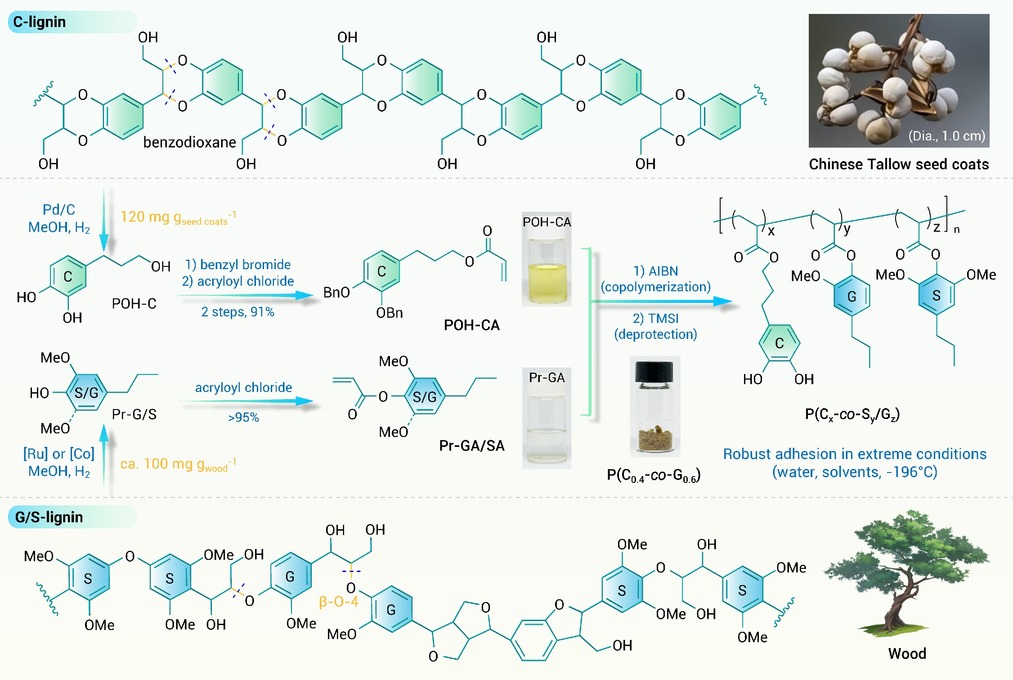
Figure 1.
Schematic diagram illustrating design and fabrication of mussel-inspired polymers from lignins.
-
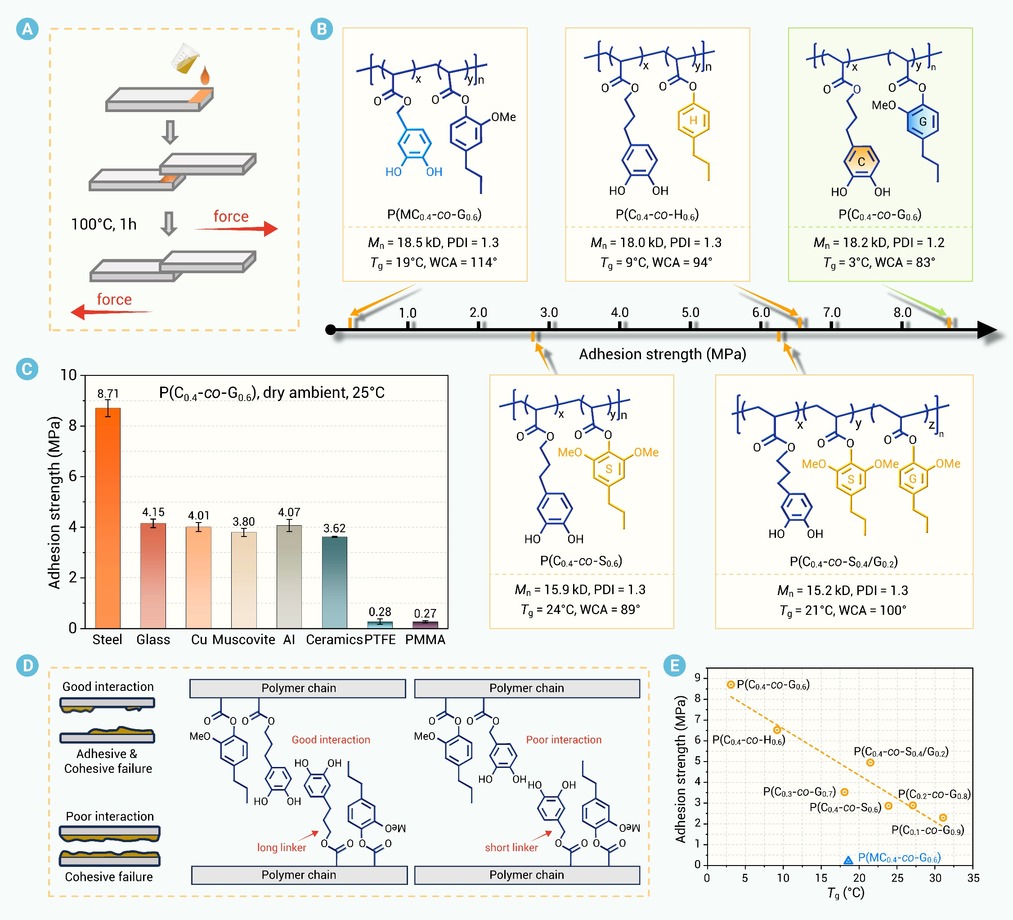
Figure 2.
Adhesive properties under ambient conditions
-
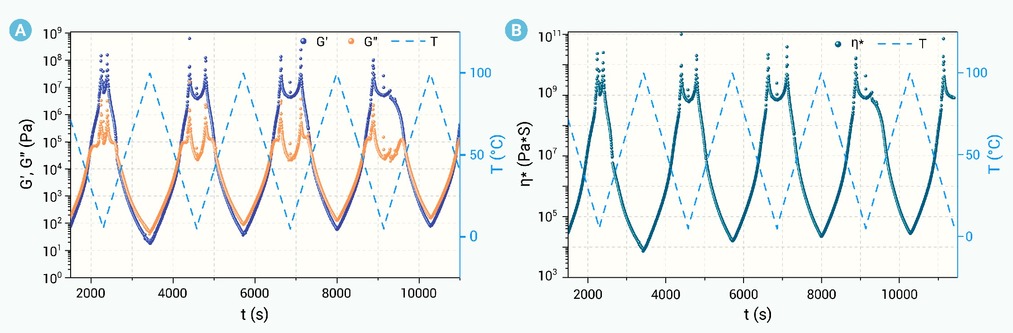
Figure 3.
Rheological behaviors of P(C0.4-co-G0.6) during the cooling−warming cycles.
-
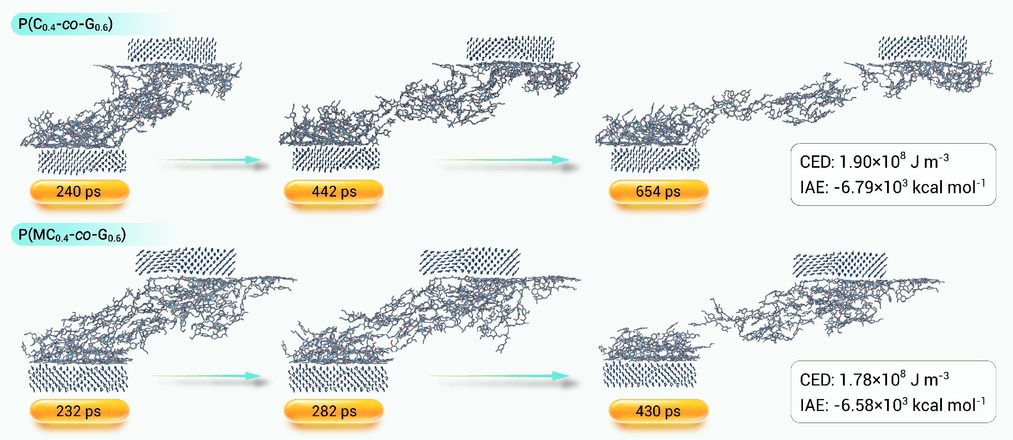
Figure 4.
Molecular dynamics simulation of the lap-shear process on steel surfaces.
-
Figure 5.
Adhesive performance at multiple extreme conditions
-
Figure 6.
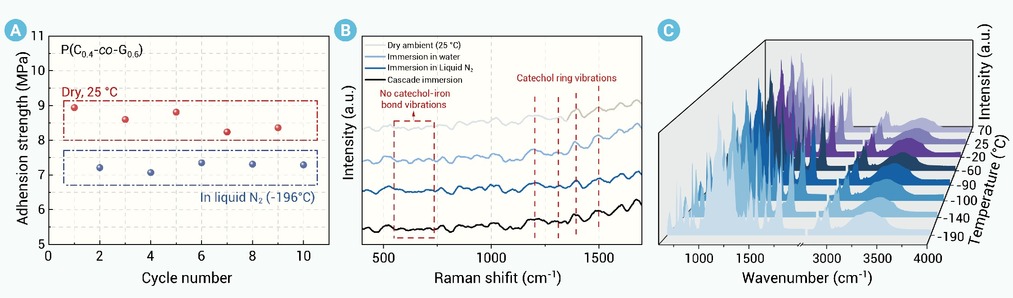
(A) Cycling tests of P(C0.4-co-G0.6) adhesive. (B) Raman spectra of catechol-containing networks. (C) Temperature-dependent FT-IR spectra of P(C0.4-co-G0.6).
-
Figure 7.
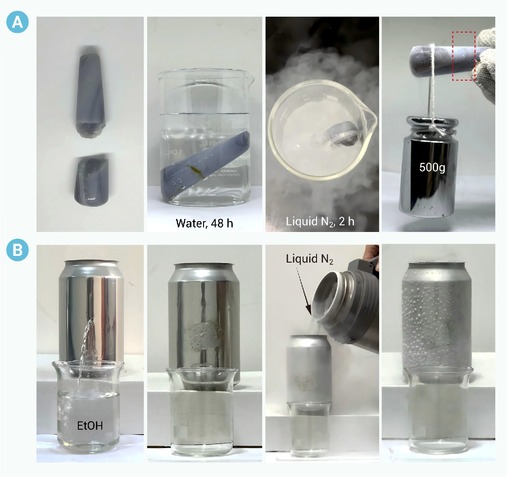
Illustrations of various applications of P(C0.4-co-G0.6) adhesive
